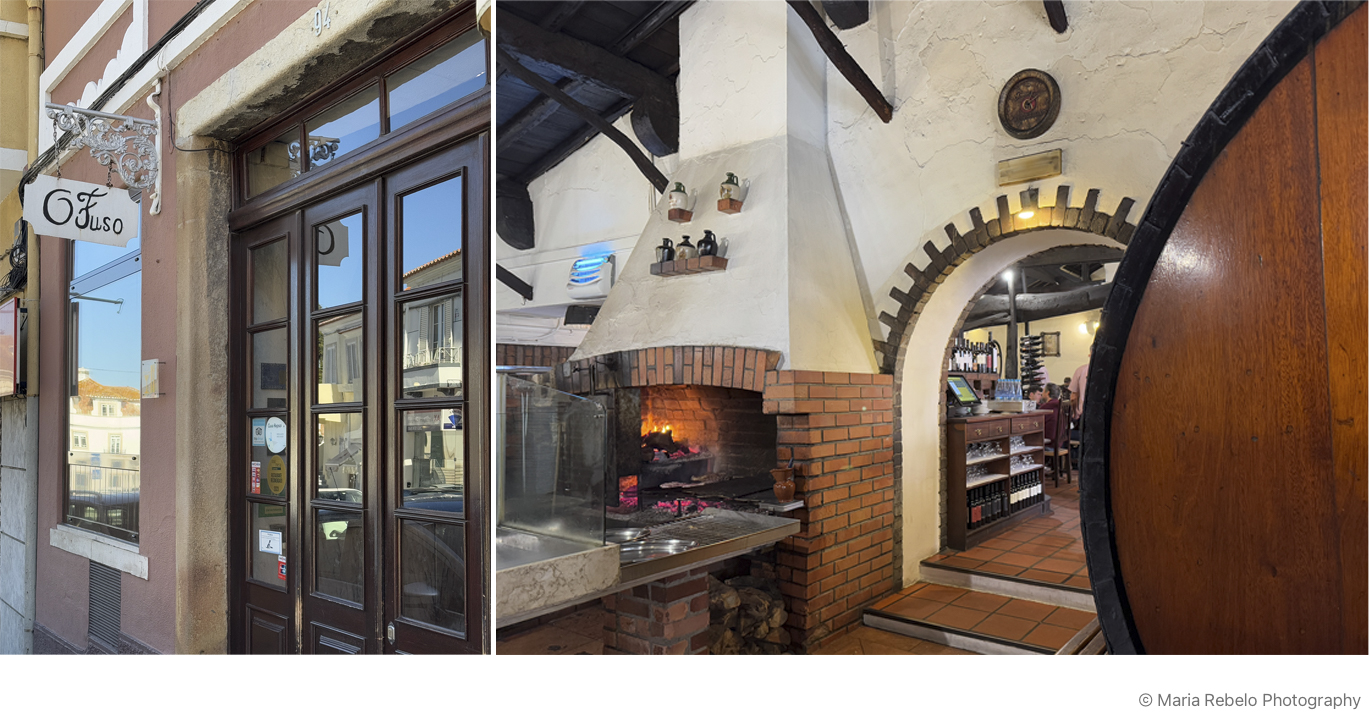
Fuso, a landmark restaurant

Located in Arruda dos Vinhos, 20 miles north of Lisbon, Fuso is a restaurant from another era. It opened its doors, in the space once used as a winery and a tavern, on March 9, 1973.

The concept for the restaurant was created by Fernando Guerra Cardoso, a successful car salesman who enjoyed socializing over food. He persuaded his friend, Armindo Mera Dominguez, to open a restaurant serving oversized portions that encouraged people to bring their friends. Today, the restaurant is run by the great-grandchildren of both founders.

Diogo Coucello, Fernando’s great-grandson, leads a team of 30 waiters and kitchen staff, ensuring seamless service for up to 300 guests. Reservations are essential—Fuso is always full. 

Since 1973, the menu has remained unchanged, focusing on two signature dishes: charcoal-grilled codfish and bone-in rib steak. Your meal can begin with delectable appetizers such as prosciutto, savory sausages, or grilled shrimp and end with various desserts, ranging from roasted apples to egg puddings and chocolate cake. But the main attractions are grilled codfish and steak.

You can find these dishes in many other restaurants, but Fuso’s renditions are exceptional. The codfish, imported from Norway, is meticulously selected for its succulence and rich flavor. The rib steak, consistently tender and tasty, has been sourced from the same butcher since the restaurant’s inception.

Fuso’s rustic décor has remained untouched since its opening. The restaurant’s name refers to the fuso, or spindle—a large wooden screw—attached to the wine press that still occupies the center of the dining room. The entrance is dominated by towering wine barrels made from exotic wood and a grand charcoal grill glowing with embers.

In a world where everything feels fleeting, it’s a privilege to eat at a restaurant that has been a gathering place for friends who love food for over half a century.

Fuso is located at Rua Cândido dos Reis, 94, Arruda dos Vinhos, tel. 263 975 121, 263 978 547.

Quinta de São Sebastião

Francisco Melícias, the general manager of Quinta de São Sebastião, invited us to visit the estate. So, we traveled along narrow roads that wind through villages where houses are nestled among vineyards until we arrived at Arruda dos Vinhos.  This historic town, established in 1160 by Portugal’s first king, owes its name, “wine route,” to its role as a transit point for wines transported by horse-drawn carts to Lisbon.

Arruda’s soils, predominantly limestone and clay with patches of sand, create ideal conditions for viticulture. Limestone promotes deep root growth and imparts minerality and acidity to the wines, while clay retains water, adding richness and structure. The region’s rolling hills and refreshing Atlantic breezes lend complexity to its wines.

The town is steeped in history and faith. São Sebastião, its patron saint, is credited with three miracles. First, in the 14th century, Arruda was spared from the bubonic plague that devastated much of Portugal. Second, in 1755, the town escaped the earthquake, tsunami, and fires that reduced nearby Lisbon to ruins, prompting King José I and his family to seek refuge in Arruda. Third, in the late 18th century, the region’s sand patches protected its vineyards from the phylloxera pest that devastated European vineyards.

Our journey continued up a steep hill to Quinta de São Sebastião, an estate established in 1755. We visited the chapel, once part of a monastery founded by monks who sought peaceful retreat. Francisco tells us that during the Napoleonic invasions, the estate played a role in the Lines of Torres Vedras, a network of fortifications built in 1809–1810 to defend Lisbon against Napoleon’s troops. Today, the remnants of these fortifications are a reminder of the estate’s historical importance.

In the 1980s, António Parente, an industrialist, bought Quinta de São Sebastião and invested in its future. The vineyards, planted on steep hills with different exposures, offer diverse terroirs that allow winemaker Filipe Sevinate Pinto to create distinctive blends. These wines combine traditional local varietals like Touriga Nacional with carefully selected French grapes.

We sampled some remarkable wines in the estate’s tasting room, which overlooks a picturesque riding arena where horses are trained. The 2022 Reserva Branco, a blend of Arinto, Cercial, and Sauvignon Blanc, has a pleasurable intensity and minerality. The Sauvignon Blanc provides a seasoning touch that allows the blend to shine. A surprising single-varietal made from Cercial, a grape known as Esgana-Cão in the Douro Valley, impressed us with its elegance and freshness. The Provence-style rosé, Dona Aninhas, pays tribute to António Parente’s mother with its delightful balance and vibrant acidity.

We also tried three reds. The first, a Reserva, is a blend of Touriga Nacional, Merlot, and Sousão. The aromatic Touriga complements the delicate Merlot, while the lively Sousão provides a touch of exuberance. The second, a blend of Alicante Bouschet and Syrah is intense, offering a beautiful harmony of flavors. Finally, the Grande Reserva—a daring mix of Merlot and Sousão— captivated us with its depth, complexity, and character. This wine is an ode to joy!

Quinta de São Sebastião is building on its rich heritage to create wines that are distinctive and deeply enjoyable.

Quinta de São Sebastião is situated in Arruda dos Vinhos. Click here for their website.