
Ângelo Ataíde, a judge passionate about wine, decided to plant a vineyard on the Alentejo estate his wife, Rosário, had inherited. Local farmers advised him against it. The site, in a valley near the Montargil dam, has a humid microclimate where downy and powdery mildew thrive. Undeterred, the judge planted the first vines in 2000.
Rosário’s father used to call her raposinha (little fox). When foxes began strolling through the young vines at dusk, Ângelo and Rosário renamed the farm Monte da Raposinha.
Today, the estate is in the hands of the next generation: Rosário’s son, João, oversees the business, while his wife, Paula, leads viticulture and enology.
João followed the family tradition and studied law, but he never took to office life. He preferred the freedom of the open fields.
Paula’s father, a doctor fascinated by wine, invited her as a child to smell different wines and describe their aromas. She grew up loving animals and plants, and later studied agronomy in Lisbon, specializing in viticulture. As a student, she often passed Monte da Raposinha on her way to her grandmother’s house, sometimes stopping to buy a few bottles whose distinctive character intrigued her.
She met João through mutual friends. They fell in love and married at Monte da Raposinha, which became their life’s project. João and Paula do nearly everything themselves: pruning and harvesting, fermenting and aging, bottling and labeling.
Paula explains how the morning dew brings freshness to this otherwise hot region, cooling the grapes and slowing maturation. To preserve the fruit’s character, she relies entirely on the wild yeasts that live on the grape skins, rather than adding commercial strains. The result is less predictable, but truer to the vineyards.
They practice regenerative, organic farming, no small challenge in such a humid climate. The vines are protected with the traditional Bordeaux mixture, a solution of copper sulfate, lime, and water. They also spray infusions of acacia, nettle, and willow. In difficult years, João and Paula accept losses; in 2025, they lost 80 percent of their production.
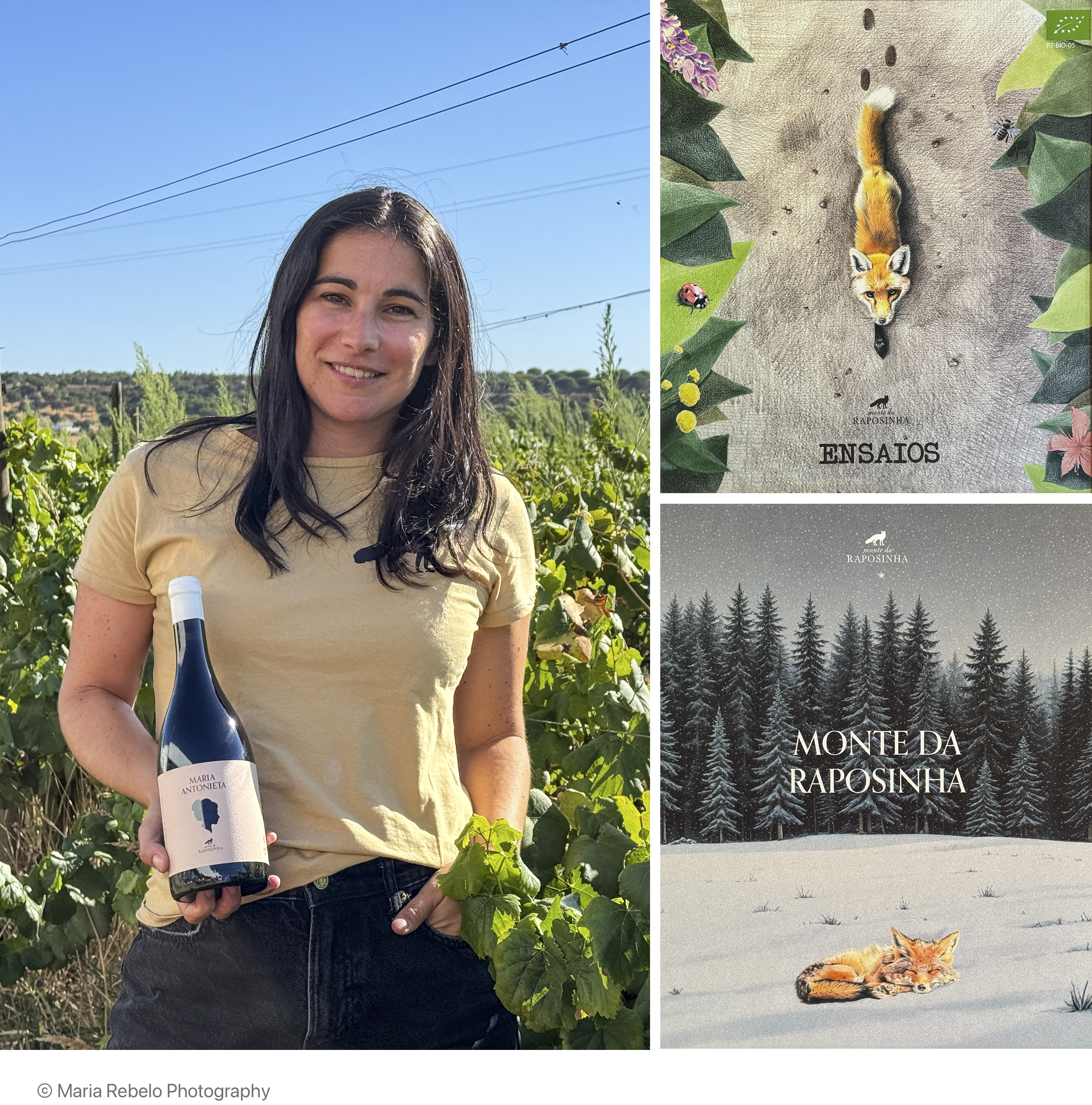
And what do they get in return? “A land that is alive,” Paula says. She speaks passionately about the worms in the soil, the legumes that fix nitrogen, the birds and bees that share the vineyard. Her affection for these creatures runs so deep that she asked designer Francisco Eduardo to include them on the wine labels.
The estate has a guest house with expansive views over the fields and an inviting swimming pool. Staying there is the best way to understand their work: mornings in the vines, afternoons in the cellar, evenings around the table, enjoying the wines born from their soil.
For João and Paula, the health of the land, the authenticity of place, and the singular voice of their wines come first.
Their rosé, made from Touriga Nacional, is bright and expressive, all freshness and immediacy. The white reserve draws its body from Viosinho, ripened under the generous Alentejo sun, while Arinto and Esgana Cão lend tension and acidity. The blend carries delicate aromatics and a long, persistent finish that both cleanses and lingers. The extraordinary Maria Antonieta, named in homage to João’s great-grandmother, is made from Touriga Nacional grown on a small plot with soil made from river stones.
Monte da Raposinha proves that great wines can come from improbable places, but only for those with the courage and endurance to care for them.
Monte da Raposinha is located at Estrada do Couço, S/N. 7425-144 Montargil. Click here for their website.
 Salt of Portugal