

A young Port appears impenetrable; its purple hue is so dense that it seems to swallow the light. Yet time works a quiet alchemy, transforming that darkness into amber, copper, and finally gold. Few wines undergo such a dramatic transformation. In this ninth lecture with Douro viticulturist António Magalhães, we turn to the mystery of Port’s color.
To understand why color exerts such power over our perception of wine, we must consider how human vision evolved. Our ancestors lived in trees, where survival depended on gauging distances and spotting ripe fruit at a glance. Vision became our dominant sense, forming impressions almost instantly, while taste and smell unfold more slowly. That may be why color matters so profoundly in wine: the moment we see it, the mind begins to anticipate flavor, aroma, and structure. As the neuroscientist Gordon Shepherd observed, we drink with our eyes.
In Port, a deep red hue has long been a mark of quality, eagerly pursued by producers. In his 1788 treatise, John Croft recounts what might be called Port’s original sin: the discovery of an artifice to darken its color. On his way to the Douro, Peter Bearsley, an English factor living in Viana in the mid-eighteenth century, pressed elderberry juice at a roadside inn and mixed it with ordinary wine, finding that it “heightened and improved its colour.”
The elder tree (Sambucus nigra) bears intensely pigmented berries long valued for their coloring power and reputed medicinal virtues. Local tradition held that each tree sheltered the spirit of a healer unjustly burned as a witch. In spring, its delicate white blossoms resemble lace woven by fairy hands into a bridal bouquet.

Before the Marquis of Pombal demarcated the Douro in 1756, adding elderberry juice was a common practice. Its use sparked a bitter dispute in 1754 between the English Factory and its agents in the Douro. The latter argued that merchants’ dissatisfaction stemmed from their unreasonable expectations. They sought wines that were “a potable fire in the spirits, gunpowder in combustion, ink in color, Brazil in sweetness, and India in aroma.” Only artifices, the agents insisted, could produce such a wine.
The demarcation created the world’s first system to safeguard the wine’s origin and quality. A 1757 edict prohibited the use of elderberry to “taint, arrange, or improve” wine and ordered the uprooting of all bushes within five leagues of the Douro River. A further decree in 1771 extended the ban to neighboring provinces. Pombal enforced the rules with legendary severity.
Once elderberry was forbidden, growers sought natural ways to achieve the coveted dark color. Most red grapes have pale pulp, but a few varieties, known as teinturier, or “ink-producers,” have red flesh. One such grape, known as Vinhão in Minho and Sousón in Galicia, was brought to the Douro Valley under the name Sousão.
In 1790, Francisco Rebelo de Sousa noted that landowners planted Sousão widely in hopes of achieving a vivid ruby hue, but the results proved highly site-dependent: generous in fertile soils, meager in poor ones, and prone to shriveling before ripening.
Hopes that Sousão would, by itself, produce great Port soon faded. In 1830, John Delaforce judged the grape unsuitable for Port, producing wine “of darker colour but in general bad — green.” The Baron of Forrester described it simply as “the deepest in color.” Growers learned that color intensity did not guarantee quality.
After phylloxera, two other teinturier grapes appeared in small quantities: Alicante Bouschet and Grand Noir de la Calmette, known locally as Grand Noir. Unlike Sousão, whose color lies chiefly in the skin, these varieties contain red pigment in both pulp and skin. Both were the result of 19th-century crossings by Louis Bouschet and his son Henri, designed to combine high yields with intense color. Although deeply pigmented, they never became central to Port production and were not highly regarded by older Douro growers. In recent decades, however, Alicante Bouschet has gained favor among some table wine producers.
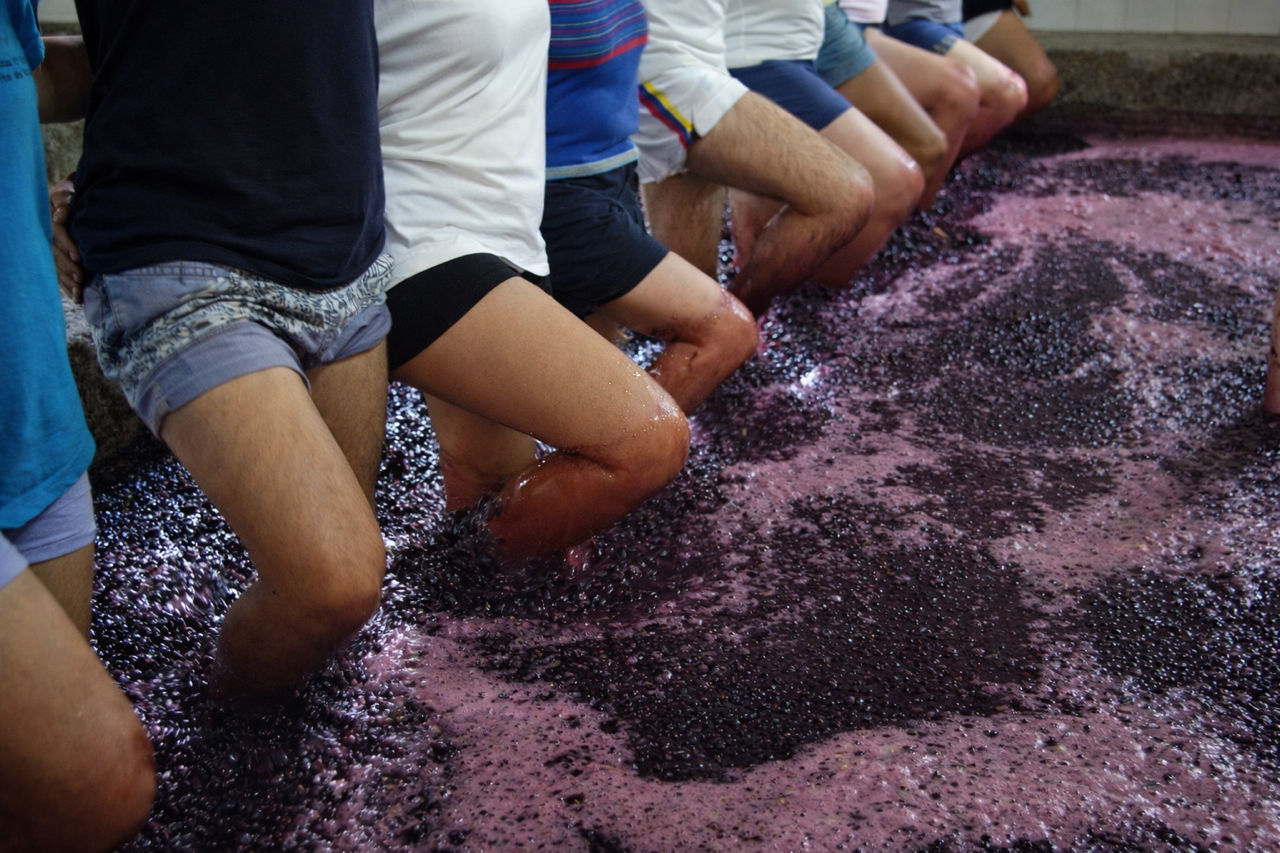
Color is ultimately extracted during vinification. Traditionally, the grapes are trodden by foot in granite lagares, a practice now often reproduced mechanically, gently crushing the berries and releasing the free-run juice while drawing deep color from the skins. Fermentation lasts about 72 hours before fortification, sufficient to extract pigments and tannins. The remaining skins and seeds are then pressed in a basket press, producing a denser wine, rich in color and structure. This press wine is fortified separately and may later be blended into the fortified free-run wine to reinforce the final blend.

Where, then, does Port derive its color? From the outset, color was a key criterion in selecting Douro red varieties. Two moments illustrate this importance. After phylloxera, Bastardo, a pale variety, was replaced by Touriga Francesa. Later, when Port merchants became large-scale growers, they restored the pre-phylloxera primacy of Touriga Nacional, another deeply colored grape that the Baron of Forrester regarded as “the finest.”
The color of red Port results from a chain of choices and circumstances. Dry, sun-exposed sites promote full ripening and deep color concentration. Weather, especially September rainfall, can dilute or intensify the color, while careful harvest selection affects color by removing unripe or damaged fruit before it reaches the winery.
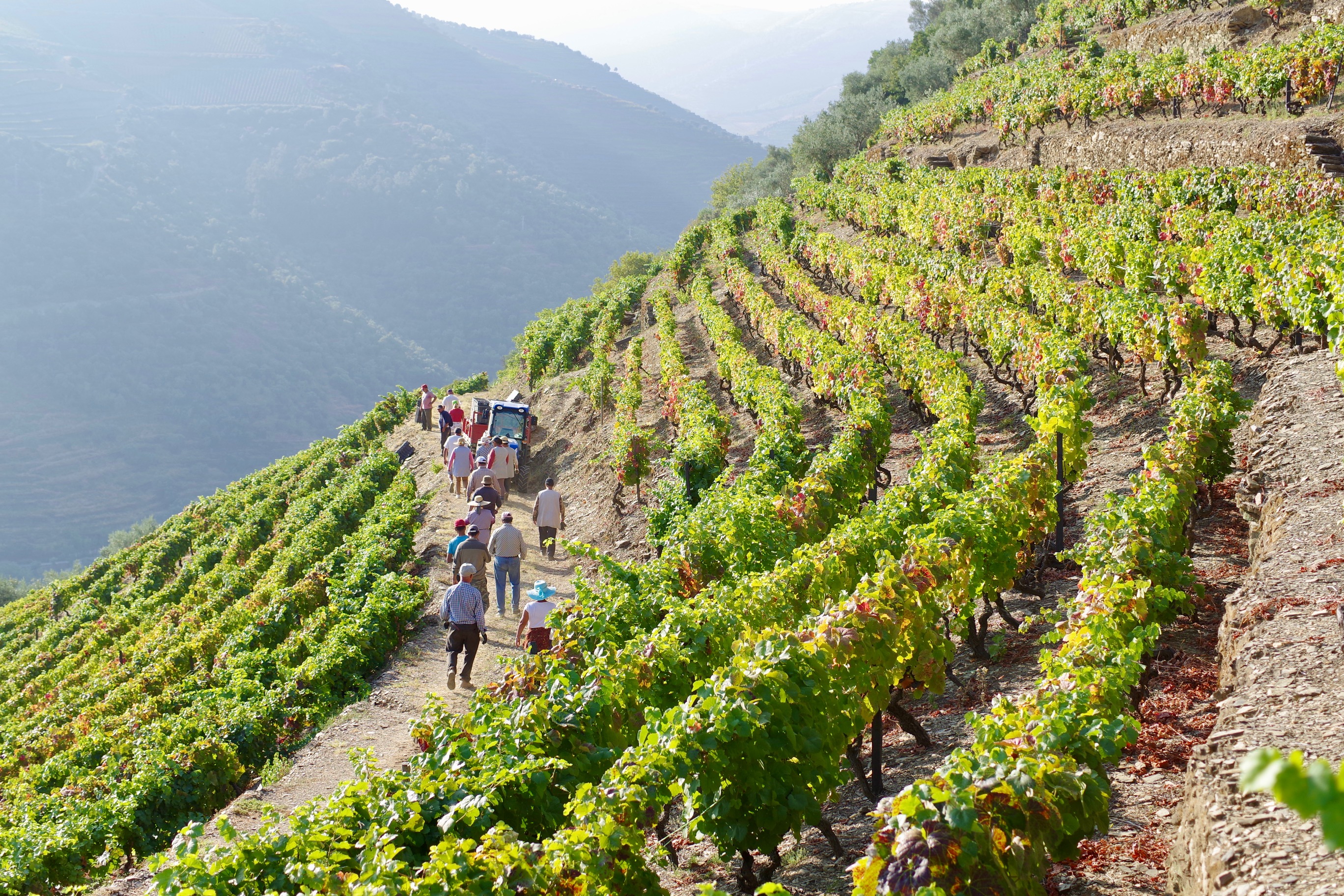
Aging completes the transformation. Small casks expose the wine to oxygen, gradually turning its red hues tawny, amber, and eventually golden, while large vats admit far less air and preserve the wine’s youthful depth. Over time, this slow oxidation reshapes not only the color but the wine’s entire character.
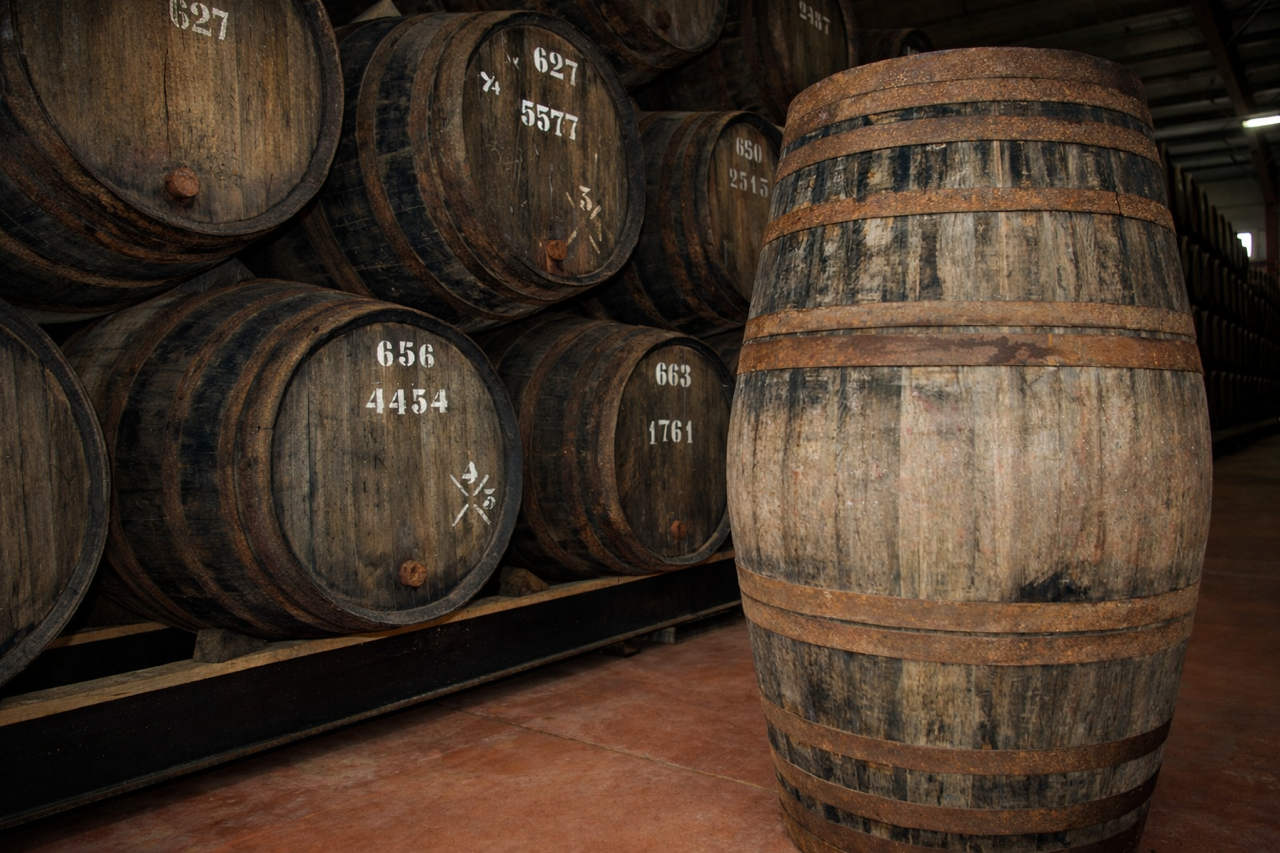
In 1950, the Port Wine Institute proposed a scale for red Ports that traces how the wine’s color evolves under the combined influence of time and blending. The scale moves from the opaque purple of very young wines (retinto), through a clearer red (tinto), to ruby (tinto aloirado), then to tawny tones (alourado) as oxidation begins, and finally to pale light tawny (alourado claro) after prolonged aging in wood. Here, “tawny” refers to color rather than to the Tawny style of Port.
A freshly bottled Vintage appears deeply purple, but over time it may acquire tawny hues reminiscent of wood-aged wines. Tawny Ports undergo an even more dramatic chromatic journey, from reddish amber at ten years to luminous copper or gold after many decades. White Ports follow their own path, gradually deepening from pale to straw to golden tones as they age.
Nothing reveals Port’s color better than a thin crystal glass, slightly tilted so light passes through the wine. The same Port that once seemed to swallow the light can, with time, glow softly by candlelight at a wedding banquet, perhaps with elderflowers adorning the table.
 Salt of Portugal