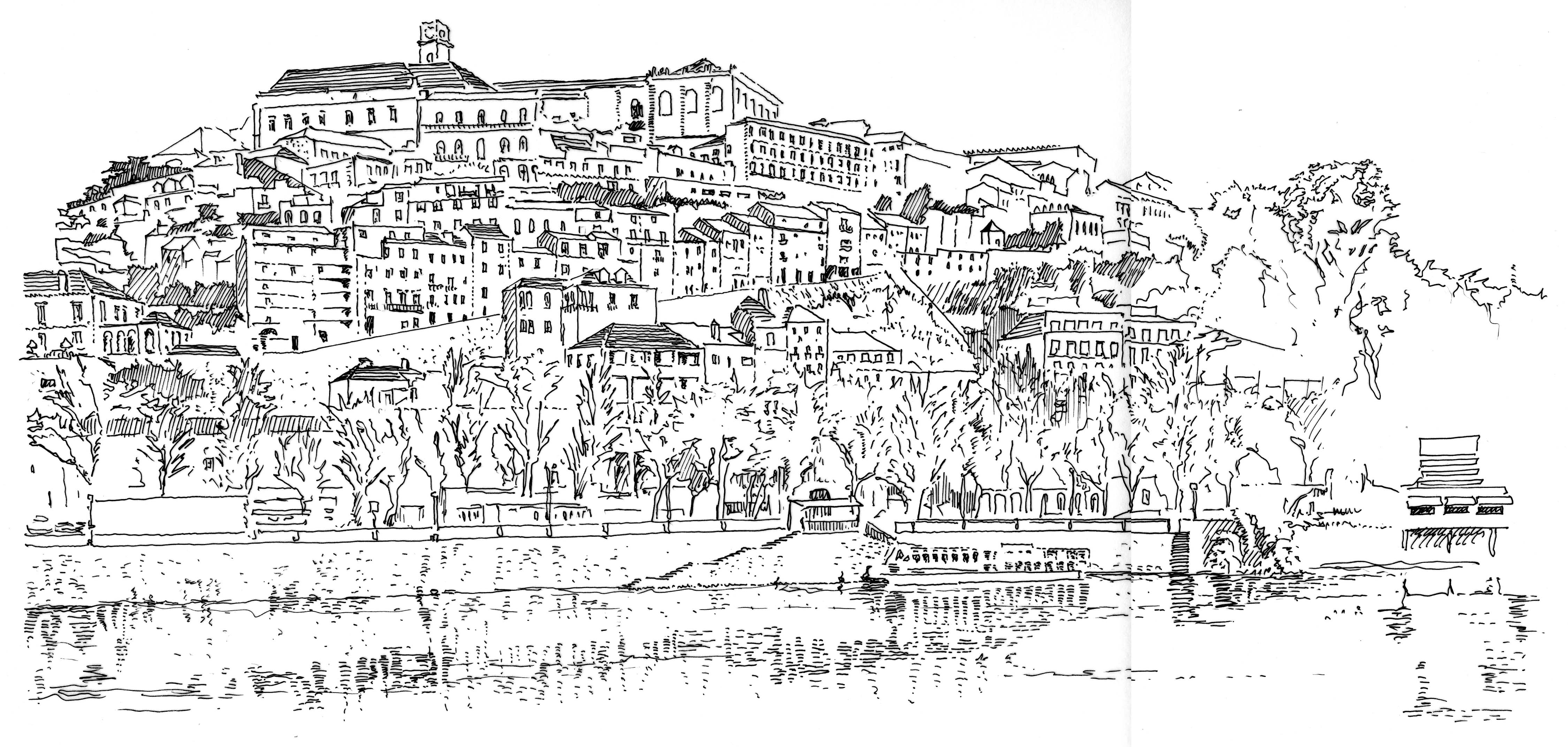
Coimbra

Coimbra, Rui Barreiros Duarte, ink on paper, 2011.

Coimbra is famous for its university, one of the oldest in the world. It is a beautiful city that seduces its visitors slowly, with its winding streets, ancient buildings, and academic traditions. According to an old folk song “Coimbra is most alluring when you try to say goodbye.” Hans Christian Andersen, the author of “The Little Mermaid” and other popular fairytales, visited Coimbra in 1866 and fell under its spell. Here’s what he wrote:

“We drove along the Mondego river whose broad bed displayed more dry sand than running water. Yet, what freshness and forest charm all around! The city rose as the loveliest flower in the whole bouquet. Coimbra rests upon the mountain side, one street higher than another. The streets are narrow, crooked, and rise continually. Shops and bookstores are here in abundance.

From the cloister of Santa Cruz the streets ascend towards the university, an extensive building that occupies the highest site in the city. Up there, through the dilapidated walls of the fortress, one enters the botanical garden, which is rich in rare flowers and trees.

I met some students all in their medieval garb: one went by himself, reading; three others passed in lively conversation with the guitar strung over the shoulder; their wild pranks in these surroundings put me in a cheerful mood; it was as if I lived back in an earlier century.”

Fernando Pessoa

Fernando Pessoa, Rui Barreiros Duarte, ink on paper, 2012.

It is not easy to write about the great poet Fernando Pessoa. Even if we weight every syllable, our words are still too heavy to describe his graceful prose and sublime rhyme. So, perhaps we should stick to the facts.

Pessoa was born in Lisbon in 1888. His father, a journalist, died when he was young. His mother remarried and moved to Durban, South Africa, where Pessoa received a British education.

After returning to Lisbon in 1905, Pessoa earned a modest living making translations and writing business letters. He published poems, essays and literary criticism, but remained unknown during his lifetime.

Many of his poems were written in coffee shops, at Brasileira in Chiado or in Terreiro do Passo’s Martinho da Arcada. He wrote under different identities, each with its own personality and distinctive style. Some say that Pessoa and his four major pen names, Álvaro de Campos, Ricardo Reis, Alberto Caeiro, and Bernardo Soares are the five finest Portuguese poets.

Pessoa died in 1935, at age 47, one year after publishing his first major book, The Message. He left a literary treasure trove: a trunk full of poetry and prose, including The Book of Disquiet, which, published in 1982, created a new wave of interest in the poet.

Reading Pessoa can change your life, at least that’s what happened to the Italian writer Antonio Tabucchi. A chance encounter with Pessoa’s poem “A Tabacaria” (The Tobacco Shop) made him fall in love with the poet’s work and with the language and culture of Portugal.

Here are the first lines of “A Tabacaria” translated by Richard Zenith. Read them at your own peril.

“I’m nothing.
I’ll always be nothing.
I can’t want to be something.
But I have in me all the dreams of the world.”