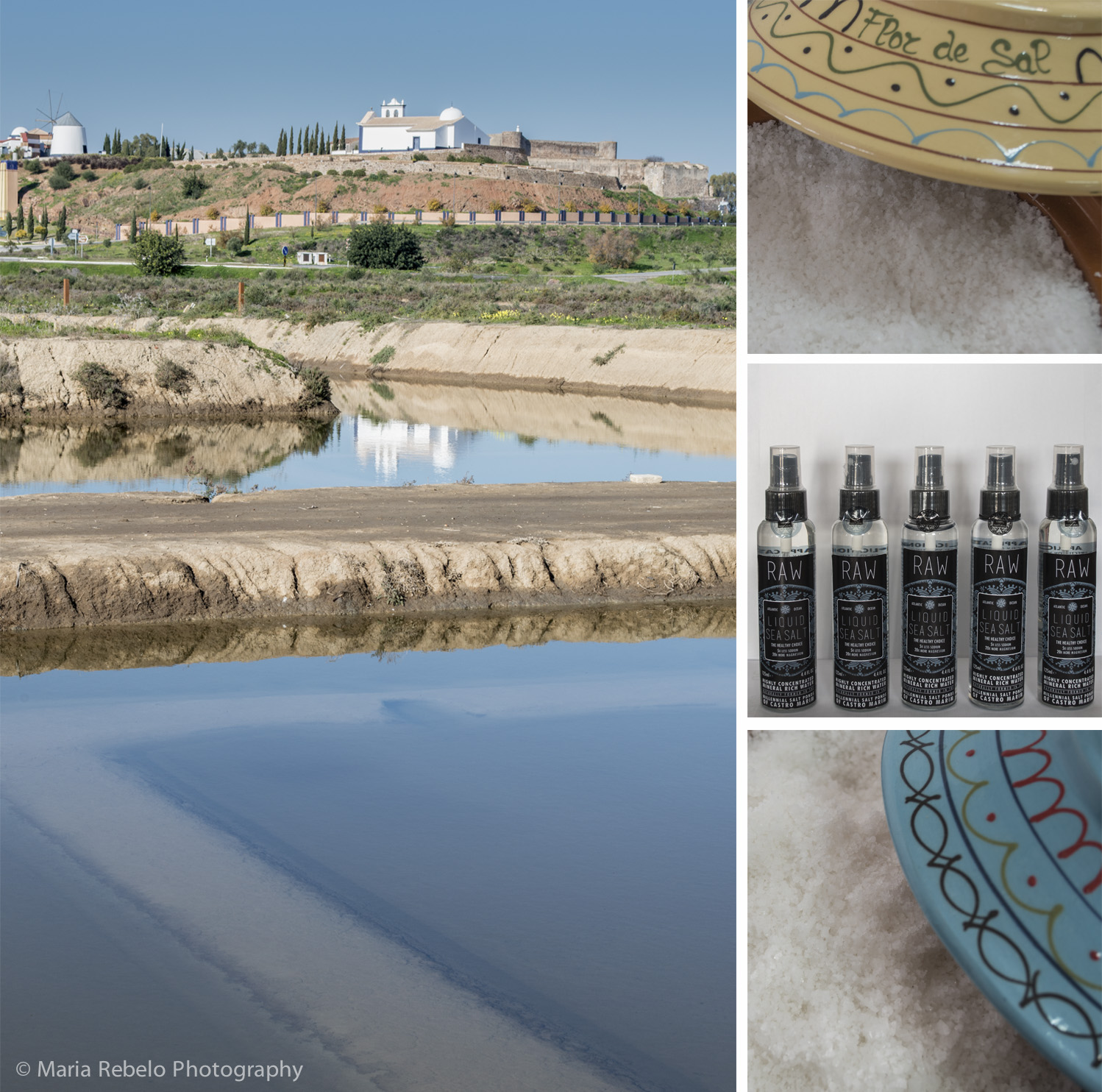
The extraordinary salt of Castro Marim

Castro Marin Composit

The Romans loved salt. They used it to cook, to preserve food, and as a form of currency (the practice of paying soldiers in salt is the origin of the word salary). So, it is not surprising that the Romans settled in Castro Marim. This small town on the marshes of the Guadiana river produced great salt.

During the 20th century, this production became industrialized. The salt was harvested with heavy machinery that leaves plenty of chemical residues. It was then washed and processed to turn its grey color into white, striping the salt of magnesium, potassium, and other important minerals.

Artisanal producers abandoned their salt ponds and so did the fish and birds that used them as habitats. Centuries of knowledge about producing great salt was on the verge of being lost.

But then, the tide turned. In the late 1990s, a cooperative called Terras de Sal revived the artisanal salt trade. It invited a French certification body to establish the strictest certification norms to ensure the highest standard of quality. It created the conditions to attract a new generation of producers who left their city jobs and came to Castro Marim to produce the best salt in the world.

These producers harvest the salt manually with wooden tools, a slow process that is essential to avoid chemical contamination. They do not wash the salt, to ensure that it retains all its important minerals. Since rain muddies the water, they only harvest when the weather is dry, between May and September.

One of the cooperative’s producers is called Água Mãe. Their salt is amazingly white and flavorful. Their “fleur de sel,” made of fine crystals created by temperature differentials between water and air, is exquisite. Água Mãe also bottles liquid salt, which is low in sodium and high in magnesium. When we spray it on our salads it gives them layers of delicate flavor.

The Romans were prescient in their love of salt. An amazing fact about our bodies is that, because life began in the sea, the composition of our tissue fluid resembles that of natural sea salt.

The ordinary act of seasoning our food becomes extraordinary when we use salt from Castro Marim. It is a privilege to nourish our body with the same pristine salt prized by the Romans 2000 years ago.

You can find the Água Mãe salt store on Travessa dos 3 Marcos, n.º 11, Castro Marim, Algarve, tel. 961380503, email  aguamae@aguamae.pt . Click here for the Terras de Sal web site. To buy the wondrous salt of Castro Marim in the U.S., click here.

Portuguese melon


Fatia de Melão-2

One of the pleasures of the Portuguese summer is eating melon. But melons are like lottery tickets. You can win the grand prize, a perfectly ripe melon bursting with sweetness, or strike out and get a tasteless specimen. There’s a coloquial expression that reflects this uncertainty. We say “que melão,”  which means “what a melon,” when we suffer a minor disappointment.

Melon sellers have some curious idiosyncrasies. They like to boast that their melons come from Almeirim, a region that is famous for its melon but has a small production volume.  They also take pride in being able to pick a ripe melon, even though their track record is often spotty.

Restaurant waiters talk about melon with great diplomacy. When they say: “The melon is usually great but I didn’t try it today,” it means that the melon is a dud.

There are restaurants that always serve good melon. No one seems to know how they do it. Perhaps they buy many melons and throw away the bad ones.

According to an old proverb, “por cima de melão, vinho de tostão,” which means “after melon, drink wine that costs a penny.” Since a penny was a lot of money in old times, the proverb recommends drinking good wine after eating melon.

So, here’s our advice. Ask a melon seller to pick a ripe melon from Almeirim for you. If the melon is lousy, just say “que melão” and move on. If the melon is great, celebrate with a great bottle of wine!

Black figs

Figos

When you go to the market buy black figs, recommends the Portuguese writer Sophia de Mello Breyner Andresen in her poem The Morning Walk: “but figs are not black, they are blue on the outside and pink on the inside and they all shed a tear made of honey.”

Amazing produce

DCIM100GOPRO

Older people often complain that food doesn’t taste as good as it once did. Are they right or it is just that everything tastes better when we’re young? We can answer this question thanks to Herdade do Freixo do Meio, an Alentejo estate.

In 2001, the Herdade adopted organic production methods and planted old varieties of fruits and vegetables that were left behind by the industrialization of agriculture. They also started to raise black pigs, Barrosa cows, Alentejo turkeys, and other animals, letting them roam free. You can see and taste the amazing results by visiting their store in Lisbon’s Ribeira market.

When you try their products, you quickly realize that older people are right: food used to taste much better. The good news is that Herdade do Freixo is bringing that taste back!

Click here for the Herdade do Freixo do Meio web site.

A memorable sandwich

Sandes de leitão- ©mariarebelophotography.com

The Earl of Sandwich is credited with the idea of placing food inside two slices of bread. But it was Portuguese peasants who turned this aristocratic whim into something sublime.

In ancient times, peasants in Mealhada, a town in the Bairrada region, used to offer their largest pigs to the nobles who owned the land. The peasants were left with small pigs called “leitão” (“laytaoum”).  They roasted them in wood ovens, seasoned with garlic, bay leaves, olive oil, and plenty of white pepper. The meat, cut into slices and served inside country bread, produced amazing sandwiches.

One of our favorite side trips from Lisbon is to drive the 90 km to Mealhada to enjoy a freshly-made “leitão” sandwich, accompanied with local sparkling wine. On the way there, we visit the beautiful Batalha monastery. On the return, we stop by the enchanting Bussaco Palace for coffee and pastry. The delicious food and beautiful scenery always make for memorable trips.

There are many good restaurants in Mealhada serving “leitão à moda da Bairrada” (leitão Bairrada style). Two of our favorites are Meta dos Leitões (IC2, Estrada Nacional 1, Sernadelo, Mealhada, tel. 231 209 540, email: casadesarmento@gmail.com) and Pedro dos Leitões (Rua Alvaro Pedro no 1 Sernadelo, Mealhada, tel. 231 209 950).

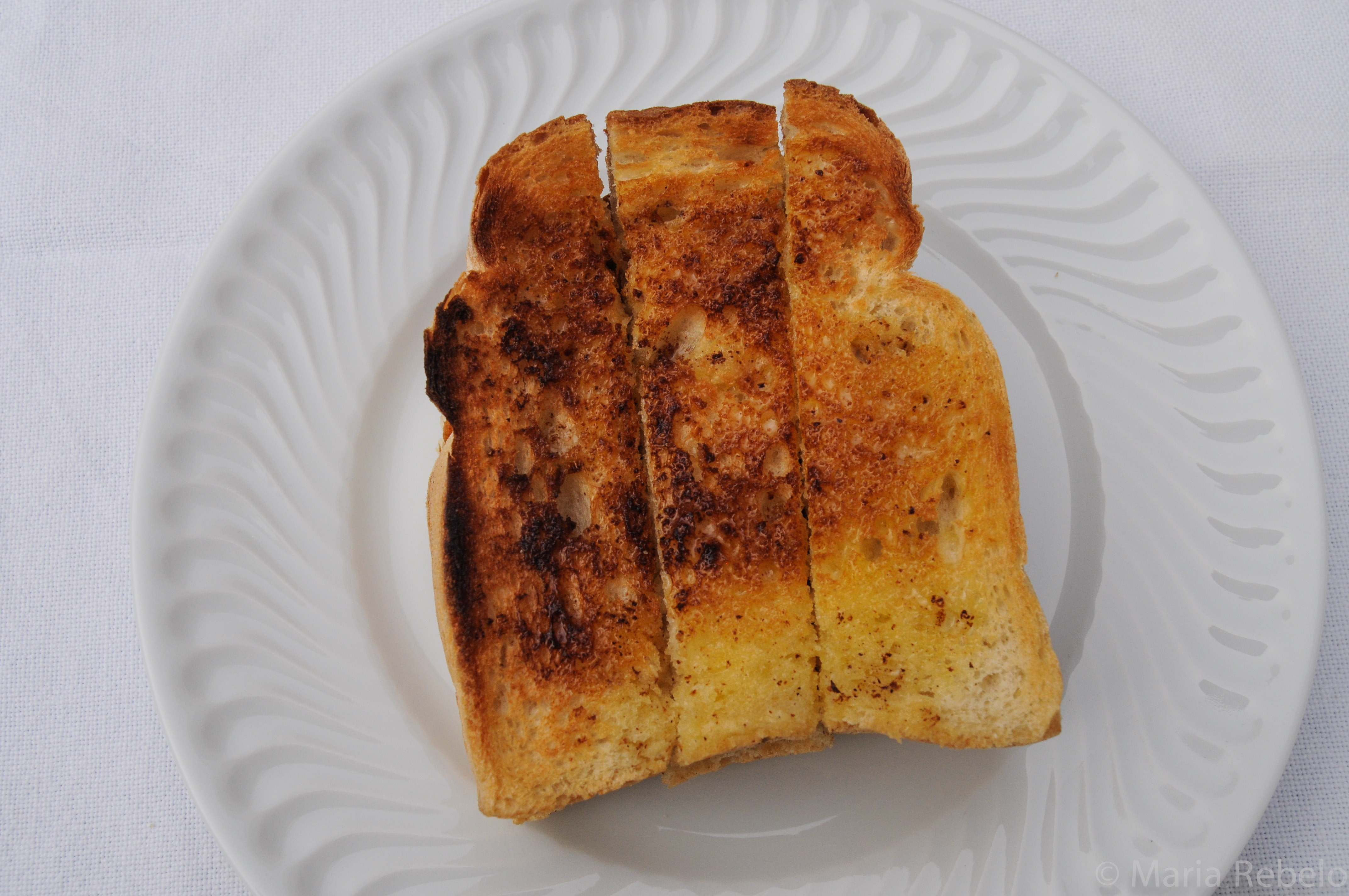
A toast test

Blog_149F

One of Portugal’s simple pleasures is to sit in an esplanade drinking coffee and eating a “torrada” (toorrahdah). Torradas are buttered toasts made from “pão de forma,” a bread with a soft texture perfect to absorb melted butter.

Each torrada has two bread slices and each slice is cut into three neat rectangular tranches. The best tranches are the middle ones, which have almost no crust. So, you have to decide: which tranche will you eat first?

Just so you know, there are three schools of thought on this topic. According to the first school, you should start with the two middle tranches, so you’ll enjoy them while they’re hot. The second school recommends that you leave the best for last and eat the prized middle tranches at the end. The third school, advises you to avoid difficult choices and ask for a “torrada aparada.” This torrada has no crust, so all the tranches look the same.

Torradas are a personality test in disguise: the Portuguese can read you like a book by the way you eat your toast.

The three petiscos

3petiscos

Petisco (pronounced peteescoo) is the Portuguese word for tapa. There are three very popular petiscos in Portugal. The first is the “bolo de bacalhau,” a fantastic creation that combines some of Portugal’s favorite ingredients–codfish, potatoes, onions, and parsley– into a single bite. The second is the “rissol,” a half-moon-shaped delicacy made with breaded pastry and a shrimp or berbigão filling. The third is the “croquete,” a cylinder of ground meat, delicately spiced, first coated with egg and bread crumbs and then fried.

These finger foods are the perfect foil for a glass of great Portuguese red wine. Combine them with tomato rice, and you’ll have a very satisfying meal.

The attentive reader will notice that there’s a fourth petisco in the photo. Well, the three musketeers were also four. The triangular-shaped “chamuça” is the D’Artagnan of petiscos. Inspired by Indian cuisine, it adds spice and excitement to the meal.

Farmers markets

D. Natividade

We love going to farmers markets. We always imagine we are in a museum and study the whimsical shapes of the vegetables, the exuberant colors of the fruit, and the amazing aromas.

Most of these fruits and vegetables cannot withstand long distance travel or extended stays in supermarket shelves. But what they lack in endurance they more than make up in taste and smell.

We enjoy talking to the fruits and vegetable vendors. They always have interesting insights about their produce as well as about life. So, if you see a sign saying “Mercado,” follow it. You’ll find food for your body and wisdom for your soul.

The photo shows three generations of wonderful fruits and vegetable vendors: Dona Natividade, her daughter in law and her granddaughter.

Nannarella

Nannarella

Why would an Italian couple move with their children from Rome to Lisbon to open a gelato store? And why would they name it after a 1950s actress that no one remembers? We don’t know, but what’s important is that they came.

They use Italian technology and the best Portuguese ingredients, such as water from the Estrela mountain, Vigor milk, Delta coffee, Pantagruel chocolate, rocha pears, Port wine, and Óbidos ginja. The result is gelato so indescribably delicious that we feel the urge to sing: con Nannarella la vita è bella!

Nannarella is located on Rua Nova da Piedade, 68 in Lisbon in the Principe Real neighborhood.

Secrets of Portuguese cooking

Portuguese cooks love to alter traditional recipes, adding ingredients that can be difficult to detect but impart a special taste. We recently learned a few of these tricks.

Our fish monger told us that “people always rave about my fish sauces. They don’t know I use a secret ingredient. When no one’s looking, I blend in a tablespoon of Savora mustard. It makes all the difference.”

A saleswoman at Quinta do Sanguinhal confided: “when I roast meat, I use a secret ingredient. When no one’s looking, I pour a glass of “licoroso” (desert wine) on the meat. It gives the sauce an amazing taste.”

The butcher gave us a pretty conventional stew recipe. When we asked him what made the recipe so special, he said, “Well, I use a secret ingredient. When no one’s looking I pour half a beer on the stew. Then, I drink the other half.”

We plan to find out whether these tricks work… when no one’s looking.