Modern luxury at the Four Seasons Hotel Ritz in Lisbon

Ritz

António Salazar, the man who ruled Portugal from 1932 to 1968, detested extravagance so he resisted the idea of building a Ritz hotel in Lisbon. But a group of entrepreneurs convinced him to support the project. Salazar visited the hotel before the inauguration and disliked what he saw. He exited through the back door and never came back. Despite Salazar’s disapproval, the Lisbon Ritz was a huge success.

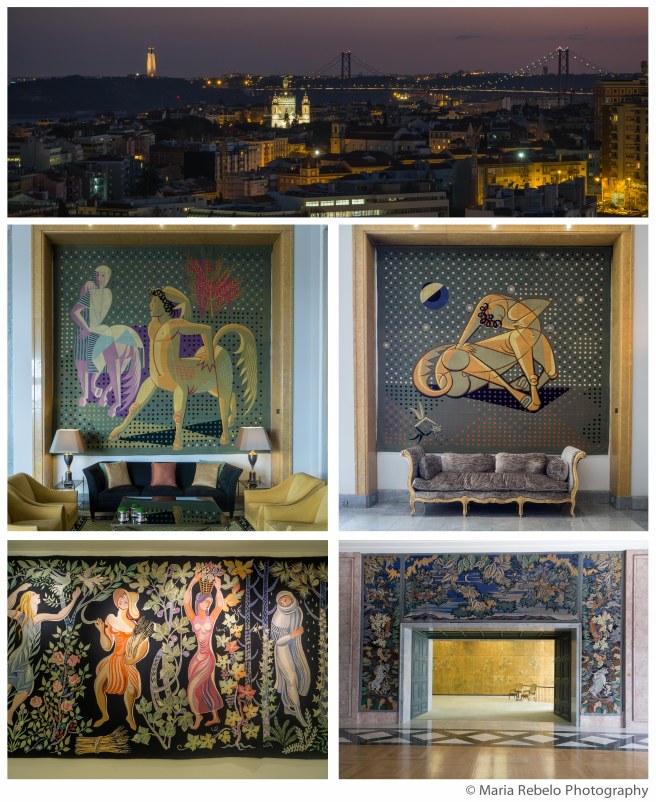
The entrepreneurs tapped Porfirio Pardal Monteiro to be the architect. It was an inspired choice. Monteiro used the Parthenon and the Erechtheum to guide his search for the ideal location. But he avoided the temptation to build a hotel that imitates the past. Instead, he drew inspiration from Le Corbusier to design a modern building with beautiful proportions.

Monteiro was friends with the great painter Almada Negreiros. He engaged Almada and other artists to produce works of art for the new hotel. The result is a stunning art collection that creates unique interior spaces. Almada designed exuberant tapestries with centaurs and etched agricultural motifs into black granite using gold leaf. His wife Sarah Afonso produced a joyous allegory of the seasons. Querubim Lapa, Martins Correia, Carlos Botelho and many others contributed to the collection of roughly 600 works of art.

The hotel has 4 elevators for the guests and 12 elevators for the staff. When it opened in 1959, it had 330 rooms and 400 employees. Even though the ratio is no longer the same, the service is still flawless. Run by the Four Reasons group, the hotel has been regularly renovated to continue to offer outstanding comfort. The elegant breakfast room is the perfect place to start your morning in Lisbon. The rooftop was converted into a modern gym with a running track that offers expansive views of the city.

The Four Seasons Hotel Ritz is one of Europe’s grand hotels, a unique combination of architecture, art, comfort, and hospitality that creates an unforgettable experience.

The Four Seasons Hotel Ritz in Lisbon is located at Rua Rodrigo da Fonseca, 88, tel. (21) 381-1400. Click here for the hotel website. 


Sleeping in a medieval castle by the Sado river

Composite Alcácer

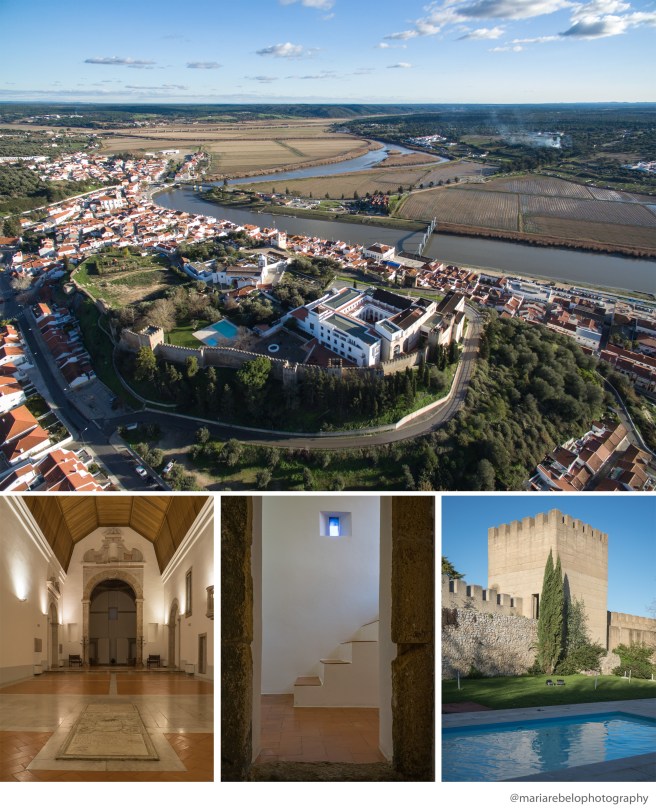
One hour away from Lisbon, you can stay in an historical hotel that occupies a medieval castle with wonderful views of the Sado river and the rice fields of Alcácer of Sal. It is a place where people have gathered since the Iron Age to worship the gods above.

For more than 2,000 years, people came to Alcácer do Sal to farm the land, tend to herds of sheep and goats and produce salt on the marshes of the Sado river. The Sado made it all possible, its waters bestowed fertility on the land and carried boats loaded with agricultural products to far away lands. Underneath the pousada there are remnants of Greek pottery and Egyptian jewelry, foreign luxuries purchased with the fruits of the Sado river.

In the 2nd century BC, Alcácer was conquered by the Romans who made it a center for the production of wool and salt. With their penchant for grandiose names, the Romans named the city Salacia Urbs Imperatoria.

In the 6th century AC, the Visigoths conquered the territory that is now Portugal. But life did not change in Alcácer until the moorish conquered the city in the middle of the 8th century AC. They built the caste and made the town an important trading outpost.

The first king of Portugal, D. Afonso Henriques, conquered Alcácer in 1160. But the moors fought back and it was only in 1217 that Alcácer became a permanent part of the Portuguese territory. The castle was then converted into a monastery occupied by the order of Saint James.

In the 17th century, the old monastery was adapted to welcome the nuns of Saint Claire of Assisi. The new building was called the Convent of Her Lady of Aracaeli.

The Pousada is a magical place. Every window frames a beautiful landscape. Every step reminds us that we are on hallowed ground. But hard decisions have to be made: should we stay by the spacious hotel pool relaxing or go see the gorgeous beaches of the coast of Alentejo?

Here’s a link to the pousadas’ website. You can find a large collection of photos of the pousadas at www.mariarebelophotography.com.

An hotel in the land of silence

Composit Colmeal

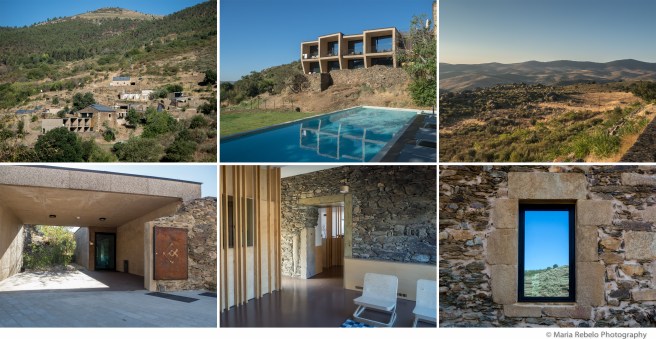
As we drove on the narrow road from Figueira do Castelo Rodrigo to Colmeal, we felt we were leaving the modern world behind. All we saw ahead of us were granite hills and fertile valleys under a sapphire blue sky. Even as we got close to the hotel, the building remained invisible. Its honeycomb shape dissolves into the landscape leaving us with a pristine view of the Marofa mountain. The same view that the Neolithic people saw when they made their paintings nearby, 3,000 years ago. The same panorama that welcomed the pilgrims who followed the ancient spring that goes by the village of Colmeal, on their way to Santiago de Compostela. This water, crystalline and pure, was a blessing to the travelers. And so was the food and hospitality offered by the population of this village that dates back to the 12th century.

The new Colmeal Countryside Hotel seeks to revive this tradition of hospitality.  In the evening we enjoyed a simple meal of watercress soup, local cheese and fruit. When we asked our waiter why the soup tasted so great, he told us that one of the secrets is the local spring water. “Anything cooked with this water is transformed,” he said.

The hotel, designed by architect Pedro Brígida, is warm and welcoming. It integrates perfectly with its the surroundings, which include a manor house and a church that once belonged to the family of Pedro Álvares Cabral, the navigator who discovered Brazil.

The environment is so peaceful that we found ourselves whispering to avoid staining the immaculate silence. We sat on the terrace on a warm Summer night bathing in star light, happy to have left the modern word behind.

Click here for the hotel’s website.

An 18th century oasis

Casa de Sezim composit

Where can we start to tell you what a privilege it is to stay at Casa de Sezim in Guimarães? This manor house is the perfect place to experience the glamour of aristocratic life.

The house is built around a tower that remounts to 1376. The magnificent salons and the expansive veranda were added in the 18th century. It was at this time the famous hand-crafted wall papers were ordered from Zuber in France.

These papers fill the walls with the adventures of Dom Quixote and glimpses of faraway lands: India and the United States. Zuber made two editions of the papers with American landscapes, one for Casa de Sezim and the other for the White House in Washington D.C.

We arrived with a long list of places to visit in the vicinity. But we fell under the spell of Casa de Sezim and decided to relax and spend some time in this 18th century oasis. Why go far in search of beauty when you have it near?

Casa de Sezim is located in Guimarães at Rua de Sezim. Click here for their web site.


The governor’s palace

Palácio do Governador

Just when we think that Lisbon told us all her secrets, the city finds new ways to surprise and delight us. This time we discovered a new hotel called Palácio do Governador (the governor’s palace).  Located near the Tagus river, it occupies a 16th century manor house that once belonged to the governor of the Belém neighborhood.

The governor’s room overlooks the Tower of Belém which used to be connected to the house through an underground passage. Near this passage, you can find the ruins of a Roman factory that produced garum, a fish sauce used in Roman cuisine.

We had a wonderful stay. The hotel integrates old and new with ease, offering  comfortable rooms and elegant public spaces. The service is attentive and the location is perfect.

Our only source of anxiety was the temptation to forego breakfast at the hotel and walk over to the Confeitaria dos Pasteis de Bélem to start the day with a heavenly pastel de Belém.


Palácio do Governador is located on Rua Bartolomeu Dias 117, in Lisboa, tel. 212 467 800. Click here for the hotel’s website.

Santa Maria do Bouro in the light of eternity

Composit Amares, exposição

The granite walls of the Santa Maria do Bouro Pousada belong to a Cistercian monastery built in 1162 by the first king of Portugal. They aged perfumed by incense and lulled by religious chants.

The monks enjoyed their meals sitting around an imposing stone table. The kitchen had two fountains that supplied water, several wood-fire stoves and a fireplace used for roasting. A large chimney released the appetizing food aromas to the skies above. Perhaps the monks wanted to advertise their talents, in case there were opportunities for good cooks in heaven.

This golden age gave way to an era of slow decline. Eventually, the monks moved out. Wild animals and vegetation moved in.

Just when the old monastery had gotten used to oblivion, a small group came for a visit. They wanted to turn the ruins into an historical hotel.  Among them was a quiet man who stared in silence at the granite walls. He is an architect called Eduardo Souto de Moura who would one day win the Pritzker prize.

In his reconstruction plan, Souto Moura left the walls exposed to showcase their beauty. He avoided imitating the old, so he complemented the granite with new materials. The ivy that embraced windows and columns was allowed to stay and a green roof was built to welcome the vegetation back to the building.

Everything in this beautiful hotel breathes harmony and tranquility. The rooms have expansive views of the surrounding mountains.  And there are many spaces, indoors and outdoors where we can enjoy a glass of wine or a cup of tea.

The kitchen was transformed into an elegant dining room and the large chimney became a skylight. The ancient stone table is still there, covered with irresistible desserts that would make the old monks proud.

Today, the walls of Santa Maria do Bouro stand with the confidence they will be beautiful in the light of eternity. And we think they’re right.

Here’s a link to the pousadas’ website. You can find a large collection of photos of the pousadas at www.mariarebelophotography.com.

Tranquility at Quinta de Guimarães

Quinta de Guimarães

The best way to experience the magic of the Douro valley is to sojourn at a local farm. It was this possibility that attracted us to Quinta de Guimarães, an estate that dates back to the year 1720. It offers rooms in an ancient manor house and in two beautifully restored country homes surrounded by vineyards.

We loved the tranquility of the quinta and the sumptuous meals that Fernanda Pinto, the property caretaker, prepares with produce from the farm. Breakfast includes country breads, homemade sausages and prociuttos, eggs from happy chicken, and traditional desserts. We enjoyed a wonderful dinner composed of spinach soup, baby goat with roasted potatoes, followed by the farm’s luscious fruit. The meal was accompanied by a bright “vinho verde” (slightly sparkling white wine) produced on the property under the label Cazas Novas.

A visit to Quinta de Guimarães is a journey to a place where time has stopped because it found perfection.

Quinta de Guimarães is located at Lugar de Miguas, Sta. Marinha do Zézere, tel. 912 915 699. Click here for the quinta’s website.


A joyous view

Vista Alegre-Montebelo

In the early 19th century, Portugal’s royal family and nobility served their meals on expensive porcelain imported from China. José Pinto Bastos, an entrepreneur,  saw in this fashion a business opportunity: he decided to produce porcelain in Portugal. It was a risky venture because the process for porcelain production was a closely guarded secret. So, Pinto Bastos started by making glass and crystal to finance his porcelain experiments.

He found the name of his brand and the perfect location for his factory on a hill near Ilhavo that overlooks the “ria,” an elongated body of water where fresh water mixes with salty water. On top of the hill there’s a beautiful church built in 1696 by a bishop who liked the location because of its “vista alegre” (joyous view).

In 1824, Pinto Bastos built a house adjacent to the chapel and a factory called Vista Alegre. There, he started to unravel the secrets of porcelain making. A team of workers labored day and night to feed large ovens with coal or wood so they could burn at 1,400 degrees Celsius for 40 hours in a row.

After much trial and error, a few pieces of porcelain were finally produced. But these pieces had a light gray color which was much less attractive than the pure white of Chinese porcelain.  Out of desperation, Pinto Bastos sent his son to Sèvres, the famous French porcelain factory, to ask for technical assistance. The young man came back with bad news: porcelain production requires a rare mineral rock called kaolin. Pinto Bastos was not deterred, he searched all over Portugal for this precious rock. Eventually, he found a large deposit a mere 20 km from his factory.

By 1835 Vista Alegre was producing excellent porcelain. Over the years, it became one of Portugal’s most cherished brands and a very successful business.

When, after a long sleep, China woke up to the world in the late 20th century, it flooded the market with cheap porcelain. Vista Alegre had trouble competing and for a while it looked like Portugal would, once again, buy all its porcelain from China. But Vista Alegre found new owners who modernized its factories. They also built a new hotel around the original Pinto Bastos family home, an interesting museum that traces the history of Vista Alegre, and stores where visitors can buy the company’s products.

The new wing of the hotel overlooks the “ria” and the old Pinto Bastos house was converted into elegant suites. It is a thrill to stay in this porcelain palace and enjoy its joyous view.

Click here for the website of the Montebelo Vista Alegre hotel. 

Eternal beauty in the heart Alentejo

Composit São Lourenço

We hope the gods of the sea will forgive us, but São Lourenço do Barrocal made us forget the ocean and its waves. We were dazzled by the exuberant fields covered with white daffodils, surrounded by the simple elegance of the old farm buildings.

São Lourenço has been in the family of its current owner, José António Uva, since the 19th century. It once employed 50 families who lived and worked on the farm. The estate was occupied in 1975, the year in which José António was born, as part of the wave of expropriations that followed the 1974 revolution. After the property was returned to the Uva family in 1984, the abandoned fields were replanted and the farm was brought back to life. But the buildings that once served as cellars and accommodation for the workers remained in ruins.

After studying in Paris and working in London, José António returned to Alentejo. While thinking about his future, he rebuilt a small house for his own use and a water tank that served as a swimming pool. He decided to devote four years to turning the estate into a hotel. Instead, the project took 14 years. Eight of these years were spent working with Eduardo Souto de Moura, the Pritzker laureate architect who oversaw the reconstruction project. Instead of using the property as a canvas to design new buildings, Souto de Moura followed a humble approach: he preserved and highlighted the beauty of the vernacular buildings that were there.

The interiors were decorated by José António’s wife, Ana Anahory. She used a wide range of artifacts, from antique agricultural implements to the heads of animals once hunted on the property. Her exuberance contrasts with the restraint of Souto Moura’s style. But, somehow, this creative tension works, making the space interesting and alive.

There are great hiking trails on the property with beautiful views of Reguengos de Monsaraz and the surrounding country side. One of the highlights is a menhir that is 7,000 years old.

It is heartwarming to see the natural beauty of a place where humans lived in the distant past so well preserved for the future.

Click here for the web site of São Lourenço do Barrocal.


The blessing of the breeze

Pousada de Palmela.jpg

When you look out the window from your room at the Pamela pousada, you understand why the medieval king Sancho I built a castle on this location. You see mountains and valleys and the sea in the distance. Who would not want to conquer this piece of paradise? A castle was needed to ward off invaders.

The pousada and the surrounding castle are a spectacular wedding venue. There is a terrace called Pátio do Pessegueiro with a fabulous view of Troia and Setúbal and an indoor courtyard that is perfect for a banquet.

The restaurant staff told us how much they look forward to the wedding services. “It’s hard work but it is very rewarding to see two people start a happy life together.” How do you know the marriage will be blissful?, we asked. “There’s an old belief that when the wedding is blessed by the breeze the marriage is happy. And there’s always a breeze in Palmela.”

Here’s a link to the pousadas’ website. You can find a large collection of photos of the pousadas at www.mariarebelophotography.com.