Portuguese pousadas

composit-pousadas

It was so hard to travel in old times! There were no hotels or restaurants. Some towns had modest inns where guests could rest and eat a simple meal. But on many nights, travelers slept under the stars hoping they would find a village in the morning where they could buy some food.

The only way to travel in style was to be a member of the royal family or high nobility. You would then have access to an informal network of palaces, castles, and convents that took great pride in their hospitality. The arrival of an illustrious guest was a cause for celebration. A banquet would be prepared and the best wine brought out of the cold cellars and warmed by the fireplace.

The meals ended with elaborate desserts which William Beckford, a well-traveled English nobleman, described as “an admirable dish of miracles, well seasoned with the devil and prettily garnished with angels and moonbeams.”

This informal network of convents and palaces worked well in Portugal until the 19th century. But after the monastic orders were abolished in 1834, convents felt into disrepair. In 1910, the monarchy was abolished and many noble families could no longer maintain their palaces.

The tradition of hospitality was never lost, because it is an integral part of the Portuguese character. But the beautiful buildings and the recipes perfected for centuries in their kitchens seemed condemned to oblivion.

In the 1940s, the Portuguese government started buying old palaces, castles and monasteries to convert them into historical hotels called pousadas. Vintage furniture was restored. Old recipe books were dusted and their secrets put back into use.

With their fairy-tale locations, these hotels offer unforgettable experiences. You’ll find great food and wine, the best dessert tables in the country, and a staff that treats every guest as an opportunity to celebrate the traditions of Portugal.

Here’s a link to the pousadas’ website. You can find a large collection of photos of the pousadas at www.mariarebelophotography.com.
 

The Guimarães pousada

DCIM104GOPRO

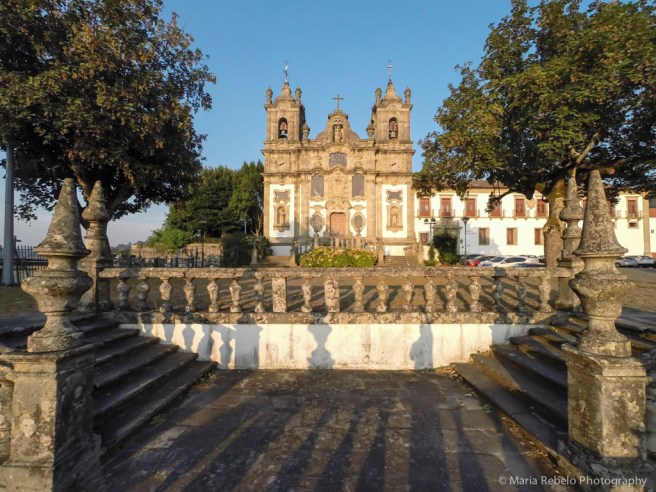
The narrow, meandering road that leads to the Guimarães pousada is good at keeping secrets; it gave us no glimpse of what this historical hotel looks like. When we arrived late in the afternoon, we were stunned to see the imposing granite facade of the church adjacent to the monastery bathed in golden light. Did the architects position the church to benefit from the sun’s exposure or did the sun move so it can shine on the magnificent building?

The origin of this monastery is intertwined with the early days of Portugal as a nation. It was built in the 12th century in fulfillment of a promise. Dona Mafalda, the wife of the first king of Portugal, vowed to fund the construction of a monastery for the order of Saint Augustine if she gave birth without complications. The monastery was named after the patron saint of expectant mothers, Santa Marinha.

In the 16th century, the monastery was transferred to the order of Saint Jerome. The monks offered university degrees in the arts and the humanities that attracted students from the royalty and nobility.  It was during this time that the chapter room, the place where monks read chapters of the bible, and the famous Saint Jerome terrace, an outdoors meditation space, were built.

In 1834, when the state abolished the religious orders, the monastery was sold and became a private residence. In the 1950s, a fire destroyed part of the building and turned it into a ruin.

In the 1970s, the Portuguese government bought the monastery and hired architect Fernando Távora to convert it into an historical hotel. Távora did a masterful job of restoring the old and integrating it with the new.

Every morning we took a walk in the romantic woods that surround the pousada. It is a place with no traces of modern civilization, where damsels in silk dresses and knights in shining armor would not be out of place. We returned to the pousada summed by the chanting of the waters that flow from the fountain in the Saint Jerome terrace. Every minute spent in this terrace was a moment of zen.

The pousada has a proud gastronomic tradition. Its kitchen staff has accompanied the president on foreign diplomatic visits to showcase Portugal’s culinary heritage. The restaurant, decorated with elegant blue tile panels, occupies the space that was once the cellar. We tried two delicious entrées: baby goat rice and roasted black-pork shoulder. They were followed by an artisanal ice cream based on a traditional dessert from Guimarães: toucinho do céu. It is the kind of divine treat you would expect from a convent.

The Guimarães pousada is a history lesson, a gourmet destination, and the perfect place to rest and recharge.

The Guimarães Pousada is located at Largo Domingos Leite de Castro, Lugar da Costa, Guimarães tel. 351 253-5112-49. Click here for the pousadas’ website.


The Queluz pousada

Composit Queluz.JPG

Once upon a time, there was a prince called Pedro who was calm and handsome. As the younger brother of the king, he did not expect to have to perform royal duties. So he devoted his energies to the construction of a palace in the village of Queluz where he could host hunting parties.

The king died and his daughter Maria inherited the throne. Her volatile temperament made many fear for the future of the kingdom. Pedro was asked to marry his niece, so that he could help rule Portugal. The prince accepted this arranged marriage as an obligation. But the queen fell in love with her dashing prince and her devotion was such that he fell in love with her.

The Queluz palace became a royal project, financed by the river of gold and diamonds that flowed from Brazil. A French architect, Jean Baptiste Robillon, was hired to build a palace that would rival Versailles. The original plan was inspired by the harmonious royal marriage: it included two symmetrical buildings that complemented each other.

After the first edifice was built, the royal couple spent as much time as they could at Queluz. They lived a blissful life, surrounded by their six children in one the world’s most graceful palaces.

Before the construction of the second building began, these happy times came to an end: Dom Pedro died of a stroke. The queen never recovered from this loss and her elder son replaced her as the prince regent.

In 1819, to mark the birth of a granddaughter of the old queen, the royal family built the watch tower of the second building planned for Queluz. Later, a private theater and servant quarters were later added to the tower.

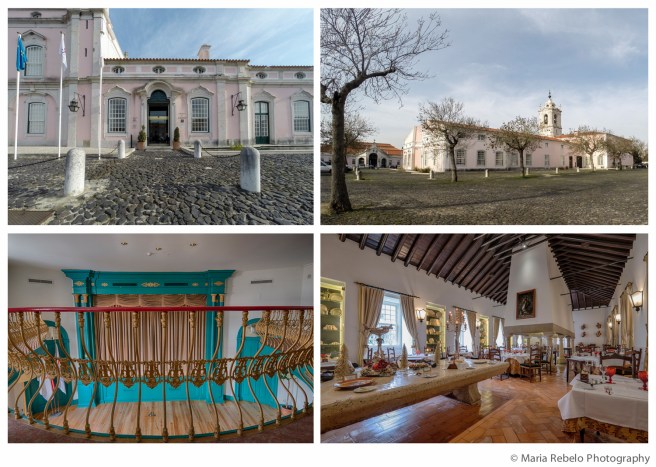
In 1995, the watch-tower building and the old palace kitchen were converted into an historical hotel called Pousada Dona Maria I.

If you’re planning to divide your time between Lisbon and Sintra, Queluz is a superb location. You can wake up in the morning to the singing of birds, enjoy a wonderful breakfast, and walk to the Queluz palace before other visitors crowd in. You can drive or take the train to Lisbon (12 km) or Sintra (16 km). And return in the evening to this enchanting place that preserves the romance and splendor of an age gone by.


The Pousada Dona Maria I is located at Largo do Palácio Nacional, Queluz, tel. 351 21 435 6158. Click here for the pousadas’ website and here for a large collection of photos of the hotel.

The Lisbon Pousada

PousadaLisboaLisbon has a wonderful new historical hotel: the Lisbon Pousada, located in the old royal-palace courtyard known as Terreiro do Paço.

Until the middle of the 18th century, ministers, nobles and other power brokers constantly stamped the soil of this courtyard with their footprints. But, after the 1755 earthquake destroyed the royal palace, the king moved to Ajuda and the courtyard lost its illustrious traffic.

In the 20th century, Terreiro do Paço regained its status as the walkway of power. The new hotel occupies the Ministry of Internal Affairs building. It was here that Salazar, the man who ruled Portugal from 1926 to 1970, had his office.

The pousada is decorated with numerous historical artifacts, including models for many of the statues that adorn the city. The rooms are elegant and comfortable with windows that frame beautiful views of downtown Lisbon: stucco buildings, ancient tiles, pink roofs, the walls of St. Jorge’s castle, and the northern margin of the Tagus river. Salazar’s old office is now a spacious bedroom suite.

It is said that in stressful times, Salazar avoided the main entrance of the building, using instead a discreet back door. This back door is now closed. Surrounded by elegance and comfort, pampered by the hotel’s well-trained staff, stress is the last thing on the mind of the guests of the Lisbon Pousada.

The Lisbon Pousada is located at 31, Praça do Comércio, tel. 351 21 040 7640. Click here for the pousadas’ website and here for a large collection of photos of the hotel.

A pink palace in the Algarve

358 - Pousada de Estói - @mariarebelophotography.comFIt takes a long time to build a beautiful palace. An Algarve aristocrat started in 1840 to build the Estoi palace in an estate near Faro. When he died, his son took over. But by 1893, the building was still unfinished and seemed destined to become a decorative ruin. It was then that a wealthy landowner bought the palace and spent a fortune on its completion. The sumptuous inauguration took place in May 1909. Decades later, the palace was abandoned.

In 2009, a century after its inauguration, Estoi opened once again, this time as a luxury historical hotel. It is a place out of a fairytale, its opulent salons and elegant gardens restored to their original glory.

Our stay at Estoi was an extraordinary experience. Some days, we relaxed by the pool and spent time admiring the statues, fountains and myriad of architectural details. Other days, we went to the beach and enjoyed the pleasures of the sea even more than usual. For we knew that when the day was done, we would have our pink palace to return to.

The Estoi palace is part of a network of historical hotels called Pousadas. Click here for the Pousadas’ website and here to see a large collection of photos of the palace.

The Seteais palace

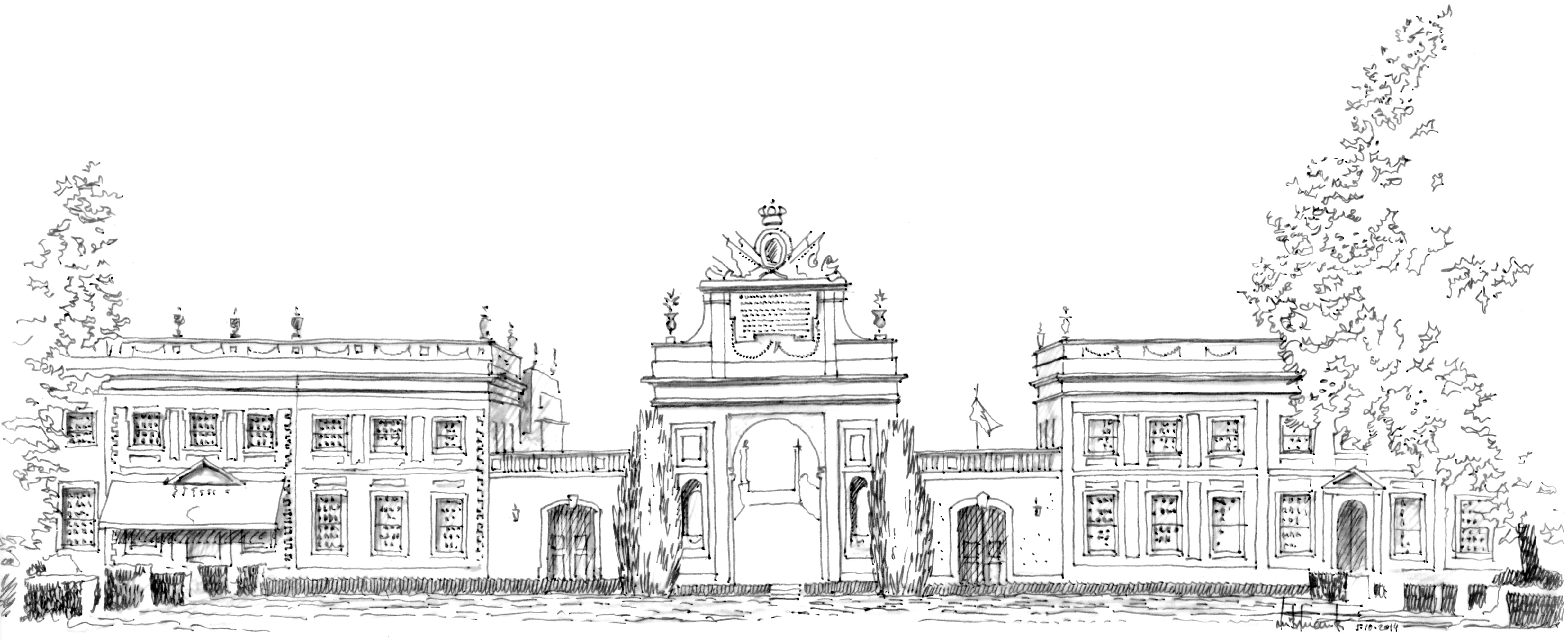
The Seteais Palace, Rui Barreiros Duarte, ink on paper, 2014.

Seteais means seven sighs, a name inspired, according to legend, by the romance between a Portuguese noble and a Moorish princess.

The Seteais palace was built in Sintra in 1787 by the Dutch consul and later sold to the wealthy Marquis of Marialva.

In 1954, the palace was converted into a luxury hotel. Booking a room at Seteais guarantees you’ll have a memorable experience. If you don’t stay at the hotel, you can still experience its unique atmosphere by visiting the elegant bar for a glass of white port before dinner.

In 1802, the Marquis of Marialva invited the Prince Regent, John IV and his wife for a visit. To celebrate the occasion, the Marquis built an archway decorated with busts of the royals. A Latin inscription praises the prince for his wisdom and prudence. No one could guess that five years later the Portuguese royal family would flee to Brazil to escape Napoleon’s troops.

The echoes of these twists and turns of Portuguese history have long faded. What remains, is one of the most romantic places in the world.

 Click here to see the Seteais Palace website.

On top of the world in Marvão

Marvão composit @

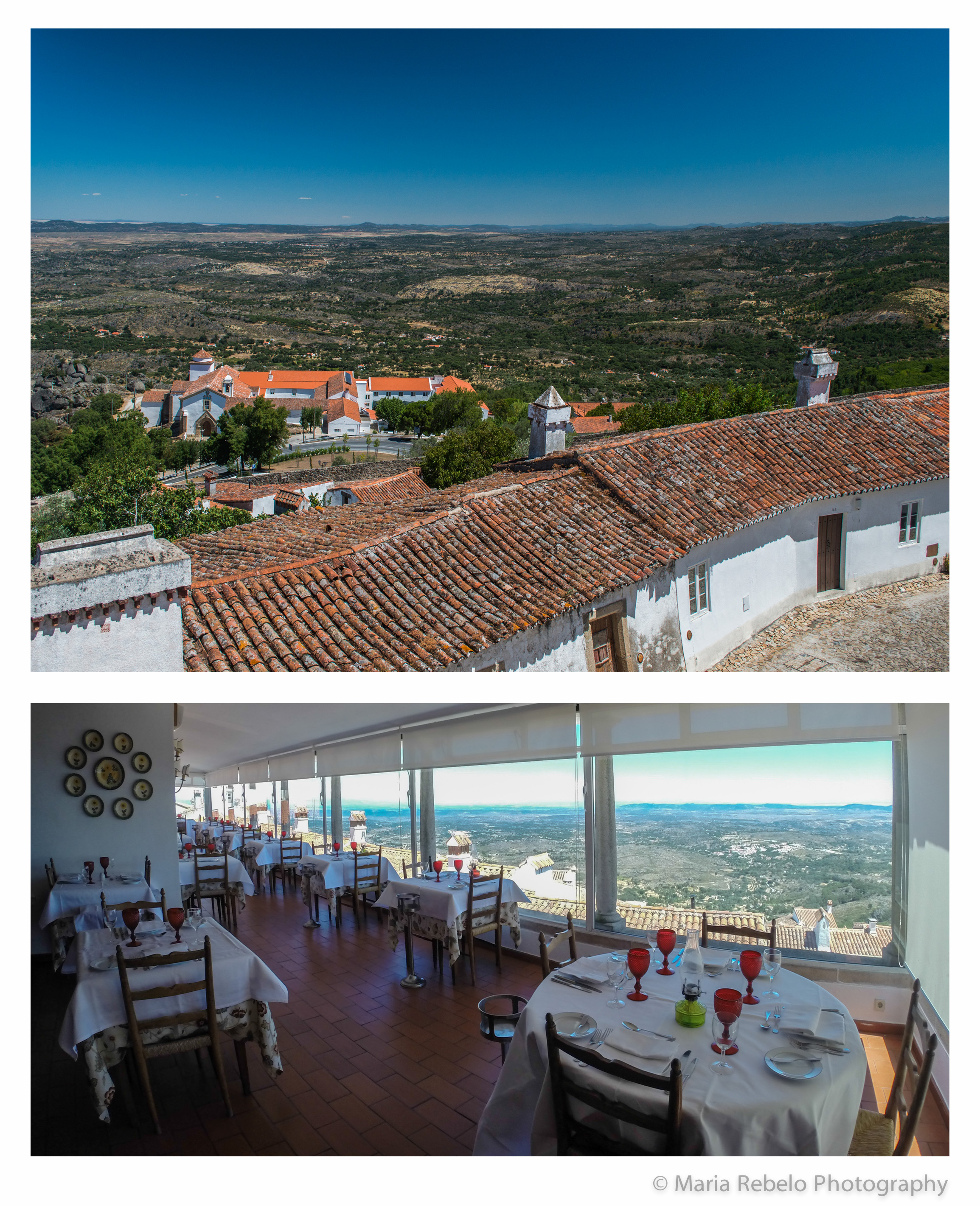
Some people climb the Kilimanjaro, others struggle to conquer the Himalayas. But you can feel on top of the world without hiring sherpas or buying oxygen masks. Simply drive to Marvão, a village on the São Mamede mountain, 834 km above sea level.

We spent the morning exploring the ancient castle and walking the beautiful narrow streets. After working up an healthy appetite, we walked to the Pousada for lunch. The view from the dining room is absolutely stunning.

The Pousada has some wonderful signature dishes, including codfish Santa Maria, partridge with 14 (partridge cooked with 14 ingredients), and shrimp Alentejo style. We asked chef Conceição Lourenço why codfish Santa Maria tastes so wonderfully unique. Her eyes smiled brightly for this is one of the culinary secrets she has guarded in her three decades as a chef. She confided that: “the codfish is cooked with flour made from a local mushroom; but that’s all I can say.”

We stayed for quite a while at the table mesmerized by the view. Seen from Marvão, the world below looks harmonious and the skies above divine.


Click here for the Pousadas’ website and here for more photos of Marvão.

The serene beauty of Flor da Rosa

DCIM102GOPRO

On the way to Flor da Rosa, a medieval castle converted into an historical hotel, we traveled through small villages lost in time and fields of cork and olive trees. Nothing prepared us for the sight of the castle standing proudly on the Alentejo plain.

The hotel has 24 rooms with beautiful views of the countryside and a swimming pool that overlooks the castle. The space is designed to offer guests great privacy. And the staff is so attentive that they made us feel like royalty.

The next morning, we woke up in luxurious silence, far from the cacophony of modern life. We relaxed by the pool until it was time for lunch. We then headed to the restaurant where we tried some wonderful renditions of the local gastronomy: purslane soup, fish in coriander sauce, and marinated rabbit. These courses were followed by cheese from Nisa and Serpa. Our taste buds were celebrating these amazing gifts from the shepherds of Alentejo when a sampling of desserts arrived. They had uncommon names like “sericaia” and “encharcada,” and rightly so for everyday words cannot begin to describe these sweet creations.

We had a great time sightseeing around Crato, the village where the hotel is located. In the late afternoon, the church bell reminded us that the sun would soon retire and that it was time to return to the castle. As we crossed the vaulted arches, we heard birds singing. These are the same sounds that were heard in the castle during the middle ages. Flor da Rosa is a precious time capsule that preserves the beauty of an age gone by.

Click here for the Pousadas’ website and here for more photos of Flor da Rosa.

Spending time at the Arraiolos Pousada

Arraiolos CompositWhen you need to rest your body and nurture your soul, there is no place like Alentejo. It is a land of great natural beauty, blessed by the sun and far from the concerns of daily life.

One of our favorite places in Alentejo is the Arraiolos Pousada, a 16th century monastery that was converted into a wonderful hotel.

There’s a lot to do in the vicinity of the Pousada. You can take horseback-riding lessons, visit wineries, shop for the famous Arraiolos rugs, or do some sightseeing. But it is also great to relax in the spacious balconies that overlook the countryside or to seat by the pool, enjoying the view of the perfectly-round Arraiolos castle.

When we first arrived at the Pousada, we walked to our room through a sequence of hallways of different sizes that took us from light to shade and then back to light. This walk felt like an initiation rite. And indeed it was. Our stay at Arraiolos was an introduction to the art of enjoying the passage of time. We now need to return to continue our apprenticeship.

Click here for the Pousadas’ website and here for more photos of the Arraiolos Pousada.

The place to be in Lisbon

Palácio Valle Flôr compositF©For the price of ordinary accommodations in London or Paris, you can stay in an extraordinary palace in Lisbon. It’s all thanks to José Dias, an entrepreneur who made a fortune producing cocoa to feed Europe’s insatiable appetite for chocolate. After many years of hard work on the island of São Tomé, Dias returned to Lisbon. He received the title of Marquis of Valle Flor and began the construction of a magnificent palace.

The Marquis bought land with breathtaking views of the Tagus river and hired architects to design a building with perfect proportions. He then decorated it with great refinement, commissioning elegant furniture, beautiful paintings, graceful sculptures, and radiant stained-glass windows. After its inauguration in 1915, the palace became a fashionable gathering place for the royal family, celebrities, and nobility.

With the death of the Marquis in 1932, the edifice entered a period of slow decay. To save this work of art from oblivion, Dionísio Pestana, a successful hotelier, bought the building in 1992 to convert it into a luxury hotel.

It took almost ten years to restore the edifice and equip it with modern comforts. The result is the Pestana Palace, a hotel favored by a long list of celebrities that includes Bill Clinton and Madonna. The Marquis of Valle Flor would surely love to see that his palace is, once again, the place to be in Lisbon.

The Pestana Palace is located at Rua Jau, 54, tel. 210401711 , email: guest@pestana.com. Click here for the hotel’s web site and here to see more photos of the palace.