The setting of the sun

sunset-at-areia-branca

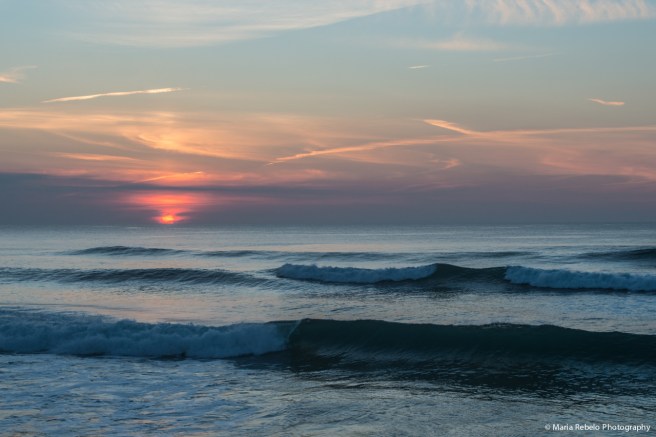
Yesterday the elements were tired after so many performances. The wind stayed at home but the waves came, dressed in white linen. The sun was in an orange garb brought from the far east. Seagulls danced to the roar of the waves while the sun kneeled in reverent prayer until the blue curtains were drawn.

Today a new season begins. We wish you a blissful New Year and we hope you’ll come see the spectacle of the sun setting on the Portuguese sea.

Tasting moscatel in Setúbal

composit-jmf

No one knows for sure how moscatel, a white grape from Egypt, arrived in the Setúbal peninsula, near Lisbon. What we know is that moscatel took to the region, producing wines that are perfect to start or end a meal. Over the years, the grape mutated into a new varietal—purple moscatel—that only exists in Setúbal. It is sweeter and more aromatic than its white cousin.

Moscatel wines are produced in the same way as port wine. The grapes are fermented for 4 or 5 days. The fermentation is then arrested before the yeast turns all the sugar into alcohol by adding “aguardente vínica” (brandy) to kill the yeast. The result is a fortified wine that is sweet and has 17 to 18 degrees of alcohol.

A great way to learn about moscatel is to visit José Maria da Fonseca’s winery in Azeitão. Founded in 1834 by a mathematician turned wine maker, it is one of the oldest wine companies in Portugal.

After one of his moscatel wines won a prestigious prize in Paris in 1855, Fonseca decided to export his wines to Brazil. A ship loaded with barrels of moscatel crossed the Atlantic. But the wine did not sell in Brazil and the ship returned with most of its original cargo. The sea voyage did wonders for the wine: in nine months the wine seemed to have aged 15 years, gaining complexity and depth. This moscatel, known as “torna viagem” (round trip), continues to be produced today with barrels carried by Sagres, a beautiful sailboat owned by the Portuguese navy.

José Maria da Fonseca ’s moscatel cellar contains bottles from every vintage since 1880 except for 1936-37 and 1939-40 when production was disrupted by the Spanish civil war and the Second World War, respectively.

It is great fun to do a blind tasting of moscatel wines at José Maria da Fonseca’s. Everybody has preconceptions about which wine will be their favorite. Some are sure they will favor the rarer purple moscatel or the older vintages. Others think that they will prefer the newer wines. Surprises abound. You will learn a lot about moscatel and a little about yourself.

Click here for information about visits to José Maria da Fonseca’s winery.


A faithful friend

OLYMPUS DIGITAL CAMERA

Portugal’s favorite fish does not swim in Portuguese waters. Since the 16th century, Portuguese fishermen have sailed to Newfoundland in search of gadus morhua, more commonly known as codfish. The French call the bland-tasting fresh cod “cabillaud” and the more appetizing salted cod “morue.” In Portugal this distinction is superfluous because only the salted variety is appreciated. So, one word suffices: “bacalhau.”

Since cod has very little fat, once it is cured in salt it keeps for a long time without becoming rancid. For this reason, dried codfish was often consumed by those who lived far from the coast in days of religious abstinence from meat like Christmas Eve.

The quality of the cod depends on the size of the fish (the larger the better) and the type of cure. To produce the best cod, the cure must begin on the boat, shortly after the fish is captured. This cure continues on land, usually in open-air pavilions. Lesser cod is stored frozen in the boat and cured only on land. Much of the codfish consumed in Portugal is cured in Ílhavo, a region with abundant sea salt.

Two popular sources of cod are Norway and Canada, but the best cod is caught in Iceland by Portuguese fishermen.

Before cooking, salted cod is soaked in water for two or three days to re-hydrate and remove most of the salt. The fish is then ready to be combined with symbiotic ingredients such as garlic, potatoes and olive oil.

The commerce of “bacalhau” is so important that there’s a whole street in Lisbon, Rua dos Bacalhoeiros, that was once reserved for codfish vendors.

In good times and bad, the Portuguese gather at the table to share this fish we call “fiel amigo” (faithful friend). It is a delicacy that comes from afar but has the taste of home.

Lisbon wakes up

rbd_praca-do-rossio_lisboa_peq-c
Rossio, Rui Barreiros Duarte, ink on paper, December 2016.

We envy the early risers. They see Lisbon wake up, dress in pale blue light, put on a cinnamon fragrance and get ready to enchant its visitors.


We’re often asked about the drawings used on our blog. They’re the work of architect Rui Barreiros Duarte. For the first time, he’s selling a few original drawings like the one on this post. The sizes are around 60 cm x 40 cm and the prices around 200 euros. If you’re interested, email apprbd@gmail.com .

Eating with the best people in Vila Real

OLYMPUS DIGITAL CAMERA

“I’m sorry, but we cannot accommodate you. We won’t have a free table any time soon,” said Eleutério Lameirão in a serious tone that agrees with his solemn name. His small restaurant, located in a residential area of Vila Real, was full of regular customers.

Before we left, we took a glance at the menu and found a quote by Julia Child: “People who love to eat are always the best people.” Inspired by this quote, we decided to wait. Eleutério gave us a puzzled look, but fifteen minutes later he had a table for us.

We ordered rissois, fried breaded dough shaped like a half moon with a shrimp or meat filling. Eleutério brought them to the table and waited around to see our reaction. They were crispy on the outside and full of flavor on the inside.  When we said “wow, these are amazing!” Eleutétio abandoned his shy demeanor and smiled, pleased by our reaction. He went back into the kitchen and brought us a plate of codfish cakes. These were also extraordinary: light, airy and slightly crunchy, a four-part harmony of cod, parsley, egg, and potato.

Finally, we had small sardines called “petingas,” incredibly fresh, fried and seasoned to perfection. They came with an hearty bean rice that melted in the mouth and blended with the salty sardines.

The restaurant was still very busy but Eleutério came to chat with us. He told us that the menu is always small, three or four items made with the best fresh ingredients and modestly priced. The recipes have been refined over many years and require great attention to detail. “It is hard work because there’s no room for distractions. Everything has to be right, the timing, the temperature, the seasoning. But it is worth it because when everything is right the taste is amazing,” he said. If you ever have the privilege of eating at O Lameirão, we think you’ll agree.

The restaurant O Lameirão is located on Rua da Cruz, Vila Real, tel. 259 346 881.

Perfection at Adraga

Composit Adraga.JPG

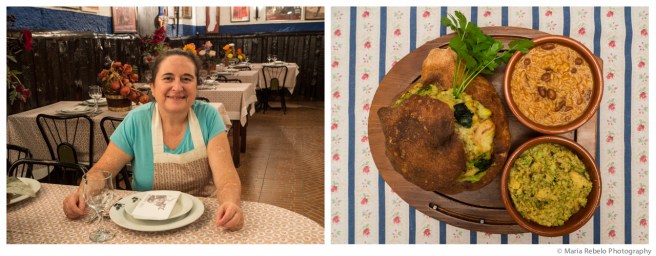
When we were very young, our parents used to take us to an idyllic beach with crystal blue waters and natural rock archways sculpted by the sea. In the end of the afternoon, we often had dinner in a small restaurant right on the beach.  It was simple fare: “percebes” (gooseneck barnacles), grilled fish, and salad. But the flavor and aromas were amazing and so was the spectacle of the sun setting on the ocean. We forgot the name of the beach and that is just as well, for places change and fail to live up to our memories of them.

During a visit to Sintra this summer, we decided to have lunch in the nearby Adraga beach. As soon as we arrived, we realized that this was the beach from our childhood!  There were little kids playing in the same rock archways we once loved and bathing in the same blue waters we so much enjoyed.

We sat at the beachside restaurant and ordered “percebes,” grilled fish, and salad. We kept our expectations low. Surely, the food has changed. Then the seafood and fish arrived, fresh, full of flavor, meticulously prepared. It was as if we were going back in time, to a simplicity and authenticity that are so rare today.

We complimented Jorge Pimenta and his mother Suzette, the restaurant owners, on the quality of their food. They responded with modesty: “Everything we do is simple but we try to do it well.  The percebes were caught this morning right on the beach. The fish is very fresh. All we do is respect the ingredients that the sea brings to us.”

The reasonably-priced wine list has many great choices. But in a restaurant where everything is local, it makes sense to drink the magical wine produced nearby in Casal de Santa Maria by a Russian Baron who is 103 years old.

The same family has owned the Restaurante da Adraga for four generations. In the beginning of the 20th century, queen Dona Amélia used to come here to eat fish while the king hunted in the Sintra mountain. One century later, the Adraga restaurant continues to delight anyone who loves great food, whether or not they have royal blood.

Restaurante da Adraga is located at Praia da Adraga, 143, Sintra, tel. 219280028. Reservations are a must. Ask for a table near the windows facing the beach for a spectacular view.

Sweet temptations in Sintra

OLYMPUS DIGITAL CAMERA
Sintra queijadas from Pastelaria Gregório

The road to Sintra is paved with sweet temptations. We stopped for a coffee at Pastelaria Gregório and couldn’t resist eating one of their travesseiros (pillows). They were still warm, the layers of dough fusing with the rich almond cream. Our palates were so delighted that we asked for a queijada, another classic Sintra pastry. A plate with several miniature queijadas arrived and, although we tried, it was impossible to eat only one.

Gregório Ribeiro started producing and selling these wonderful queijadas in 1890. The business continues to be in the family. Gregório’s great-grandchildren work at the pastry store, making sure that the quality is exceptional, baking the pastries in small batches so that everything is fresh out of the oven.

There was a constant flow of regular customers who came in for their favorite sweet treats: almond tarts, bolos de amor (love cakes), broas de mel (honey cakes), and much more. We asked Teresa Matos, the owner of Pastelaria Gregório, whether they’re always this busy.

“Christmas is our toughest season,” she answered. “Customers love our traditional Bolo Rei (king’s cake) so there’s always a long line outside the store. We know it’s frustrating to wait for so long to buy our cake. But we don’t want to bake the cakes in advance because they lose their freshness.”

“Is the cake really worth the wait?” we asked. “You need to decide for yourself,” said Teresa with a mischievous smile. In December we’ll be waiting in line to find out.

Pastelaria Gregório is located at Av. D. Francisco de Almeida 33/35 in Sintra, tel. 219-232-733.


Wine heritage at Sanguinhal

composit-quinta-do-sanguinhal

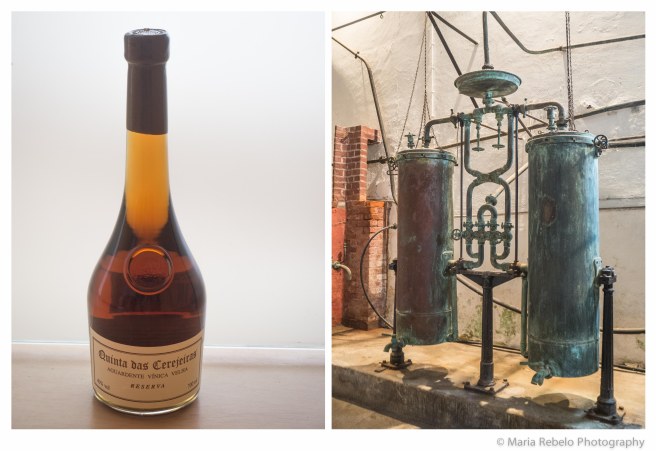
The Quinta das Cerejeiras Reserva is a smooth, beguiling red wine that has enlivened many of our dinner parties. So, it was with great anticipation that we drove to Bombarral, 70 km north of Lisbon, to meet the producer of this precious nectar.

We were received by Ana Reis. She is the great-granddaughter of a wine legend: Abel Pereira da Fonseca who, early in the 20th century, owned more than 100 taverns in Lisbon. In 1926, Pereira da Fonseca bought three estates in Bombarral (Sanguinhal, Cerejeiras and São Francisco) to venture into wine production. Almost a century later, these “quintas” remain in his family, producing wines that every year earn more accolades and awards.

Bombarral is the Napa valley of Portugal, a region near the ocean with exceptional conditions for wine production. The soils have a high clay content and the Montejunto mountain joins forces with the Atlantic breezes to create a microclimate with mild summers and temperate winters.

We started our tour in the shade of an old cork tree to learn about the production of cork in Portugal. Then, we stepped into the wine cellar. The temperature was a few degrees lower and the air was perfumed with voluptuous aromas. The ancient oak barrels are full of precious brandies and fortified wines. Produced decades ago, they wait in the dark for the perfect moment to be brought to light. “This is barrel #6, we’ll later try some of its content,” promised Ana with a twinkle in her eyes.

Next, we visited the distillery, the place where the magical “aguardente” (fire water) was once produced. Grapes were crushed and distilled to make brandy (“aguardente vínica”). The stems and remnants from brandy production were then distilled to make “aguardente bagaceira,” which is what Italians call grappa. Nothing was wasted: the leftovers from this second distilling were used to fertilize the land.

We toured the vineyards near the house which are planted with muscatel grapes. There is a rose bush in every row. Roses are very sensitive to diseases like mildew, so they give advanced warning of any problems that might affect the grapes.

The quinta is full of memories of times gone by: ancient mulberry trees whose leaves were once used to make silk, a romantic 19th-century garden, old vines with varietals like carignan, brought by French peasants during the Napoleonic invasions.

Our final stop was the “adega,” the place where the wines from the three quintas were produced until 1960. It has large stone tanks and wooden presses built in 1871. We sat at a table, sampling Portuguese cheeses and sausages while listening to Ana speak with eloquence and passion about the secrets of wine making.

There was a treasure trove of wines for us to try. The feast started with Sottal, a flirtatious, light aromatic wine made with muscatel grapes. Next, we tried the Cerejeira Seleccionado Rosé, a perfect Summer companion, fruity, full bodied with a gorgeous color. Things got serious with the 1998 Quinta do Sanguinhal DOC, a wine of great depth and charm. We then fell in love with the white Quinta da Cerejeira Reserva. After a 40-year hiatus, this wine, made with chardonnay and aged in oak, was brought back into production two years ago. Its smooth, elegant flavors left our palates in a state of bliss.

After trying several other interesting wines, we tasted the content of barrel #6, a Quinta de São Francisco licoroso. It is a sweet, fortified wine with great complexity, the perfect ending to a perfect wine tasting.

The great poet Fernando Pessoa made a living as a translator. In the middle of the afternoon he would often take a break and tell his workmates he was going to see Abel. He then walked to one of Abel Pereira da Fonseca’s taverns to enjoy a glass of wine.

The wines from Sanguinhal, Cerejeiras and São Francisco inspire conversation, friendship and, if you’re lucky, immortal poetry.

Click here for information on how to book a visit or a wine tasting at Quinta do Sanguinhal.