O Cantinho do Avillez

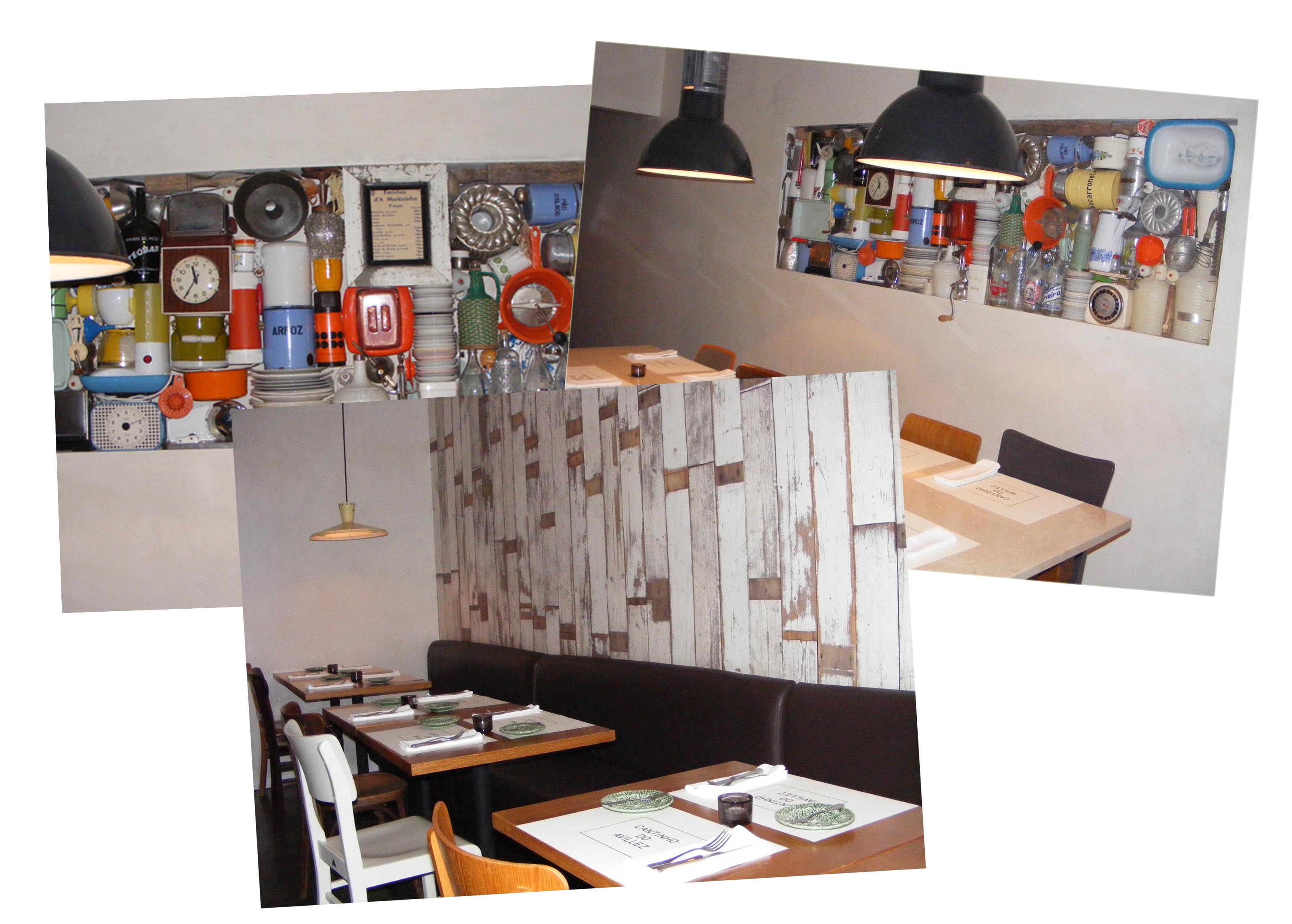
This small restaurant near Chiado has a funky, bohemian décor that makes it look like a theater set. The servers, all implausibly good looking and articulate, are clearly trained actors.

Chef José Avillez directs this food theater. He has great credentials, having apprenticed with Alain Ducasse and Ferran Adrià. Here he cooks traditional fare with original variations that create new layers of taste.

It is difficult to choose from the menu because everything is so delicious. There is vegetable tempura that is crunchy and crisp, savory partridge turnovers with an intense, gamey flavor, homemade canned tuna with a pungent mayonnaise of ginger and lime, sautéed chicken liver and grapes perfumed with Port wine, and so much more.

When you leave O Cantinho you feel like you’ve just seen a wonderful play that you would love to see again.

Rua dos Duques de Bragança, 7, Lisboa, tel. 21-199-2369. Click here for the restaurant’s website. Reservations are a must.

Fernando Pessoa

Fernando Pessoa, Rui Barreiros Duarte, ink on paper, 2012.

It is not easy to write about the great poet Fernando Pessoa. Even if we weight every syllable, our words are still too heavy to describe his graceful prose and sublime rhyme. So, perhaps we should stick to the facts.

Pessoa was born in Lisbon in 1888. His father, a journalist, died when he was young. His mother remarried and moved to Durban, South Africa, where Pessoa received a British education.

After returning to Lisbon in 1905, Pessoa earned a modest living making translations and writing business letters. He published poems, essays and literary criticism, but remained unknown during his lifetime.

Many of his poems were written in coffee shops, at Brasileira in Chiado or in Terreiro do Passo’s Martinho da Arcada. He wrote under different identities, each with its own personality and distinctive style. Some say that Pessoa and his four major pen names, Álvaro de Campos, Ricardo Reis, Alberto Caeiro, and Bernardo Soares are the five finest Portuguese poets.

Pessoa died in 1935, at age 47, one year after publishing his first major book, The Message. He left a literary treasure trove: a trunk full of poetry and prose, including The Book of Disquiet, which, published in 1982, created a new wave of interest in the poet.

Reading Pessoa can change your life, at least that’s what happened to the Italian writer Antonio Tabucchi. A chance encounter with Pessoa’s poem “A Tabacaria” (The Tobacco Shop) made him fall in love with the poet’s work and with the language and culture of Portugal.

Here are the first lines of “A Tabacaria” translated by Richard Zenith. Read them at your own peril.

“I’m nothing.
I’ll always be nothing.
I can’t want to be something.
But I have in me all the dreams of the world.”


Pêra Manca

Pêra Manca is a cult wine produced near Évora, in Alentejo. It has a long pedigree that is intertwined with the history of Portugal. Pedro Álvares Cabral took bottles of Pêra Manca in the voyage that resulted in the discovery of Brazil, in 1500. The wine continued to gather fame, wining gold medals in Bordeaux in 1879 and 1898, but its production ended with the death of the vineyard’s owner in 1920.

In 1990 the Eugénio de Almeida Foundation resumed the production of Pêra Manca, aging the wine in the cellar of a 1580 Jesuit monastery. Francisco Colaço do Rosário, an enologist who did a groundbreaking study of the Alentejo varietals, selected an old vineyard for this project.

The white Pêra Manca is made with Antão Vaz and Arinto grapes. The red Pêra Manca is made with Trincadeira and Aragonês grapes and it is produced only in exceptional years.

It is a wonderful wine for a special occasion. After all, it was good enough to celebrate the discovery of Brazil.

Click here for the Eugénio de Almeida Foundation Cartuxa winery website.

Learning how to surf

Neptune rode the seas on a copper chariot. Surfers make do with much less, gliding the waves on their slender boards. Portugal is a great place to learn the art of surfing. There are many beaches with dependable, tubular waves, and schools that provide instruction, equipment, and lodging. Every year, hundreds of visitors arrive in Portugal as ordinary humans and leave transformed into gods of the waves, ready to challenge Neptune to a race.

The poetry of flying

TAP, Portugal’s national airline, is not immune to the cost cutting pressures common to the industry.  But it has a new fleet of large, confortable Airbus airplanes and it is promoting a warm attitude that you can feel in this music video that gathers the Portuguese Mariza, the Angolan Paulo Flores, and the Brazilian Roberta Sá.

When you set foot on a TP flight, you are already in Portugal and magical moments can happen. On a recent flight, a passenger was about to fill a glass with water from a bottle sitting on the counter in the kitchen area. A stewardess quickly intervened saying, “that is my bottle, let me open one for you.” Then, to ease the awkwardness of the moment, she pointed to her bottle and said: “I kissed that water; if you drank it you would learn all my secrets.” Any airline can get you from here to there, handle baggage, count frequent-flyer miles. But which other airline provides such spontaneous moments of poetry?

Pasteis de Belém

When you land in the Lisbon airport, there’s a heightened anticipation for what comes next. There’s the usual ritual of waiting in line, searching for your luggage, going through customs, all transforming you from in transit to landed. But here, arriving isn’t the best part. You drive out of the airport towards the river Tagus. As you get close, you first see the seagulls. Then, you see the Tower of Belém and the Jerónimos Monastery, monuments to the many “caravelas” that departed from a nearby dock. A marble Henry the Navigator leads a pack of explorers, pointing the way to the new world. But that’s not why you came here. You came here for a small pastry shop just down the road.

In 1834, the government closed down all Portuguese convents and monasteries. The friars of the Jerónimos Monastery needed a source of income. So, like other religious orders in Portugal, they used their ancient recipes to make pastries for sale. The Jerónimos monks made little cups of flaky pastry dough filled with custard and topped with cinnamon. All monastery pastries are delicious, but these “pasteis de Belém” are a piece of heaven. The recipe hasn’t changed since the pastry shop opened in 1837, and everything about it is shrouded in mystery. Only three master patissiers, who prepare the cream and dough in the “Oficina do Segredo” (secret workshop), know the recipe.

These pastries are ephemeral bites of cinnamon and warmth. They must be eaten right away, never saved for later. Every coffee shop in Portugal produces an imitation, but none quite captures the lightness of the dough, the creaminess of the filling. These imitations even bear a different name: “pasteis de nata.” Because there is only one place in the world where you can get “pasteis de Belém.”

Antiga Confeitaria de Belém, Rua de Belém, 84-92, Lisbon. Tel. 21-363-7423. Email: pasteisdebelem@pasteisdebelem.pt. Click here for website.

The perfect espresso cups

Coffee lovers are on a constant search for aromatic coffee beans, roasted to perfection. They get up early on weekends to study Italian, hoping to uncover the nuances lost in the translation of their espresso-machine manual. They mumble incantations like “ruotare la manopola in senso antiorario per aprire il rubinetto di erogazione vapore” with a passion normally reserved for the poetry of Dante. They listen in rapture to the machine’s rumbles as the water rushes through the coffee at the ideal pressure.

But, after all this effort, they pour their brew into bulky, thick porcelain cups. European cafés use these cups, they tell you with pride. True, but cafés only use them because they rarely break. The coffee tastes so much better in thin coffee cups!

Vista Alegre, the great Portuguese porcelain maker, produces the best espresso cups we have ever tried.  They have the perfect shape and come in bright, joyful colors. These cups are hard to find outside of Portugal. So, if you are visiting Portugal, here’s your chance to bring something unique to your java friends.

Here is a link to the Vista Alegre website.

The Portuguese house

Raul Lino is a Portuguese architect who was influential in the first half of the 20th century. In an era shattered by two World Wars and the Great Depression, Lino craved the stability and permanence that he associated with tradition. He codified this tradition, inherited from the Romans and adapted throughout the centuries, creating the archetypal Portuguese house. Using stone, brick, and terracotta roof tiles, he designed homes that infused the vernacular architecture with proportion and elegance. Some felt that Lino should have looked forward instead of backwards, adopting the modernism of Le Corbusier and Mies van der Rohe. But, by embracing the past, he helped preserve the sense of place that we feel when we see a Portuguese house.

In 1912, Raul Lino built a private residence for his family, the “Casa do Cipreste” in Sintra. It is perched on a hill, overlooking the Sintra Palace. Thanks to the blog of Rui Morais de Sousa, a virtuoso of large-format photography, we can visit this graceful home with just the click of a mouse (here). What a privilege!

Arraiolos

Medieval Arraiolos, Maria Rebelo, gelatin silver print, 2003.

Arraiolos is a picturesque Alentejo village with traditional whitewashed houses and an oval-shaped castle built in 1305.

The town is famous for the production of beautiful needlework rugs. It is also known for the story of an indecisive bride. With her wedding about to start, she could not decide what to wear. She kept hesitating while the guests waited … for two weeks! In the end, she chose to wear only a shepherd’s mantle.

It was well worth the wait to see this Arraiolos bride discover that “less is more” centuries before Mies van der Rohe.

Reverso’s jewels

“Verso” means rhyme. “Reverso” means the other side. Portugal has a long jewelry tradition. At Reverso you see the other side: the work of contemporary jewelers, not just from Portugal but from all over the world. Many of these pieces are quite affordable. Their value is not measured in ounces and carats but in originality and creativity. Paula Crespo, Reverso’s owner, loves to show her work and that of other artists. And she makes Reverso rhyme with elegance.

Galeria Reverso, Rua da Esperança, nº 59/61, 1200 – 655 Lisboa, Tel. 213 951 407, mail@reversodasbernardas.com, click here for website.