If you’re a foodie, few pleasures in Portugal rival a visit to a farmers’ market. On the Saturday before Christmas, we stopped by the market in Régua, and it was a delight.
The town’s full name is Peso da Régua. Peso, meaning “weight,” likely refers to the role the town assumed after the Marquis of Pombal demarcated the Douro region in 1756: a logistical hub where wine and other goods were weighed before beginning their journey downriver. Régua, meaning “ruler,” describes the way the town stretches along the banks of the Douro, long and narrow, following the river’s course.
Régua welcomes visitors through an elegant iron bridge, inaugurated in 1872, but much of the surrounding architecture fails to do justice to the valley’s natural beauty. Still, there is an undeniable authenticity to the place and to its people.
We went to the Régua market in search of a local delicacy called falachas, a sweet biscuit made from chestnut flour. We were told, regretfully, that these small culinary miracles appear at the market only on Wednesdays. But there were other blessings. Stalls overflowed with apples—including the celebrated Bravo de Esmolfe and a lesser-known variety called Porta da Loja. There were cabbages of many shapes and forms, piles of chestnuts, dried figs, and walnuts. At the center of the market, a large stall tempted passersby with sausages and cured hams (presuntos). Near the entrance, a baker displayed baskets filled to the brim with bread: loaves made from white or yellow corn, golden olive-oil breads, and bola de carne, bread generously stuffed with meat or sausage.
What makes the market special, though, are the vendors themselves, warm, genuine, and quietly persuasive. “Try our delicious figs,” says one. “We dust them lightly with white flour so they stay soft and don’t stick together.” “Taste these walnuts,” urges another vendor. “They’re from a nearby farm. A woman’s been looking after the trees her whole life. She only gets about six hundred kilos, but they’re really great. We’re lucky to have them.”
In this holiday season, it is a rare gift to taste the fruits produced by people who devote their lives to caring for the land. We are fortunate to have them!
António Magalhães closed his lecture on the Douro’s grape varieties with a provocative question: “But who can hope to understand so many grapes without tasting Port?”
Port wine is the ultimate expression of the vineyards of the Douro Valley. As scholar Alfredo Guerra Tenreiro famously observed, “There is a uniqueness in the Douro climate that one can recognize and feel in the uniqueness of Port wine.”
Here are António’s recommendations for enjoying Port wine at its best.
Five Golden Rules
1) Choose the proper glass A classic white wine glass made of thin glass is ideal for Port. It lifts the aromas, focuses the flavors, and makes every sip a celebration.
2) Serve Port properly chilled The ideal serving temperatures for each style of Port are: • White Ports: 6–10 °C (43–50 °F) • Tawnies: 10–12 °C (50–54 °F) • Rubies: 12–16 °C (54–61 °F)
Once opened, White Ports and Tawnies should be stored in the refrigerator door. Ruby Ports, especially Vintage Ports, are best enjoyed soon after the cork is pulled.
The British have a tradition of passing the Vintage Port bottle or decanter from right to left, keeping it in motion. If someone forgets, the other guests often ask, “Do you know the Bishop of Norwich?”—a nod to Henry Bathurst, the early-19th-century bishop known for dozing off at dinner and neglecting to pass the Port.
3) Keep a 20-Year-Old Tawny in the refrigerator Tawnies are generally crafted from wines of various harvests, aged patiently in oak casks until the perfect moment for blending and bottling. A 20-year-old Tawny brings together wines with a weighted average age of twenty years, creating an alchemy of time and winemaking artistry. António’s longtime favorite is the magnificent Taylor’s 20-Year-Old Tawny Port.
4) Always decant Vintage and Crusted Ports Vintage Ports are bottled without filtration, which allows them to continue evolving in the bottle. Over time, sediment naturally accumulates. Decanting separates the clear wine from this sediment—harmless, yet coarse and unwelcome in the glass. It also allows the wine to breathe, letting oxygen gently soften its structure and release its full array of aromas.
When Port was shipped in barrels, British merchants crafted Crusted Ports by blending more than one Vintage, aging the wines in large wooden vats, and bottling them unfiltered for cellaring. After Portugal banned bulk exports of Vintage Port in 1974 (extended to all Ports in 1997), this style became rare. Today, only a few houses, like Fonseca, continue the tradition. Like Vintage Ports, Crusted Ports develop a natural “crust” as they mature and should always be decanted before serving.
5) Port is to be shared Port invites conversation and brings out sincerity. Violette Toussaint, the unforgettable protagonist of Valérie Perrin’s Fresh Water for Flowers, put it best: “My port wine has the same effect on everyone. It acts like a truth serum.”
How to Decant a Vintage or Crusted Port at Home
The day before serving, select the bottle you wish to open and stand it upright so the sediment can settle at the bottom. Leave it somewhere convenient—on a sideboard or on the kitchen counter.
Use a suitable corkscrew; a two-pronged cork puller is ideal for opening older bottles, whose corks are often fragile. Once opened, pour the wine slowly into a decanter or glass jug.
Strain the wine through a small flannel filter to ensure perfect clarity. Take a moment to taste the wine and enjoy that first impression.
Rinse the bottle and let it drain completely. Return the decanted wine to the original bottle. Keep the bottle in a cool place and check the temperature before bringing it to the table. If needed, a brief rest, fifteen minutes or so, in the refrigerator door will bring it to the ideal 16–18 ºC, with the higher end recommended for older Ports.
Magical Pairings
White Port
White Port is typically enjoyed as an aperitif and is made in a range of styles, from extra-dry to sweet. Even the sweeter versions remain balanced and never feel cloying on the palate.
There are two production approaches: oxidative and non-oxidative. In the non-oxidative style, winemakers shield the wine from oxygen to preserve its vibrancy. These Ports are bright and citrusy, ideal for the popular Port Tonic cocktail.
In contrast, the oxidative school relies on controlled exposure to air. Depending on the winemaker’s approach, this exposure may begin during fermentation and continue throughout aging in wooden vessels ranging from small casks to larger vats such as toneis and balseiros. Over time, this gentle oxidation deepens the wine’s character, imparting a golden hue and nuanced layers of nuts, caramel, butterscotch, and dried fruits.
António favors the oxidative style. His preferred White Ports, both made from blends that include Malvasia Fina, are the Fonseca Guimaraes Siroco—crisp and extra-dry—and the Ramos Pinto Finest White Reserve, which offers a discreet, delicate sweetness.
White Port pairs beautifully with toasted almonds, especially those from the Douro Superior, and with codfish cakes. It also harmonizes with soft-ripened cheeses, lending a bright acidity that lifts their richness.
Tawny Port
Tawnies pair blissfully with sweet desserts. In the Douro Valley, they are often served with crème brûlée—torched before serving—or almond tart. Egg pudding and Tawny Port are made for each other; tradition even calls for two glasses of Port instead of one: the first to honor the pudding, and the second to toast the cook who prepared it.
Another indulgence that pairs perfectly with Tawny Port is Toucinho do Céu (bacon from heaven), a convent sweet made with almonds, egg yolks, sugar, and a touch of lard that lends a soft, velvety texture. Murça, near Vila Real, is renowned for the version created at the Santa Maria Monastery and now made by Casa das Queijadas e Toucinho do Céu. The town is also celebrated for the vineyards that surround it, which produce some of the Douro’s finest white grapes—coveted by both Port and DOC Douro winemakers.
Tawnies also shine alongside nuts, dried fruit, or simply on their own, paired only with the quiet luxury of time and good conversation.
Ruby Port
Ruby Ports are excellent companions for cured cheeses. Portugal offers a rich array of these cheeses from regions such as the Estrela Mountain near Seia, Serpa in Alentejo, Azeitão near Lisbon, and São Jorge in the Azores.
English Port merchants traditionally pair Ruby Ports, particularly Vintage Ports, with Stilton cheese. Vintage Port is made only in exceptional years, aged in wood for one or two winters, and then bottled to mature slowly and majestically.
For an unforgettable experience, seek out the Vintage Vargellas Vinhas Velhas 2004, crafted in a superb year from a field blend of vines planted soon after phylloxera. António believes old vineyards like the one that produces this wine hold the key to understanding the future of viticulture in the Douro Valley.
Late Bottled Vintage (LBV)
António enjoys pairing LBVs (rubies aged four to six years in oak and then bottled), with chocolate mousse. His favorite mousse replaces butter with extra-virgin olive oil from the Douro Valley. He generously shares his recipe below.
Mousse de Perdição (Sinful Chocolate Mousse)
Ingredients • 150 g dark chocolate (70% cocoa) • 100 ml extra-virgin olive oil (preferably from the olive groves that frame Douro vineyards) • 5 tablespoons sugar • 4 eggs, with yolks and whites separated
Instructions
1. Melt the chocolate Break the chocolate into small pieces and melt gently in a bain-marie or in short microwave intervals. Allow it to cool slightly.
2. Add the olive oil Whisk in the olive oil until the mixture is smooth and glossy.
3. Prepare the yolks Beat the egg yolks with the sugar until pale and creamy. Fold into the chocolate mixture.
4. Whip the egg whites Beat the whites until firm peaks form, then gently fold them into the chocolate base, preserving as much lightness as possible.
5. Chill Spoon into serving cups or a single bowl. Refrigerate for at least 3 hours, ideally overnight.
Dining at Ceia is always a singular experience, but even more so when shared with the legendary Brazilian chef Alex Atala, seated humbly among the guests as if he were a mere mortal.
Lisbon’s most elegant table was adorned with the bark of a cork tree, harvested on the thirtieth anniversary of its growth. Draped in moss, mushrooms, and delicate flowers, it set the stage for a menu designed by chef Renato Bonfim and inspired by Hieronymus Bosch’s Garden of Earthly Delights.
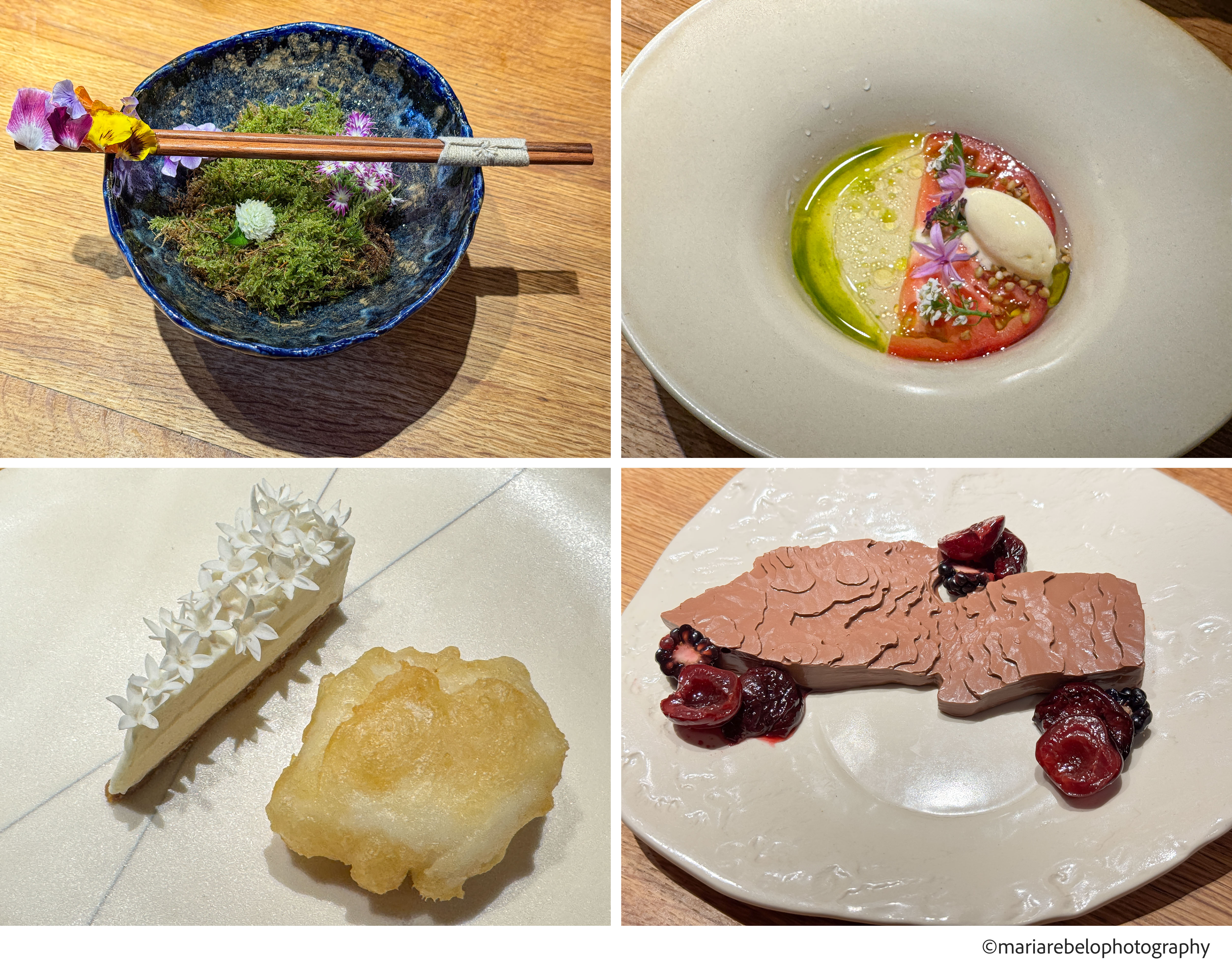
The meal began with a whisper—an ethereal broth of ginger and algae, offering no hint of the wonders to come. A bowl soon appeared, strewn with moss and topped with chopsticks decorated with flowers. Nestled beneath the blossoms was a sublime tartare of carabineiros, the crimson prawns of the Algarve. “I was trained as a Bocusian,” Atala said, referring to Paul Bocuse, the patriarch of nouvelle cuisine. “I expect the food to be on the plate, but here, the food is beyond the plate.” A joyful Blanc de Noirs from Bairrada, fittingly named Dinamite, kept us good company.
Then came Water: a delicious composition of tomato, coriander oil, and a sorbet of toasted bread and garlic. Kristin Liebold, the gracious maître d’, poured glasses of Tepache she had crafted herself—a lightly fermented pineapple elixir that brightened the palate.
Another delight soon followed: slices of savory garlic cheesecake, adorned with white blossoms, served with perfectly fried hake from the Azores. The fish was prepared in a traditional style: marinated in milk, lemon, salt, and pepper, then delicately fried in tempura batter.
Atala reflected on how his time in Italy had taught him the importance of simplicity and repetition in dishes like fried fish. “Every Sunday, the mother cooks for the family,” he said, “but when the nonna (grandmother) prepares the same dish, it becomes a feast. The ingredients don’t change—but the nonna brings a deeper understanding, born of repetition and a lifetime of attention to detail.”
An exquisite wine, whimsically called Viagem ao Princípio do Mundo (journey to the beginning of the world), filled our glasses. It is made with Alvarinho grapes grown in Melgaço and aged in sherry casks.
We were then invited into the garden, where, under flickering candlelight, oysters from Setúbal arrived dressed in spinach and algae, gently cooked in a Bulhão Pato style. Atala spoke about the importance of authenticity and of how this dish marries local ingredients and time-honored techniques with a sense of modernity.
Back in the dining room, the next course arrived: cordyceps mushrooms cleverly disguised as pasta. They were glazed in aged balsamic and served with a warm, buttery brioche, the perfect partner to their umami taste. A luminous white wine from António Madeira in the Dão lent the moment a festive air.
The final savory dish was a richly flavored wild boar terrine, served with oven-cooked rice and bread made from roasted quiabos (okra).
Dessert began with a leche de tigre jelly, adorned with nasturtiums and elderflower. Then came a mousse sculpted in the shape of Silent Living’s Herdade no Tempo, the estate that supplied much of the pristine produce featured throughout the meal. The mousse was encircled by an orchestra of cherries: fresh, roasted, and infused with lemon.
A 2000 vintage Port crowned an unforgettable meal that Renato Bonfim and his youthful brigade cooked for Alex Atala, a philosopher-chef who sees food in its fullness: as ingredient and craft, as joy and communion.
Ceia is located at Campo de Santa Clara, 128. Lisbon. Click here for the restaurant’s website.
Albricoque, a quaint word for apricot used in the Algarve, is a great name for a Lisbon restaurant that blends the old with the new. The space is old; it opened in 1905 as a tavern for travelers from the nearby Santa Apolónia train station. The food is rooted in the traditional culinary vocabulary of the Algarve, the birth place of Albricoque’s chef, Bertílio Gomes. But the approach to food and service is new. Every recipe has been refined to make it more appealing. The character of the restaurant, imparted by features such as the original floor paved with hydraulic tiles, was preserved. But modern amenities, unthinkable in 1905, have been added.
Everything on the menu is delicious. Our meal began with a plate of olives that tasted like sausage because of the way in which they were fermented. There was also a salad made with the purple carrots that were common in the Algarve in old times. Then, the feast continued: savory muxama (cured tuna), plump oysters from Ria Formosa, crispy rissois de berbigão (cockle turnovers), silky alhada de raia (manta ray with garlic), extraordinary marinated carapau (horse mackerel) combined with figs and toasted almonds and served on shinzo leafs.
Chef Bertílio likes to explore the methods for preserving food used in the Algarve before refrigerators became common. He salts a fish called abrótea then hangs it in the cold for a couple of days to drain its liquid. The result is an intense, satisfying taste reminiscent of that of salted codfish.
We didn’t order the fried moreia (moray), because it is usually greasy and chewy, but the chef brought a plate to the table for us to try. It was very thinly sliced and perfectly fried, a revelation of flavor, texture and aroma. The meal ended on a sweet note with almere, a dessert made with the liquid that is left from the making of requeijão, flavored with thyme and pine nuts.
If you’re near Santa Apolónia, stop by Taberna Albricoque to try its delicacies. If you’re far, come to Santa Apolónia for the privilege of dining at Taberna de Albricoque.
Taberna Albricoque is located at Rua Caminhos de Ferro nº98, Lisboa, tel. 21 886 1182, email reservas@albricoque.pt.
Bairrada is a region in the center of Portugal known for its refreshing sparkling wine and its “leitão” (roasted suckling pig). The best leitão in Bairrada comes from a restaurant called Mugasa located in the middle of nowhere in a small village called Fogueira.
The restaurant’s owner, Álvaro Nogueira, retired from a desk job and opened a small café in 1981. He wanted to learn the art of roasting piglets to turn his café into a restaurant. But the learning curve was steep until one of his cousins, a master roaster, offered to teach him.
After this jump start, Álvaro kept perfecting his art. In 1991, he entered a competition organized by a gastronomic society and won first prize.
“Why is roasting so difficult?” we asked Álvaro. ” Every pig is different, with a different size and fat content. We use six wood-fired ovens and every oven is different. We have to make constant adjustments to guarantee perfection. That is why we only roast four piglets per oven, to have time to make all the necessary adjustments.”
“In the first 20 minutes, the oven has to be very hot, between 280 and 300 degree Celsius to make the outside crunchy. Then we cover the wood with ashes to bring down the temperature. There are many details so we have to pay close attention. The traditional seasoning made with garlic, lard, white pepper, and salt is important but you cannot use it to cover up mistakes.”
We sat at the table to try Mugasa’s leitão. It is indeed remarkable, crunchy on the outside, succulent on the inside, with just enough seasoning to accentuate the taste of the meat.
Álvaro is very proud of the celebrities that drive to Fogueira just to eat at his restaurant. But he is even more proud of his son Ricardo. “My son is the best master roaster in Portugal,” Álvaro said smiling. “He learned my secrets and discovered new ones.”
Many Bairrada wine makers eat regularly at Mugasa, so you often overhear discussions about weather conditions and grape maturation. The restaurant offers some of the best wines from these producers at very attractive prices.
The formula for Mugasa’s success is easy to write down but hard to replicate: amazing leitão plus great Bairrada wine = unforgettable meals.
Mugasa is located at Largo da Feira, Fogueira, Aveiro, tel. 234 741 061
The existence of one of Lisbon’s best fish restaurants has been a closely guarded secret for more than half a century. Its name is “Último Porto” (the last harbor). Now that the secret is out, we might as well confess everything.
The restaurant is tucked away in the corner of one of Lisbon’s harbors (Rocha do Conde de Óbidos). It is not a glamorous place. But for fish lovers it is heaven.
There are tables inside and an esplanade surrounded by containers that is very pleasant when the weather is warm. It is easy to park and the walk to the restaurant is beautiful with the river in front of us and the city on our back.
“Último Porto” opens only for lunch and it is always full of locals. Grilled fish is the main event and the stars of the show are the “salmonetes” (mullets). Their skins are colored with yellow and orange hues, their flavors as bold as their colors. But, there are many other great choices, from sea bass to codfish.
Many restaurants showcase their fish in a refrigerated display. Others bring a fish platter to the table so that customers can choose what they want. At Último Porto, the fish is treated like a work of art—shielded from light and protected from the elements. It only leaves the refrigerator to go to the grill where it is cooked to perfection. It is this care that makes the last harbor our first choice for grilled fish in Lisbon.
Último Porto is located in the Estação Marítima Da Rocha Conde d’Óbidos, tel. 21 397 9498. It only serves lunch and reservations are a must.
Portugal’s favorite fish does not swim in Portuguese waters. Since the 16th century, Portuguese fishermen have sailed to Newfoundland in search of gadus morhua, more commonly known as codfish. The French call the bland-tasting fresh cod “cabillaud” and the more appetizing salted cod “morue.” In Portugal this distinction is superfluous because only the salted variety is appreciated. So, one word suffices: “bacalhau.”
Since cod has very little fat, once it is cured in salt it keeps for a long time without becoming rancid. For this reason, dried codfish was often consumed by those who lived far from the coast in days of religious abstinence from meat like Christmas Eve.
The quality of the cod depends on the size of the fish (the larger the better) and the type of cure. To produce the best cod, the cure must begin on the boat, shortly after the fish is captured. This cure continues on land, usually in open-air pavilions. Lesser cod is stored frozen in the boat and cured only on land. Much of the codfish consumed in Portugal is cured in Ílhavo, a region with abundant sea salt.
Two popular sources of cod are Norway and Canada, but the best cod is caught in Iceland by Portuguese fishermen.
Before cooking, salted cod is soaked in water for two or three days to re-hydrate and remove most of the salt. The fish is then ready to be combined with symbiotic ingredients such as garlic, potatoes and olive oil.
The commerce of “bacalhau” is so important that there’s a whole street in Lisbon, Rua dos Bacalhoeiros, that was once reserved for codfish vendors.
In good times and bad, the Portuguese gather at the table to share this fish we call “fiel amigo” (faithful friend). It is a delicacy that comes from afar but has the taste of home.
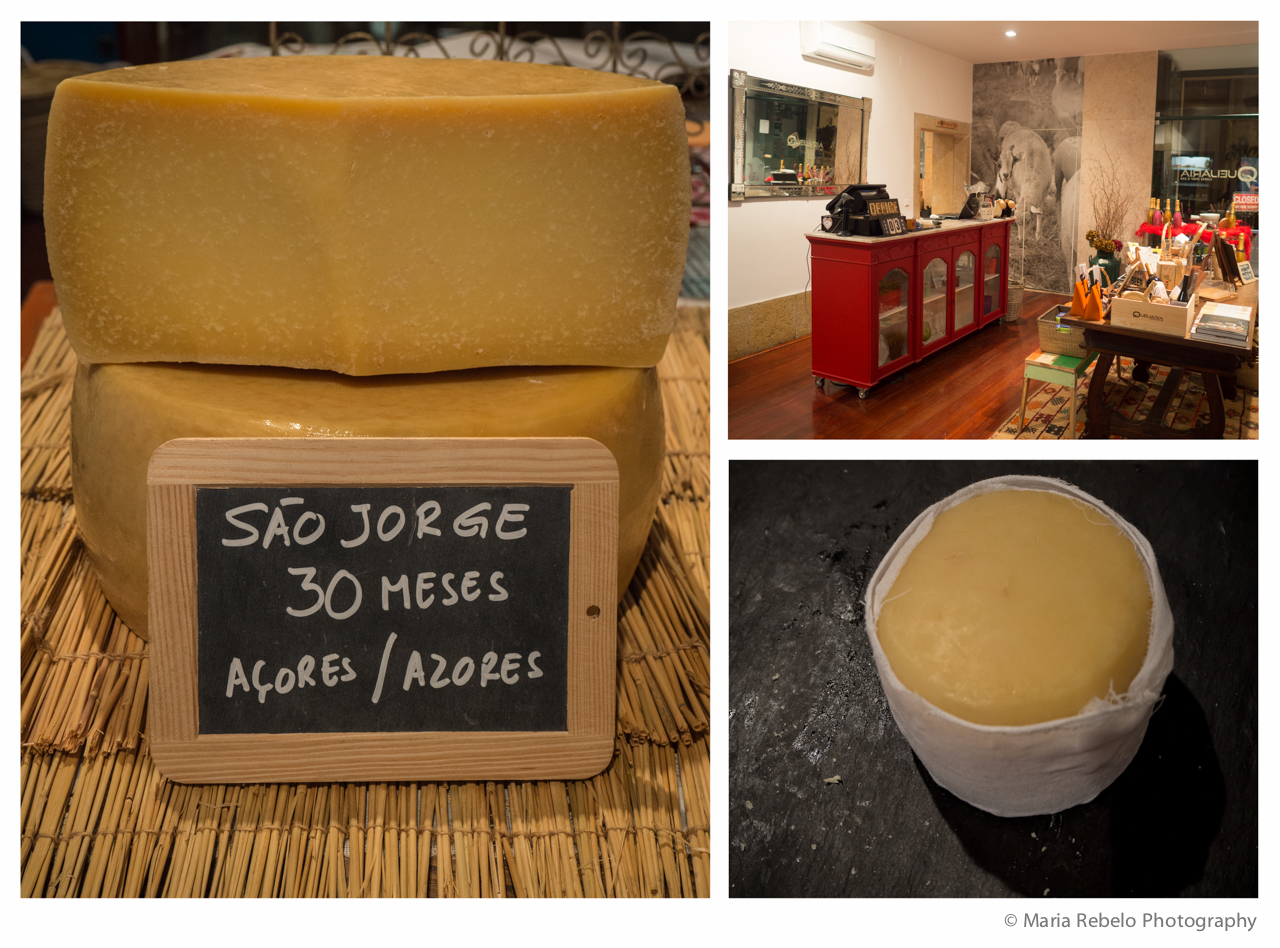
Queijaria, our favorite cheese store in Lisbon, keeps getting better. It is a place where the ordinary is banned to make room for extraordinary artisanal cheeses made in small batches by traditional producers.
On our last visit Pedro Cardoso, one of the owners, invited us to taste two unique cheeses. The first was from São Jorge, an island in the Azores archipelago. It is made with the milk of happy cows that roam free on the island. São Jorge cheese is always delicious but this one was the best we ever had–sharp, peppery and full of flavor. “This cheese is aged for 30 months which makes all the difference. It is very hard to find because the production is tiny and almost all consumed locally,” said Pedro.
The second cheese was from Serra da Estrela. It melted in our mouths leaving an amazing buttery after taste. It is made with milk from “bordalesa” sheep. This breed is being replaced with sheep whose milk is less flavorful but more abundant. “Eating this cheese is an act of defiance. It is saying that we don’t want this wonderful taste to disappear; that quality trumps quantity.”
Pedro speaks with revolutionary zeal. He wants to preserve and enrich Portugal’s wonderful cheese heritage. Will you support his cause?
Queijaria is in the Principe Real neighborhood at Rua do Monte Olivete, 40, tel. 21 346 0474. Click here for their web site.
More than a century ago, a baker from Vila Real was given four secret recipes from the local Santa Clara convent. The pastries she made with these recipes were so extraordinary that she decided to turn her bakery into a pastry store.
Today, her great grandchildren continue to use the same prized recipes at Casa Lapão, a pastry store in Vila Real. Their most popular pastry is called “Crista de Galo,” which means rooster comb. We recommend that you try them with your eyes closed so you can better appreciate the heavenly combination of the flaky dough with the egg and almond filling.
If you’re near Vila Real, a stop at Casa Lapão can turn an ordinary day into a memorable one.
Casa Lapão is located at Rua da Misericórdia 53/55, Vila Real, tel 259 324 146, email casalapao@gmail.com. Click here for their website.
Tascas are modest, inexpensive restaurants that offer a small, seasonal menu. They are often family affairs; the parents cook and the kids wait the tables. The quality of tascas is highly variable, some are good, a few are great, many are just passable.
When tascas become popular, they often have trouble coping with success, and their quality suffers. That is why people who find a great tasca usually like to keep it secret.
We’ll break with these social norms and tell you the name of our favorite tasca in Lisbon: Das Flores in Rua das Flores. This establishment is not to be confused with the more posh (and also very good) Taverna da Rua das Flores located on the same street.
You could write a dissertation about the eating habits of Lisbon residents by studying Das Flores’ menu. It includes items like poached grouper, grilled sole, codfish cakes with tomato rice, pork and clams Alentejo, and grilled lamb chops. All perfectly prepared with pristine ingredients. Many items on the menu cost less than 10 euros, which is why the small dining room is always crowded. The restaurant caters to its regular customers, so it can be difficult to get a table.
Das Flores is not a place for a romantic date. But it is a great choice if you want to experience traditional Portuguese food on a budget. Just don’t tell anyone else, ok?
Das Flores is located on Rua das Flores 76, Lisbon, tel. 21 342 8828. If you do go to Das Flores on a date, skip dessert and go to Landeau on the same street for chocolate cake. It will make the whole experience more glamorous.






 Salt of Portugal