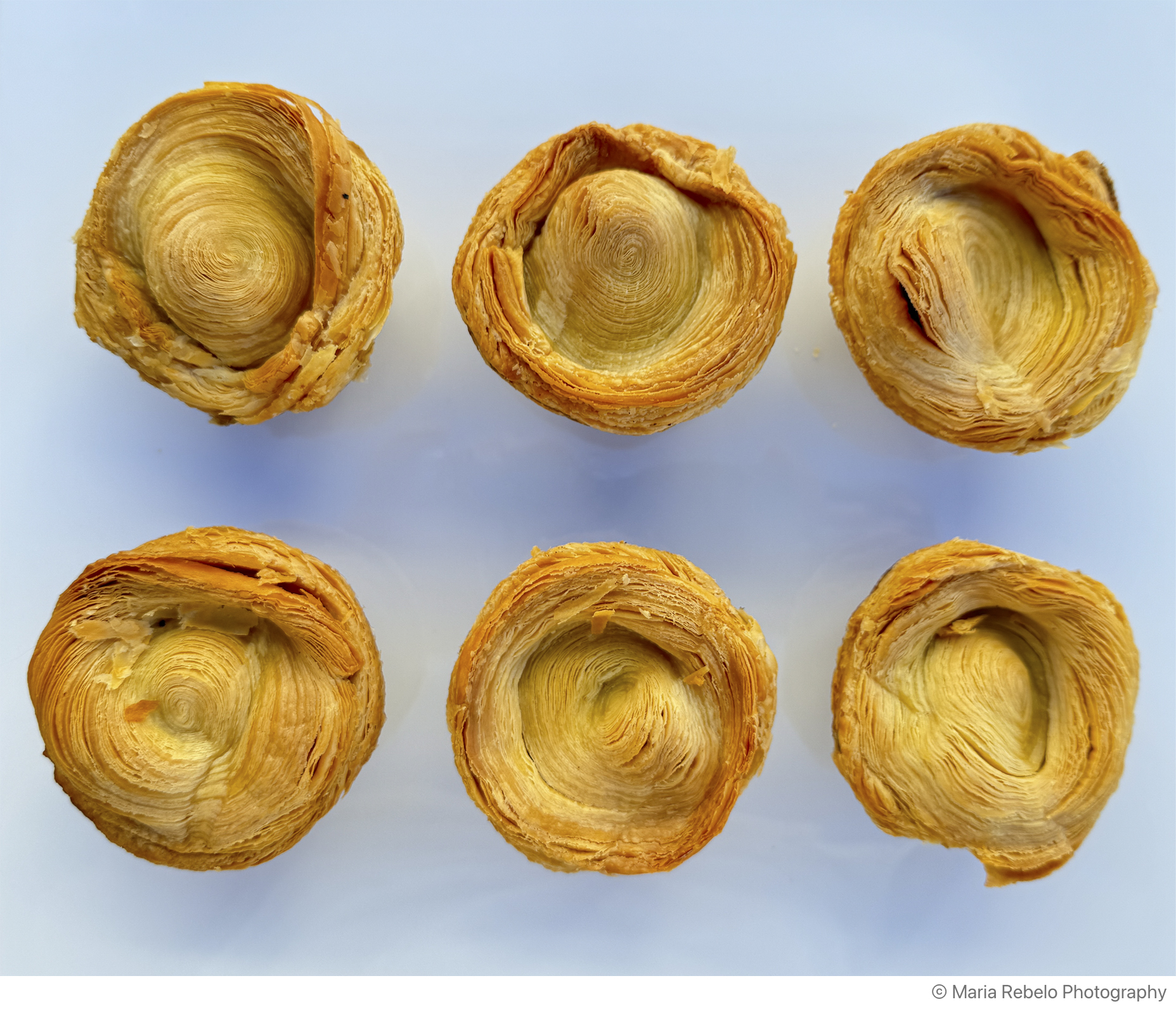
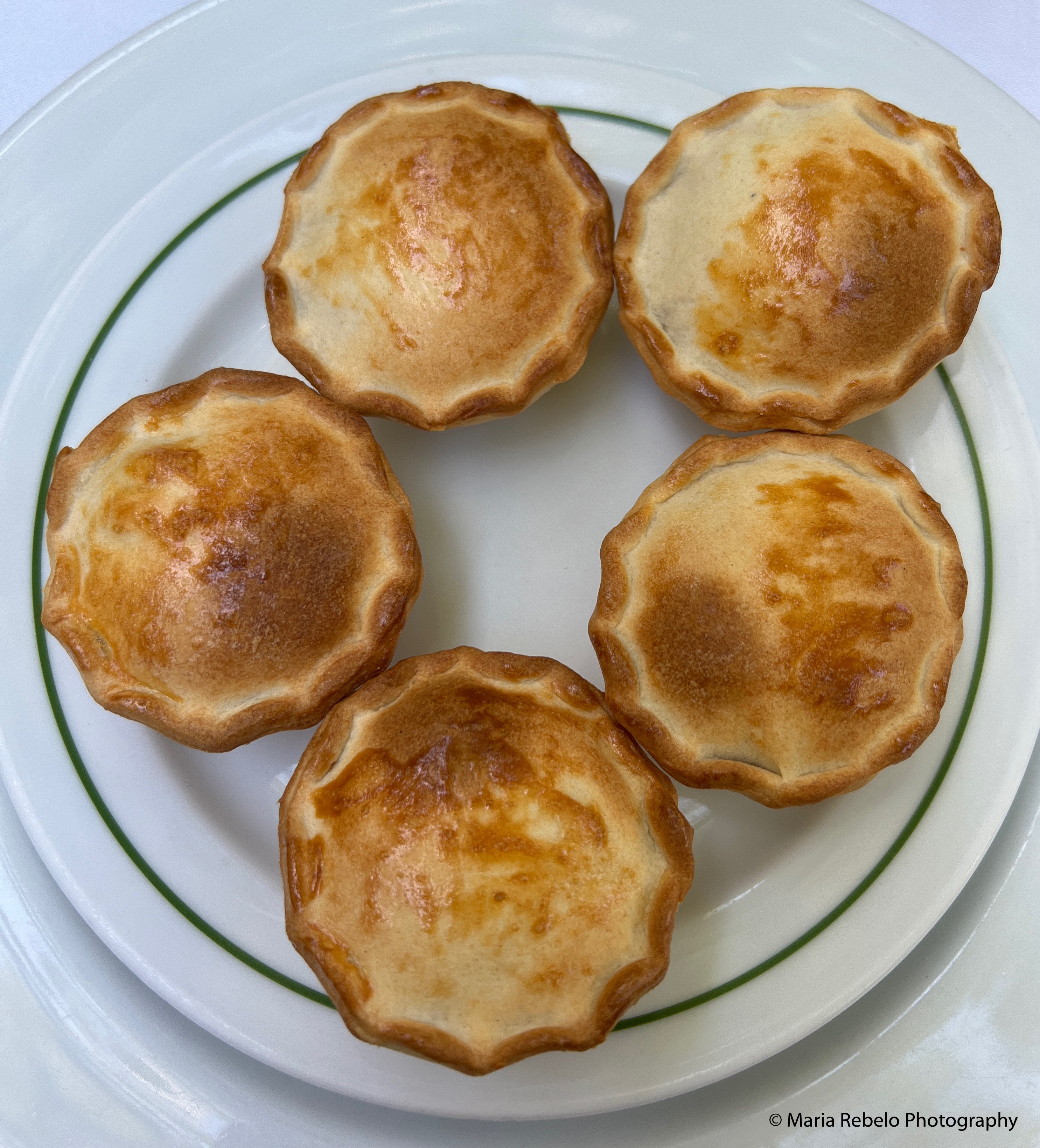
Covilhetes are small meat pies cherished in Vila Real, a town near the Douro Valley. Their origins date back over two centuries when they were sold at religious fairs. By the mid-19th century, covilhetes had become a staple in restaurant and café menus, often served with oven-baked rice. Their popularity has endured ever since.
In 2015, a guild was established to safeguard the authenticity and quality of covilhetes. The unique taste of these pies reflects the premium ingredients used, such as fine flour, Maronesa veal (from a breed native to the Marão mountains), and local sausages.
Though recipes for covilhetes exist, mastering the art of crafting their delicate, flaky pastry and intricate oval crust resembling planetary orbits is challenging. Fortunately, pastry shops in Vila Real’s historic district, such as Pastelaria Gomes, Casa Lapão, and Loja do Covilhete, produce daily batches of these heavenly pies, fresh from the oven, ready to delight our palates.
Perhaps it’s the way the sunlight falls on the steep hill that slopes down to the river or the breathtaking vistas of century-old vineyards. Quinta da Côrte has an enchantment all its own.
This 18th century estate in the Douro Valley once belonged to a family that supplied their prized grapes to renowned port winemakers. Philippe Austruy, a French entrepreneur and wine enthusiast, fell in love with the estate and purchased it in 2013. The boutique hotel opened its doors in 2018.
The restoration of the buildings and wine cellars was a labor of love, meticulously executed in the traditional style, featuring clay-tiled roofs and yellow-ochre trims around windows and ceilings.
The interior spaces were curated by Pierre Yovanovitch, a designer whose taste was honed during his tenure with Pierre Cardin. Yovanovitch created warm, inviting interiors that blend a sense of place with whimsical elements that surprise and delight.
Each of the eight rooms has a unique personality. All offer great comfort and sweeping views of the Douro Valley. The bathrooms in the main house are adorned with traditional tiles and ceramics that harken back to an era gone by.
Mornings at Quinta da Côrte start with a splendid breakfast served in the kitchen, right by the spacious chimney where sausages used to be smoked.
Then, there’s a world of possibilities waiting outside. Explore the many trails through the vineyards, take a dip in the granite swimming pool, rest in one of the lookout points, enjoying the spectacular landscape, or visit the cellars, where you can savor the estate’s precious ports and elegant table wines. The port wine cellar stores impressive chestnut barrels, too big to fit through the doors. How did they get in? They were assembled inside the cellar in 1938.
The dedicated staff attends to every detail. A stay at Quinta da Côrte isn’t a typical hotel experience; it’s more like being a guest at the home of a dear friend with impeccable taste.
Quinta da Côrte is located near Valença do Douro, near Pinhão. Click here for their website.
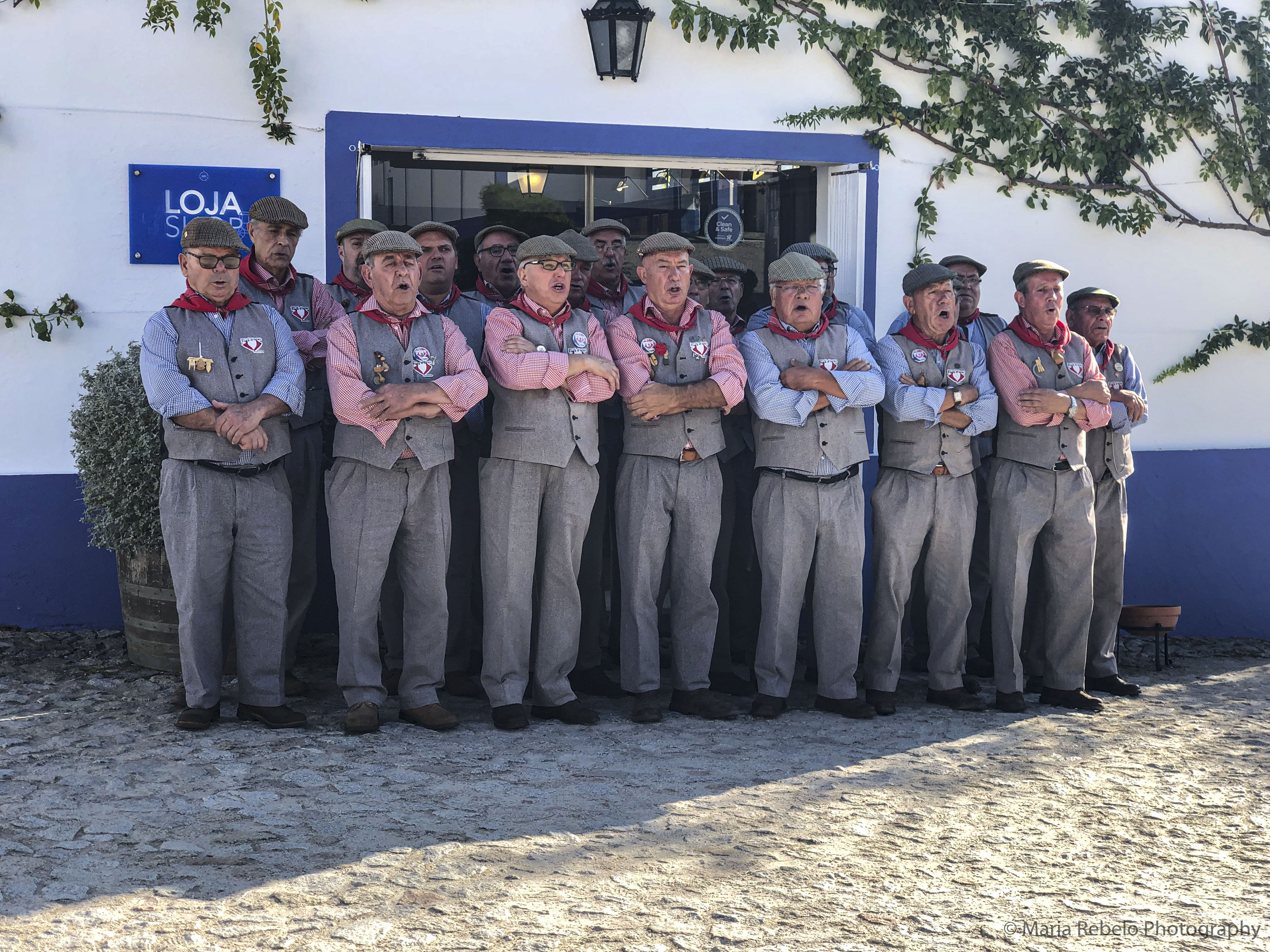
Rows of laborers stand motionless, like a battalion poised for battle. The “ponto” starts singing a few verses alone. The “alto” responds often singing the same melody a major third above the ponto. Then, the choir sings, their voices soaring towards the sky. This style of music is called “cante.” UNESCO recognized it in 2014 as part of the Intangible Cultural Heritage of Humanity.
The tunes are generally in a major key, but the people of Alentejo imbue their singing with such a sense of longing that they make major scales sound minor. The tempo is languid, like the rhythm of life in Alentejo, a place where the summer’s sweltering heat eases the pace of everything.
The verses are simple and sincere. They speak about toiling in the fields, love, faith, the fruits of the land, and the hardships of life.
As the day winds down, people often congregate at local taverns to drink a glass of amphora wine with bread, olives, and some black-pork sausages. Someone sings a few verses, someone else responds, and the group spontaneously burst into song. It is a privilege to hear these voices that carry with them the soul of Alentejo.
Field recording of Fora d’horas group singing at Monte da Ravasqueira by Vasco Rosa Santos. Sound editing by Pedro Rebelo.
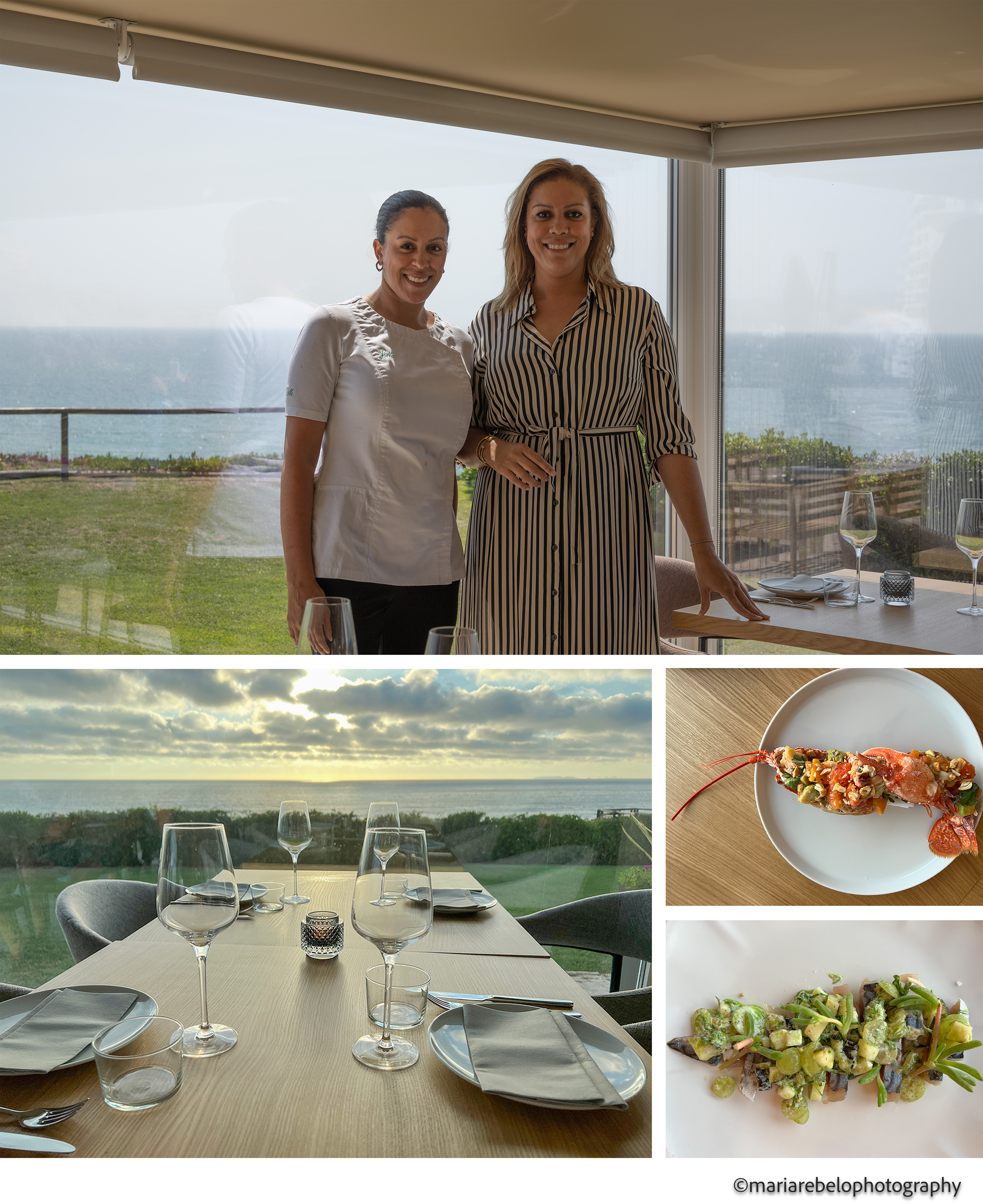
Alta, a new restaurant perched on a cliff overlooking Praia da Areia Branca, offers mesmerizing views of the Berlenga island and the endless sea. But it was hard to pay attention to the view once the tempting appetizers arrived at our table. First, a plump burrata adorned with an enticing tomato jam. Then, marinated mackerel seasoned with salicornia and green grapes—a culinary dance of saltiness, sweetness, and acidity. Next, fabulous codfish cakes–light, crisp, and full of flavor. Finally, a stunning lobster salad beautifully served in its shell.
In a blatant plea for attention, the sun began to set, painting the sky with brilliant yellow hues. We admired the spectacle, but our focus shifted to the main courses: mouthwatering seafood rice and a succulent roasted pork belly. The menu tempted us with many other delights, such as grilled fish and codfish confit. The meal ended with a taste of sweetness from slices of chocolate and ricotta cakes.
Alta has become popular since opening on June 10, so it’s best to make a reservation. But even waiting for a table is a pleasure–we can sit on the esplanade drinking an aperitif and taking in the magnificent vistas.
Chef Julie Marteleira and her sister Jennifer moved from Toronto to Praia da Areia Branca to create Alta. Even though they were born in Canada, this venture feels like a homecoming. Their parents, Joana and Joaquim, got married in Abelheira, a quaint village you can see from the restaurant. Julie dreamed of one day working in Portugal. We’re all lucky that her dream has come true.
Alta is located at Alameda a Ver-o-Mar, no 1, Praia da Areia Branca, Lourinhã, tel. 261 422 310.
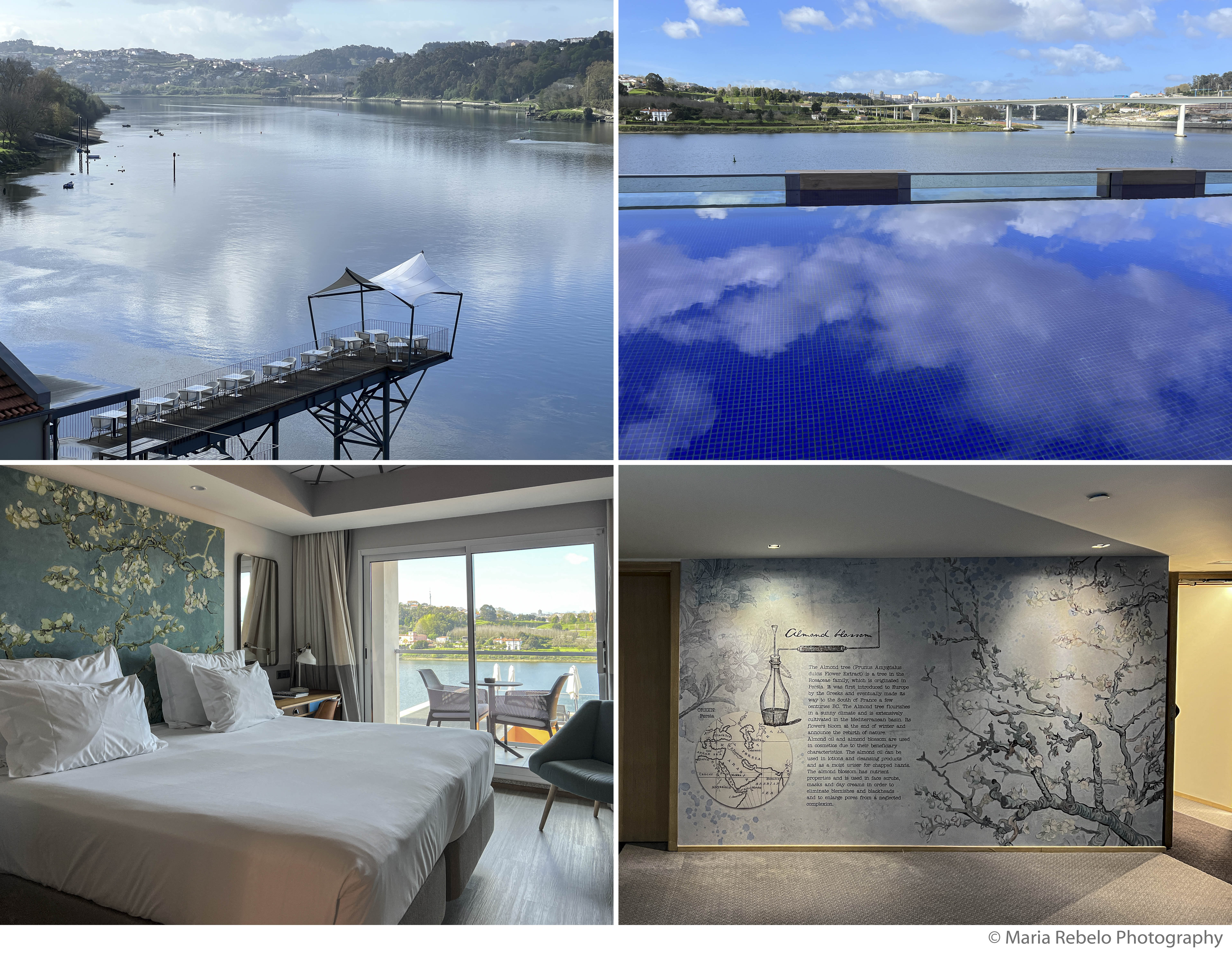
We love falling asleep to the sound of the river flowing by at the Douro Riverside in Porto. Adjacent to its older sibling, the Freixo Palace, the hotel occupies the site where a company called Floral produced soaps, candles, and perfumes between 1888 and 1990.
Floral’s imposing brick chimneys, built by master Lino Soares Guedes, were meticulously restored. The formulations used to produce the scents prized by the city’s aristocracy adorn the walls. And the flowers are back, lending their aromas and elegance to the interiors.
But it is the river that plays the lead role. Its views are everywhere, from bedrooms, balconies, public interiors, and terraces. An infinity pool creates the illusion that its waters mix with the river. But the Douro keeps to itself and looks straight ahead as it flows to the sea.
The Pestana Douro Riverside is on Av. Escritor Costa Barreto nº60, Porto. Click here for the hotel website.
No visit to Vouzela is complete without tasting the famous local pastries. The recipe, created by nuns of the order of Santa Clara, involves an impossibly thin Philo-like dough that wraps a luscious filling made of sugar and egg yolks. In the 19th century, an orphan adopted by the nuns mastered the tricky recipe and started selling “pasteis de Vouzela” to make a living. Today, four families produce these pastries.
We stopped at Café Central, which, as the name promises, has a central location. It is close to the village pillory and has a view of the cobalt blue tiles that cover the façade of the Misericordia church. The café was inaugurated in 1929, just in time to bring some sweetness to the lives affected by the Great Depression.
Tengúgal and Vouzela are rivals, each town claiming to produce the finest version of the same convent recipe. We ordered a couple of pastries and asked whether we could photograph a tray full of pastries. Before agreeing, the waiter asked, “Have you tried Tentúgal’s pastries?” “Yes, but we find their dough slightly thicker,” we answered. “I’m glad you noticed,” replied the waiter with evident satisfaction, bringing a tray for us to photograph.
We sat at a table, enjoying our “pasteis.” Created by nuns who lived in prayer and solitude, every bite is a glimpse of heaven.
Belmiro is the kind of restaurant that is increasingly hard to find in Lisbon. It does not prepare food to look good on Instagram. It does not seek originality for its own sake. Instead, it cooks classics of the Portuguese cuisine with good-quality, seasonal ingredients.
The restaurant is named after Belmiro de Jesus, an old hand who’s been a chef at places like Salsa & Coentros. Belmiro is famous for his mouthwatering “empadas,” small pies with delightful fillings. And he is a virtuoso at cooking partridge and hare. He prepares them with rice, in “açorda,” with beans, and much more. The menu is seasonal, it changes to reflect what’s fresh in the market. If you can’t decide what to choose, a good rule of thumb is to order anything cooked in a “tacho” (a saucepan).
We like to go to Belmiro with friends and ask the chef to prepare a few entrées we can all share. Accompanied by some good bottles of wine, the meal always turns into a party.
Belmiro is located at Paço da Rainha 66, Lisbon, tel. 21 885 2752.
The best partridges we ever tasted were cooked by a professor. His name is Emídio Gomes. He is the rector of the UTAD, the university that trained many of the star enologists who work in the Douro valley.
Emídio learned to cook while studying in France on a meager scholarship. He asked his grandmother to teach him some of her recipes so that he could eat at home. Cooking was so relaxing that he continued to cook regularly after returning to Portugal.
Emídio’s stewed partridges are renowned throughout the Douro valley. The professor generously gave us his grandmother’s recipe and allowed us to share it with our readers.
The recipe starts with an admonition: “If the partridges are good, make sure you don’t ruin them.” Here’s the rest.
Remove the feathers and the tripes of the wild partridges and cut them into pieces. Marinate them for twelve hours in a small amount of white wine, laurel, parsley, and a little thyme.
Heat a cast iron pot. Pour a generous amount of olive oil. The quality of the olive oil is paramount. Choose an olive oil with low acidity, ideally from the Douro valley. Slice enough onions to cover the bottom 2 inches of the pot. Slowly sweat the onions. Remove the thyme, laurel, and parsley, and place the partridges in the pot. Add a small amount of water to prevent the stew from drying.
Cover the pot with the lid and slowly stew the partridges for four to five hours. Monitor periodically to ensure the stew does not dry; add small amounts of water as necessary. Season with salt towards the end of the cooking period. After the first four hours, regularly pierce the meat with a fork. The partridge is ready when the meat offers no resistance. Serve with white rice and toasts.
Like a top scientific paper, the recipe requires high-quality content and flawless execution. And in the end, the results look deceptively simple.
On the last day of the year, there were fireworks on the beach. People enjoyed the impressive pyrotechnics. But the ocean did not stand still to stare at the sky; its waves kept rolling on the sand.
On the first day of the new year, there was copious rain. The ocean, created by millions of years of precipitaton, rejoiced like a child who sees her mother after a long absence. The waves danced, and we watched in awe how a coastline known for its sunny days could be so beautiful in the rain.
We wish you a joyous New Year and hope you come to see the beauty of the Portuguese coastline, rain or shine.
We arrived late in the afternoon and waited outside the imposing marble gate. Before we could say ‘abracadabra’ or some other incantation, the gate opened, welcoming us to Quinta Dona Maria, a magnificent wine estate in Alentejo.
Isabel Bastos came to greet us. We walked with her to the palace’s chapel and sat down to hear her recount the story of Quinta Dona Maria. The estate was a gift from King John V to Dona Maria, a lady of the court with whom the king fell in love. Dona Maria left no descendants, so the property was sold in a public auction upon her death. The Reynolds, a family of merchants from southern England, purchased it. They renamed the estate Quinta do Carmo in honor of an image of the Lady of Carmo they bought for the chapel in 1752. The estate currently belongs to Júlio Bastos, Isabel’s husband, who descends from the Reynolds family.
Júlio’s grandfather started producing fine wines on the estate. The project was so successful that in a blind tasting with the Rothschilds held in the late 1980s, the wines from Quinta do Carmo tied with Lafitte Rothschild. Impressed by this feat, the Rothschilds proposed Júlio Bastos a partnership. But the two winemakers had different objectives and approaches. Júlio is passionate about the old vines planted with the traditional varietals of Alentejo, most of all Alicante Bouschet, a varietal brought by the Reynolds from France to Alentejo. The Rothschilds wanted to replant the vineyards with French varietals that could appeal to the international market. Eventually, the two parties separated. In this process, the Rothschilds kept the brand Quinta do Carmo, so Júlio renamed his wines and estate Quinta Dona Maria.
We walked to the wine cellar to see the 18th-century marble tanks where the grapes are still crushed by foot treading. The tanks were brimming with grapes that were starting the fermentation process that transmutes earthly grape juice into heavenly wine. Isabel served us an enticing rosé with pleasing fruit notes and refreshing acidity. Next, we tried a delightful white Viognier that shows how much this French grape shines in the soils of Alentejo. The tasting ended with pomp and circumstance provided by two sumptuous Dona Maria red reserves from 2005 and 2008.
It was time to go to the palace. The large door creaked as it slowly opened to show us rooms lit by candlelight that made us feel like we were back in the 18th century. Júlio joined us for dinner. His love for the land, food, and wine of Alentejo were evident throughout the meal.
The dinner, prepared by Filipe Ramalho from Páteo Real and Beatriz Tobinha, the palace’s resident chef, was a memorable feast. It started with Filipe’s famous tart made from chestnut-flower sausage, pears cooked in wine, quince marmalade, and chard. Then there was a slew of appetizers: tomato and watermelon salad, roasted peppers with bacon, slices of the brilliant sausages made at Salsicharia Canense, plates with savory Alentejo cheeses, and chickpeas with pickled codfish salad. A rich white Dona Maria reserve delicately aged in oak was an enthralling gastronomical companion.
Next came the main dishes: cação (a fish popular in Alentejo) in coriander sauce, pheasant in escabeche sauce and marinated carrots, and duck croquettes with black garlic mayonnaise. A splendid Dona Maria red reserve from 2017 made from old vines complemented the food with its festive taste of berries and hints of spices.
The dessert was an almond and pumpkin tart paired with the famed Júlio B. Bastos Alicante Bouschet, named after Júlio’s father. The wine’s acidity, tannins, and fruit sing to the palate in perfect harmony.
Glancing at the watch, we saw the two hands pointing to midnight. We knew from fairy tales that it was time to leave. We thanked Isabel and Júlio for their warm hospitality and drove back to our hotel. We slept peacefully but woke up wondering: was the dinner at Quinta Dona Maria a dream?





 Salt of Portugal