What’s your favorite Madeira?

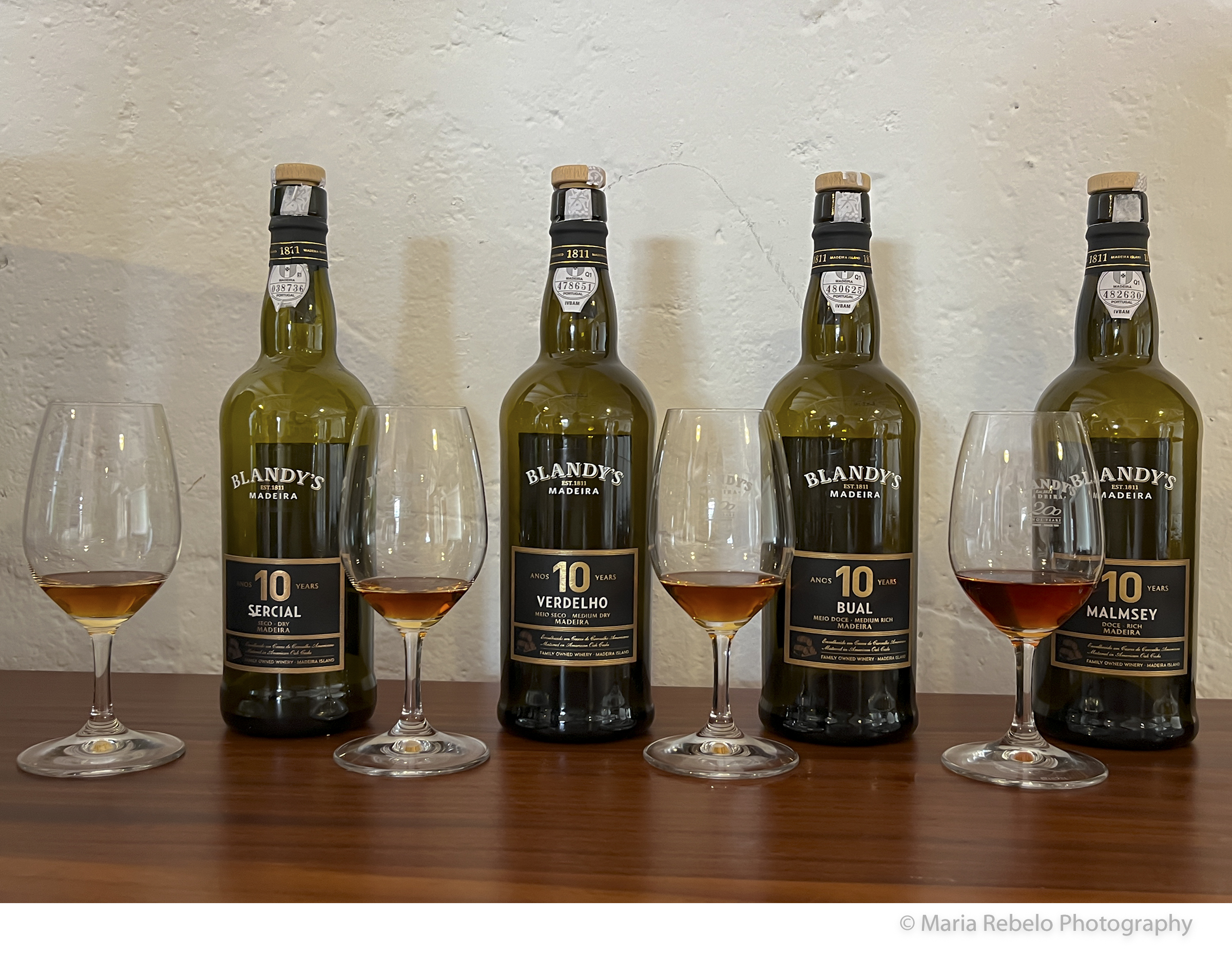
If you’re looking for a fun holiday activity for your grown-up friends, we have just the thing: a Madeira wine tasting. We suggest starting with the four classic styles, each named after the white grape varietal used in its production: Sercial, Verdelho, Bual, and Malmsey. 

These wines have a combination of sweetness and acidity that enchants the palate. But each style is distinct. Sommeliers often serve the dry Sercial and medium-dry Verdelho as aperitifs and the medium-sweet Bual and sweet Malmsey as dessert wines. 

Madeiras are fortified wines. Winemakers add neutral vinic alcohol at 96 degrees to stop the fermentation process through which yeast converts grape fructose into alcohol. As a result, not all fructose is converted into alcohol and the wine retains some residual sugar. Fortification has been used since the mid-18th century to give Madeiras the endurance they needed to survive long sea voyages.  

Francisco Albuquerque, Blandy’s winemaker, says he generally stops the Sercial fermentation after ten days. For Malmsey, he suspends the fermentation after two days, so there’s a lot more sweetness left in the wine. Perhaps that is why, according to Shakespeare, the Duke of Clarence, condemned to death for treason against his brother King Edward IV, asked to be drowned in a cask of Malmsey. 

Shippers discovered that Madeiras improve when they cross the equator in the hulls of sailboats. To mimic this effect, producers expose Madeiras to heat. For superior Madeiras this exposure happens in warm cellars, where the wines age for several years in old American oak casks before they’re ready for our enjoyment. The longer they stay in oak barrels, the more complex they become. 

So, which Madeira do you favor? And which do your friends prefer? It’s great fun to find out! 

The leader of the Barbela tribe

Barbela is a nutritious wheat that, until the 1930s, accounted for the bulk of Portuguese wheat consumption. It came from the fertile crescent and thrived in Portugal because it is hardy and can grow anywhere. Its long roots allow it to survive droughts and flourish in poor soils.

Hybrid wheats arrived in Portugal in the 1930s. They are low in nutrition but have high production yields boosted by chemical fertilizers and pesticides. Gradually, barbela lost ground to these flashy newcomers until only one barbela field remained. It is located on the foot of the Montejunto mountain and belongs to João Vieira. We drove to this place, far from the commotion of urban life, to meet with him.  

At 83 years of age, João speaks with the passion of youth and the wisdom earned over the course of a life well lived. Everything he says comes from a well of deep reflection. 

João worked in France during his youth, but when manufacturing jobs started to disappear, he returned to the land of his ancestors. He realized that barbela, once ubiquitous on the sandy soils of Montejunto, was vanishing. The seed stock was dwindling, and so was the cultivation knowledge. João started planting barbela seeds that came from his father and grandfather. He loved seeing this tall wheat sway again with the wind, making waves like the sea. 

What started as a one-person campaign against oblivion mobilizes today a small army. João calls it the barbela tribe. It is a loose network of farmers who plant barbela and share their experiences. João inducts new members by giving them seeds on the condition that they later provide other people with seeds and bring them into the tribe. 

Barbela is a soft wheat that produces flour suitable for breads, tarts, and cakes. Every day, João makes bread with his barbela flour. After harvesting, threshing, and milling, the sieve has the last word, choosing what makes it into the flour. João likes his bread with a coarse texture, so he occasionally overrules the sieve and lets a few larger grains into the mix. 

He went into the kitchen and returned with a basket of bread to share with us. We sat with him for quite a while, trying this exquisite bread and listening to his precious words. It was a very fine use of time. 

A codfish restaurant

If you’re yearning for codfish, we know a restaurant that will satisfy your lust. Called Sal na Adega, it is part of Adega Mãe, a winery in Torres Vedras that belongs to Ribeiralves, a company famous for its salted cod. 

Sal na Adega has a spacious dining room that overlooks serene vineyards. A large round window gives us a glimpse of the kitchen’s hustle and bustle. 

You can accompany the meal with any wine from the winery’s shop by paying a modest cork fee. The menu lists many meat and fresh fish preparations, but the star offering is salted cod. Codfish usually pairs with red wine, but if you’re feeling adventurous, we suggest a white wine made from Vital. There are only a few wineries making wine with this grape varietal. The results are exciting, and the wine is a great companion for the fish.

Our meal started with codfish cakes, a litmus test passed with flying colors–the cakes were crispy, rich, and flavorful. Then we tried a trio of cod preparations. First, a codfish loin topped with crunchy prosciutto and onion in a vinegar sauce called escabeche. Second, grilled codfish neck, the most succulent part of the fish because of its abundance of collagen. It is an epic preparation, up there in the pantheon of best codfish we have ever tried. Third, a delicious codfish in coriander rice.

The dessert menu includes many temptations and one irresistible choice: the famous bean pastries from Serra da Vila in Torres Vedras. 

The meal ends with a pleasant surprise: a 10 percent discount on the wines purchased at the wine shop. We went to Sal na Adega for the codfish, and came back with some great wine.

Sal na Adega is located at Estrada Municipal 554, Torres Vedras, tel. 261-950-105.

Susana Esteban’s thrilling wines

Susana Esteban agreed to present her wines at the Arraiolos Pousada in September. It was an act of generosity because the harvest was in full motion, and she’s a perfectionist. Like the photographer Cartier-Bresson, she’s always looking for the decisive moment. The moment when the grapes are perfectly ripe to be gently harvested by hand, when the fermentation has run its course and worked its magic, when the oak barrels have refined the wine without changing its temperament.

As soon as Susana started talking, the sun set as if sensing that another star had arrived. Her Portuguese is seasoned with a charming accent–she was born in a Spanish region called Galicia. After graduating in enology, she decided to do an internship in the Douro valley, a place that was then remote and isolated. She stayed and worked in the Douro during her formative years. Then, like the swallows, she went south in search of something new– vineyards where she could develop her style and make wines that can age and evolve for many decades.

She made her first wine in 2011. It is called Procura, the Portuguese word for search. Susana found what she was searching for in the hills of São Mamede in Portalegre–centenarian vines full of character. They needed a lot of care, but Susana nursed them back to health with patience and affection.

Susana is cloning the old vineyards to preserve their genetic material and pass it onto the new vineyards that she is planting. None of her vineyards, new or old, are irrigated. The thirsty vines produce low quantity but high quality. 

We first tried a rosé made from Aragonês and purple muscatel that is pleasantly aromatic and light in alcohol–a perfect summer drink. 

Then, we tasted an exquisite white wine made in amphoras called Tira o Véu (removing the veil). The first time Susana made it, in 2019, she witnessed a rare phenomenon: a veil formed on top of the amphora. It is a film created by yeast highly prized in the production of sherries. No one knows what makes it occur, but every year the veil returns to make this wine more seductive and mysterious.

Next, we drank an alluring red wine made with Touriga Nacional and Aragonês. For Susana producing wine is an adventure, so she calls it Aventura. We’re lucky to be part of this thrilling experience that results in a wine full of freshness and minerality.

Finally, we tried the wonderfully harmonious 2016 red Procura. It combines a field blend with Alicante Bouschet from ancient vines aged in oak to round the tannins. It is a “vinho de guarda,” a wine with great longevity that will improve and surprise with the passage of time. We’re so lucky that Susana found the vineyards she was looking for!

A sublime pumpkin tart

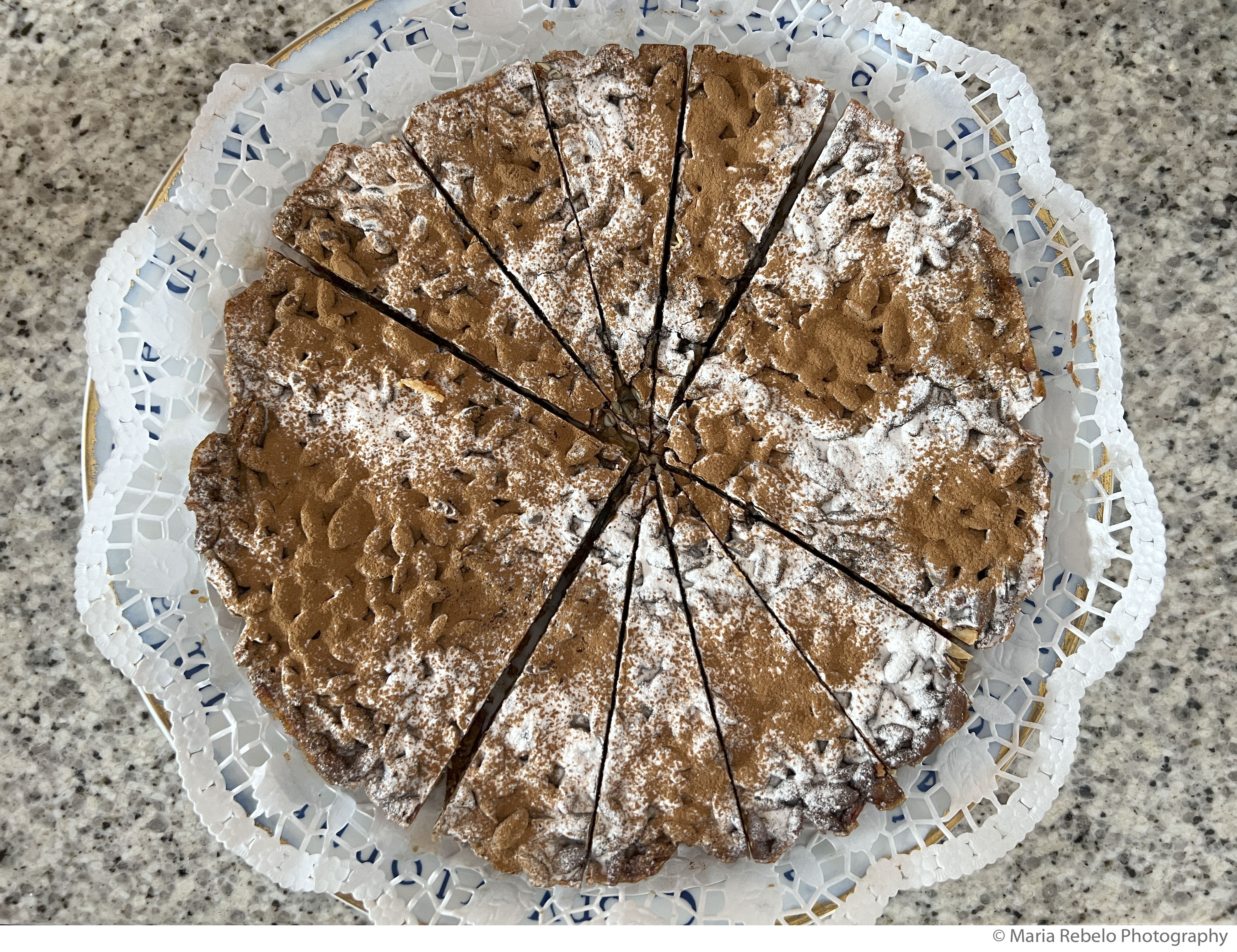
Edgardo Pacheco is a Portuguese journalist who writes with eloquence and grace about gastronomy. He knows so many people in the food world that he managed to surprise us on our home turf. He arrived at our house with an irresistible sweet tart. When we asked him about the provenance of this delight, he revealed it came from the town nearby!

The tart was created in 2018 for the local pumpkin festival by a young chef called Sílvia Batista. It has a flour, butter, and sugar base, a pumpkin-pulp filling, and a topping made with pumpkin seeds, sugar, and butter. The combination is sublime.

Silvia makes the tart with her mother, Diná, and sells it in Lourinhã, where it is quickly gathering fame. The chef didn’t name the tart after herself. She called it “Dona Isabel” in honor of Isabel Mateus, who, with her husband, discovered a nest of dinosaur eggs in a local beach. 

Creating a brand-new recipe requires skill. But the naming of the tart reveals another important ingredient: generosity. Sílvia has both talent and generosity in abundance. We can’t wait to taste what else she’ll make!

Click here for Sílvia Batista’s web site. You can buy or order her tart at O Casco, Rua Dr. Francisco de Sá Carneiro, Lt 22 R/Ch Dto. Lourinhã, tel. 910 121 280.

Alentejo’s star wine grape

In the middle of the 19th century, Henri Bouschet crossed Petit Bouschet, a combination of Aramon and Teinturier de Cher conceived by his father, with Grenache. The new varietal, Alicante Bouschet, produces wines with a beautiful dark-red color. 

Over time, the French lost interest in Alicante Bouschet. But the grape found its home in Alentejo, where it flourished and transformed, becoming one the region’s most emblematic varietals. 

Alicante Bouschet was first planted in Alentejo at the end of the 19th century by the Reynolds, a British family that purchased Herdade de Mouchão. It is the star of the wines made by Julio Bastos, an heir to the Reynolds family, at Quinta Dona Maria

The photo shows some beautiful Petit Verdot (on the right) and Alicante Bouschet (on the left) grapes picked at Monte da Ravasqueira. Like Petit Verdot, most red grapes have white pulp. That is why we can make white wine from red grapes (“blanc de noirs”). If we extract the red-grape juice and avoid contact with the skins, the result is a white wine. If we allow for some skin contact, we get a rosé.  

Both the skin and pulp of Alicante Bouschet grapes are red. This type of grape is called tintoreira (dyeing) because it gives color to the wine. But it has much more to offer: enticing aromas, structure, concentration, and aging ability. Open up a bottle of Alentejo wine, and you’ll see!

Dinning with Marlene

When we dined at Marlene Vieira’s new restaurant, appropriately called Marlene, the place was packed. But, like a star performer, Marlene made us feel like she was cooking just for us, often coming to our table to chat about the food she served. 

The meal started with a variation on one of her classic themes, the “filhós de berbigão” that she serves at Zun Zum, her more casual restaurant. This time, the filhós, a star-shaped shell made from fried dough, was gloriously stuffed with foie gras, reineta apple, and a Madeira-wine gel. 

Next, came a trompe l’oeil preparation. It looked like cheese topped with prosciutto. But the cheese turned out to be an egg cooked at low temperature that, mixed with the prosciutto, created a festival of umami sensations.

We were taken to the sea by a delicate combination of violet shrimp from the Algarve accompanied by a gazpacho made with the shrimp’s head, topped with a percebes tartlet. 

Then, we returned to land with two crusty loaves of bread, one made with wheat and rye and the other with white corn. They came with fragrant olive oil made in Trás-os-Montes at Quinta de São Miguel do Seixo. 

The next menu entry was a delicate part of the codfish called cocochas seasoned with parsley and pine nuts. We reached the mid-point of our culinary journey with tasty white truffles and morel mushrooms stuffed with requeijão

They were followed by a ravishing sole dressed in an asparagus sauce, butter, and caviar. We reached the climax with a savory pudding made with an eel broth seasoned with saffron and topped with the eel’s skin. It is sublime!

Dessert was a delightful pine nut mousse with apple granita and pineapple from the Azores. The petit fours were lovely: merengue with a strawberry cream, tangerine leaves, and macaroons stuffed with almonds and eggs.

We’re lucky to have a chef like Marlene Vieira, who studied the past to invent the future of our culinary tradition!

Marlene is located at Av. Infante D. Henrique, Doca do Jardim do Tabaco, Lisboa, tel. 351 912 626 761, email marlene@marlene.pt.

Tasting Malvasias in Madeira

Prince Henry the Navigator was an early-day venture capitalist. He financed expeditions on small boats called caravels to find new lands, keeping 20 percent of the resulting profits. His first big success came in 1419 when his navigators discovered an island covered by a laurel forest. They named it Madeira, the Portuguese word for wood.  

The prince brought sugar cane from Sicily to Madeira, where it thrived because of the abundance of water and subtropical climate. The island became Europe’s leading sugar producer until the first half of the 16thcentury, when Brazil supplanted it.

Prince Henry was also interested in wine, in part because of its use in liturgic services. The best 15th-century wine was made in Crete from a white varietal called Malvasia Cândida and produced with overripe grapes. 

The Jesuits planted Malvasia Cândida from Crete in a small region of Madeira called Fajã dos Padres. Today, this varietal is rare on the island. It was superseded by Malvasia de São Jorge, a hybrid created in the 1950s by Leão Ferreira de Almeida and generally used to make Madeira Malmsey. 

Manuel Malfeito, our friend who’s an enology professor, brought to Madeira a bottle of fortified wine made in Crete from Malvasia Cândida so we could compare it with Malmsey. “Perhaps this is the first time in 500 years that a wine from the original Malvasia Cândida is drunk on the island of Madeira!” said Manuel with glee. 

How do the two wines compare? The wine from Crete is pleasant and intensely sweet. The Madeira Malmsey has much more depth because of its acidity. This acidity comes in part from Madeira’s volcanic soils, which are rich in iron, manganese, and magnesium. 

It is the combination of sweetness and acidity that makes Madeiras so exquisite. Each glass of Madeira wine is a gift from a prince.

The Paimogo fort

There are two ways to reach the fort of Her Lady of the Angels of Paimogo. During low tide, we can walk on the white beach sand while the cool sea waters bathe our feet. We can always go by land, through rolling hills painted with sepia colors that contrast with the shimmering blue of the sea. Either way, the fort awaits us at the end of our journey. 

Built in 1674, it maintains its original architecture. It has two spacious rooms on each side of the main door. In the back, a chamber with thick walls and a vaulted ceiling stored ammunition. Side stairs lead to a terrace with magnificent views. In the distance, we see the Berlenga island surrounded by the infinite sea. Below, the bay of Paimogo offers shelter from the storms.  

The fort was part of a line of defense that stretched from Cascais to Peniche, protecting the coast against pirates and other aggressors. It was used in 1808 during the Napoleonic invasions and again in 1832 during the civil war that pitched two royal brothers, Pedro and Miguel, against each other. Since then, the fort has retired from military pursuits. It is a peaceful place where we can marvel at the beauty of the land and the splendor of the sea.

The Paimogo fort is located 3.5 km north of Praia da Areia Branca.

Lunch at a royal courtyard

We drove to Alter do Chão in Alentejo to have lunch at Páteo Real, a restaurant headed by a young chef called Filipe Ramalho. Páteo Real means royal courtyard, a reference to the castle of Alter do Chão, which stands proudly in the restaurant’s backyard. 

After working in fine dining for seven years, Filipe wanted to put the new techniques he mastered at the service of the traditional cuisine of Alentejo. When he learned that Páteo Real was for sale, he drove there on a Friday and closed the deal by Monday. 

But this new beginning was tough. The locals suspected the restaurant would charge high prices for small portions of pretty food. Visitors were few and far between. One year later, it is difficult to get a reservation–the restaurant is full of visitors and locals. And for a good reason: its food is a delicious evolution of the traditional cooking of Alentejo. 

We sat in the courtyard under large white umbrellas that protected us from the exuberant Alentejo sun. A waiter filled our glasses with “O Nosso,” a pleasant white wine from Serra Papa Leite. The meal started with Filipe’s signature dish: a tart cooked with farinheira sausage made with chestnut flour, topped with pears cooked in wine, quince marmalade, and chard. This unusual combination is so harmonious that it will likely become a classic.

A plate of sliced sausages followed the iconic tart. Alentejo’s sausages are generally excellent, but these are exceptional. They come from Salsicharia Canaense, an artisanal producer with whom Filipe collaborates. Their products also starred on the following two plates: cabeça de xara (a pork preparation) served with pickled purple onions and coriander pesto and delicately smoked bacon served with roasted red peppers, olive oil, coriander, paprika, and large capers.

Next, we tried some delightful duck croquettes served with puffed rice and coriander mayonnaise. The savory part of the meal ended with duck livers seared in brandy and combined with thinly-sliced fried potatoes. It is an explosion of flavor. “When we recommend duck livers and the clients hesitate, we offer a money-back guarantee,” said Filipe smiling. “People are always surprised at how good it is.”

The dessert was a delicious tart made from almonds and pumpkin jam. We loved the arch and rhythm of the meal. It kept our palates interested and left us deeply satisfied. It is a royal honor to dine in Filipe Ramalho’s courtyard!

Páteo Real is located at Av. Dr. João Pestana 37, Alter do Chão, tel. 960 155 363.