The Dão wine region

Dão

The Dão river lends its name to one of the most important wine regions in Portugal. Demarcated in 1908, it has granitic soils and remarkable indigenous varietals like the red Touriga Nacional and the white Encruzado.

Dão wines are full of character, much like the people who live in this area. They can be brash when they’re young, but they age beautifully, acquiring elegance and complexity.

It is not unusual to find Dão wines that keep improving for several decades. The legendary 1964 vintage is a great example of this longevity.

Some say that the least happy people in heaven come from the Dão region. For they regret having left behind a few great bottles of wine.

Dining with the minister at Campo Maior

Taberna O Ministro

We strolled around in Campo Maior, a small town in Alentejo close to the border with Spain, looking for a place for lunch. We noticed a tavern called O Ministro (the minister) which was full of locals. There was a bottle of Caiado–the wonderful entry wine from Adega Mayor—on every table. Encouraged by these favorable omens, we decided to enter.

Traditional music played in the background, mostly fado tunes about the travails of love and the fickleness of life. Every now and then, a folk song from Alentejo came on and the locals raised their voices to sing along.

A plate with codfish cakes, slices of sausage, and green olives arrived at the table. We ordered “migas” made with bread and turnips and fried cação, a small shark that somehow manages to swim from the coast to the menus of Alentejo. We also ordered “carne do alguidar,” marinated pork loin. We were astonished by the quality of everything that came to the table. It was delicious and deeply satisfying food, with a perfect sense of time and place.

João Paulo Borrega, the chef and owner of this magical restaurant came out of the kitchen, and stoped by each table to ask whether people liked his food. “The food is fantastic,” we told him. “Can we make reservations for dinner and arrive a little early to talk to you?” Sure, he said with a bemused smile.

Late in the afternoon, he sat down to talk with us. Like most Alentejo cooks, he learned cooking from his mother and grandmother. His restaurant opened in 1989 and has changed location over the years. It is named after João Paulo’s father, a man whose role in the revolutionary days after April 1974 earned him the nickname “the minister.”

João Paulo tells us that the current restaurant location is ideal. “I want to cook by myself, and this space has the maximum number of tables I can comfortably handle.” He talks enthusiastically about his favorite recipes: fried rabbit, toasted chicken, chickpea soup, and ensopado de borrego (lamb stew).

“Why does your food taste so good?,” we asked. “I am going to show you my secret,” he said, inviting us into the small kitchen. He pointed to an old, tiny refrigerator. “Everything I use I buy fresh every day. That is why I have no freezer, just this small refrigerator. At the end of the day I give away any leftovers to my friends. The next day I start everything from scratch. Meats, fish, vegetables, herbs, sauces, everything has to be fresh.”

All his products are local and seasonal, produced by people he knows. He rattled off the names of the friends who supply him: the olive-oil maker, the farmer who plants the potatoes and onions, the person who chooses ripe melons for his table; the list goes on. The quality of his sourcing would make many three-star chefs envious.

João Paulo talks with great knowledge about the details of the different recipes and the properties of various herbs and spices. “People often use too much laurel. That is a mistake,” he says. “Laurel is very powerful and can overwhelm other ingredients.” “The cuisine of Alentejo does not require much fussing around,” he explains. “But the ingredients need to be first rate and the last flourishes before the dish is brought to the table have to be perfect. Some dishes are finished with white wine, others with vinegar, herbs play a key role.”

We sat down for a wonderful dinner. It started with toasted chicken perfumed with vinegar and prepared with olive oil, garlic and parsley. Then came a steaming chickpea soup with Alentejo sausages, Savoy cabbage, carrots, and mint. Next, we tried the fried rabbit. The meat had been  marinated with rosemary, thyme, pepper, white and red wine. Then it was stewed to perfection in a large iron-cast pan with olive oil, garlic, and some more wine. Delicious slices of ripe melon brought this memorable meal to a sweet finale.

No matter how much you travel, it is hard to find food that is as simply satisfying as the one served in this little tavern in Alentejo. If you have a chance, come to Campo Maior to dine with the minister.

Taberna O Ministro is located at Travessa dos Combatentes da Grande Guerra
Campo Maior, Portalegre, tel. 351-965-421-326.

A superb vermouth

Soberbo Vermouth

The summer winds brought a wonderful gift, a vermouth called Soberbo, the Portuguese word for superb. It is made with white port by Poças, a centenarian port-wine house, according to an updated version of a 1930s recipe.

The sweetness of the white port balances the bitterness of the aromatic herbs to create an harmonious vermouth. Enjoying a glass of this nectar is the perfect way to prepare our palates for an elegant dinner.

Click here for the Poças web site.

A dinner in grape country

País das Uvas

Paulo Laureano recommended that we try O País das Uvas for dinner. “Sopa de Cardo (thistle soup) is one of their specialties,” he said.

The name of the restaurant, which means The Grape Country, is a literary reference. It is the title of a book by Fialho de Almeida, a writer born in 1857 in Vila De Frades, the Vidigueira village where the restaurant is located.

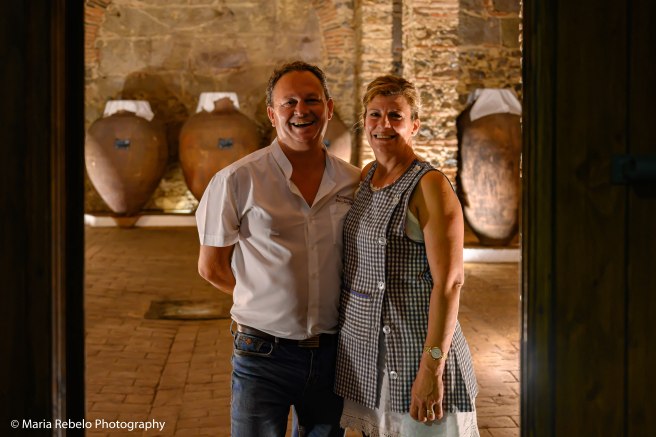
The restaurant is full of ancient amphoras inscribed with messages left by patrons praising the food and the hospitality. António Honrado told us that this place has been a tavern for more than a century. He bought it 17 years ago with his wife Jacinta to turn it into a restaurant.

In the early days, Jacinta’s mother was in charge of the cooking. But she was advanced in age and the work was hard. One day, Jacinta told her mother that they had hired a new cook who had come during the night to prepare the most popular dishes on the menu. Jacinta’s mother worried that hiring a new chef would worsen the quality of the food. But upon trying the different dishes she exclaimed: “They taste exactly like my cooking! Who prepared them?” “I did,” confessed Jacinta. Since that day, Jacinta has been the chef at O País das Uvas.

We ordered the famous Thistle Soup and Cozido de Grão, a traditional chickpea stew made with cabbage, carrots, potatoes, meats, and sausages. Both dishes have bold, satisfying flavors that made our taste buds fall in love with the simple ways of Alentejo.

After dinner, António and Jacinta invited us to see their discovery. When they did some construction on the restaurant, they uncovered a cellar that is many centuries old. It has a well-preserved clay-tile floor, graceful arches and a water well. They restored the cellar and devoted it to producing amphorae wine with the help of Paulo Laureano.

We bid farewell to António and Jacinta, promising to return. Then we went out into the warm Summer night, enchanted by the honesty of the food and the warmth of the people of Alentejo.

O País das Uvas is located at Rua General Humberto Delgado, nº19, Vila De Frades, Alentejo, tel. 284 441 023.

Paulo Laureano

Paulo Lauriano

Now we know how it feels to go from purgatory to heaven. After many hours of delays in Newark, we arrived in Lisbon and drove to Vidigueira to meet with Paulo Laureano, a famous Portuguese enologist. The encounter was five years in the making because he is a busy man and our schedules never intersected.

Paul greeted us at the door of his winery with the easy smile of a man who has found his place in the world. Many harvests ago he graduated in enology in Évora. After an internship in Australia, he was invited to teach at the university. But soon he became involved with so many wineries that he left academia to practice enology full time. He bottled the first wines under his name in 1999. Since then, he has produced a steady stream of remarkable nectars.

Our visit started with a tour of the winery. “There is no technology here,” he says proudly. “Our work is all done in the vineyards. We use old vines and we harvest the grapes by hand, that is our secret.”

Paulo is passionate about the terroir of Vidigueira. He explains to us how the hard schist soils give minerality and freshness to the wines. How the winds travel from the sea to Vidigueira to bring humidity. How the slopes of the terrain create different exposures to the sun. How the varietals change when planted in this soil. And how the indigenous varietal Tinta Grossa creates wines like no others.

Since wines cannot be understood without drinking them, Paulo took us to a tasting room that overlooks the vineyards. We started with a white wine produced from old vines made from Antão Vaz, Arinto and Fernão Pires. We would have been happy continuing drinking it, but there were more wines to taste.

Paulo showed us two wonderful wines he makes for the U.S. market. When his long-time U.S. distributor visited with his little daughter, Ema, the girl asked whether she could have her own vineyard. Remembering this endearing moment, Paulo called the white and red blends Ema’s vineyard.

Next. our glasses filled with an Old Vines Private Selection white. It showcases the brilliance of the Antão Vaz from Vidigueira. “Antão Vaz can be heavy and boring but here in Vidigueira it is always interesting and elegant,” says Paulo.

It is time for two more reds. The Old Vines Private Selection is smooth and refined, an harmonious combination of Aragonês, Trincadeira, Alicante Bouchet and Touriga Nacional.  Our tasting ended with fireworks: we tried one of the 5,000 bottles of Tinta Grossa produced in 2015. It is a remarkable wine full of depth and character.

Wherever you are, if you see a bottle of Paulo Laureano’s wine grab it without hesitation. And then you too can have a taste of these heavenly wines made in the unique terroir of Vidigueira.

Paulo Laureano’s winery is located in Monte Novo da Lisboa, Vidigueira, tel. 284-437-060.


Every cup of coffee is a voyage

Sr. Adelino Delta

It was with anticipation that we drove to Campo Maior to meet Adelino Cardoso. For 41 years he has tasted, tested and roasted the coffees made by Delta, a renowned Portuguese coffee brand.

When Adelino joined Delta, he first had to prove his worth by roasting humble ingredients like barley and chicory. It was only then that Comendador Nabeiro, the legendary founder of Delta, took Adelino under his wing and started introducing him to the secrets of coffee production.

Adelino speaks about coffee with great  passion. “Every cup of coffee is a voyage,” he tells us. “To places like Brazil, Kenya and Vietnam where the coffee is cultivated. Every day containers arrive from faraway lands.  We take samples that are visually inspected and analyzed in the laboratory. If these tests are satisfactory, we roast the beans, grind them and brew coffee. We taste the coffee in a quiet room where nothing distracts us from the appreciation of the aromas and flavors. When the coffee does not meet Delta’s rigorous standards, the container is returned to the seller. We stand by quality, we want our clients to love our coffee. Comendador Nabeiro’s motto is that every client is a friend.”

“What is the secret of producing a great blend?” we ask. Adelino hesitates because this is a naive question, one that takes a life-time of experience to answer. He finally tells us that “It is complex. At a basic level, the Arabica beans lend aroma and acidity and robusta beans lend the viscosity that we often call body or intensity. But there are many other important elements. At what altitude was the coffee produced, how and when was it harvested, how was it processed after the harvest. Then there is the roasting. How long did the roasting last, how quickly did the temperature rise, how high did the temperature get.  The coffee beans have to be ground in a way that is appropriate to the method used to brew the coffee. The amount of coffee used has to be exact. The coffee cups have to be heated before the coffee is served. All these factors determine the quality of the coffee. A good espresso has a thick hazelnut cream that protects the delicate coffee aromas. As it comes out of the machine, the last drop should be white.”

“I would like to invite you for a cup of coffee.” Adelino says.  We walk with him to the lab and watch the meticulous preparations. The way he measures the coffee and drains hot water from the machine before brewing. The way he heats the cups. Finally, the coffee comes out of the machine. “For me, the ideal espresso has 35 ml of coffee, not too short, not too long,” he says stopping the machine at the right moment. “You should not drink the coffee right after it is brewed. The coffee pours out of the machine like a wave crashing on the shore. We have to wait until it settles down.”

The coffee has a gorgeous hazelnut cream adorned by a white drop. We wait for a moment and then take a sip.  It is fantastic. We enjoy it slowly aware of the length of the journey, the depth of the knowledge, and the strength of the passion that produced this perfect cup of coffee.

You can visit Delta’s Center for Coffee Science at Herdade das Argamassas in Campo Maior, tel. 268 009 630, email geral@centrocienciacafe.com. It is a great place to learn about coffee and to enjoy a perfect cup of espresso.


Provesende, a fairy tale village

ProvesendeIn the first half of the 18th century the production of port wine was in dire straits. Inferior wines were often mixed with sugar, spices and elderberry juice to be sold off as port wine. In 1756, the Marquis of Pombal, the autocratic prime minister of King Dom José, created the Royal Company to regulate the production of port wine in order to protect its authenticity.
Pombal sent officials to define the boundaries of the Douro region and classify all its vineyards, creating one of the world’s oldest demarcated wine regions. Vineyards classified as “vinho de ramo” could only produce wine for domestic consumption. Vineyards classified as “vinho de feitoria” could export their wine. These classifications had an enormous impact on property values.

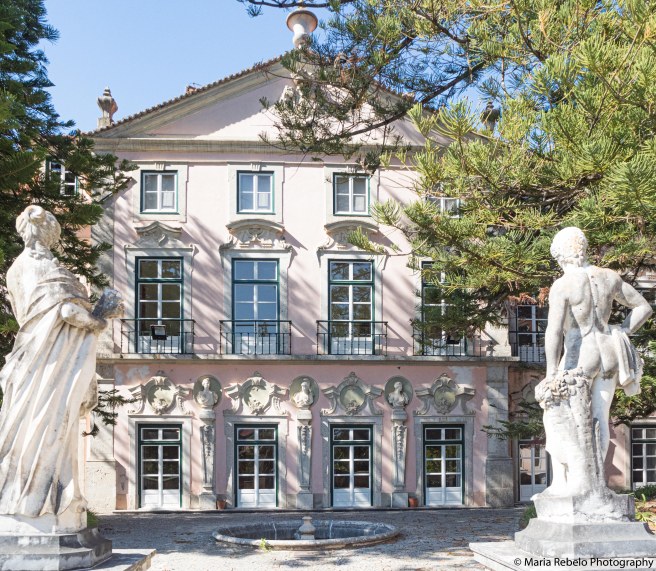
The officials charged with classifying the vineyards and regulating the port-wine trade settled in a small village called Provesende. Over the following decades, the village experienced a construction boom. Large land owners built imposing manor houses so they could spend time in Provesende and rub shoulders with government officials.

The memories of the parties hosted in these mansions have faded in time. What we have left is a charming village that belongs in a fairy tale.

The Marquis of Pombal and his dessert wine

OLYMPUS DIGITAL CAMERA

Almost everyone who visits Lisbon runs into the statue of Sebastião José de Carvalho e Melo, the Marquis of Pombal. It stands on top of a giant pedestal facing the downtown neighborhood that the Marquis helped rebuild after the 1755 earthquake.

The Marquis had a profound influence on the production of port wine.  In 1757, he ordered the first classification of port-producing vineyards, making the Douro one of the world’s oldest demarcated wine regions. He also founded the Royal Company which controlled the exports of port to England and Brazil. These measures were unpopular, but they greatly improved the quality of the port produced.

We wonder whether, after doing what he thought was right for the Douro region, the Marquis had second thoughts. He owned a large wine estate in Oeiras, in the outskirts of Lisbon, that produced an excellent fortified wine. But according to the rules he helped create, he couldn’t call it port wine. Instead, the wine was known as Carcavelos, after one of the region’s seaside villages.

An early coup for Carcavelos wines came in 1752. King Dom José gathered a collection of luxurious gifs chosen to impress the emperor of China. One of these gifts was a red velvet box with two bottles of Carcavelos wine.

Half a century later, the winds of history interceded in favor of the Carcavelos wine. When Napoleon’s troops invaded the north of Portugal, it became difficult to export port wine to England. Carcavelos wine emerged as an excellent alternative, gaining fame and prestige among British wine connoisseurs.

In the 1930s, the Carcavelos vines started to be uprooted to make space for suburban homes. As a result, wine production dwindled. In 1997, the Oeiras city council decided to invest in the preservation of the vineyards that were left, saving this historical wine from oblivion. The city also restored the palace that belonged to the Marquis of Pombal.

If you’re looking for an outing near Lisbon, a visit to this palace is a great choice. You can stroll through elegant salons and manicured gardens. And you can try a glass of Carcavelos wine. Drier than port, it has enticing aromas and exquisite flavors that enchant the senses. A sip of this nectar is a trip back in time, a taste of the wine enjoyed by a Chinese emperor and served at the lavish parties staged by the Marquis of Pombal . 

The Palace of the Marquis of Pombal is located at Largo Marquês de Pombal, in Oeiras, tel. 214.430.799. You can reach Oeiras by taking the Lisbon/Cascais train.

Lumiares, our home in Bairro Alto

Hotel Lumiares Composit

The grand palace built in the 18th century by the powerful widow of the count of Lumiares languished in ruins in the middle of Bairro Alto, an ancient neighborhood in Lisbon. Two years ago, the derelict building was transformed into a boutique hotel. The new structure preserves what remains of the old palace: imposing marble staircases and decorated doorways. But it adds to them a modern decor with humorous touches, such as  the green shades painted on the portraits that hang in the restaurant.

Instead of rooms, the hotel offers small suites equipped with everything we need to feel at home. The walls are adorned with cozy artisanal Portuguese rugs. The fridge is stocked with complimentary white wine, water and beer. The coffee machine is ready to pour a fragrant blend of arabica and robusta into elegant Vista Alegre cups.

The hotel’s best-kept secret is the wonderful rooftop, a place where we can seat above the hustle and bustle of Bairro Alto to enjoy panoramic views of St. Jorge’s castle and the Tagus river. How sweet it is to stay at Lumiares!

The Lumiares hotel is located at Rua do Diário de Notícias 142, Lisbon, tel. 21 116 0200. Click here for the hotel’s website. 

Taberna Sal Grosso

Taberna Sal Grosso

When we arrived at number 22, Calçada do Forte in Lisbon’s old Alfama neighborhood, there was a group of people congregated around the door. They were all trying to get a table in a small restaurant called Taberna do Sal Grosso (Coarse Salt Tavern). An exasperated waiter explained that he could not bend the laws of physics to accommodate more guests. No one was happy with the news that miracles could not be made. We too walked away disappointed. But we were so intrigued by the tavern’s atmosphere that we made reservations for lunch two days later.

As soon as we sat for lunch, it became obvious why the place is so popular. It serves delicious food with a happy vibe at modest prices. This trio of qualities is rare. It is hard to keep the quality of the food consistent and feel happy about serving inexpensive meals. Joaquim Saragga, the chef and owner, manages to do it because because he views his restaurant as more than just a business.

Joaquim lost his job, so he decided to change his life. When he was a student in London,  he used to cook for his roommates. He remembered feeling happy in the kitchen, so he enrolled in culinary school and went on to complete a Masters in gastronomy.

When he opened the tavern in 2015, he shunned the tricks that most eateries use to become more profitable. There are no couvert charges. He serves only two inexpensive but very drinkable house wines and a few artisanal beers. Desserts are modestly priced.

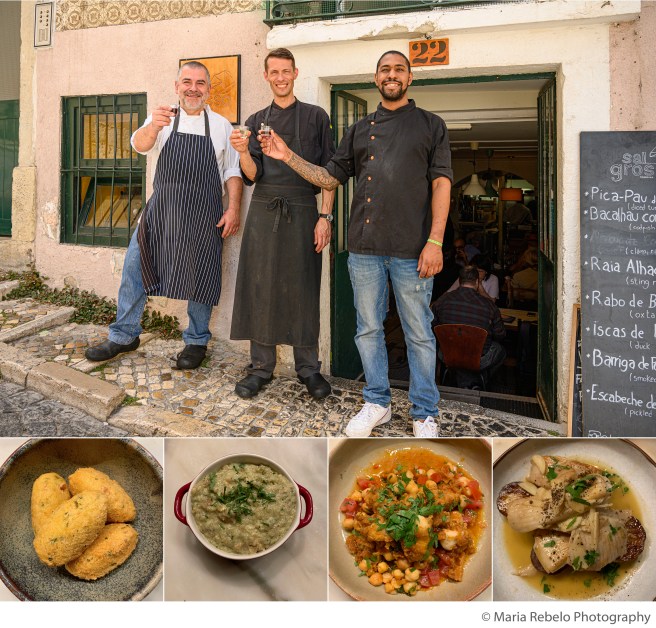
“I’m not trying to innovate, only to serve my favorite traditional recipes prepared with local, seasonal ingredients. I cook the food I like to eat.” he told us. Everything we tried was perfect: a watercress and orange salad, codfish cakes, manta ray and garlic, oxtail with quince, codfish and chickpeas.  “I needed to create my own job,” he explained, “but I also wanted to create a place where people feel at home.”

We proposed to take a photo of the staff at the door of the restaurant but then another wave of guests came in. Joaquim asked one of the chefs and the waiters to pose for us but he stayed inside the restaurant, clearing the tables and welcoming people. It is this dedication to serving others that make Taberna do Sal Grosso such a special place.

Taberna do Sal Grosso is located at Calçada do Forte, 22. Reservations are a must. They do not accept phone reservations. Reservations can only be made by sending a message through Facebook. You need to receive a confirmation in order for the reservation to be valid.