Guided by the stars

In the early 16th century, Lisbon was one of the world’s richest cities. A constant stream of caravels departed to far-away destinations like India and Brazil. Some of these ships perished tragically on the high seas. The ones that returned brought their hulls crammed with gold, silver, and spices. 

During the day, sailors relied on the sun to measure their latitude. At night, they were guided by the stars. Skilled pilots pointed sextants at the sky to estimate the ship’s position and evaluate its course. On the last night of the year, we too look at the stars for guidance on where we are and what lies ahead. We hope they can point us all to a blissful, healthy New Year that brings us back to Portugal.

Lisbon’s palatial surroundings

One curious fact about Lisbon is that there are few palaces in the center and many in the outskirts of the city. Before 1755, Lisbon was an overcrowded place where pestilence could quickly spread. So, the royal family and the aristocrats liked to build palaces away from the crowds, in places where the air was pure. 

King John I built the Sintra town palace in 1415, which became a perennial favorite of the royal family. King John V used the riches from Brazil to finance the construction of an imposing palace in Mafra in 1717.  Dom Pedro de Bragança, a prince who married his niece, Queen Dona Maria I, erected an exquisite palace in Queluz in 1747. 

We are lucky that all these palaces were built away from the capital. In November 1, 1755 a massive earthquake destroyed much of Lisbon, including the royal palace at Terreiro do Paco and many other architectural jewels. From the rubles of the earthquake, the Marquis of Pombal, King Dom José’s powerful prime minister, created a new city where large avenues replaced the meandering medieval streets. The old ornate palaces gave way to the simpler but sturdier buildings that we still see in the downtown district.

If you visit Lisbon, make some time to travel to its surroundings to experience the palatial riches of a time gone by.

The shark’s beach

IMG_2617

Roger Sobreiro, an American wine merchant of Portuguese descent, recommended a small restaurant called A Praia do Tubarão (the shark’s beach) that is his safe harbor when he visits Portugal. We drove to the picturesque town of Costa Nova to try it out.

The restaurant’s facade is painted with the traditional red and white stripes used to decorate fishermen houses. The same red and white palette dominates the cosy interior where Adriano Ferreira, the owner, was waiting for us. He has worked in Costa Nova for 50 years, first as a waiter and then, in the last three decades, together with his wife at A Praia do Tubarão.

“I hunt and fish and all hunters and fishermen are liars,” he said as a way of introduction. Despite this forewarning, we asked Adriano to choose our lunch menu.  “Most of our food is served in the pots where it is cooked: caldeiradas (boulliabaisses) , “ensopados,” and seafood rices. We follow two simple rules: everything is fresh and everything is cooked to order,” he explained.

Adriano went into the kitchen and returned with a plate of petinga (small sardines) and tiny fried balls of berbigão rice. Then, he poured two generous glasses of the wonderful Duas Quintas white from Ramos Pinto. The petinga was crisp, hot, luxuriously fresh and perfectly fried. The rice balls were flavorful and deeply satisfying.

We ate an “ensopado,” a plate made with fish, potatoes, onions, garlic, and olive oil. It is seasoned with “sal d’unto,” a salt and lard combination. It comes with a sauce called “alhada,” made from garlic, lemon and piri piri. The flavors blend to create a unique taste and aroma. The quality of the ingredients and the cooking is superb.

Dessert was a small bowl of the traditional “ovos moles,” a convent sweet made with egg yolks and sugar. The meal ended with a vibrant espresso made with Delta’s famous diamond blend.

We said goodbye to Adriano and promised to be back soon to this welcoming place that serves delicious traditional food.

A Praia do Tubarão is located at Rua José Estevão, 136, Costa Nova Prado, Ilhavo, tel. 234 369 602.

Pristine fish at Taberna do Valentim

OLYMPUS DIGITAL CAMERA

We met Valentim, the chef and owner of Taberna Valentim in Viana do Castelo, as soon as we entered the restaurant. He was working hard at the grill but took time to show us the superb mullets that had just been delivered. “The seas are often rough during Winter so at times we have to close the restaurant because we can’t find fresh fish of the quality we seek. These mullets came from Póvoa do Varzim. The sea was rough yet the fishermen still went out. Their fish is gorgeous but the they take too much risk to catch it.”

Taberna do Valentim has offered the same small menu for 40 years: pristine seasonal fish perfectly grilled, fish rice, “ensopado de peixe,” a fish stew prepared with white pepper and served on bread toasts, and caldeirada (bouillabaisse). The quality is high and prices are modest so the place is always packed.

After a very satisfying lunch, we resumed our conversation with Valentim.  “I started working when I was 8, serving glasses of wine and codfish cakes in my mother’s tavern,” he told us. “Then, I began to cook, so I’ve been cooking for a long time. But time is not what’s important. Passion is. Unless you have passion for what you do you’ll never be great at it.” This passion is evident in everything that comes to the table at Taberna Valentim.

Taberna Valentim is located at Avenida Campo do Castelo nº45 in Viana do Castelo, tel. 258-827-505.

The generosity of cork oaks

Cork Trees Ravasqueira

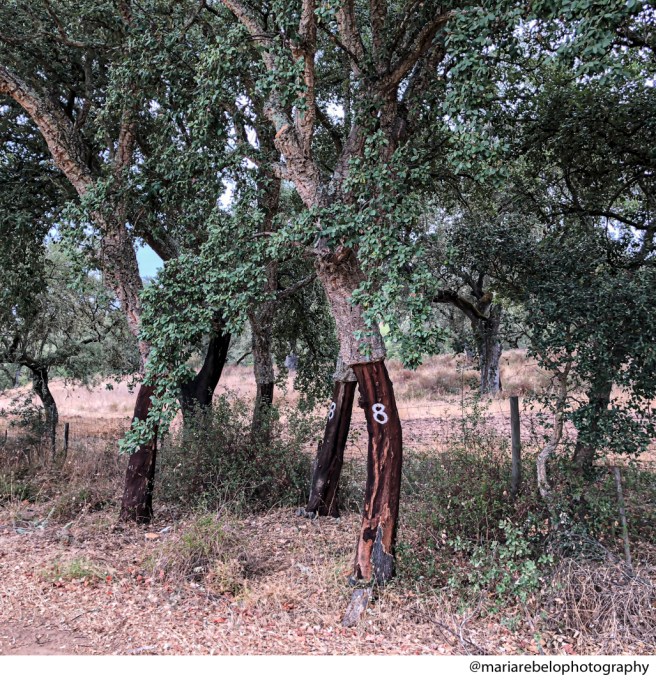
Cork oaks are generous trees. They provide homes to the birds that nest on their branches and nourishment to the black pigs that feed on their acorns. The bark of the oak tree is manually stripped to produce cork, a natural material known since ancient times for its versatility. Pliny the Elder writes in his Natural History that the bark can be used to make anchors, drag-ropes, and shoe soles. The bows and keels of the ships used by Portuguese navigators were made of cork.

After each stripping, the oak bark grows back. The first stripping generally occurs when the tree is 25-year old. Subsequent strippings follow a nine-year cycle. Trees are marked with a number that indicates the time of the last stripping. It takes 43 years for the bark to be thick enough to produce wine corks. So, most wine corks come from oaks that are much older than the wine they protect.

Cork oaks live for roughly two centuries. Their roots make them resilient to winds and droughts so they can grace the landscape of Portugal with their generosity and beauty.

Dining with the minister at Campo Maior

Taberna O Ministro

We strolled around in Campo Maior, a small town in Alentejo close to the border with Spain, looking for a place for lunch. We noticed a tavern called O Ministro (the minister) which was full of locals. There was a bottle of Caiado–the wonderful entry wine from Adega Mayor—on every table. Encouraged by these favorable omens, we decided to enter.

Traditional music played in the background, mostly fado tunes about the travails of love and the fickleness of life. Every now and then, a folk song from Alentejo came on and the locals raised their voices to sing along.

A plate with codfish cakes, slices of sausage, and green olives arrived at the table. We ordered “migas” made with bread and turnips and fried cação, a small shark that somehow manages to swim from the coast to the menus of Alentejo. We also ordered “carne do alguidar,” marinated pork loin. We were astonished by the quality of everything that came to the table. It was delicious and deeply satisfying food, with a perfect sense of time and place.

João Paulo Borrega, the chef and owner of this magical restaurant came out of the kitchen, and stoped by each table to ask whether people liked his food. “The food is fantastic,” we told him. “Can we make reservations for dinner and arrive a little early to talk to you?” Sure, he said with a bemused smile.

Late in the afternoon, he sat down to talk with us. Like most Alentejo cooks, he learned cooking from his mother and grandmother. His restaurant opened in 1989 and has changed location over the years. It is named after João Paulo’s father, a man whose role in the revolutionary days after April 1974 earned him the nickname “the minister.”

João Paulo tells us that the current restaurant location is ideal. “I want to cook by myself, and this space has the maximum number of tables I can comfortably handle.” He talks enthusiastically about his favorite recipes: fried rabbit, toasted chicken, chickpea soup, and ensopado de borrego (lamb stew).

“Why does your food taste so good?,” we asked. “I am going to show you my secret,” he said, inviting us into the small kitchen. He pointed to an old, tiny refrigerator. “Everything I use I buy fresh every day. That is why I have no freezer, just this small refrigerator. At the end of the day I give away any leftovers to my friends. The next day I start everything from scratch. Meats, fish, vegetables, herbs, sauces, everything has to be fresh.”

All his products are local and seasonal, produced by people he knows. He rattled off the names of the friends who supply him: the olive-oil maker, the farmer who plants the potatoes and onions, the person who chooses ripe melons for his table; the list goes on. The quality of his sourcing would make many three-star chefs envious.

João Paulo talks with great knowledge about the details of the different recipes and the properties of various herbs and spices. “People often use too much laurel. That is a mistake,” he says. “Laurel is very powerful and can overwhelm other ingredients.” “The cuisine of Alentejo does not require much fussing around,” he explains. “But the ingredients need to be first rate and the last flourishes before the dish is brought to the table have to be perfect. Some dishes are finished with white wine, others with vinegar, herbs play a key role.”

We sat down for a wonderful dinner. It started with toasted chicken perfumed with vinegar and prepared with olive oil, garlic and parsley. Then came a steaming chickpea soup with Alentejo sausages, Savoy cabbage, carrots, and mint. Next, we tried the fried rabbit. The meat had been  marinated with rosemary, thyme, pepper, white and red wine. Then it was stewed to perfection in a large iron-cast pan with olive oil, garlic, and some more wine. Delicious slices of ripe melon brought this memorable meal to a sweet finale.

No matter how much you travel, it is hard to find food that is as simply satisfying as the one served in this little tavern in Alentejo. If you have a chance, come to Campo Maior to dine with the minister.

Taberna O Ministro is located at Travessa dos Combatentes da Grande Guerra
Campo Maior, Portalegre, tel. 351-965-421-326.

Provesende, a fairy tale village

ProvesendeIn the first half of the 18th century the production of port wine was in dire straits. Inferior wines were often mixed with sugar, spices and elderberry juice to be sold off as port wine. In 1756, the Marquis of Pombal, the autocratic prime minister of King Dom José, created the Royal Company to regulate the production of port wine in order to protect its authenticity.
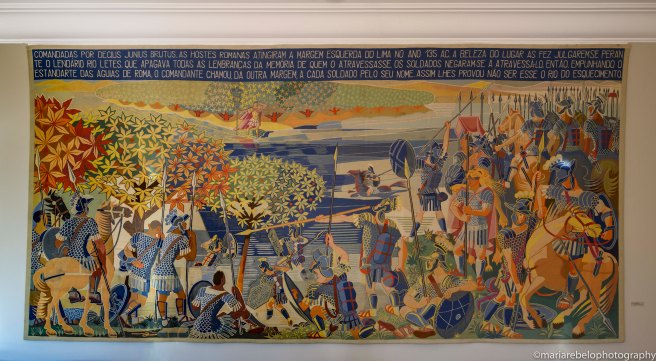
Pombal sent officials to define the boundaries of the Douro region and classify all its vineyards, creating one of the world’s oldest demarcated wine regions. Vineyards classified as “vinho de ramo” could only produce wine for domestic consumption. Vineyards classified as “vinho de feitoria” could export their wine. These classifications had an enormous impact on property values.

The officials charged with classifying the vineyards and regulating the port-wine trade settled in a small village called Provesende. Over the following decades, the village experienced a construction boom. Large land owners built imposing manor houses so they could spend time in Provesende and rub shoulders with government officials.

The memories of the parties hosted in these mansions have faded in time. What we have left is a charming village that belongs in a fairy tale.

Dona Antónia’s great grandson

Composite Quinta S. José

João Brito e Cunha is the great grandson of the legendary Dona Antónia Ferreira, the woman who shaped the future of wine production in the Douro valley.  Born in 1811 to a family of rich wine makers, Dona Antónia seemed destined to enjoy a life of leisure. Instead, she had to contend with two plagues that decimated European vineyards, the oidium in 1850 and the phylloxera in 1870. Dona Antónia rose to the occasion, making shrewd choices and taking calculated risks. She made great wine and amassed a large fortune. When she died in 1896, she owned 24 wine estates and huge wine cellars in Vila Nova de Gaia.

João’s grandfather was a taster for the renowned Real Company Velha. His father managed the famous Quinta do Vesuvio, which in Dona Antónia’s time produced some of the most expensive wines in the Douro valley.

We tell you this family history so that you know that João Brito e Cunha had no choice, the love of wine runs in his blood. He studied enology, first in Vila Real’s UTAD and then in Australia. He interned in Champagne and in many other wine regions. When he felt ready, he bought Quinta Dom José from his father and moved to the estate with his wife Sofia and their kids.

We arrived at Quinta Dom José late in the afternoon, just as the sun was getting tired of making the brilliant light that shines on the Douro valley. João is very intense and his energy is contagious. He wanted to show us everything, the vines, the cellars, the different viewpoints. As soon as we got into his jeep, he accelerated up the steep, treacherous road leaving being a colorful dust cloud.

We stopped on a hill top with breathtaking views of the Douro river. João wants us to understand that in a region where beauty abounds, this quinta is like no other. He shows us with pride the schist soil that preserves humidity during the scorching Summers and the vine roots that dig deep in search of water.

João drove us up to the tasting room to try his wines. The Flor de São José white Reserva is an aristocratic wine that enchants the palate with its refined elegance. The Touriga Nacional Reserva is an indulgent red, with a full body and an understated intensity. The Grande Reserva is a profound wine, full of wisdom, finesse and subtlety. The 3,400 bottles produced last year quickly sold out.

We stayed in the terrace outside the tasting room talking to João for hours. It was a warm night with a sky full of stars.  A choir of crickets sang in the background. João told us about his vines, his wines and his dreams.

Dona Antónia regretted every moment she spent away from the Douro. João feels the same way–he inherited his great grandmother’s passion for the Douro valley. And like her, João is destined to make great wine.

Quinta de São José is located on Ervedosa do Douro, tel. 93 4041413. Click here for their website. 

Caldo verde

Caldo Verde

Caldo verde (green broth) is the most Portuguese of soups. It comes in different versions but Maria de Lurdes Modesto, the doyenne of traditional Portuguese cooking, recommends a simple preparation used in the village of Marco de Canaveses.  Here’s the recipe.

Gently boil 500 grams of potatoes, 3 garlic cloves, one sliced chouriço (meat sausage) and some olive oil.  Crush the potatoes with a masher. Add the shredded Galician cabbage for just a couple of minutes (avoid overcooking the cabbage). Dress the soup with olive oil. Serve, preferably in a clay bowl, and accompany with broa, a Portuguese corn bread.

The soup has the colors of the Portuguese flag: green from the cabbage, red from the sausage, and yellow from the olive oil. You find caldo verde everywhere: in homes and restaurants, in places where fado singers gather, and in festivals and fairs. The soup is so popular that vendors in farmers’ markets have a special shredder to make the distinctive strips of Galician cabbage that are the hallmark of caldo verde.

As with many traditional recipes, the origin of this soup is lost in time. There’s no recipe for caldo verde in the cookbooks written by Domingos Rodrigues in 1680 or by Lucas Rigaud in 1780. But these chefs worked for the royal family, so they probably shunned peasant cooking. The soup is mentioned in several 19th century literary works and it is the first recipe in Culinária, an influential cookbook published in 1928 by António Maria de Oliveira Bello.

Caldo verde is often served at midnight on New Year’s eve. Its comforting taste helps everyone feel warm and optimistic about the New Year!


The art of growing old

OLYMPUS DIGITAL CAMERA

A friend brought a precious gift to a recent dinner party:  a bottle of Madeira from 1853! The wine was produced at a time when the future of Madeira looked bleak. Robert White and James Johnson in the 2nd edition of their book “Madeira its Climate and Scenery,” published in 1856, offered the following prognosis:

“The wine of Madeira, which has acquired worldwide celebrity, will soon be no more than a thing of history. In the Spring of 1852, a disease suddenly showed itself which, in process of time, destroyed the grape and ruined the prospects of the hardly-tasked cultivators. […] it is calculated that in two or at most three tears not a pipe of wine will be left in the island.”

The disease was caused by a fungus called oidium tuckeri. According to White and Johnson, production dwindled from roughly 8,000 pipes in 1851 to roughly 2,000 pipes in 1854. Luckily, the discovery that oidium could be controlled by dusting the vines with sulphur saved Madeira’s vineyards from oblivion.

It was with great expectation that we broke the 165-year-old crimson seal to persuade the steadfast cork to retire from the job of guarding the priceless nectar. The wine left the bottle full of vigor, with a crystalline amber color and an enchanting aroma. No wonder Madeira was once used as a perfume in the court of Russia!

Less sweet than more recent vintages, the taste has an elegant “vinagrinho,” the name for the volatile acidity produced by the passage of time. It is a wine that has much to teach us about the art of growing old.