Calçada Portuguesa (Portuguese cobblestone) is a mosaic pavement built with cubes made of limestone and basalt. Each stone is carefully cut and laid by hand by a master “calceteiro.” It takes months, sometimes years to build these majestic pavements. So, if you visit Portugal, by all means, look up to see the cerulean blue sky, the castles on hilltops, the seagulls gliding on the wind. But do not miss the beauty beneath your feet.
Beneath your feet, Maria Rebelo, gelatin silver print, 2003.
That’s what the Roman poet Marcus Lucanus wrote about Troy. It means “no stone is without a name.”
Portugal has beautiful scenery, wonderful food, perfect weather. But what makes this country truly unique is its history. Africans, Celts, Jews, Moors, Phoenicians, Romans, Suevi, Visigoths, they all shared this corner of the world. They all left their marks on the Portuguese landscape. Monuments to their triumphs, ruins from their defeats are everywhere. No stone is without a name.
Fernando Pessoa, Rui Barreiros Duarte, ink on paper, 2012.
It is not easy to write about the great poet Fernando Pessoa. Even if we weight every syllable, our words are still too heavy to describe his graceful prose and sublime rhyme. So, perhaps we should stick to the facts.
Pessoa was born in Lisbon in 1888. His father, a journalist, died when he was young. His mother remarried and moved to Durban, South Africa, where Pessoa received a British education.
After returning to Lisbon in 1905, Pessoa earned a modest living making translations and writing business letters. He published poems, essays and literary criticism, but remained unknown during his lifetime.
Many of his poems were written in coffee shops, at Brasileira in Chiado or in Terreiro do Passo’s Martinho da Arcada. He wrote under different identities, each with its own personality and distinctive style. Some say that Pessoa and his four major pen names, Álvaro de Campos, Ricardo Reis, Alberto Caeiro, and Bernardo Soares are the five finest Portuguese poets.
Pessoa died in 1935, at age 47, one year after publishing his first major book, The Message. He left a literary treasure trove: a trunk full of poetry and prose, including The Book of Disquiet, which, published in 1982, created a new wave of interest in the poet.
Reading Pessoa can change your life, at least that’s what happened to the Italian writer Antonio Tabucchi. A chance encounter with Pessoa’s poem “A Tabacaria” (The Tobacco Shop) made him fall in love with the poet’s work and with the language and culture of Portugal.
Here are the first lines of “A Tabacaria” translated by Richard Zenith. Read them at your own peril.
“I’m nothing.
I’ll always be nothing.
I can’t want to be something.
But I have in me all the dreams of the world.”
TAP, Portugal’s national airline, is not immune to the cost cutting pressures common to the industry. But it has a new fleet of large, confortable Airbus airplanes and it is promoting a warm attitude that you can feel in this music video that gathers the Portuguese Mariza, the Angolan Paulo Flores, and the Brazilian Roberta Sá.
When you set foot on a TP flight, you are already in Portugal and magical moments can happen. On a recent flight, a passenger was about to fill a glass with water from a bottle sitting on the counter in the kitchen area. A stewardess quickly intervened saying, “that is my bottle, let me open one for you.” Then, to ease the awkwardness of the moment, she pointed to her bottle and said: “I kissed that water; if you drank it you would learn all my secrets.” Any airline can get you from here to there, handle baggage, count frequent-flyer miles. But which other airline provides such spontaneous moments of poetry?
Raul Lino is a Portuguese architect who was influential in the first half of the 20th century. In an era shattered by two World Wars and the Great Depression, Lino craved the stability and permanence that he associated with tradition. He codified this tradition, inherited from the Romans and adapted throughout the centuries, creating the archetypal Portuguese house. Using stone, brick, and terracotta roof tiles, he designed homes that infused the vernacular architecture with proportion and elegance. Some felt that Lino should have looked forward instead of backwards, adopting the modernism of Le Corbusier and Mies van der Rohe. But, by embracing the past, he helped preserve the sense of place that we feel when we see a Portuguese house.
In 1912, Raul Lino built a private residence for his family, the “Casa do Cipreste” in Sintra. It is perched on a hill, overlooking the Sintra Palace. Thanks to the blog of Rui Morais de Sousa, a virtuoso of large-format photography, we can visit this graceful home with just the click of a mouse (here). What a privilege!
It is great fun to read John Murray’s “Handbook for Travellers in Portugal,” published in London in 1864. He warns that, to explore far-distant valleys, hills, and mountains, the tourist in Portugal “must be prepared for poor accommodation, poor food, and great fatigue.” But, at the same time, “to one who is in pursuit of scenery, more especially to the artist, no other country in Europe can possess such attractions and such freshness of unexplored beauty.”
So much has changed in the last 150 years! You can now travel throughout Portugal in great comfort, eating delicious food, and staying in elegant hotels, pousadas and bed and breakfasts. But, what remains unchanged, is the freshness of the country’s beauty. Take a look!
Archaeologists discovered 2,000 year-old Egyptian honey that is still in good condition. This longevity stems from the honey’s remarkable purity.
There are a number of Portuguese beekeepers that strive for this purity. They spurn the industrialized processes that sacrifice the bees to extract the honey. They shun the additives used to keep the honey from crystalizing during Winter. Some produce honey from the nectar and pollen of a single flower species, such as eucalyptus, lavender, or rosemary. Others produce multifloral honey, extracted only after the bees feasted on flowers from all seasons, from the wild flowers that bloom after the Winter rains to the fleeting pumpkin flowers that bloom only for a day.
It takes a little effort to find this superior artisan honey. It is mostly sold in farmers markets (one of our favorite producers, Miguel Evaristo, sells his honey at the Lourinhã fair on the last Saturday of each month). But, once you buy it, you can take your time enjoying it. It is good for 2,000 years.
We know nothing about the biology of the lingueirão (Portuguese razor clam). All we know is that, when steamed, it releases the scent of the ocean and we feel we are on the high seas. Use the cooking water to make lingeirão rice and the result is a dish with complex flavor. Guests will think you have been cooking for hours, reducing sauces, combining delicate infusions. And all you did was take advantage of the amazing biology of the lingueirão.
Americans discovered France, Italy, and more recently,
Spain, as vacation destinations. But Portugal has remained terra incognita. That is changing. The New York Times has written a steady stream of articles about Portugal. Most are about Lisbon; about the places to go, the culinary renaissance, the new restaurants, the new museums, the relaxed atmosphere, and the art scene. But the Times has also discovered Cascais and Évora. The Wall Street Journaltells its readers that “In Portugal you can pack seven days worth of castles, clubbing, seafood, shopping and luxury hotels into one perfectly affordable long weekend.” Now, perhaps Woody Allen will consider directing a movie about a writer who comes to Lisbon and discovers that the secret to eternal youth is a daily bath of piri-piri sauce.
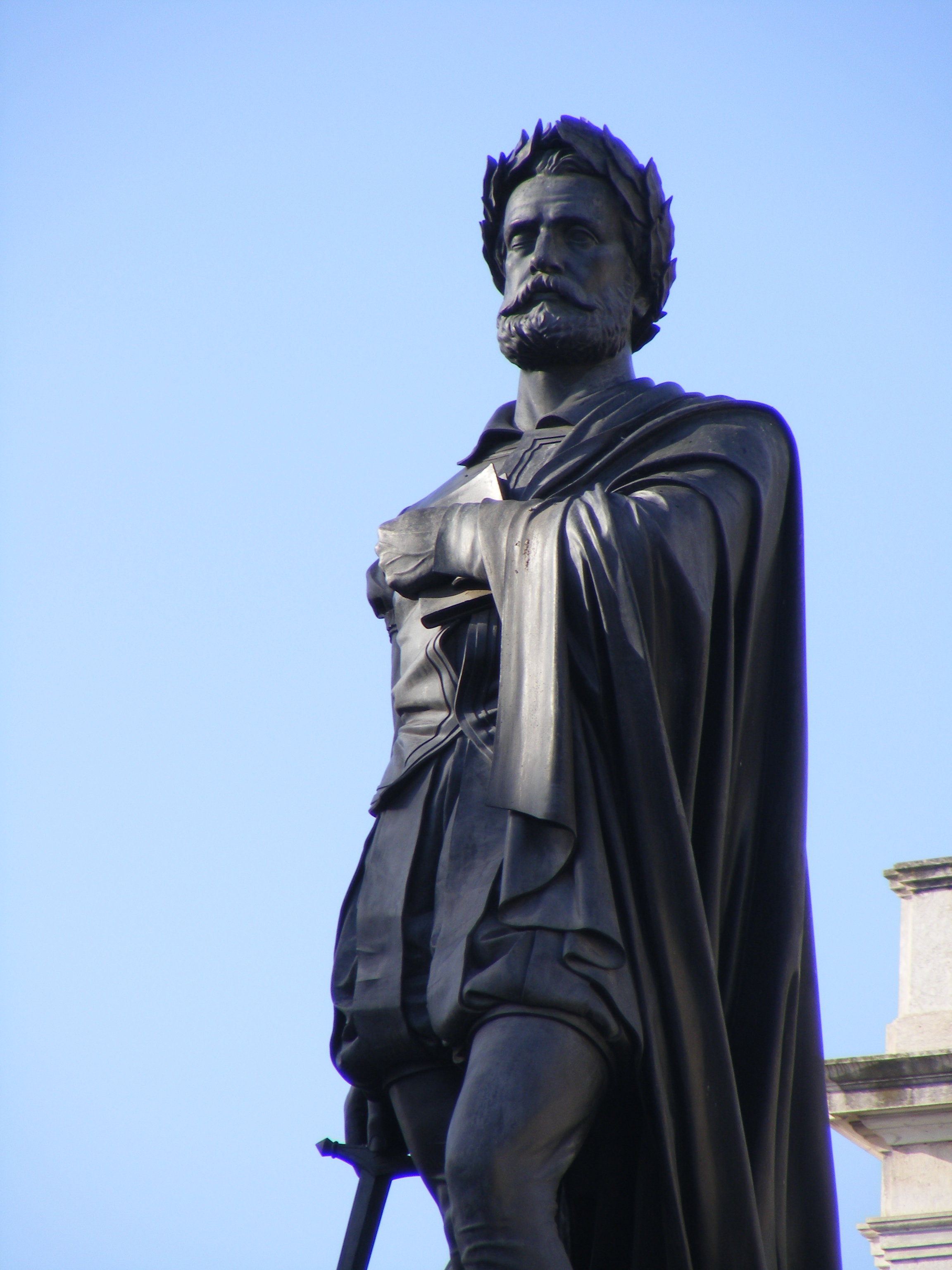
The great poet Luís Vaz de Camões published his masterpiece, the Lusíadas, in 1572. In the first part of this epic ode we learn that the fate of Portugal is being decided in Greece. The Greek gods (called by their Roman names) are divided into two parties. Bacchus is the nemesis of Portugal. With the help of Neptune, he sows unexpected obstacles and unending perils on the path of the Portuguese. But Venus takes up the cause of Portugal. And, with her thoughtful help, the Portuguese show that they can accomplish great things.