Paulo Laureano

Paulo Lauriano

Now we know how it feels to go from purgatory to heaven. After many hours of delays in Newark, we arrived in Lisbon and drove to Vidigueira to meet with Paulo Laureano, a famous Portuguese enologist. The encounter was five years in the making because he is a busy man and our schedules never intersected.

Paul greeted us at the door of his winery with the easy smile of a man who has found his place in the world. Many harvests ago he graduated in enology in Évora. After an internship in Australia, he was invited to teach at the university. But soon he became involved with so many wineries that he left academia to practice enology full time. He bottled the first wines under his name in 1999. Since then, he has produced a steady stream of remarkable nectars.

Our visit started with a tour of the winery. “There is no technology here,” he says proudly. “Our work is all done in the vineyards. We use old vines and we harvest the grapes by hand, that is our secret.”

Paulo is passionate about the terroir of Vidigueira. He explains to us how the hard schist soils give minerality and freshness to the wines. How the winds travel from the sea to Vidigueira to bring humidity. How the slopes of the terrain create different exposures to the sun. How the varietals change when planted in this soil. And how the indigenous varietal Tinta Grossa creates wines like no others.

Since wines cannot be understood without drinking them, Paulo took us to a tasting room that overlooks the vineyards. We started with a white wine produced from old vines made from Antão Vaz, Arinto and Fernão Pires. We would have been happy continuing drinking it, but there were more wines to taste.

Paulo showed us two wonderful wines he makes for the U.S. market. When his long-time U.S. distributor visited with his little daughter, Ema, the girl asked whether she could have her own vineyard. Remembering this endearing moment, Paulo called the white and red blends Ema’s vineyard.

Next. our glasses filled with an Old Vines Private Selection white. It showcases the brilliance of the Antão Vaz from Vidigueira. “Antão Vaz can be heavy and boring but here in Vidigueira it is always interesting and elegant,” says Paulo.

It is time for two more reds. The Old Vines Private Selection is smooth and refined, an harmonious combination of Aragonês, Trincadeira, Alicante Bouchet and Touriga Nacional.  Our tasting ended with fireworks: we tried one of the 5,000 bottles of Tinta Grossa produced in 2015. It is a remarkable wine full of depth and character.

Wherever you are, if you see a bottle of Paulo Laureano’s wine grab it without hesitation. And then you too can have a taste of these heavenly wines made in the unique terroir of Vidigueira.

Paulo Laureano’s winery is located in Monte Novo da Lisboa, Vidigueira, tel. 284-437-060.


Provesende, a fairy tale village

ProvesendeIn the first half of the 18th century the production of port wine was in dire straits. Inferior wines were often mixed with sugar, spices and elderberry juice to be sold off as port wine. In 1756, the Marquis of Pombal, the autocratic prime minister of King Dom José, created the Royal Company to regulate the production of port wine in order to protect its authenticity.

Pombal sent officials to define the boundaries of the Douro region and classify all its vineyards, creating one of the world’s oldest demarcated wine regions. Vineyards classified as “vinho de ramo” could only produce wine for domestic consumption. Vineyards classified as “vinho de feitoria” could export their wine. These classifications had an enormous impact on property values.

The officials charged with classifying the vineyards and regulating the port-wine trade settled in a small village called Provesende. Over the following decades, the village experienced a construction boom. Large land owners built imposing manor houses so they could spend time in Provesende and rub shoulders with government officials.

The memories of the parties hosted in these mansions have faded in time. What we have left is a charming village that belongs in a fairy tale.

The perfect wine party

Goliardos

A group of wine connoisseurs called “Os Goliardos” turned their love of wine into a business–they distribute interesting artisanal wines, made with passion and respect for the land.

Every year in July, the Goliardos invite a group of their favorite wineries to showcase their wines at an event called Vinho ao Vivo (Wine Live). The setting is À Margem, an esplanade by the Tagus river with a view to the tower of Belém on one side and the monument to the discoveries on the other.

Portuguese wineries share the stage with producers from France, Spain, Germany and Italy.  There are musicians serenading our ears and food producers filling our bellies with black-pork prosciutto, sausages, oysters, cheese and much more. It is the perfect wine party. If you missed it this year, mark your calendar for next year.  And get a few bottles from the Goliardos’ wine list, they’ll make the wait seem much shorter.

You can find Os Goliardos at Rua General Taborda, nº91, in Lisbon’s Campolide neighborhood. They can be reached by phone (213 462 156) or email info@osgoliardos.com. Click here for their website.

Lumiares, our home in Bairro Alto

Hotel Lumiares Composit

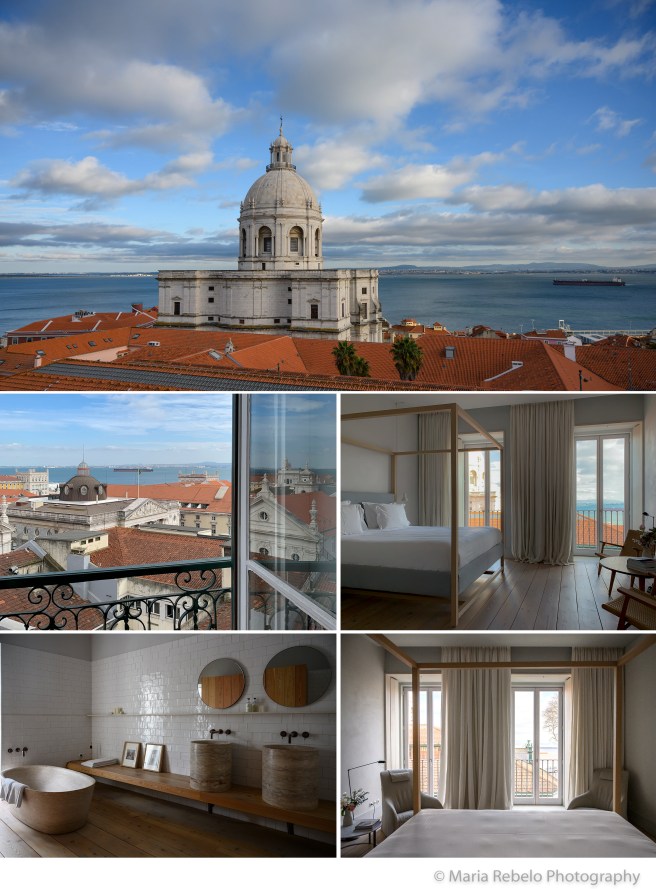
The grand palace built in the 18th century by the powerful widow of the count of Lumiares languished in ruins in the middle of Bairro Alto, an ancient neighborhood in Lisbon. Two years ago, the derelict building was transformed into a boutique hotel. The new structure preserves what remains of the old palace: imposing marble staircases and decorated doorways. But it adds to them a modern decor with humorous touches, such as  the green shades painted on the portraits that hang in the restaurant.

Instead of rooms, the hotel offers small suites equipped with everything we need to feel at home. The walls are adorned with cozy artisanal Portuguese rugs. The fridge is stocked with complimentary white wine, water and beer. The coffee machine is ready to pour a fragrant blend of arabica and robusta into elegant Vista Alegre cups.

The hotel’s best-kept secret is the wonderful rooftop, a place where we can seat above the hustle and bustle of Bairro Alto to enjoy panoramic views of St. Jorge’s castle and the Tagus river. How sweet it is to stay at Lumiares!

The Lumiares hotel is located at Rua do Diário de Notícias 142, Lisbon, tel. 21 116 0200. Click here for the hotel’s website. 

Taberna Sal Grosso

Taberna Sal Grosso

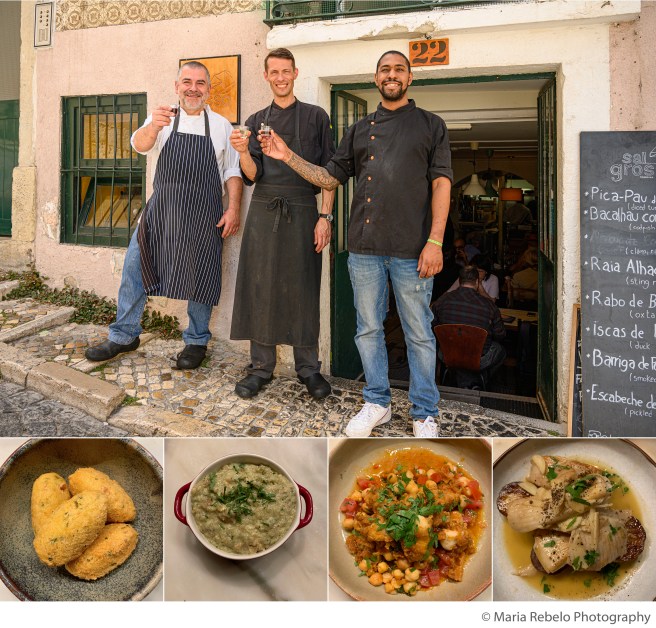
When we arrived at number 22, Calçada do Forte in Lisbon’s old Alfama neighborhood, there was a group of people congregated around the door. They were all trying to get a table in a small restaurant called Taberna do Sal Grosso (Coarse Salt Tavern). An exasperated waiter explained that he could not bend the laws of physics to accommodate more guests. No one was happy with the news that miracles could not be made. We too walked away disappointed. But we were so intrigued by the tavern’s atmosphere that we made reservations for lunch two days later.

As soon as we sat for lunch, it became obvious why the place is so popular. It serves delicious food with a happy vibe at modest prices. This trio of qualities is rare. It is hard to keep the quality of the food consistent and feel happy about serving inexpensive meals. Joaquim Saragga, the chef and owner, manages to do it because because he views his restaurant as more than just a business.

Joaquim lost his job, so he decided to change his life. When he was a student in London,  he used to cook for his roommates. He remembered feeling happy in the kitchen, so he enrolled in culinary school and went on to complete a Masters in gastronomy.

When he opened the tavern in 2015, he shunned the tricks that most eateries use to become more profitable. There are no couvert charges. He serves only two inexpensive but very drinkable house wines and a few artisanal beers. Desserts are modestly priced.

“I’m not trying to innovate, only to serve my favorite traditional recipes prepared with local, seasonal ingredients. I cook the food I like to eat.” he told us. Everything we tried was perfect: a watercress and orange salad, codfish cakes, manta ray and garlic, oxtail with quince, codfish and chickpeas.  “I needed to create my own job,” he explained, “but I also wanted to create a place where people feel at home.”

We proposed to take a photo of the staff at the door of the restaurant but then another wave of guests came in. Joaquim asked one of the chefs and the waiters to pose for us but he stayed inside the restaurant, clearing the tables and welcoming people. It is this dedication to serving others that make Taberna do Sal Grosso such a special place.

Taberna do Sal Grosso is located at Calçada do Forte, 22. Reservations are a must. They do not accept phone reservations. Reservations can only be made by sending a message through Facebook. You need to receive a confirmation in order for the reservation to be valid.
Where great views and delicious food go together

EPUR

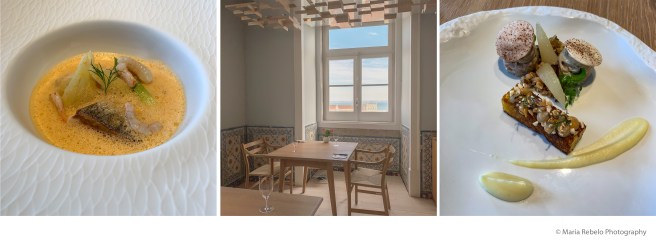
It is often said that restaurants with good views serve lousy food. This aphorism doesn’t apply to EPUR, chef Vincent Farges’ new restaurant in Lisbon. Its windows offer beautiful views of the Tagus river and the rooftops of downtown Lisbon. But, once the food arrives, it is hard to choose between looking out the window and admiring the elegance of the sustenance on our plate. When we taste the food, our brain’s ability to process pleasurable sensations has to stretch even further.

Served on graceful white plates, the food looks ready for a Vogue photoshoot. Its beauty is not superficial, it stems from the quality of the ingredients and the meticulous preparations.

We tried a flavorful rabbit rillette with foie gras, seasoned with pear vinegar, a delicate avocado mousse topped with crispy Galician cabbage, the type of cabbage used to make caldo verde. Our lunch ended with a sumptuous soup starring a trio of marvelous fish: manta ray, sea bass, and monkfish.

It is hard to think of a better place to meet Lisbon for a lunch date than at Vincent Farge’s EPUR.

EPUR is located at Largo da Academia Nacional de Belas Artes 14, Lisboa, tel. 21 346 0519.


Three foods to try in Terceira, Azores

Açores

In Terceira, an island in the Azores archipelago, we can’t resist climbing every hill and descending to every valley to admire the unspoiled beauty of the landscape from different perspectives. When meal times comes, we’re always ravenous. Luckily, Terceira offers plenty of fresh fish to satiate our apetite. It also has three unique specialty foods that are a must try.

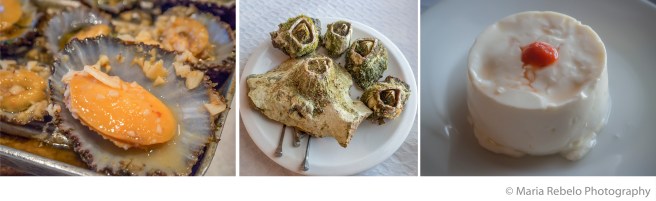
The first is fresh cheese topped with a pepper sauce called “pimentinha” (little pepper). The silky texture of the cheese combines with the salty, hot sauce to get the meal off to a great start.

The second is called “cracas” (barnacles). It is a local crustacean that lives inside rocks shaped like small volcanos. Charles Darwin, who visited Azores in 1836, studies it in his book Living Cirripedia. But “cracas” are much more than a scientific curiosity. They are delicious seafood. Their meat has a delicate, sweet taste that combines perfectly with the briny liquor inside the shell.

The third is “lapas” (limpets), a type of seafood abundant in the coast of Portugal. But while in continental Portugal “lapas” tend to be small and chewy, in Azores they are large, tender and delicious.

These are only three of the many reasons to visit the Terceira island, an enchanting place that is the perfect vacation destination.

The train to Pinhão

Trains Composit

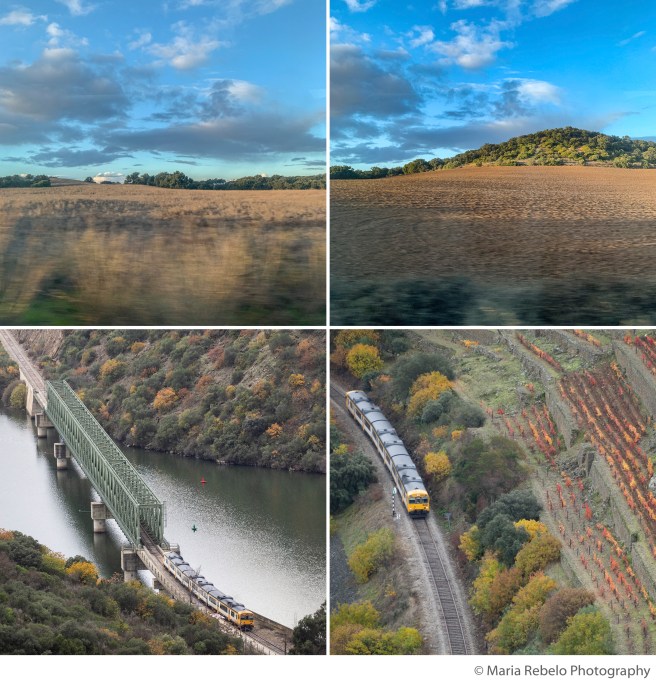
There’s a splendid train that travels from Oporto to Pinhão. Its creaky carriages are quite modest but they have windows that offer sumptuous views of the Douro valley.

The train leaves the station at a lazy pace but then it speeds up, hoping to impress the Douro river with the power of its engines. The river ignores these antics and continues to flow with confidence and poise.

At times, it looks like the train is going to dive into the river, such is the seductive power of the blue-green waters. At other times, the train tries to keep its distance, only to fall again under the spell of the Douro and travel back to its margins. It is as witnesses of the courtship between the steel train and the molten river that we arrive at Pinhão in the heart of the Douro valley.


The magic of a dinner at the Yeatman

Yeatman restaurant

At the end of our dinner at the Yeatman last November, chef Ricardo Costa gave us an envelope sealed with wax stamped with the hotel’s Y symbol. We brought the envelope home where it’s been sitting on our desk. A couple of days ago, we woke up to the sight of grey skies and the sound of howling winds. We reached for the envelope and broke the seal, hoping to summon some of the magic of our Fall evening at the Yeatman. Inside, we found the dinner’s menu.

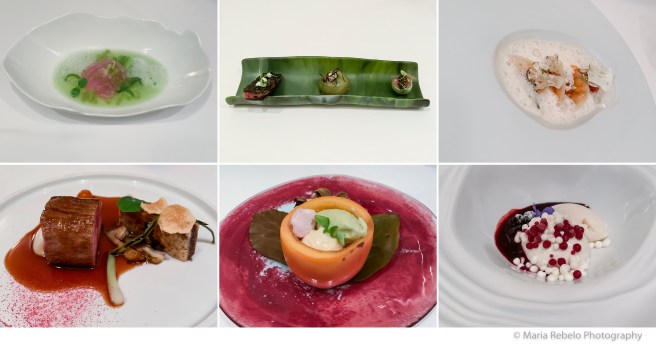
We recalled that our meal started softly, with a cup of tea made from kombu, an Asian algae. Then, there were oysters with foie gras and an apple gel that accentuated their  briny taste. They harmonized with a glass of bright, sparking wine from Murganheira. The meal continued merrily with a miniature piece, three inventive combinations of algae and tuna.

This preamble was followed by a chicken oyster–a small oval cut with intense flavor. It was delightfully roasted, seasoned with dehydrated chili pepper, served with a mushroom broth and topped with a cheese sauce.

Beautiful slices of lírio, a fish from the Azores, arrived on top of a cylinder bathing is sea foam and decorated with pearls.  The pearls, cylinder and foam were all made of cucumber. The delicate flavors paired perfectly with a glass of Quinta de Baixo Vinhas Velhas, a great white wine made by Dirk Niepoort from old vines in Bairrada.

The white wine refreshed our palate so that we could fully appreciate the next course: a succulent lobster with cauliflower puré and a whimsical bloody Mary made from lobster jus. Then, more of our favorite flavors gathered on the plate: xarem, a polenta-like preparation popular in Algarve, topped with a corn cream, a cockle called berbigão, black-pork prosciutto, egg, and a coriander broth.

A refined bouillabaisse arrived at the table, meticulously prepared with imperador fish accompanied by small, flavorful shrimps from the Portuguese coast and dehydrated algae. What would Marcel Pagnol think if he saw Marseille’s rustic bouillabaisse  prepared with the artistry of a Cartier jeweler?

A glass of a great red from the Dão region produced by Quinta do Perdigão heralded the arrival of the luxurious meat dishes. First, succulent veal with spring onions, Jerusalem artichokes. Then, crispy roasted piglet with spices and tropical fruits.

The meal ended with a delightful persimmon filled with pistachio sorbet topped with a cream of vanilla and saffron. But this was a deceptive ending  because soon another pleasing dessert arrived: blueberries with mascarpone ice-cream and kafir limes. And just when we thought it was time to leave, our waiter arrived with a serving cart full of irresistible chocolates, caramels and nuts. It was an epic dinner!

We finished reading the menu and looked up. The wind had waned and the sky was blue.

The Yeatman is located at Rua do Choupelo, (Santa Marinha), in Vila Nova de Gaia. Click here for the hotel’s website. 


The resplendent tranquility of the Mafra library

OLYMPUS DIGITAL CAMERA

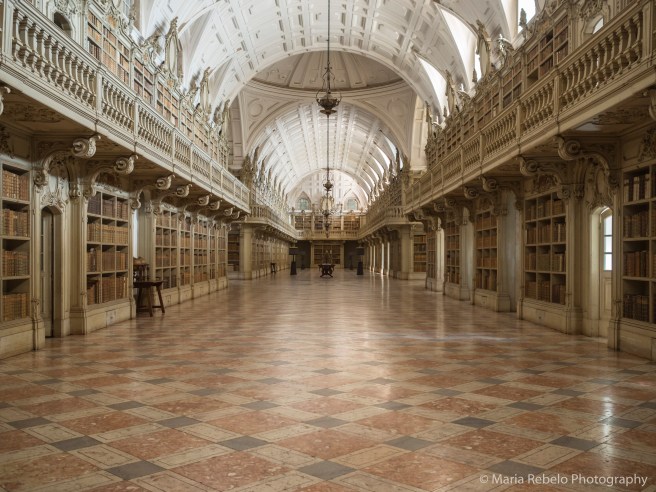
Standing at the entrance of the library of the Mafra palace, it is easy to believe that the world is orderly. In the pristine silence of this space designed by architect Manuel Caetano de Sousa, we have everything we need to understand the world of the 18th century. There are science and mathematics books in the shelves near the entrance, so we can learn the laws of the physical world. Further ahead, there are bookshelves with travel diaries that tell us about lands near and far. Dictionaries and grammars teach us the rhythms and intonations of foreign languages. If we use them to master Greek and Latin, we can enjoy the classics of antiquity, tales of love and war, stories about gods and humans. Walking the 88 meters of marble floors that take us to the end of the library, we reach the shelfs devoted to the mysteries of the soul.

The palace of Mafra and its library were built with the riches from Brazil. But the money ran out and the gold decorations that had been planned for the library were never executed. It is just as well, because the white Nordic-pine shelves give this library an elegant simplicity that looks modern.

It was here that José Saramago, a Nobel laureate, found inspiration for his famous novel about the construction of the Mafra Palace as seen through the eyes of two young lovers, Baltasar and Blimunda.

If you’re traveling in Portugal, don’t miss the chance to experience the resplendent tranquility of the Mafra library. And don’t forget to take a notebook, in case the muses that inspired Saramago whisper in your ear.