Mesa de Lemos

Composit Quinta de Lemos

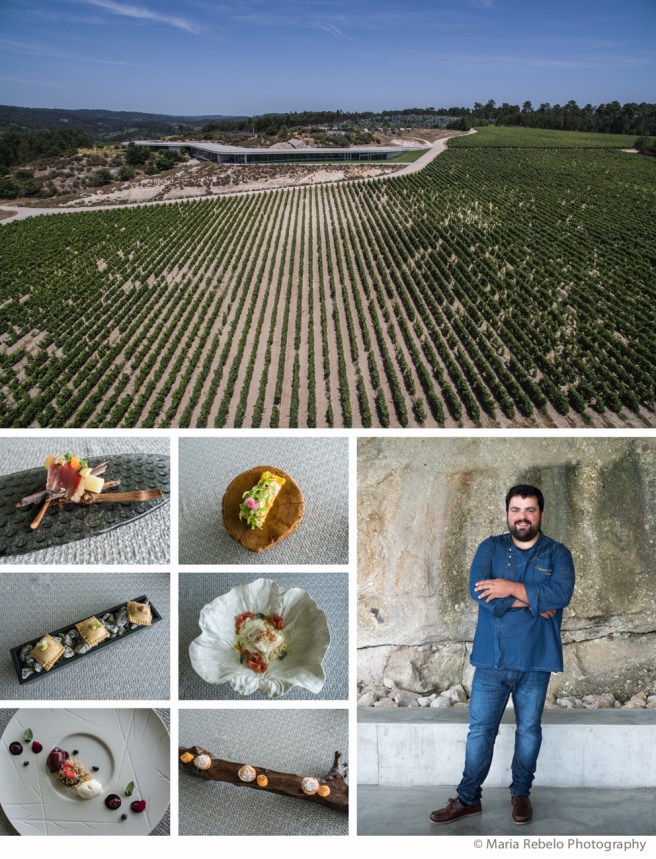
The most elegant place to dine in the Beira region is called Mesa de Lemos. Located near the village of Canas de Senhorim, the building is ensconced in the ancient granite boulders and looks like an integral part of the landscape. It was built three years ago by Celso de Lemos to showcase the wonderful wines he produces in the winery that also bears his name.

The restaurant tables overlook the surrounding vineyards, making us feel as if we are dining in the middle of the vines. There’s a fixed menu with optional, but indispensable, wine pairings. The delicious food is created by chef Diogo Rocha who was born in Canas de Senhorim. He draws inspirations from local traditional recipes to produce food that is elegant and satisfying.

Our meal started with a joyous sparkling wine called Geraldine in honor of Celso’s daughter. It has very fine bubbles and an elegant brioche aroma that combines perfectly with Diogo Rocha’s appetizers, a set of preparations reminiscent of a picnic in the countryside.

Next came Dona Santana, a complex red made from the four emblematic varietals cultivated in the Dão region: Touriga Nacional, Tinta Roriz, Jaen, and Afrocheiro. It paired perfectly with the braised bízaro pork. The last entrée was codfish adorned with an ethereal parsley foam and paired with an elegant red wine made from a single varietal, Afrocheiro.

The dessert feast started with an interesting experimental fortified wine produced by the quinta. It continued with a cherry pudding and a salty ice cream made from requeijão, a pastry filled with a sweet bean paste and a chestnut-shaped concoction made from egg yolks.

The wines of Quinta de Lemos are diamonds that sparkle anywhere. But at Mesa de Lemos they have their perfect setting.

Click here for the Mesa de Lemos web site. The restaurant is located at Quinta de Lemos, Passos de Silgueiros, near Viseu, tel 961 158 503.

Dear chef Avelino

Composit Zélia-Edit

We are writing to thank you for the delicious food you have been cooking at Zélia in Bombarral since 1981. It’s hard to serve high-quality traditional food at affordable prices year after year. That is why so many chefs burn out and so many restaurants close. But you keep going, like a marathon runner, cheered by all the families that come to your restaurant to enjoy a great meal.

We first tried your cooking many years ago at the Bombarral wine fair. We had an amazing grilled rabbit on a magical Summer night under an ancient oak tree. Since then, we had lunch and dinner at Zélia many times. Your codfish, bathed in shimmering olive oil, surrounded by thinly-sliced fried potatoes and adorned by onions, pepper and tomato is irresistible. And the duck rice seasoned with a pinch of raisins and toasted pine nuts is the best we ever had.

Your ingredients are always excellent and everything you cook has a special touch. We like the fact that you remodeled the dining room but didn’t change the food, which is as great as always.

We wish you a long life, as wonderful as your cooking!

Restaurante Zélia is located at Rua dos Combatentes da Grande Guerra 9, Sanguinhal, Bombarral 2540-454, tel. 262 605 157.


The luxurious Dom Feijão

Dom Feijão

There are plenty of “tascas” in Lisbon, small informal restaurants that offer seasonal menus at low prices. But when locals want to have a nice meal with friends or family, they don’t go to a tasca. They prefer to pay a little bit more and eat at a neighborhood restaurant with better ingredients and service.

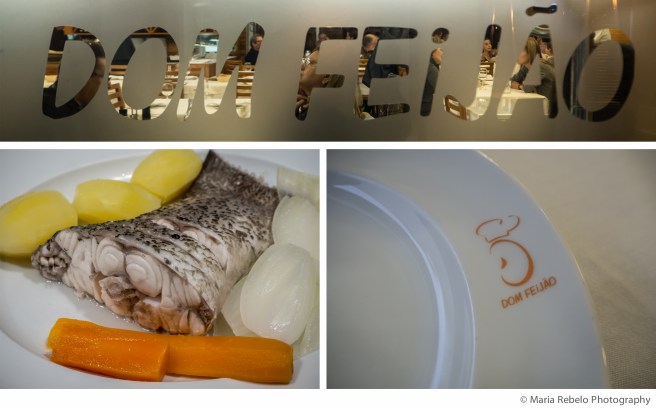
One of our favorite neighborhood restaurants in Lisbon is Dom Feijão (Sir Bean), a place with generous portions, modest prices and top-notch ingredients. What’s the catch? You have to be persistent to get a reservation or be prepared to wait for a table. The waiters don’t answer the reservations phone line when they’re very busy and they’re almost always very busy.

The restaurant is popular with families, on our last visit the place was full of grandparents, parents and children sharing the pleasures of the table.

Before we had time to open the menu, our waiter brought us some delicious fried marinated sardines and a plate of the same black-pork prosciutto they serve in heaven on special occasions.

We’d seen a large “sável,” a prized river fish, in the restaurant’s refrigerator so we asked the waiter whether we could order it. “Not today,” he replied “The sável has to be thinly sliced and marinated for a few hours. Sorry, but we cannot rush the preparation.”

We ordered instead poached cherne (sea bream). It was deliciously succulent, a reminder that when the ingredients are perfect, simple preparations are the best.

Next, we had grilled “secretos,” divine slices of fatty black pork. Two decades ago, these cuts of black pork were exported to Spain. Since then, the Portuguese have wised up and started consuming them. Exports suffered but our happiness boomed.

We ended the meal with some grilled codfish. The waiter asked what was our favorite part of the codfish so he could ask the chef to prepare it. Large tranches of codfish swimming with roasted potatoes in a sea of olive oil made our delights.

We told chef João Araújo how much we enjoyed the meal. “We’re a simple restaurant that serves traditional Portuguese food,” he said. “Our only luxury is the ingredients we use.”   This is, of course, the kind of luxury we fancy.

Dom Feijão is located near the posh Avenida de Roma at Largo Machado de Assis 7 D, tel. 21 846 4038. There’s a convenient paid garage underneath the restaurant. You can ask the waiter to validate your parking.

Making Alenquer a food destination

Casta 85.jpg

In the 19th century, Alenquer was one of Portugal’s premier wine regions. Its fortunes waned for much of the 20th century. But the tide turned and Alenquer rightly regained its status as a prized wine destination. A young chef called João Simões wants to help Alenquer become a food destination as well.

João apprenticed at the Ritz and worked in many posh hotels and restaurants. Three years ago, he decided to return to his roots to recover and renew the culinary traditions of the region where he was born. He uses local products like quails and Rocha pears and works with farmers on projects like producing goat cheese in the Montejunto mountain. His restaurant is called Casta 85. Casta means varietal, a reference to the region’s wine tradition. The number 85 refers to the chef’s birth year.

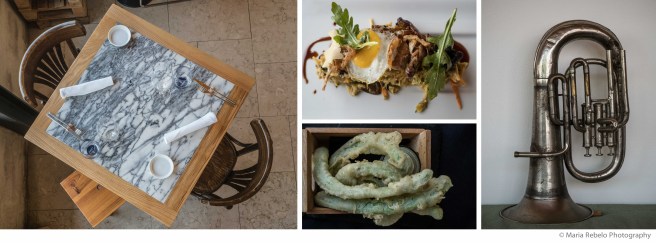
The dining room is decorated with furniture procured in the chef’s village. It is a pleasant space that overlooks the Alenquer river. This tributary of the Tagus flows proudly through town, reveling from the praise it received in Luis Vaz de Camões’ epic poem, the Lusíadas.

Casta 85’s service is relaxed and attentive. Ana Santana, our genial server, met the chef when they both played in a brass band. The chef’s old instrument is now part of the decoration and some of the band’s brashness inspires the intense, harmonious food.

We tried appetizing alheira croquettes with apple sauce and crisp green bean tempura with garlic mayonnaise. Next, came a delicious quail Brás style served with a quail egg, fried onion and cassava chips. Our meal ended with a luscious duck leg served over a risotto of mushrooms and asparagus.

We returned from Alenquer through a scenic road that took us though countless vineyards. We can’t wait to go back to visit the wine quintas and have another great lunch at Casta 85!

Casta 85 is located at Largo do Espírito Santo, 31 in Alenquer, tel. 915 761 911.

Mugasa

OLYMPUS DIGITAL CAMERA

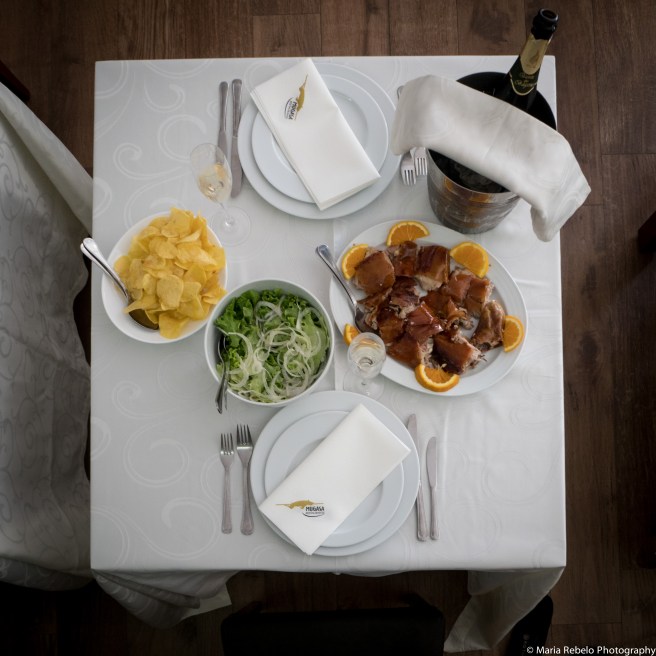
Bairrada is a region in the center of Portugal known for its refreshing sparkling wine and its “leitão” (roasted suckling pig). The best leitão in Bairrada comes from a restaurant called Mugasa located in the middle of nowhere in a small village called Fogueira.

The restaurant’s owner, Álvaro Nogueira, retired from a desk job and opened a small café in 1981. He wanted to learn the art of roasting piglets to turn his café into a restaurant. But the learning curve was steep until one of his cousins, a master roaster, offered to teach him.

After this jump start, Álvaro kept perfecting his art. In 1991, he entered a competition organized by a gastronomic society and won first prize.

“Why is roasting so difficult?” we asked Álvaro. ” Every pig is different, with a different size and fat content. We use six wood-fired ovens and every oven is different. We have to make constant adjustments to guarantee perfection. That is why we only roast four piglets per oven, to have time to make all the necessary adjustments.”

“In the first 20 minutes, the oven has to be very hot, between 280 and 300 degree Celsius to make the outside crunchy. Then we cover the wood with ashes to bring down the temperature. There are many details so we have to pay close attention. The traditional seasoning made with garlic, lard, white pepper, and salt is important but you cannot use it to cover up mistakes.”

We sat at the table to try Mugasa’s leitão. It is indeed remarkable, crunchy on the outside, succulent on the inside, with just enough seasoning to accentuate the taste of the meat.

Álvaro is very proud of the celebrities that drive to Fogueira just to eat at his restaurant. But he is even more proud of his son Ricardo. “My son is the best master roaster in Portugal,” Álvaro said smiling. “He learned my secrets and discovered new ones.”

Many Bairrada wine makers eat regularly at Mugasa, so you often overhear discussions about weather conditions and grape maturation. The restaurant offers some of the best wines from these producers at very attractive prices.

The formula for Mugasa’s success is easy to write down but hard to replicate: amazing leitão plus great Bairrada wine = unforgettable meals.

Mugasa is located at Largo da Feira, Fogueira, Aveiro, tel. 234 741 061


Belcanto

Composit Bel Canto

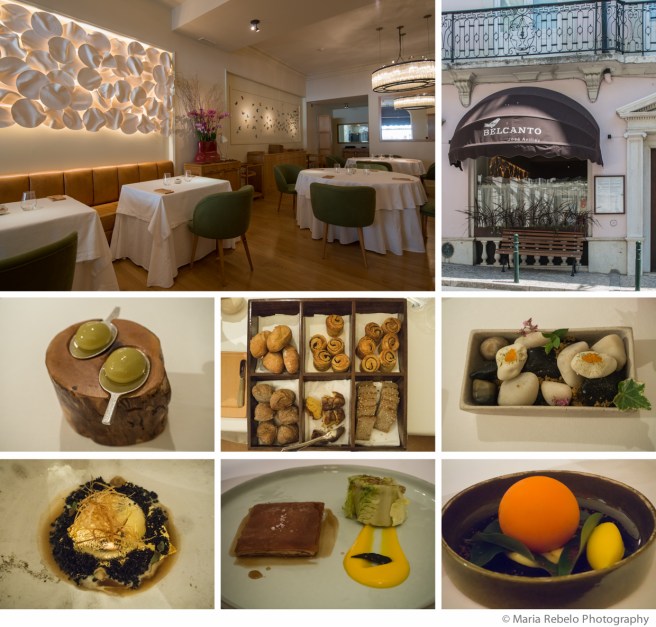
Perhaps it’s not a coincidence that Belcanto, the most celebrated restaurant in Lisbon, is close to the São Carlos opera house. Decorated with whimsical porcelain plates, the restaurant looks like a stage and its meals are as thrilling as a great opera performance.

Our lunch’s overture was composed of small bites often included in the couvert of traditional restaurants:  tremoços (lupini beans), olives, and a carrot and garlic salad. The presentation was unusual–they were served on top of Portuguese cobblestones. But the real surprise was that they all turned liquid once we bit into them, filling our mouth with explosions of flavor. This culinary prelude was accompanied by Vicentino, a wine from Zambujeira do Mar that left our paletes refreshed with hints of green pepper.

There were more surprises. First, a fake edible stone covered with salmon caviar. Then, crispy chicken skin with corn coriander and liver, a combination that tastes like roasted chicken. Next, a delicious algae cornet filled with tuna served inside a flower pot.

A genial waiter introduced a chorus of breads made from corn, buckwheat, quinoa, and puff pastry. Next came a duet for clams and “lingueirão” (razor clams) accompanied by a 1979 Porta dos Cavaleiros, a velvety red wine from the Dão region produced in the birth year of chef Avillez.

Then the arias started. The first was a Golden Egg–an egg cooked at a low temperature, covered with gold leaf and adorned with threads of fried leek. It arrived with a lively Arinto white wine made by António Maçanita in Pico, a volcanic island in the Azores archipelago.

The second aria was called Ocean Dive: a pristine sea bass (robalo) cooked in sea water with seaweed, “salicórnia” (samphire), razor clams, and mussels. We were still savoring the final chords of this crowd pleaser when a new theme was introduced: a flavorful remake of the bucolic “cozido” that the chef’s grandmother used to prepare with boiled meats and cabbage. It came with a vigorous 2012 Bruto from the Douro region.

The performance reached its climax with another traditional recipe reinvented: the roasted piglet from Bairrada. We don’t know what culinary sorcery was used to produce this perfect combination of crispy skin and juicy roasted meat. All we can tell you is that the result is magical.

A new theme was introduced by a duo of pre-desserts: a raspberry sorbet and an “abade de priscos” pudding. They were followed by a tangerine dream made from frozen juice and filed with tangerine sorbet. Vila Oeira, a rare dessert wine from Carcavelos harmonized with these sweet delights. Coffee and mignardises brought our meal to a blissful finale.

You have to be patient to dine at Belcanto. The restaurant is booked for weeks in advance. But it’s worth the wait to experience such an unforgettable culinary performance.

Belcanto is located at Largo do São Carlos in Lisbon, tel. 21-342-0607.


Serra d’Ossa

Composit Serra D'Ossa.JPG

It was an act of bravery. We drove up the serpentine road to Serra d’Ossa to dine at a restaurant we couldn’t find on trip advisor!  But a trusted local source told us that this was the place to go if we wanted to taste the rustic food of Alentejo. And so we went.

We were welcomed by Paula Patinho who owns the restaurant with her husband Francisco. Her mother cooks and her father makes the house wine. We were surprised by the menu prices: they were half of what we would have paid in Évora or Estremoz.

Francisco suggested that we start with “sopa de cação” (dogfish soup), continued with a tomato and fried meat soup, and ended with “lagartos,” thin strips of black pork grilled to perfection. The flavors are bold but harmonious perhaps because all the ingredients were local, cultivated in the same lands by the same people.

The house wine is staged in stainless steel. It tastes pure and smooth and pairs perfectly with the food.

We asked Francisco what makes the food taste so great. “There is a deceiving complexity to the cuisine of Alentejo,” he explained. “The preparations look simple but pushing the flavors to a higher level takes time and requires many ingredients.”

Our audacity was greatly rewarded. We discovered an inexpensive restaurant that does justice to the rich culinary tradition of Alentejo.

Serra d’Ossa is located on Rua Principal, 77, Aldeia da Serra D’Ossa, Redondo, tel. 266-909-037.

Buxa

OLYMPUS DIGITAL CAMERA

Natália Maia, the manager of the Guimarães pousada, recommended Buxa, a small restaurant right in the center of the Guimarães historic district.

As soon as we arrived, we recognized all the traits of the restaurants we favor.  First, the place was completely full. Second, there were people without reservation trying to charm the waiters into giving them a table (can you believe their nerve?) Third, there was a rhythm to the service: waiters moved with agility and grace to the beat of the kitchen drums. Fourth, the menu is small, focused on a few perfect preparations. And fifth, the price is right.

We loved the codfish with broa, a symphony of traditional flavors of the Portuguese cuisine: codfish, olive oil, corn bread (broa) and potatoes. The black pork was grilled to perfection, salty and satisfying. The tripe cooked with beans had layers of wonderful flavors (if tripe is too adventurous for you it is worthwhile ordering it just to eat the amazing beans). The octopus was tender and delicious. And the “alheira,” a sausage from nearby Mirandela, was spectacular.

We confess that we arrived at Buxa without reservations and charmed the waiter into giving us a table. But we promptly made reservations for the next day. The food at Buxa is too good to leave to chance!

Buxa is located at Largo da Oliveira 23 in Guimarães, tel. 252 058 242. Reservations are a must.

Magano

Composit Magano

When lunch time comes, some Lisbon residents dream about being magically transported to the plains of Alentejo. “O Magano,” a restaurant in the Campo de Ourique neighborhood, is a place where these dreams come true. Open for more than a decade, it brings to the capital untranslatable Alentejo delights such as “pézinhos de coentrada” and “carne de alguidar.”

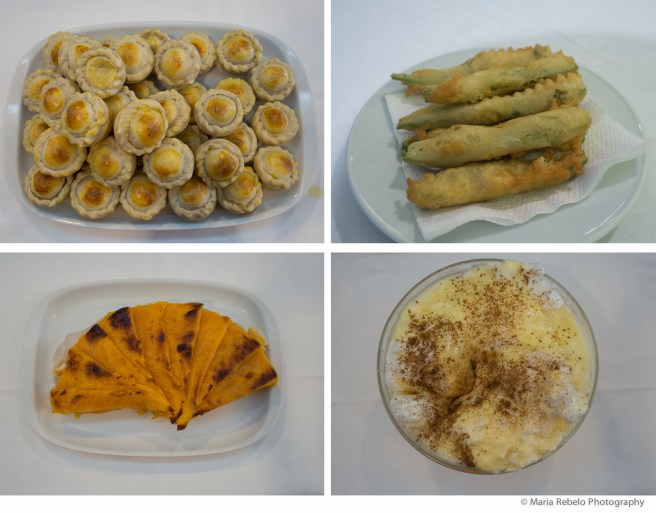
We told our waiter that we wanted to try a little of everything. “I can bring you the menu or you can leave it up to me,” he said with a twinkle in his eyes. We agreed to put him in charge and soon the table was covered with small plates of codfish with chickpeas, grilled peppers, favas with chouriço, miniature pies, green bean tempura, and marinated partridge with razor-thin fried potatoes.

“This was a wonderful lunch,” we said, complimenting our waiter on his choices “It’s not a problem if you want to skip it,” he said “but I had something else for you to try.” He went to the kitchen and brought back a steaming terrine of tomato broth. He carefully placed a piece of bread on each soup plate. Then, he poured the tomato broth and toped each piece of bread with a slice of grouper. The result was pure culinary satisfaction.

We made it clear that we didn’t have room for dessert. “I understand,” our waiter said with an enigmatic smile. He then brought us a plate with “queijadas,” “lérias,” “fidalgo,” and a Portuguese version of “îles flottantes.” “Just in case you change your mind and decide to end the meal on a sweet note,” he said. It was a pleasure to succumb to these temptations.

Magano means mischievous boy in the slang of Alentejo. Our waiter is a magano who knows that no one can resist the brilliant simplicity of the food of Alentejo.

O Magano is located at Rua Tomás Anunciacão 52 in Lisbon, tel. 21 395 4522. Reservations are a must. 

The last harbor

OLYMPUS DIGITAL CAMERA

The existence of one of Lisbon’s best fish restaurants has been a closely guarded secret for more than half a century. Its name is “Último Porto” (the last harbor). Now that the secret is out, we might as well confess everything.

The restaurant is tucked away in the corner of one of Lisbon’s harbors (Rocha do Conde de Óbidos). It is not a glamorous place. But for fish lovers it is heaven.

There are tables inside and an esplanade surrounded by containers that is very pleasant when the weather is warm. It is easy to park and the walk to the restaurant is beautiful with the river in front of us and the city on our back.

“Último Porto” opens only for lunch and it is always full of locals. Grilled fish is the main event and the stars of the show are the “salmonetes” (mullets). Their skins are colored with yellow and orange hues, their flavors as bold as their colors. But, there are many other great choices, from sea bass to codfish.

Many restaurants showcase their fish in a refrigerated display. Others bring a fish platter to the table so that customers can choose what they want. At Último Porto, the fish is treated like a work of art—shielded from light and protected from the elements. It only leaves the refrigerator to go to the grill where it is cooked to perfection. It is this care that makes the last harbor our first choice for grilled fish in Lisbon.

Último Porto is located in the Estação Marítima Da Rocha Conde d’Óbidos, tel. 21 397 9498. It only serves lunch and reservations are a must.