The fox hole

OLYMPUS DIGITAL CAMERA

There are very few great restaurants in the Douro valley. This scarcity has an historical origin: most vineyard owners used to live in Oporto. When they visited the Douro during the harvest, their meals were prepared by the wife of the caretaker or by some other talented local cook. So, a tradition of eating in restaurants never developed.

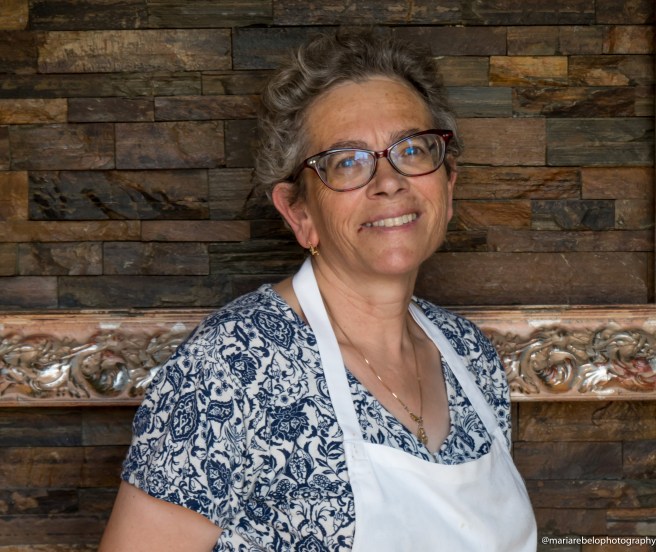
We were curious when Abílio Tavares da Silva, the Quinta de Foz Torto winemaker, promised to take us to a wonderful restaurant. Abílio drove us to a small village called Ervedosa do Douro and introduced us to Dona Maria da Graça Gomes. For many years, she worked as a cook for the great families of the Douro valley. Her dream of opening a restaurant came true in 2011 with the help of her two children, Rosário who runs the dining room and shares the cooking duties, and Fernando who helps manage the restaurant and curates the wines. The people of the village of Ervedosa are known as “raposas” (foxes), so they called the restaurant A Toca da Raposa (the Fox Hole).

We liked the food so much that we kept returning to Toca da Raposa during our Douro visit. We asked Rosário to choose our meals and she filled our table with culinary delights. The “pataniscas de bacalhau” a combination of codfish, potatoes and parsley are light and flavorful, the best we ever tried. The eggs with alheira (a sausage made with bread and fowl) are delicious. We loved the satisfying taste of the fatty baby-goat rice cooked in the oven. The flavorful “salpição” rice cooked with beans and salpicão sausage made at the restaurant is a revelation.  We marveled at the quality of the codfish and at the flavor of the grilled pork butt.

For dessert, Rosário brought us slices of cheese with an assortment of delicate jams made of strawberries, white grapes, quince, blackberries, orange, and zucchini.

Ervedosa is surrounded by vineyards that produce some of the best wine in the Douro valley. And at Toca da Raposa, it has food that is as great as the wine.

Toca da Raposa is located at Rua da Praça in Ervedosa do Douro, tel. 254 423 466.


Two recipes from Ílhavo

16 - Chefe Cristina Almeida - @mariarebelophotography.com

The Montebelo Vista Alegre hotel in Ílhavo is a hidden travel-destination gem in the center of Portugal. The hotel has a stunning location on the marshes where river and sea water meet.

The building complex incorporates the elegant manor house of José Pinto Bastos, the entrepreneur who two centuries ago pioneered the production of porcelain in Portugal. You can visit an interesting museum that traces the evolution of Vista Alegre from a risky experiment to a renowned porcelain brand. It is also wonderful to visit the porcelain factory, the place where earth and fire combine to serve the imagination of designers and sculptors.

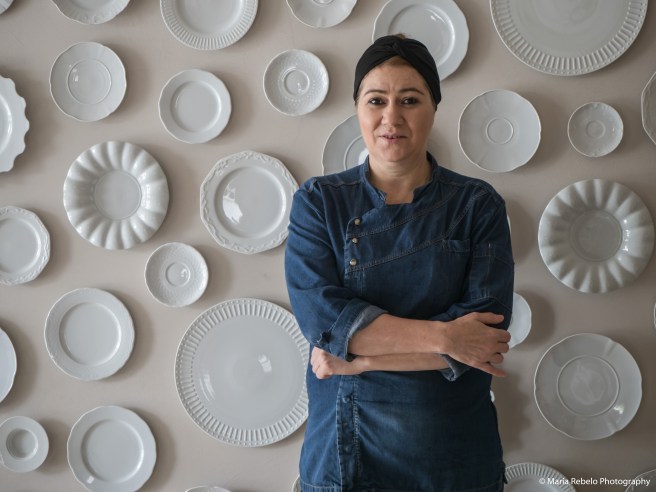
One of the pleasures of a stay at the Vista Alegre hotel are the appetizing meals served in the restaurant headed by chef Cristina Almeida. For the last three decades, Cristina has been creating and refining recipes based on Portugal’s culinary tradition. Since she opened the hotel’s restaurant in 2016, Cristina has had the luxury of serving her food in the elegant dinnerware produced by Vista Alegre.

Two of our favorite dishes at the Vista Alegre restaurant are lamb rice with mushrooms and chestnuts and velvety codfish. We enjoyed these culinary treasures so much that we dared to ask Cristina whether she would share the recipe with our readers. She graciously agreed, so here they are.

Lamb rice with mushrooms and chestnuts

Ingredients for four people

  1. 600 grams of baby lamb
  2. 400 grams of rice (Cristina uses the Carolino variety produced in Portugal)
  3. 1 garlic clove
  4. 250 grams of onions
  5. 100 grams of chestnuts
  6. 100 grams of mushrooms
  7. 0.2 liters of white wine
  8. 0.1 liters of red wine
  9. 0.1 liters of olive oil
  10. Seasonings: thyme, bay leaf, piri-piri, and salt

Cut the lamb into small pieces. Marinate it with garlic, bay leaf, the two wines, thyme and salt. Dice the onion and fry it in olive oil. Add the lamb and fry with the onion. Add the chestnuts, mushrooms, and let the mixture cook a bit more. Add enough water to cook the rice and make plenty of sauce. Wait until the mixture boils and add the rice. As soon as the rice is cooked, serve immediately.

Velvety codfish

Ingredients for five people

  1. 200 grams of codfish without bones
  2. 0ne leek
  3. 1 garlic clove
  4. 150 grams of onion
  5. 1 kg. of potatoes
  6. 0.15 liters of olive oil
  7. Seasonings: parsley and coriander.
  8. Garnish: roasted peppers

Cut the codfish in cubes. Place the codfish, leek, onion, potatoes, parsley, and coriander in a pot. Cover the ingredients with water and let them boil until cooked. In a frying pan, fry the garlic with 1/3 of the olive oil. Add to the boiling mixture. Put the mixture in a blender and blend until smooth. Serve garnished with roasted peppers.

Click here for the website of the Montebelo Vista Alegre hotel. 


A belly full of fish

Barrigada Restaurant

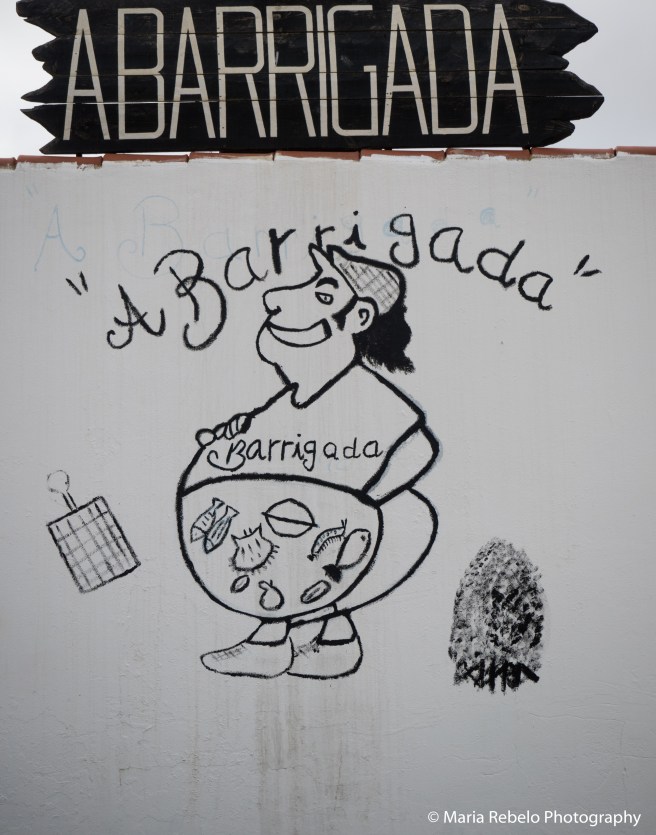
Right on the Lagos harbor there’s an old shack that houses a restaurant called A Barrigada (a full belly). It is a simple place that serves grilled fish, cataplanas and other seafood delights. Outside the restaurant, you see the fish nets and octopus traps used by some of the fishermen that supply the restaurant.

The wine list is surprisingly good. Our waiter recommended a white wine called Invisivel produced by Ervideira. It is made from the red grape Aragonês and paired perfectly with the fish feast that followed: douradas, carapau and cavalas all perfectly grilled and seasoned. The fish comes with simple accompaniments: boiled potatoes seasoned with garlic and oregano and a salad with tomatoes, cucumbers and onion.

The waiters look like friendly pirates. Are they descendants of Sir Francis Drake the buccaneer who made Sagres his home base in 1587? All we know is that Barrigada is always full of people from all ages and nationalities enjoying a bounty of fish.

A Barrigada is located at Estrada de São Roque, Cais Sul, MeiaPraia, in Lagos, tel. 282 792 453, email abarrigada@hotmail.com. Click here for the restaurant’s website,  

Cooking pork and clams on the trail of Jamie Oliver

OLYMPUS DIGITAL CAMERA

We asked Dália Soromenho, the chef/owner of Porto Santana in Alcácer do Sal,  what alchemy made her pork and clams so magical. “I don’t give out my recipes,” she said sternly. “But I have to confess that I taught the recipe to Jamie Oliver when he came to the restaurant,” she continued with pride. “That is like telling everybody!” we argued. Dália relented and shared her recipe with us. So, here it is dear reader, the recipe for the best pork and clams we ever tasted.

Dália Soromenho’s Pork and Clams Recipe

Dália likes to cook this recipe with two cuts of pork: either “pá” (shoulder) of black pork or “cachaço” (neck) of white pork. The quality of the ingredients is essential.

First, marinate the pork cut into cubes with minced garlic and “pimentão,” a paste made of red peppers and salt. Then, slowly simmer the pork in lard until it becomes deliciously tender. The cooked pork can be refrigerated at this point. When you are ready to serve, fry the pork in lard in a frying pan over high heat. Place the clams on top of the pork and cover until the clams open. Cut the potatoes into small pieces and fry them separately. Add the potatoes to the pork-and-clams combination, season with chopped coriander and serve your lucky guests

“You’re welcome to come back to cook the recipe with me,” Dália offered as we said goodbye. We surely will!

Porto Santana is located at Senhora Santana, Alcacer do Sal, tel. 969 020 740.


Eating pork and clams in Alcácer do Sal

OLYMPUS DIGITAL CAMERA

The staff of the pousadas, a network of historical hotels with fabulous locations, has always great restaurant tips, so when they recommended Porto Santana in Alcácer do Sal, we called to make reservations.

The restaurant remounts to the days when people traveled by horse to Alcácer and crossed the Sado river through a small wooden bridge to work in the fields. They left their horses by the restaurant building and came in for a bite before work. Later, the place became a tavern where people enjoyed a glass of wine. Later still, it became a “tasca,” a humble eatery that catered to local residents. The restaurant was purchased more than a decade ago by Dália Soromenho, a chef who learned from her mother the traditional recipes of Alentejo. She modernized the old place but preserved key elements of its past like the stone floor and the straw-padded roof.

Our waiter took us to a cozy table by the fireplace. The other tables were occupied by locals, most of whom seemed to be involved in agriculture. They were giving thanks for the rain that was blessing the fields and talked with excitement about their wines and their crops.

Our meal started with a soup made with clams, spinach and rice. The flavors blended perfectly and the rice grains were firm, so there was no starch from the rice clouding the flavorful broth. The meal continued with fried fillets of “peixe galo” accompanied by an “açorda” made with fish eggs. The fish was delicious, but it had a hard time competing with the magnificent açorda, the best we ever had. It was a culinary masterpiece made with fish broth, fish eggs, bread, olive oil, and garlic. Finally, we tried black pork “secretos” salted and grilled to perfection.

We told our waiter how much we liked our meal. “But you didn’t try our pork and clams Alentejo style, they are really outstanding.” he said in a tone that made us feel like we had gone to Rome and not seen the pope.

We repented and returned the next day to Porto Santana for lunch. We were received by Dália Soromenho who recommended we also try her tomato soup as a prelude to the pork and clams.

The meal started with a couvert composed of bread, olives, a delicious carrot salad seasoned with minced garlic and coriander, and fried sardines in an “escabeche” sauce made from olive oil, bay leaves and vinegar. The tomato soup was great, the acidity of the tomato contrasting with the creamy poached eggs. The pork and clams were indeed spectacular. They have everything that is lacking in ordinary preparations: the pork was succulent, the clams were not overcooked, and the fried potatoes were crisp and delicious. The dessert was a combination of eggs yolks and the famous pine nuts from Alcácer.

Dália sat at our table and asked us what we thought about the meal. We told her that it is people like her that make Portugal a place full of culinary treasures waiting to be discovered.

Porto Santana is located at Senhora Santana, Alcacer do Sal, tel. 969 020 740.

Reading Anna Karenina in Sagres

Composite Restaurant Os Arcos Algarve

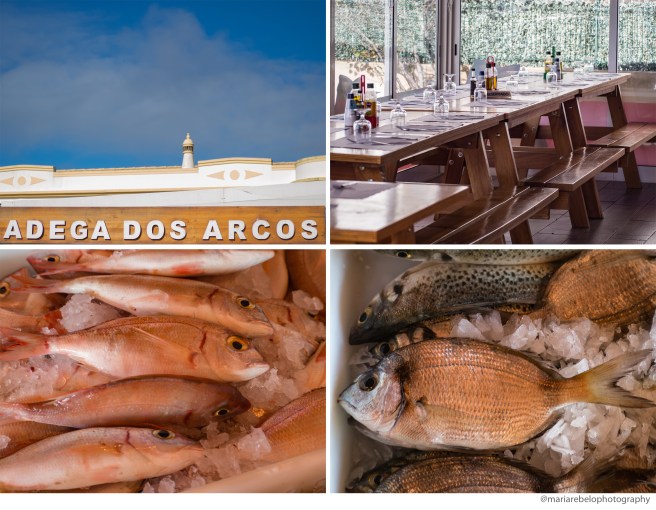
Adega dos Arcos (the cellar of the arches) is named after its many arches. It is an old “tasca,” a humble establishment that serves traditional fare. The restaurant changed owners over the years but the recipe for success has remained the same: fresh fish and grilled meats served with no frills at very modest prices.

We recommend the local fish species with names no one can translate into English. We had sargos, bicas, and liça. The sargo has a buttery taste and a wonderful consistency. Bicas have a more complex flavor reminiscent of the posh mullets. The liça has large white filets with a firm texture and delicate taste.

Everything comes with potatoes, boiled or fried and a traditional salad with lettuce, onion and tomato. The choice of wines is very limited and dominated by Caiado, a great inexpensive wine produced by Adega Mayor.

Even in the Winter, Adega dos Arcos is busy with locals and visitors. “In the Summer forget it,” says the waiter, “the lines are huge.” But the food is worth it. You can take a long Russian novel like Anna Karenina to read while you’re waiting. The novel might end badly, but we guarantee that your wait will have a happy ending.

Adega dos Arcos is located on Rua Roca da Veiga, Sagres, tel. 960 294 290.

Sweet gratitude

Casa do Gato Preto

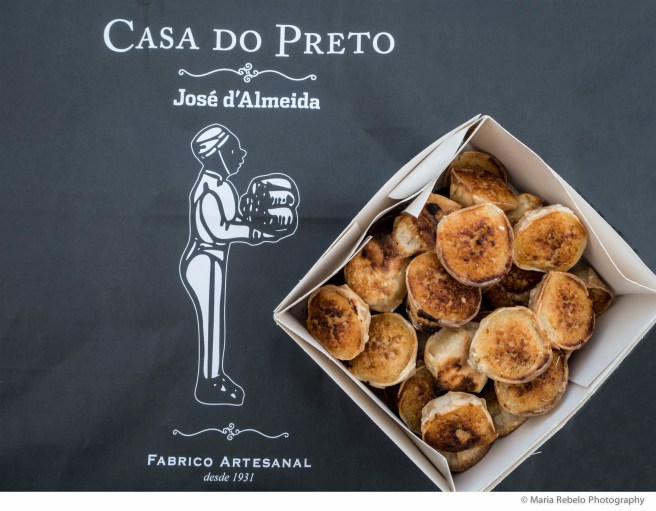
The recipe for Sintra’s queijadas was created in the 13th century by friar João da Anunciação at the Penha Longa convent. We know that the voluptuously thin crust is made with flour, lard, water, and salt. And that the indulgent filling has requeijão (a ricotta-style cheese), egg yolks, and two ingredients added in the 15th century: sugar and cinnamon. Each pastry store in Sintra has its own secret version of the recipe.

What are the best queijadas in Sintra? We’ve been pondering on this question for years, but the answer still eludes us. When we try the queijadas at Piriquita, we think nothing can be better. But then we taste the queijadas from Pastelaria Gregório and we fall in love with the crispness of the shell and the sweetness of the filling. Lately, we went to Casa do Preto and were astonished by the harmonious marriage of filling and shell.

One thing we know: these queijadas lift our minds above everyday concerns and fill our souls with sweet satisfaction. Thank you friar João!

Casa do Preto is located at Estr. Chão de Meninos 40, in Sintra, tel. 21 923 0436.


A noble crab soup

IMG_1905 2

Almost three decades ago, a friend took us to a new restaurant called Nobre in the Ajuda neighborhood. The name, which means noble, came from the surname of the chef, Justa Nobre. We recall with fondness the meals we enjoyed there. After a successful run, Nobre closed so that the chef could pursue other projects,

Last week, the same friend invited us for lunch. We were delighted to discover that we were going to a new restaurant that marks Justa Nobre’s return to Ajuda. It is called “À Justa,” an expression based on the chef’s first name that means “just right.”

The menu offers a cuisine without foreign accents that has the satisfying taste of authenticity. The recipes are grounded in the cooking of Justa’s grandmothers. But they are not a copy of the past. They reflect years of refinements shaped by the personality and creativity of this self-taught chef.

The restaurant was full. The Portuguese like to flirt with contemporary food trends but they always come back to their one true love, which is the traditional cooking of Portugal.

We had a great meal that included bright green fava beans, chickpeas with codfish, codfish “pataniscas,” and fried cuttlefish. These delights were preceded by a classic of Justa Nobre’s repertoire: the spider crab soup. Its aristocratic taste makes all other seafood soups in Lisbon look common by comparison.

Many chefs keep their secrets, but Justa generously shared some of her recipes in a book titled Passion for Cooking. We translate her recipe for spider crab soup below. But you must try the original at À Justa where they make it just right.


Justa Nobre’s spider crab soup

Ingredients: 2 large spider crabs weighing about 1 kg. each, 3 liters of water, 3 tablespoons of sea salt, 150 grams of margarine, a large onion, 2 cloves of garlic, a parsley bunch, a sliced fennel head, 4 tablespoons of tomato paste, half liter of cream, 0.1 liter of dry white port, one teaspoon of powdered ginger, one teaspoon of saffron, 2 tablespoons of potato starch.

Preparation: Boil the crabs in the salted water for 8 minutes. Remove them, let then cool off and extract all the meat. Return the shells to the pan. Add some shrimp shells and let them boil for 10 minutes. In a large pot, melt the margarine and add the sliced onion, fennel and garlic. Let these ingredients cook briefly and then add the white port, the cream, the tomato paste, the spices, and two liters of the crab broth. Mix the potato starch with some cold water and add it to the soup. Check the seasoning and strain the soup. Add the crab meat and serve the soup it in the shell of the spider crab.

À Justa is located at Calçada Ajuda 107, in Lisbon. The restaurant seats only 36 people, so reservations are a must. Call 21 363 0993 or email reservas@ajusta.pt. Click here for Justa Nobre’s web site.

 

A restaurant called Romando

Rest. Romando

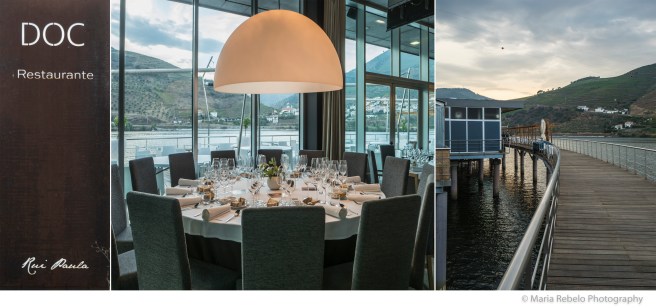
Call us old fashioned, but we don’t like to outsource our choice of restaurants to trip advisor. So, we contacted a friend who’s a bon vivant to ask whether he could recommend a good place for lunch near Vila do Conde. “Make reservations at Romando,” he said without hesitating. “It’s been around forever, serving great traditional food.” We duly called the restaurant and drove to the address they gave us. We arrived at a brand-new building decorated with modern furniture. Could this be the right place?

As soon as the first course arrived–robalo (sea bass) with shrimp rice–we knew that we were indeed at the right place. The fish had been filleted and cooked in the oven seasoned only with salt and olive oil. It is a simple preparation, but the timing has to be precise in order for the freshness of the fish to sing. And sing it did, joined by a choir of shrimps wrapped in sea aromas and rice grains dressed in tomato robes.

Next, our waiter brought us codfish cooked with red pepper, onion, and diced prosciutto. It was deeply satisfying with all the great ingredients pulling together to make the overall taste much more than the sum of the individual flavors. Finally, we tried some tender, succulent grilled meats accompanied by crispy French fries and flavorful beans.

As far as dessert is concerned, it suffices to say that Romando’s puddings, tarts and cakes tempt the most virtuous souls to indulge in gluttony.

Rosa and Armando Pena opened the restaurant soon after they got married, more than a quarter of century ago. Rosa was in charge of the kitchen and Armando managed the dining room. They combined their names and called the place Romando.

The restaurant quickly gathered fame. But the secret of their success is that they never rested on their laurels. They kept evolving, searching for better ingredients, upgrading the quality of the service and, more recently, renovating the restaurant premises. At the same time, the cooking stayed grounded in the techniques of Portuguese cuisine and in the love and commitment that inspired Rosa and Armando to combine their names.

Romando is located at Rua da Fonte, nº221 in Árvore near Vila do Conde, tel. 252 641 075. Click here for the restaurant’s web site.

Mesa de Lemos

Composit Quinta de Lemos

The most elegant place to dine in the Beira region is called Mesa de Lemos. Located near the village of Canas de Senhorim, the building is ensconced in the ancient granite boulders and looks like an integral part of the landscape. It was built three years ago by Celso de Lemos to showcase the wonderful wines he produces in the winery that also bears his name.

The restaurant tables overlook the surrounding vineyards, making us feel as if we are dining in the middle of the vines. There’s a fixed menu with optional, but indispensable, wine pairings. The delicious food is created by chef Diogo Rocha who was born in Canas de Senhorim. He draws inspirations from local traditional recipes to produce food that is elegant and satisfying.

Our meal started with a joyous sparkling wine called Geraldine in honor of Celso’s daughter. It has very fine bubbles and an elegant brioche aroma that combines perfectly with Diogo Rocha’s appetizers, a set of preparations reminiscent of a picnic in the countryside.

Next came Dona Santana, a complex red made from the four emblematic varietals cultivated in the Dão region: Touriga Nacional, Tinta Roriz, Jaen, and Afrocheiro. It paired perfectly with the braised bízaro pork. The last entrée was codfish adorned with an ethereal parsley foam and paired with an elegant red wine made from a single varietal, Afrocheiro.

The dessert feast started with an interesting experimental fortified wine produced by the quinta. It continued with a cherry pudding and a salty ice cream made from requeijão, a pastry filled with a sweet bean paste and a chestnut-shaped concoction made from egg yolks.

The wines of Quinta de Lemos are diamonds that sparkle anywhere. But at Mesa de Lemos they have their perfect setting.

Click here for the Mesa de Lemos web site. The restaurant is located at Quinta de Lemos, Passos de Silgueiros, near Viseu, tel 961 158 503.