In 1964, João Pato, father of the iconic Bairrada winemaker Luís Pato, installed a new piece of equipment at his winery in the village of Amoreira da Gândara: a rectifying chamber fitted to the traditional copper alembic. It enabled him to distill, with unusual precision, wine made from Baga, Bairrada’s emblematic red grape.
Distillation is, at its core, an act of selection. The wine is heated so that alcohol and aromatic compounds vaporize, then condensed back into liquid. But not all that emerges is equal. The first flow is harsh and volatile, the last coarse and heavy. Only the middle portion, known as the “heart,” carries purity, balance, and the true character of the wine. João entrusted the slow, exacting work to his right-hand man, Avelino Ribeiro, who distilled the wine twice, each time keeping only the heart.
João produced brandy between 1965 and 1985, the year before he died. The spirit was first aged in Portuguese chestnut casks and later transferred to used Port barrels, long favored for maturing fine brandies. João left the barrels as an inheritance for his son.
In the 1990s, Luís moved the brandy into barrels that had previously held his most celebrated wines — Pé Franco Quinta do Ribeirinho, Vinha Pan, and Vinha Barrosa — layering the spirit with further echoes of Bairrada’s finest terroirs.
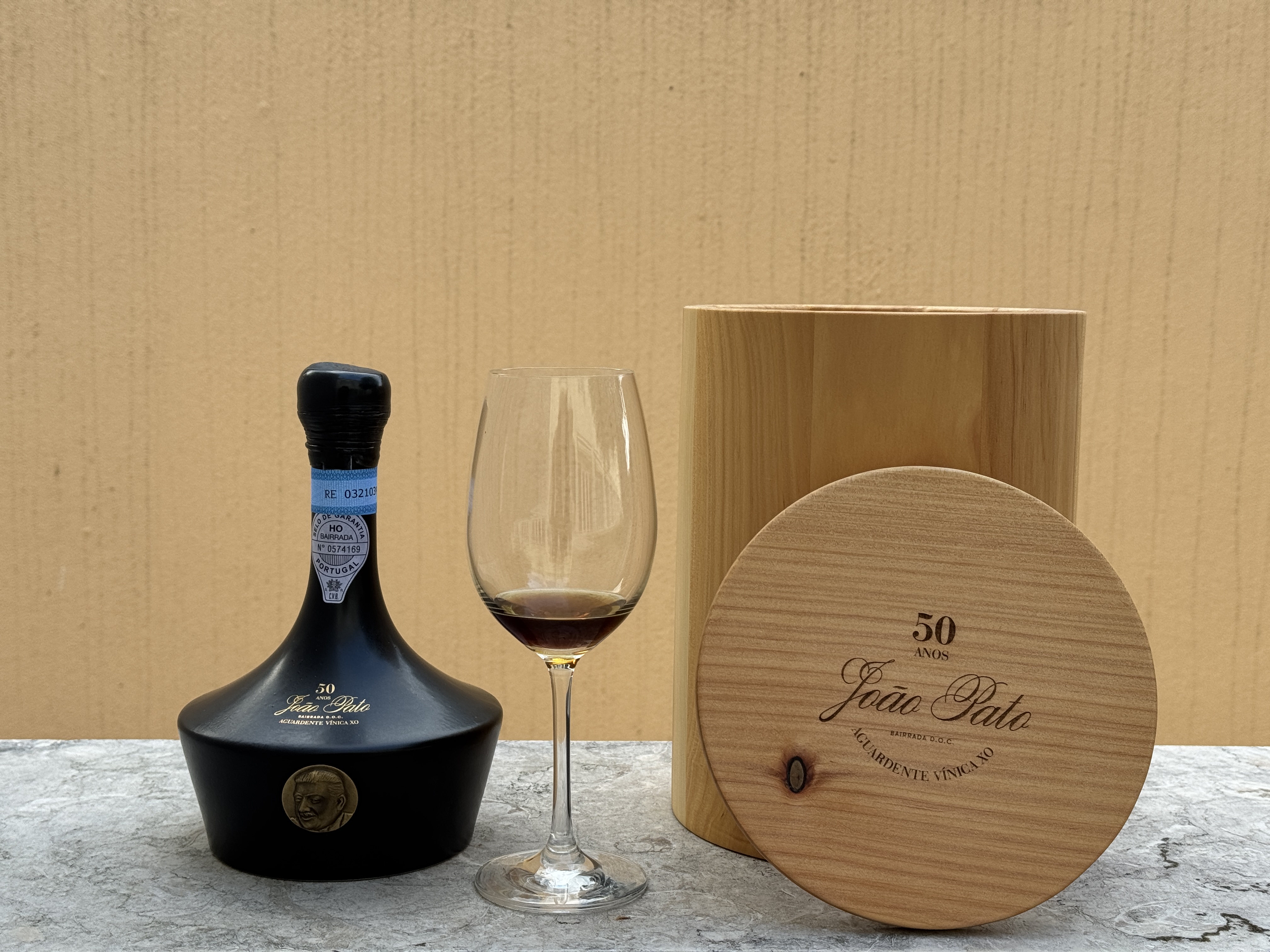
Half a century after the first distillation, Luís released only a handful of bottles. Each feels like an heirloom: an elegant black porcelain vessel resting inside a handmade wooden box, the lid closing with the soft click of a magnet, as if sealing a secret.
Winemakers whimsically call the liquid that evaporates during aging the angel’s share. In this case, the angels were clearly thirsty. Of every six liters laid down fifty years ago, barely enough is left today to fill a single 700-milliliter bottle. But what remains is the essence: flavors and aromas deepened and refined by time.
In the glass, the brandy glows deep amber. Its aroma rises with quiet confidence, warm wood, dried fruit, and a hint of smoke. On the palate, it is rich and profound, inviting slow, reverent sipping.
Sommeliers who have tasted it often describe it as incomparable, a fitting judgment for a brandy that is part of Bairrada’s history.
When wine lovers ask which places they must visit in Portugal, we always recommend Bairrada—a name worth remembering, for it belongs to one of the country’s most captivating wine regions.
Famous Grapes
Bairrada’s soils are a mixture of clay and limestone with streaks of sand. The region is the birthplace of two exceptional grapes: the red Baga and the white Bical. Baga thrives in clay-limestone, while Bical flourishes in both clay-limestone and sandy soils.
The Sparkling Capital of Portugal
Bairrada is Portugal’s sparkling-wine capital. The clay-limestone soils echo the chalk of Champagne, storing moisture during dry spells and reflecting sunlight, allowing grapes to ripen slowly while retaining vibrant acidity and minerality. Cool Atlantic breezes and morning fog temper the summer heat and lengthen the maturation process, giving the fruit extra complexity. The region has been crafting traditional-method sparkling wines since 1890, and they’re now an integral part of daily life. Many meals start and finish with a glass of bubbles, transforming even simple dinners into a celebration.
Where to Stay
We like to make the Vista Alegre Hotel in Ílhavo our base. Built on the marshes of the ria, where saltwater and freshwater meet, the hotel surrounds the 19th-century manor house of the family who discovered the secret of porcelain in 1824.
The hotel’s shops overflow with graceful Vista Alegre porcelain and exuberant mid-20th-century designs by Rafael Bordallo Pinheiro. Feeling inspired? Join a porcelain-painting class and bring home your own creation.
Wine tasting
Luís Pato
Our first stop is usually the winery of the legendary Luís Pato. In the 1990s, when foreign consultants urged Portuguese farmers to replace native grapes with French varietals, he stood firm in Baga’s defense. Time has vindicated him: today his Baga wines rank among Portugal’s most prized, and his unwavering commitment has earned him the nickname “Mr. Baga.”
Luís’ energy and creativity know no bounds. His Vinha Pã Baga blanc-de-noir sparkling wine, uses hyperoxidation rather than sulfur dioxide during must clarification. The result is a wine with fine, persistent bubbles, featuring aromas of wild berries and toasted brioche, and an elegant finish.
Every year, Luís bottles 300 precious bottles of Espumante Pé Franco. It is a sparkling wine made with grapes from century-old vines rooted in sandy soils that shielded them from the phylloxera plague that swept Europe in the 19th century. These ungrafted plants produce a tenth of the yield of a modern vineyard. But the wine is extraordinary—bursting with intensity and lingering beautifully on the palate.
Luis and his daughter, Maria João, are great hosts; gather a group of friends, and they can arrange a feast with leitão (roast piglet), perfectly paired with a dazzling tasting of their wines.
Filipa Pato & William Wouters
Luís’s other daughter, Filipa Pato, and her husband, master sommelier William Wouters, farm biodynamically with stunning results. Often dressed in their playful “Baga terroirista” t-shirts, they are passionate advocates for Bairrada’s land. Their small winery isn’t set up for visits (even members of Coldplay once struggled to arrange a tasting), but their wines are easy to find in local restaurants and well worth seeking out. Highlights include Nossa Solera, a sparkling wine made from a blend of barrel-aged base vintages going back to 2001, and Nossa Missão, an exquisitely complex Baga from a small vineyard planted in 1864, produced with gentle extraction, resulting in an elegant wine that preserves the grape’s aromatic depth.
Mário Sérgio
Another icon is Mário Sérgio, who proudly calls himself a vigneron—a winemaker who only makes wines with the grapes he cultivates. Every Saturday, he and his son Frederico welcome visitors to his cellars, pouring sparkling and still wines made with joyous finesse. His celebrated Pai Abel honors his father; both the red and the white are wonderful to drink young yet reward patience, gaining even greater depth and nuance with age.
Caves São João
At Caves São João, the genial Célia Alves leads tastings in cellars that date back to 1920, where venerable still and sparkling wines astonish with their refined character and vigor.
Many of these producers, along with others, come together each year for Baga Friends, a joyful celebration of the grape and a perfect opportunity to meet them all in one place.
Where to Eat
For a regal lunch, head to the Bussaco Palace. Built in the waning days of Portugal’s monarchy, the building, surrounded by a lush forest, was once a royal hunting retreat. The British mystery writer Agatha Christie enjoyed vacationing here. Chef Nelson Marques brings the grand dining room to life with elegant dishes crafted from the finest local ingredients, creating a memorable dining experience.
The palace is renowned for producing wines with exceptional aging potential. Its legendary cellar holds vintages dating back to the early 1900s. Winemaker António Rocha continues this tradition. He recently unveiled the palace’s first sparkling wine—a sumptuous cuvée whose brioche-scented bouquet captivates the nose while the palate delights in luxurious creaminess and vibrant freshness.
No visit to Bairrada is complete without tasting leitão assado (roasted piglet). Mugasa is a perfect place to try this delicacy and a favorite lunch spot for local winemakers.
Beyond the Vineyards
Stroll along Costa Nova, famous for its candy-striped fishermen’s houses and sweeping views of the ria. Walk the wooden promenade by the beach and savor a caldeirada (fish stew) at Clube da Vela, where the river views are as memorable as the meal.
Another local delicacy, prized since Roman times, is eel. Try the fried eels or eel stew at Marinhas in Aveiro. And don’t leave without sampling the region’s signature sweets: ovos moles, a silky egg confection, and crisp wafer-like hóstias.
The Future of Bairrada
While Champagne grapples with warming temperatures—so much so that some producers are buying vineyards in England—Bairrada is protected by the cool breeze of the Atlantic Ocean. It is a region with passionate wine makers, a unique terroir, and a brilliant future.
We met Filipa Pato and her husband, William Wouters, at Costa Nova, the beach where Filipa used to vacation as a child. Our dinner at Clube da Vela, a restaurant resembling a ship adrift on the waters of Aveiro’s Ria, was unforgettable.
Even though her family has produced wine for five generations, it was not easy for Filipa to start making wine. She didn’t own land, and she is the daughter of a legend. Her father, Luís Pato, is the visionary who placed wines made from baga, the red varietal from Bairrada, on the pantheon of the world’s finest wines. But, over time, Filipa painstakingly crafted splendid wines and forged her own legendary status. “In New York, they know me as Filipa’s father,” says Luís with pride.
After studying chemical engineering in Coimbra, Filipa interned at vineyards in France, Australia, and Argentina. She returned to Bairrada in 2001 for her inaugural harvest and bottled the wine in 2003. A Belgian distributor acquired half of the production. He sold some bottles to William Wouters, a genial chef and sommelier who owned Pazzo, an acclaimed brasserie and wine bar in Antwerp. William became a fan of Filipa’s wines. “At the time, no one knew the white grapes that Filipa uses–bical, arinto, cercial—so I called the wine a Portuguese Chablis,” says William.
William and Filipa frequently crossed paths at wine events. Like in a fairy tale, their connection blossomed into love, culminating in their marriage in 2008. Filipa, who is intense, inquisitive, and creative, found a perfect partner in William, who is funny, focused, and organized. There is a great rapport between the two. Both are artists at heart, driven by a passion for crafting exceptional wines.
Their wines have achieved tremendous success, earning a place in the lists of many renowned restaurants. The demand is so high that they sell through allocations—restaurants and distributors receive only a fraction of what they order. Each January, the couple runs out of wine to sell.
Enthusiasts from all corners of the globe make pilgrimages to meet these trailblazing winemakers. Just last autumn, Jonny Buckland, Coldplay’s guitarist and wine enthusiast, paid them a visit.
The couple lives in Óis do Bairro, a picturesque village of 200 people that dates back to the Middle Ages. They employ ten people who do everything by hand. “We prioritize investing in people over machines,” says William.
Their terroir is exceptional, with soil composed of clay and limestone from the Jurassic era. The proximity to the sea infuses the wines with a delightful salinity. The vineyards have low yields, but the quality of the grapes is superb.
They own 32 parcels of land spanning 20 hectares. “Visiting our properties is like going on a safari,” says William. The portfolio includes centenary vines as well as vineyards that predate the phylloxera outbreak in the second half of the 19th century. One of their jewels is Missão, a vineyard planted with baga in 1864.
A significant turning point in Filipa and William’s journey was their adoption of biodynamic farming practices. After enduring three years of reduced yields, their efforts began to bear fruit. Yields rebounded, and the grapes acquired a new vibrancy.
Eliminating chemicals attracted snails to the vineyards. To divert these mollusks from the grapevines, the couple planted foods that the snails find irresistible like fennel and fava beans. The biodynamic practices turned the fields into hubs of life, teeming with blooming flowers, wildlife, ladybugs, and other beneficial insects.
Because the space between vines is narrow, they employ sheep, pigs, and chickens instead of horse-drawn plowing. The pigs eat lots of grapes but, instead of lamenting the production losses, the couple takes pleasure in the pigs’ satisfaction.
Our tasting began with the festive 3B rosé sparkling wine, a perfect summer wine. The three Bs stand for Bairrada, the wine region, baga and bical, the two grape varietals. The color of the wine changes from year to year. “My wines wear no makeup; I work with what Mother Nature gives me,” says Filipa.
Next, we savored a beguiling Blanc de Blancs sparkling made from a trio of white grapes: bical, cercial, and Maria Gomes. Its creamy and refreshing character delighted our senses.
Our glasses were then filled with a 2020 Nossa Calcário white made from bical, ranked high on the Wine Spectator list of the world’s finest wines. You do not need wine critics to appreciate the excellence of this wine, with its exquisite minerality and saline notes. It is made in their village, which in the 19th century was considered the best terroir for white wines in Bairrada.
We embarked on a journey back in time with Post Quer..s Baga, a red wine produced in amphoras. This delicate wine has a transparency and purity that is rare in modern wines. Filipa does not coat the amphoras, so the porous clay naturally softens the tannins of the baga.
Next came their flagship Nossa Calcário Red. It is made from baga grapes grown on small centenary vines. The result is an opulent wine with fine tannins that is wonderful to drink now but promises even greater rewards with age.
“In Bairrada, it is a tradition to start the meal with sparkling wine and end with sparkling wine,” says Filipa. The grand finale was a stunning sparkling made with a solera process initiated in 2001.
The solera system uses a sequence of barrels. Every year, Filipa removes wine from the top barrel to use as the base for sparkling wine. This barrel is filled with wine from the barrel just below, which in turn gets filled by the barrel just below, etc. Finally, the bottom barrel is filled with new wine. The result is a moving average of all the harvests going back to 2001.
The wine was poured into a decanter designed by William and then served in white wine glasses. Just one sip of this nectar revealed why it was elected Wine of the Year by Portugal’s leading wine magazine—an exceptional honor in a country with so many distinguished winemakers.
Filipa and Williams love traveling and meeting other winemakers. They return from these trips to Óis de Bairro inspired and energized, ready to craft wines like these that bring joy to the world.
Clike here for Filipa Pato and William Wouters’ website.
France is famous for the sparkling wine produced in the Champagne region. But there are exceptional sparkling wines in other parts of the world. We’re particularly fond of the sparklings from Bairrada, which have a unique vibrancy and remarkable aging ability.
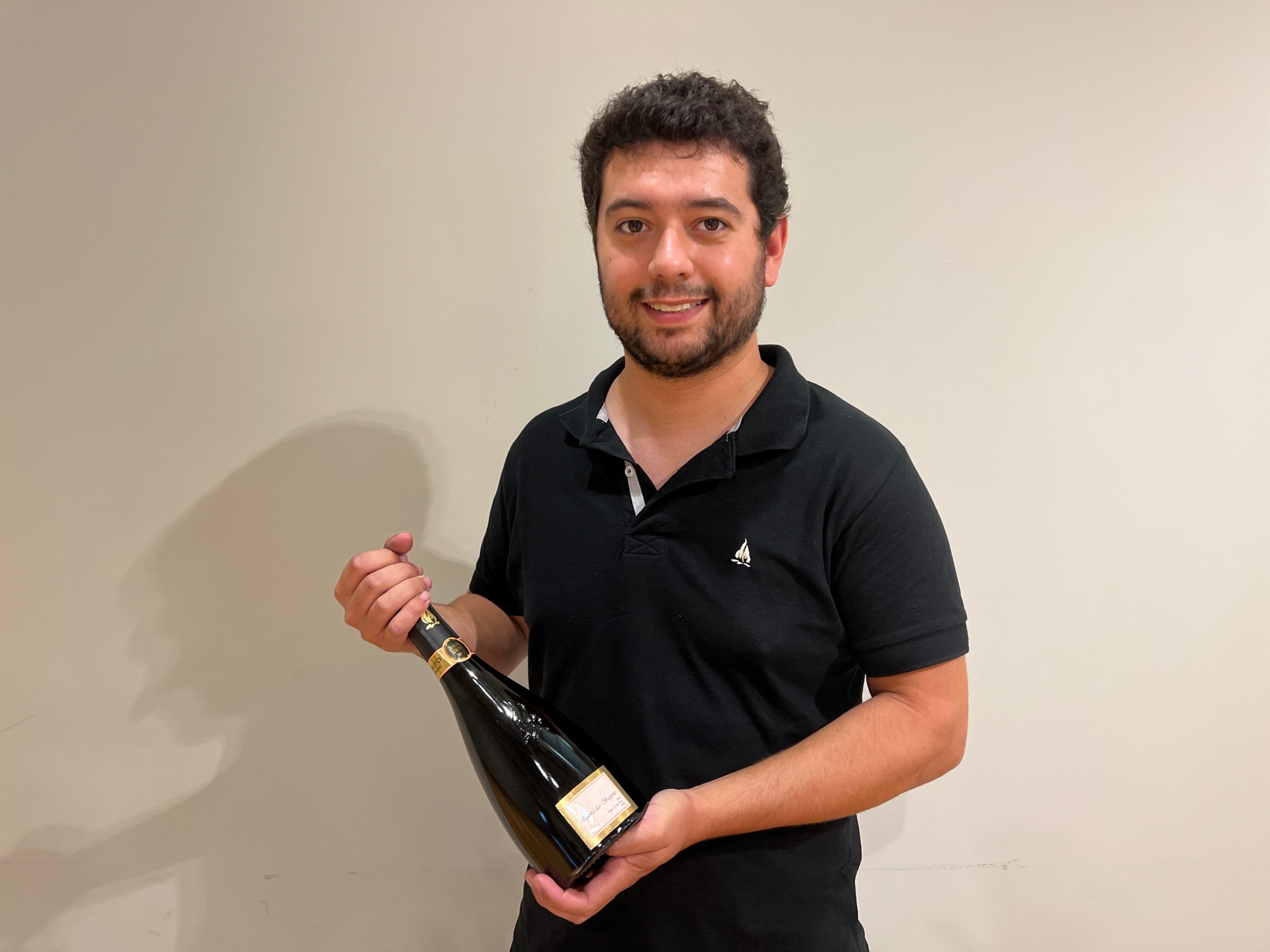
During a recent visit to Bairrada, renowned winemaker Mário Sérgio from Quinta das Bageiras asked his son Frederico Nuno to teach us the art of uncorking a bottle of sparkling wine.
Everybody knows the wine should be properly chilled and that, unless you won the grand prix, you should not shake the bottle. Start by carefully cutting away the foil covering the cork. Here’s the key tip: leave the wire cage encasing the cork intact. Removing it causes the cork to expand, making it challenging to extract. Instead, gently twist the cork with the wire cage in place. The cork should effortlessly leave the bottle with no wine spillage, letting only the delightful fragrances waft into the air.
“If the boss is in the house,” Frederico says, referring to his father, “we twist the cork slowly to ensure it comes out silently. If the boss is away, we remove the cork more briskly to hear the celebratory pop we associate with sparkling wine.”
To demonstrate the technique, Frederico opened a bottle of the splendid 2018 Quinta das Bageiras Grande Reserva, rosé sparkling wine. Once the bottle was open, there was no going back. Frederico poured the exquisite sparkling into elegant white wine glasses, allowing the wine to breathe and revealing its intricate aromas. We raised our glasses and toasted to Bairrada, a region that produces sparkling wines that rival the finest champagnes.
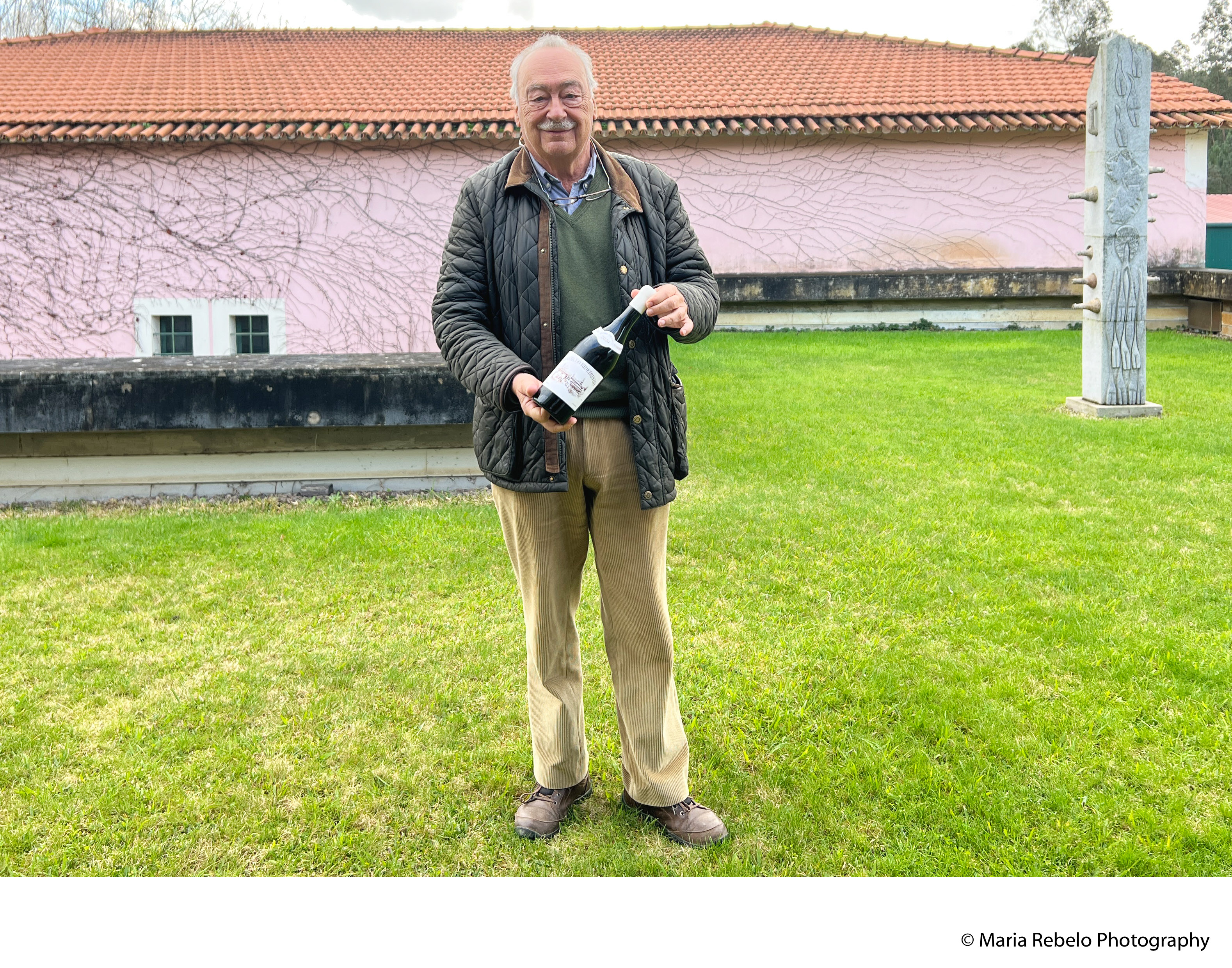
Luís Pato, the famous Bairrada winemaker, is always doing something new. One of his recent projects is a white wine made from a rare grape called Sercialinho. This varietal was created in the 1950s by crossing two iconic grapes: Sercial, used in Madeira wine, and Alvarinho, used in vinho verde (green wine). João Pato, Luís’ father, planted this new varietal about half a century ago on the sandy soils of his Quinta de Ribeirinho. Luís always loved the grape’s aromas, which resemble those of Alsatian Rieslings. For years, he has used Sercialinho to add acidity and aroma to his renowned Vinhas Velhas (old vines). In 2013 Luís made a single-varietal Sercialinho in his father’s honor. He started producing it regularly with great results since 2019. “I’m the world’s sole producer of Sercialinho,” Luís told us with pride.
But Sogrape, Portugal’s largest wine producer, also launched to great acclaim a Sercialinho wine produced in Bairrada (in Quinta de Pedralvites). It is part of their “Séries Ímpares” created to showcase unique varietals and terroirs.
DNA analysis revealed that Sogrape’s Sercialinho is a cross of Vital and Uva Cão. Is this the same varietal that João Pato planted? Are the two Sercialinhos identical twins, fraternal twins, or homonymous strangers? It is a mystery. What we do know is that they’re both spectacular wines!
Most vinegar consumed around the world is made through industrial processes that work fast but generally produce insipid results. Luckily, there is an increasing number of producers making delicious artisanal vinegars.
“It is easy to make fine vinegar, all you need is good wine and patience,” says Mário Sérgio, the winemaker of Quinta das Bageiras in Bairrada. “Fill about two-thirds of an oak barrel with good-quality wine and forget about it for 10 years. Sure enough, the wine will turn into vinegar.” The Romans seem to have followed a similar recipe–the Latin word for vinegar, vinum acer, means sour wine.
We took a bottle of Mário Sérgio’s artisanal vinegar home and were amazed at the difference it made. Its tangy taste transforms salads from good to great. Cooking with this vinegar enhances the food we prepare in ways that are subtle but profound.
The people of Epernay, a town at the heart of the Champagne region, know more about sparkling wine than almost anyone in the world. So it is remarkable that Mario Sérgio, a producer from Bairrada, found a market for his sparkling wines in Epernay.
This success has been more than a century in the making–Mário is a 4th generation wine maker. His 81-old father still labors 10 hours a day tending to the vineyards.
Mário’s family used to sell their grapes to the famed Caves São João. In 1989, at age of 23, Mário decided to reserve the grapes to make his own wines under the label Quinta das Bágeiras. From the beginning, he paid no attention to what is most fashionable or profitable. Instead, he focused on making great wines in Bairrada.
One of the first hints that Mário was on the path to greatness came in 2001 when, in a blind tasting organized in France, the judges selected two wines: a very expensive Château Haut-Brion and a modestly-priced Quinta das Bágeiras garrafeira.
Mário shuns everything that is artificial. He uses no yeasts, no filtering, no stabilization techniques. Reds are made with old wine presses using the notoriously difficult baga varietal. Sparkling wines are all Natural Brut, an exacting style that requires that there be no residual sugar in the wine.
Just like the French vignerons, Mário buys no grapes. All his wines are produced from grapes hand picked in his properties. He knows every parcel and plants vines only in soils that can produce excellent results. “I am often offered grapes from properties adjacent to mine. But many times, the soil and sun exposure are completely different from those of the parcels I own.”
Mário is particularly proud of the vineyard that produces the grapes for Pai Abel, a wine named after his father. He makes 2,000 bottles a year. Using a practice that is rare in Portugal, he sells 80 percent “en primeur” to lucky subscribers who buy the wine at a discount two years before it is ready for delivery.
A profound believer in the aging potential of Bairrada whites, he stored his 1994 white wine for 12 years before releasing it for sale. When he brought home a bottle to share with his wife, she told him: “There’s no market for aged white wine, you’ll never sell a single bottle.” When by the end of the meal the bottle was empty, she conceded that “maybe you’ll sell some of this wine.” Mário sent a couple of bottles to his friend Dirk Niepoort. In return, he received the biggest compliment a wine maker can give to another: Dirk asked to buy all the stock of Quinta das Bágeiras 1994 white!
Every Saturday, Mário Sérgio opens the door of his winery to visitors. If you’re a wine lover, it is hard to find a more enjoyable way to spend a Saturday than to pay a visit to Quinta das Bageiras.
Quinta das Bágeiras is located at Rua Principal nº598, Fogueira in Sangalhos (N 40º 29.109′ ; W 8º 29.969′), tel. 234 742 102, email mariosergio@quintadasbageiras.pt. Click here for their website.
Three brothers, José, Manuel and Albano Costa, built in 1920 wine cellars called Caves São João. They used the cellars to store the wine from Bairrada that they sold to taverns throughout Portugal.
In the 1930s, the Costa brothers ventured into wine production. They dreamed about producing wines that future generations could drink with pride. With the help of French enologist Gaston Mainousson, they learned the secrets of champagne production and started making sparkling wine in Bairrada.
In the 1950s they started producing two iconic wines: Frei João in Bairrada and Porta dos Cavaleiros in the Dão region. Made with great care, these wines were stored so that time could tame their tannins and leave only the smooth taste of the fruit.
As their wines gathered fame, the three brothers increased production and expanded storage capacity. Today the cellar holds 2.5 million bottles that preserve the rhythms of the seasons and the fruits of the toil of generations of farmers. These irreplaceable time capsules are guarded by the great-great grandchildren of the original owners.
We tried two white wines produced at Quinta do Poço dos Lobos. The first, a reserve wine from 2013 had a pale, yellow color, and a smooth taste that left our palate refreshed with notes of citrus. The second was a Poço dos Lobos colheita from 1995. What a difference three decades make! The older wine had an intense yellow color. The citrus notes were now singing with a choir of harmonious flavors orchestrated by time.
We sampled two vintages of Frei João. A red from 1980 that was rich and smooth and a white from 1986 that was still full of youth and vigor.
Our tasting ended with a brandy from 1966 that was suave and sophisticated. It is a nectar that has seen it all from the breakup of the Beatles to the fall of the Berlin wall.
Caves São João look like Aladdin’s cave, full of treasures stored away from the sun and immersed in sultry air. If a genie offers you three wishes during your visit to the cellars don’t hesitate: ask for a white Poço dos Lobos, a red Frei João or Porta dos Cavaleiros, and a bottle of 1966 brandy.
Caves São João are located at São João de Azenha in Anadia, tel. 234743118, email geral@cavessaojoao.com. Click here for their web site.
Bairrada is a region in the center of Portugal with unique conditions for wine production. Close to the Atlantic Ocean, it has sandy soils like those of Bordeaux and chalky soils like those of Burgundy. The vineyards are surrounded by pine trees and eucalyptuses that infuse the grapes with delicate flavors.
The queen varietal of the Bairrada region is the indigenous baga and the king of the baga is Luís Pato. The heir to a line of Bairrada wine makers that can be traced back to 1860, he rebelled against the idea of planting foreign varietals. “Mister Baga,” as people like to call him, has been proved right: today his baga wines are served in many of the world’s great restaurants.
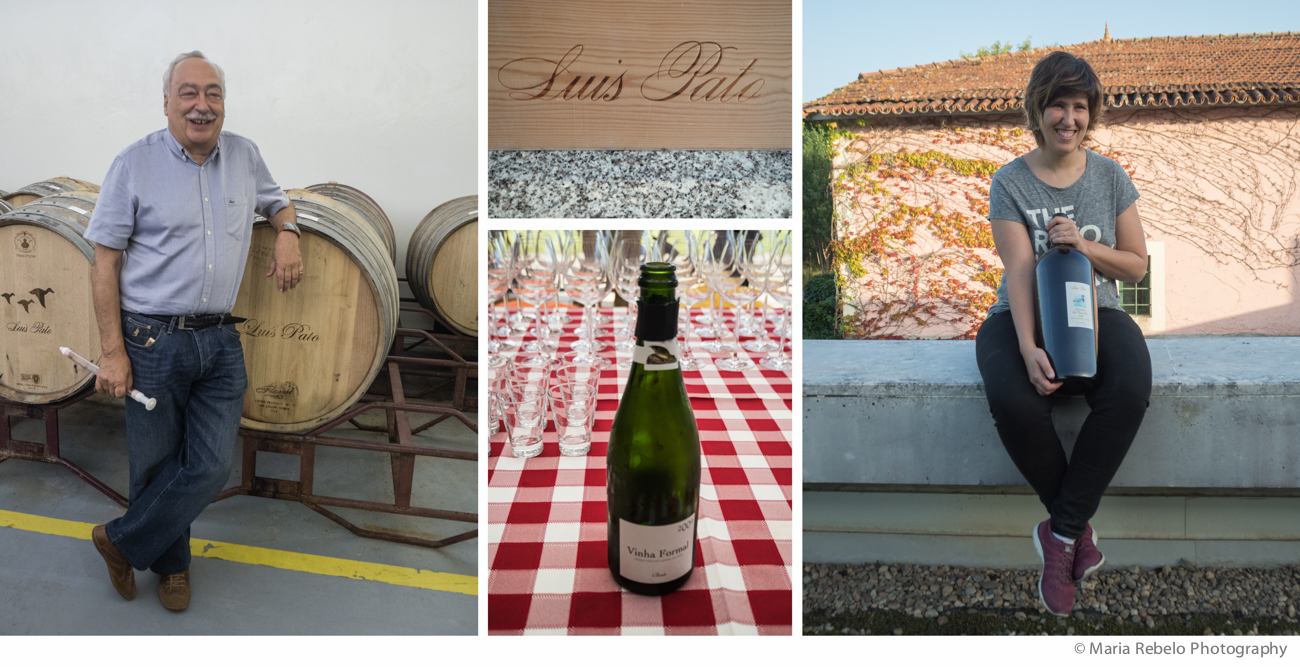
On our first visit, we were received by his daughter Maria Pato. She talks about her father’s wines as if they are part of the family. Her green eyes shined when she opened two bottles of wine from a vineyard called Vinha Formal. The first was a sparkling wine with an enticing brioche aroma. The second was an elegant white made only with bical, a local white varietal.
Next, we tried a 2000 Quinta dos Moínhos, a captivating red wine made with baga. It tastes to red fruit but the tannins have been tamed by the aging process, giving the wine an aristocratic feel.
We sampled a very interesting fortified wine. Luís Pato stopped fermentation before the yeast converted all the sugar into alcohol by freezing the grape must instead of following the traditional process of adding alcohol to kill the yeast.
On our second visit, Luís Pato took us to the cellar to sample some Pé Franco wines made from ungrafted vines that predate the onset of phylloxera. They are complex and have a wonderful acidity that will help them age gracefully.
Pato talked about how much he has learned over the years. “People in Bairrada used to say that baga wines are good in only two years out of ten. When it rained before the harvest, the grapes gained a watery taste which together with rot ruined the wine.” He had the idea of pruning the grapes early in the season and use the pruned grapes to make sparkling wine. “Pruning gives the grapes more space to breathe, preventing rot and allowing me to make good wines in years with rainy Summers.”
Some of Pato’s new projects, like his 19th century-style wines, are inspired by tradition. Others, like his sweet white wine made with from red grapes using hyper-oxygenation, defy tradition.
We asked him about his daughter Filipa Pato, who is also a wine maker. “Our wines are quite different, but we share a lot of information. In New York they know me better for being Luisa’s father than for my wines.” he said with pride.
Both wine makers are experimenting with sercealinho, a grape varietal that only exists in their properties. These vines have to be watched closely because they are highly susceptible to disease. Luís’s father kept a plot of sercealinho alive that shows great potential.
Pato told us that “As a wine maker I cannot stop, I have to continue to evolve and accept new challenges. I want to make wines that my grandchildren will drink in 30 years and say, wow this wine is great.”
Every time we try Luís Pato’s brilliant, original wines we wonder: is Bairrada the best wine region in Portugal and one of the best in the world? If you’re a wine lover, visit Luís Pato’s winery to find out.
Click here for information on how to schedule a visit to Luís Pato.
Bairrada is a region in the center of Portugal known for its refreshing sparkling wine and its “leitão” (roasted suckling pig). The best leitão in Bairrada comes from a restaurant called Mugasa located in the middle of nowhere in a small village called Fogueira.
The restaurant’s owner, Álvaro Nogueira, retired from a desk job and opened a small café in 1981. He wanted to learn the art of roasting piglets to turn his café into a restaurant. But the learning curve was steep until one of his cousins, a master roaster, offered to teach him.
After this jump start, Álvaro kept perfecting his art. In 1991, he entered a competition organized by a gastronomic society and won first prize.
“Why is roasting so difficult?” we asked Álvaro. ” Every pig is different, with a different size and fat content. We use six wood-fired ovens and every oven is different. We have to make constant adjustments to guarantee perfection. That is why we only roast four piglets per oven, to have time to make all the necessary adjustments.”
“In the first 20 minutes, the oven has to be very hot, between 280 and 300 degree Celsius to make the outside crunchy. Then we cover the wood with ashes to bring down the temperature. There are many details so we have to pay close attention. The traditional seasoning made with garlic, lard, white pepper, and salt is important but you cannot use it to cover up mistakes.”
We sat at the table to try Mugasa’s leitão. It is indeed remarkable, crunchy on the outside, succulent on the inside, with just enough seasoning to accentuate the taste of the meat.
Álvaro is very proud of the celebrities that drive to Fogueira just to eat at his restaurant. But he is even more proud of his son Ricardo. “My son is the best master roaster in Portugal,” Álvaro said smiling. “He learned my secrets and discovered new ones.”
Many Bairrada wine makers eat regularly at Mugasa, so you often overhear discussions about weather conditions and grape maturation. The restaurant offers some of the best wines from these producers at very attractive prices.
The formula for Mugasa’s success is easy to write down but hard to replicate: amazing leitão plus great Bairrada wine = unforgettable meals.
Mugasa is located at Largo da Feira, Fogueira, Aveiro, tel. 234 741 061






 Salt of Portugal