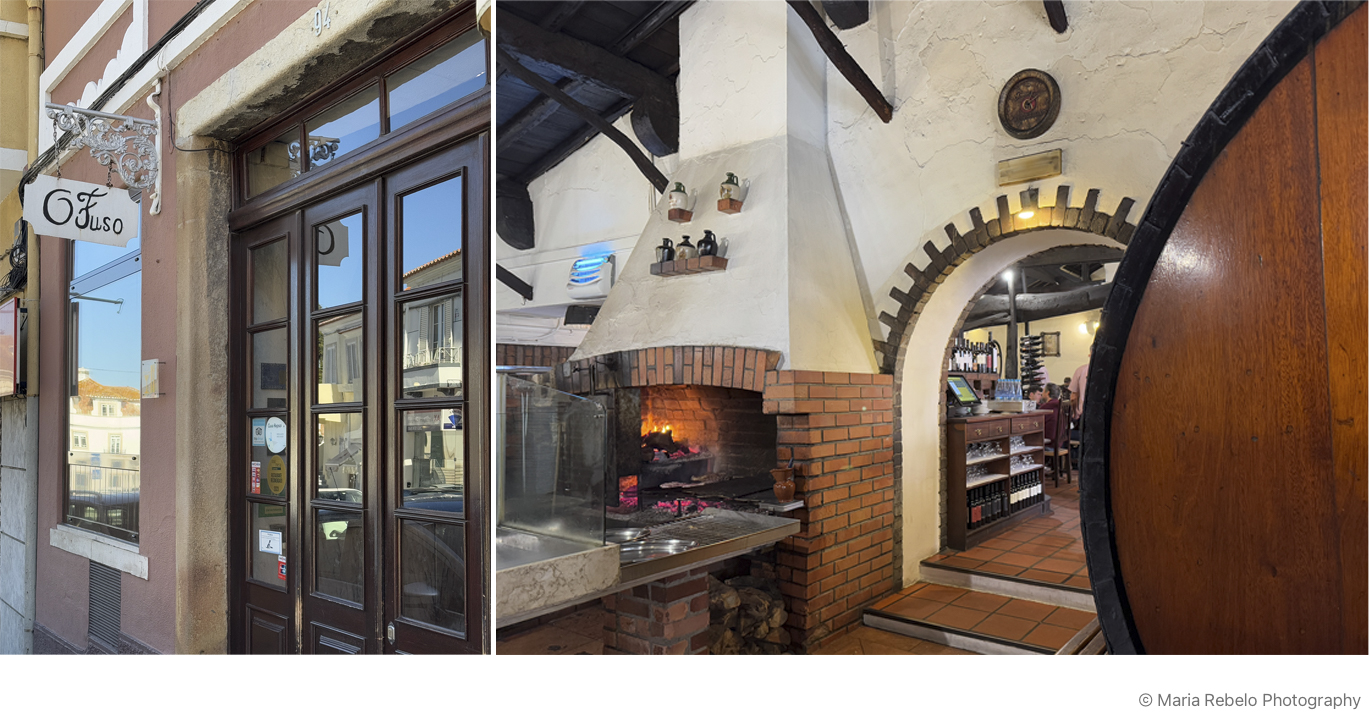
Located in Arruda dos Vinhos, 20 miles north of Lisbon, Fuso is a restaurant from another era. It opened its doors, in the space once used as a winery and a tavern, on March 9, 1973.
The concept for the restaurant was created by Fernando Guerra Cardoso, a successful car salesman who enjoyed socializing over food. He persuaded his friend, Armindo Mera Dominguez, to open a restaurant serving oversized portions that encouraged people to bring their friends. Today, the restaurant is run by the great-grandchildren of both founders.
Diogo Coucello, Fernando’s great-grandson, leads a team of 30 waiters and kitchen staff, ensuring seamless service for up to 300 guests. Reservations are essential—Fuso is always full.
Since 1973, the menu has remained unchanged, focusing on two signature dishes: charcoal-grilled codfish and bone-in rib steak. Your meal can begin with delectable appetizers such as prosciutto, savory sausages, or grilled shrimp and end with various desserts, ranging from roasted apples to egg puddings and chocolate cake. But the main attractions are grilled codfish and steak.
You can find these dishes in many other restaurants, but Fuso’s renditions are exceptional. The codfish, imported from Norway, is meticulously selected for its succulence and rich flavor. The rib steak, consistently tender and tasty, has been sourced from the same butcher since the restaurant’s inception.
Fuso’s rustic décor has remained untouched since its opening. The restaurant’s name refers to the fuso, or spindle—a large wooden screw—attached to the wine press that still occupies the center of the dining room. The entrance is dominated by towering wine barrels made from exotic wood and a grand charcoal grill glowing with embers.
In a world where everything feels fleeting, it’s a privilege to eat at a restaurant that has been a gathering place for friends who love food for over half a century.
Fuso is located at Rua Cândido dos Reis, 94, Arruda dos Vinhos, tel. 263 975 121, 263 978 547.
Francisco Melícias, the general manager of Quinta de São Sebastião, invited us to visit the estate. So, we traveled along narrow roads that wind through villages where houses are nestled among vineyards until we arrived at Arruda dos Vinhos. This historic town, established in 1160 by Portugal’s first king, owes its name, “wine route,” to its role as a transit point for wines transported by horse-drawn carts to Lisbon.
Arruda’s soils, predominantly limestone and clay with patches of sand, create ideal conditions for viticulture. Limestone promotes deep root growth and imparts minerality and acidity to the wines, while clay retains water, adding richness and structure. The region’s rolling hills and refreshing Atlantic breezes lend complexity to its wines.
The town is steeped in history and faith. São Sebastião, its patron saint, is credited with three miracles. First, in the 14th century, Arruda was spared from the bubonic plague that devastated much of Portugal. Second, in 1755, the town escaped the earthquake, tsunami, and fires that reduced nearby Lisbon to ruins, prompting King José I and his family to seek refuge in Arruda. Third, in the late 18th century, the region’s sand patches protected its vineyards from the phylloxera pest that devastated European vineyards.
Our journey continued up a steep hill to Quinta de São Sebastião, an estate established in 1755. We visited the chapel, once part of a monastery founded by monks who sought peaceful retreat. Francisco tells us that during the Napoleonic invasions, the estate played a role in the Lines of Torres Vedras, a network of fortifications built in 1809–1810 to defend Lisbon against Napoleon’s troops. Today, the remnants of these fortifications are a reminder of the estate’s historical importance.
In the 1980s, António Parente, an industrialist, bought Quinta de São Sebastião and invested in its future. The vineyards, planted on steep hills with different exposures, offer diverse terroirs that allow winemaker Filipe Sevinate Pinto to create distinctive blends. These wines combine traditional local varietals like Touriga Nacional with carefully selected French grapes.
We sampled some remarkable wines in the estate’s tasting room, which overlooks a picturesque riding arena where horses are trained. The 2022 Reserva Branco, a blend of Arinto, Cercial, and Sauvignon Blanc, has a pleasurable intensity and minerality. The Sauvignon Blanc provides a seasoning touch that allows the blend to shine. A surprising single-varietal made from Cercial, a grape known as Esgana-Cão in the Douro Valley, impressed us with its elegance and freshness. The Provence-style rosé, Dona Aninhas, pays tribute to António Parente’s mother with its delightful balance and vibrant acidity.
We also tried three reds. The first, a Reserva, is a blend of Touriga Nacional, Merlot, and Sousão. The aromatic Touriga complements the delicate Merlot, while the lively Sousão provides a touch of exuberance. The second, a blend of Alicante Bouschet and Syrah is intense, offering a beautiful harmony of flavors. Finally, the Grande Reserva—a daring mix of Merlot and Sousão— captivated us with its depth, complexity, and character. This wine is an ode to joy!
Quinta de São Sebastião is building on its rich heritage to create wines that are distinctive and deeply enjoyable.
Quinta de São Sebastião is situated in Arruda dos Vinhos. Click here for their website.
“When my father came home from work, he would spend hours studying military maps,” recalls Jorge Rosas, the CEO of Ramos Pinto, a port wine house founded in 1880 by his great-grandfather, Adriano Ramos Pinto. “He was searching for the perfect farm in the Douro Superior, a region he believed could produce exceptional wines like the legendary Barca Velha.”
Sitting on the floor with an old magnifying glass that had lost its handle, Jorge’s father, José António, pored over contour lines in search of flat land. He wanted to find terrain that was easier to cultivate than the steep slopes that dominate the Douro Valley. From Friday to Sunday, José António drove through rustic roads, to visit locations he had marked on the maps.
One day, crossing a remote mountain path, he found his dream farm. “Shangri-La!” he exclaimed. The estate, then planted with cereals, was called Ervamoira. It was love at first sight—a love so strong that his wife often felt jealous of the farm. Determined to buy it, José António contacted the owners in Lisbon. Despite having little attachment to the estate, they hesitated to sell a property that had been in their family for generations.
An avid trout fisherman, José António donned his fishing gear to fish in the rivers that cross Ervamoira, the Coa, and the Douro, even though he knew they had no trouts. Fishing was merely an excuse to immerse himself in the landscape, imagining the vineyards he might one day plant.
In the aftermath of the 1974 revolution, many farms were nationalized. Fearing expropriation, the owners of Ervamoira agreed to sell. Despite his family’s concerns about buying an estate amid so much uncertainty, José António seized the opportunity. “My father is a cereal killer,” jokes Jorge, alluding to how the cereal fields were soon replaced with vineyards.
At Ervamoira, José António introduced innovative viticultural practices. He assigned each grape varietal to a separate plot. Instead of using traditional terraces, he planted vines on platforms that facilitate mechanization. High-density planting forced roots to delve deep for nutrients, enhancing quality through higher polyphenol content and increasing drought resistance.
But a shadow loomed over paradise. In the early 1990s, plans resurfaced to construct a hydroelectric dam that would flood the estate. Horrified, José António fought tirelessly against this project. The discovery of a Roman tomb and ancient coins on the property provided fleeting hope, but archaeologists deemed the finds insufficient to halt the dam project.
Desperate, José António entered his wines into international competitions, receiving numerous awards. But not even these accolades could stop the project. “What now?” he wondered. “Only a miracle can save the farm,” his cousin, João Nicolau de Almeida, remarked.
Then, a miracle happened. Archaeologists discovered prehistoric cave engravings near Ervamoira. An expert who secretly evaluated the site revealed that the engravings are about 30,000 years old. It was widely assumed that outdoor prehistoric art couldn’t survive millennia of exposure to the elements. Ervamoira proved otherwise.
The discovery attracted the attention of the Portuguese media but failed to sway the government. Deliverance came from an unexpected source. A Portuguese émigré, who had been Jacqueline Kennedy’s butler, read about the engravings in a local newspaper. He shared the news with an acquaintance at The New York Times, and the newspaper published an article titled “Vast Stone Age Art Gallery Is Found but Dam May Flood It.” The story sparked an international outcry that led to the abandonment of the dam project.
Today, Ervamoira thrives. Its grapes contribute to the iconic Duas Quintas wines, made from a blend of grapes from two farms—Ervamoira and Bons Ares. The schist soils of Ervamoira, at 150 meters altitude, lend structure, while Bons Ares, perched at 550 meters with limestone soils, adds refreshing acidity.
Ervamoira’s magic is unmistakable. Nestled in the remote Douro Superior beyond the Cachão da Valeira—a region inaccessible until Queen Maria I spearheaded efforts to make the Douro River navigable—it is a gem of the Douro Valley, a dream that a miracle made come true.
Please click here for information on how to visit Ervamoira.
To find the finest place for lunch in Lisbon, you must head toward the majestic Pantheon, a baroque limestone masterpiece that took three centuries to build. The adjacent plaza, Campo de Santa Clara, overlooks the “sea of straw,’’ the stretch of the Tagus River that reflects the golden sunlight, resembling a field of wheat.
A short walk leads you to number 128, where the understated entrance of the elegant Santa Clara 1728 hotel awaits. From Tuesdays to Saturdays, the hotel’s dining room, home to the renowned Ceia restaurant, transforms into a lunch haven called Solo.
The meal begins with the comforting aroma of warm, house-made sourdough bread served with creamy butter. It continues with a starter and main course paired with a glass of wine and ends with dessert. The menu is updated every two to three weeks to reflect what is seasonal.
The starters are a testament to culinary finesse, featuring options like delicate Hamachi kissed with ponzu and coriander, requeijão–a soft cheese from the Estrela mountain–adorned with grapes and a touch of balsamic vinegar, or duck escabeche infused with the sweetness of ripe tomatoes.
The main courses are equally enticing, including choices like tender roast beef accompanied by grilled lettuce hearts and anchovy vinaigrette, creamy orzo with pumpkin, spinach, and truffles, or line-caught fish paired with pumpkin, hazelnut, and a rich bouillabaisse.
For the sweet ending, will you choose the tropical freshness of Azorean pineapple with yuzu syrup and finger lime? Or the indulgent richness of chocolate ganache with seasonal fruits?
Sharing the experience with a friend doubles the delight. The chef can split two menus, letting you savor two different starters, main courses, and desserts.
Solo’s exceptional cuisine is rooted in its “soil to table” philosophy. Most ingredients are sourced from Herdade no Tempo, a farm in Alentejo that uses regenerative and holistic practices to nurture the soil and support biodiversity. Chef Renato Bonfim and his team transform these pristine ingredients into dishes that celebrate the gifts of nature and the joy of cooking.
From the artful presentation to the gracious service and intimate ambiance, every detail at Solo turns lunch into an experience that lingers in our memory long after the last bite.
Solo is located at Campo de Santa Clara, 128. Lisbon. Click here for the restaurant’s website.
Victorian novels describe picnics where friends have a grand time, enjoying delicious food in idyllic settings. But real-life picnics seldom measure up to these literary accounts. Sometimes, the sun is too harsh, and the shade is scarce. Other times, it is cold, the wind blows disagreeably, or the rain intrudes. Wine and beer are lukewarm by the time they are served. Sitting is uncomfortable, and troupes of insects join the party.
When our friend Abílio Tavares da Silva invited us for a picnic, we braced ourselves for the usual woes. But, as soon as we arrived at his Douro Valley estate, it was clear that this would be no ordinary affair.
It was a midsummer day with clear skies and a gentle breeze. Spacious wooden tables with comfortable benches awaited the lucky guests under the shade of two majestic linden trees. The view, with the Douro River stretching out in all its splendor, was worthy of being painted by Turner.
The picnic basket, prepared by the talented Rosário Buia at Toca da Raposa, was brimming with delicacies. There were farinheira tarts, shrimp rissoles, oranges seasoned with olive oil and minced garlic, chickpea salad, carrot and zucchini rice, olives, freshly baked bread, and a tortilla prepared with eggs so delicious that they were surely laid by the happiest of chicken.
The food was served in colorful pottery designed by the 19th-century master ceramist Rafael Bordallo Pinheiro. Abílio’s alluring Foz Torto white wine, made from precious old vines in Porrais, was poured into crystal glasses at the ideal temperature.
The conversation flowed as freely as the food and the wine. The meal ended late in the afternoon with slices of Toca da Raposa’s famous drunken cake (bolo borrachão) accompanied by glasses of chilled 20-year-old Fonseca tawny port. Not even Jane Austen could imagine such a perfect picnic.
One of the Douro Valley’s ultimate experiences is visiting Quinta do Vale Meão. While the estate is not generally open to the public, it does receive a few small groups each year. You can email in advance to inquire whether they can host you.
Vale Meão was the last estate planted by the legendary Dona Antónia Ferreira. It was a colossal endeavor: 300 hectares of wild bush were converted into vineyards and olive groves. Dona Antónia invested in the remote Vale Meão against the advice of her general manager because of its unique characteristics. It is located on a geological fault with three different types of soil: schist, granite, and sedimentary clay deposited by the river. The weather is dry, as clouds rarely cross the Marvão mountain, reducing the prevalence of vine diseases like oidium.
The best way to reach Vale Meão is by taking the train from Pinhão to Pocinho. There are usually few passengers, so you can choose a seat by the riverside and enjoy a glorious hour beholding the Douro river in all its splendor. The train rushes through bridges and tunnels carved into granite hills, but the river is seldom out of sight.
You go by Cachão da Valeira, a treacherous spot before dams regulated the water flow. Here, Dona Antónia and the Baron of Forrester, another eminent figure of the Douro Valley, fell into the river in a boating accident. Dona Antónia survived, but the Baron drowned. The locals say in jest that her voluminous skirt saved her, while the Baron sank because his pockets were filled with gold coins.
Maria Ferreira, a former teacher who oversees enotourism at Vale Meão, picked us up at the Pocinho train station in a vintage Land Rover. Though not related to Dona Antónia, Maria speaks about the estate with such passion it feels as though she is part of the family. An eagle followed the Land Rover as we drove through Cortes de Veiga, a village created to house the many laborers who worked at Vale Meão between 1885 and 1887.
The name Meão, which means “middle,” refers to the river encircling the property, making it feel like an island. The vineyards are planted on a magnificent plateau by the river.
Maria took us on an exhilarating safari through the vineyards. We then visited Barca Velha, a cellar built in 1892 named after an old rowboat used to cross the river. Here, Fernando Nicolau d’Almeida crafted the first Barca Velha in 1952, combining grapes from Vale Meão with those grown at higher altitudes in Meda to craft a table wine that became iconic.
Our tour concluded at the main house, constructed by Dona Antónia in 1894. We were warmly received by three of her descendants: Francisco Olazabal, known as Vito, his son Francisco, known as Xito, and his daughter Luísa. They welcomed us with a refreshing white Monte Meão, made from a blend of two grape varietals grown at opposite ends of the estate—Arinto in the sedimentary soils of the north and Rabigato in the schist soils of the south. This wine beautifully showcases the diversity of the terroirs at Vale Meão.
As we talked to Vito, Xito, and Luísa, it became clear that wine is a language to them. Soils and grape varietals are like words that can express human craftsmanship and the whims of the seasons to make wine as fine as poetry. Their passion for wine is only matched by the generosity with which they share the fruits of this extraordinary place with those who visit.
We tasted the Monte Meão Vinha da Cantina, a surprising wine made from baga, a red grape from Bairrada. While in Bairrada, baga produces tannic, robust reds; here, it yields a light (11.5% alcohol), vibrant wine.
Next, we enjoyed a remarkable Monte Meão Touriga Nacional from the granite soils of Vinha dos Novos. It has a crimson color, a delicate floral aroma, and a supine elegance on the palate. It was followed by a beautiful Monte Meão from Casa das Máquinas, home to the estate’s oldest vineyards that combines Touriga Francesa and Tinta Barroca.
The tasting of table wines concluded with two stunning Vale Meão vintages. The 2014 vintage is a complex, alluring wine, and the 2002 vintage is exquisite in its subtlety and refinement.
Then, port wines entered the scene. First, a 10-year-old tawny, which is all that a great tawny can be, offering notes of nuts, coffee, chocolate, and orange rind to enchant the palate. Then, a stunning 1999 colheita, that is richly satisfying.
In 1999, Vito took a significant risk by leaving his safe position as a director at Sogrape, the large wine company that acquired most of Dona Antónia’s properties, to start a new family project under the Vale Meão name. The many accolades earned since then, including inclusion in the Wine Spectator’s list of the world’s top 5 wines, show clearly that the risk paid off. From her celestial vantage point, Dona Antónia must be beaming with pride.
In 1926, the Michelin Guide began classifying restaurants into “vau l’etape” (worth stopping), “vaut le detour” (worth going out of your way for), and “vaut le voyage” (destination restaurants).
We are often asked which are the destination restaurants outside of Lisbon and Porto. Here are our very own recommendations listed in alphabetical order.
Chef Julie Marteleira and her sister Jennie left successful careers in Toronto to open a restaurant near the Portuguese village where their parents married. Alta, at Praia da Areia Branca, offers the freshest ingredients, exceptional preparation, and stunning ocean views.
Located in Évora, a beautiful Roman town, this restaurant seats only eight people and takes no reservations. It is worthwhile to arrive early to feast on the traditional food from Alentejo prepared by Florbela Canelas and served by her husband Domingos.
A royal retreat built by King Charles I and converted into a luxury hotel in the early 20th century. This place has everything: a majestic setting, iconic wines exclusive to the hotel, and delicious food prepared by Nelson Marques, a talented young chef.
Brazilian chef Michele Marques has lived in Portugal for so long that she almost lost her Brazilian accent. But her approach to cooking food in Alentejo remains unique—a magical combination of authenticity and creativity that always produces memorable meals.
This restaurant is in Porto Covo, a seaside village so beautiful that it inspired an eponymous song by singer Rui Veloso. Chef Ana Moura offers a cuisine that is elegant, creative, and full of flavor, making every meal feel like a summer vacation.
Chef Ricardo Nogueira is renowned throughout Portugal for his delicious roasted suckling pig. His restaurant is a gathering place for great Bairrada winemakers like Mário Sérgio, Filipa, and Luis Pato. The restaurant offers their wonderful wines at modest prices.
The culinary queen of the kingdom of Algarve did not inherit the throne. She conquered it by cooking the pristine seafood of the Algarve with such reverence and care that every meal is like a prayer.
In the shade of the castle at Alter do Chão Filipe Ramalho, serves a delicious evolution of traditional Alentejo cooking. Do not miss his classic tart, cooked with farinheira sausage made with chestnut flour, topped with pears cooked in wine, quince marmalade, and chard.
Located in Ervedosa do Douro, surrounded by some of the best vineyards in the Douro Valley, Dona Graça and her daughter Rosário use almost forgotten recipes to make food that satisfies the soul.
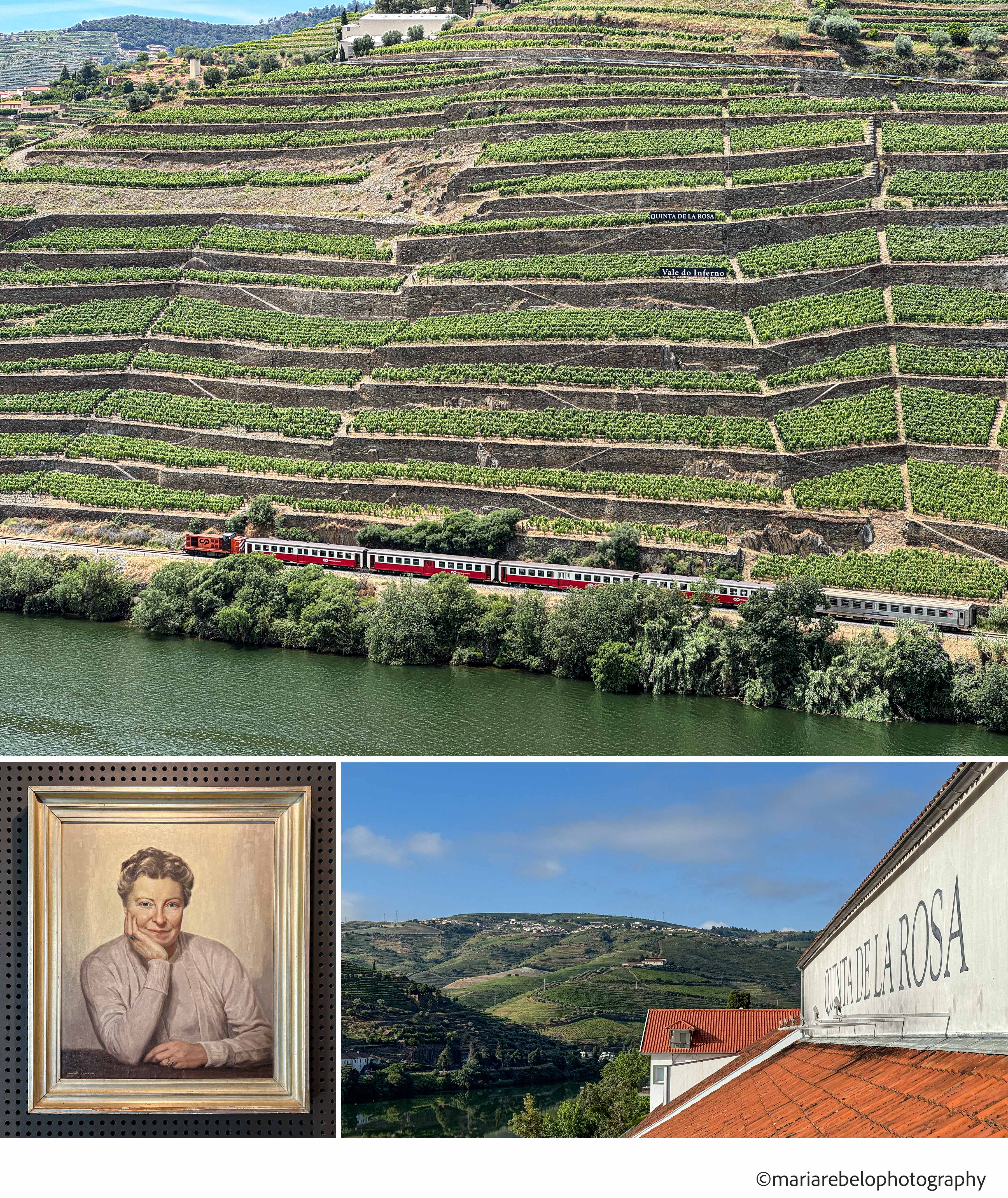
La Rosa was among the first estates in the Douro Valley to welcome guests. Over thirty years ago, several rustic houses were converted into accommodations, allowing visitors to stay amidst some of the region’s finest vines. The lodgings are simple, but the views are magnificent. Across the river, olive groves and vineyards ascend a steep hill. Below, the river flows without a care, its green waters sparkling in the sunlight like diamonds set in green turquoise.
In the morning, the sun casts a golden glow over the vines, gently evaporating the dew and steadily raising the temperature. This process helps maintain the freshness of the grapes, which contributes to the wine’s unique character.
We wake up to the sounds of boats gliding on the river and roosters singing, accompanied by a choir of birds. It’s wonderful to sit in the shade and enjoy the stunning landscape. The terrace of the breakfast room offers one of the best views in the Douro Valley.
At the turn of the 20th century, the estate was known as Quinta das Bateiras and belonged to António Reis, a local doctor. The Feuerheards, a family of German port shippers, bought the quinta as a christening present for their granddaughter Claire. Her father renamed it La Rosa after a successful brand of sherry his company had launched. He used the estate’s grapes to make port under the Feuerheard label.
In 1935, the Feuerheard shipping company went bankrupt, but Claire kept the estate because it was her personal property. When Claire divorced in 1946, she moved to La Rosa and lived there until she died in 1972. The beauty of the place compensated for the challenges of running an estate that was always in need of maintenance and repairs. To make up for the remote location, Claire hosted lively house parties for visitors and neighbors.
When, in 1988, Sophie Bergqvist, Claire’s granddaughter, took over the business with her father, the estate was in disrepair. Sophie started making port under the La Rosa name. In 1991, she enlisted David Baverstock, a famous enologist, to make one of the first Douro table wines. Since then, the fame of the wines has continued to grow. In 2002, another renowned enologist, Jorge Moreira, took over wine-making at La Rosa. Prizes and accolades continue to accumulate. If Claire were alive today, she would undoubtedly throw a grand party to celebrate the success of La Rosa.
Quinta de La Rosa, situated near Pinhão, is easily recognizable by its main entrance adorned with wooden statues of the eagles featured on the family crest. Click here for their website.
Casa Tradição is located near Lisbon’s old cathedral, a neighborhood rarely visited by locals. The restaurant has rustic decor, so we went in expecting a traditional meal. But our waiter mentioned a tasting menu, and we tried it.
Dinner began with an assortment of bread served with creamy nut butter and fragrant olive oil from Porto de Mós, the hometown of the restaurant’s chef, Samuel Mota.
Then, the unexpected delights started. First, a martini glass brimming with ice held a slice of apple marinated in citrus and spices, evoking the essence of a frozen sangria. Then, a crisp mini baguette layered with Serra cheese and exquisite Pata Negra prosciutto.
But the clearest sign that this would be a memorable night came next: a pastry resembling a pastel de nata crowned with smoked codfish and filled with a blend that echoes the flavors of traditional creamed codfish.
We were still recovering from this moment of deliciousness when we were served a cabbage tempura stuffed with migas made from beans and olives. The rich and satisfying taste was reminiscent of a Portuguese sausage called alheira.
The seafood entrée was stunning: a delicately cooked large Algarve shrimp served with a broth and fermented lupini beans. The fish course was a perfectly cooked corvina with asparagus and açorda made with fish roe.
The seventh step to culinary heaven was faux cabidela rice. Traditionally made with vinegar and chicken blood, it was ingeniously reimagined as a beetroot risotto, subtly enhanced with raspberry vinaigrette, and served with succulent guineafowl cooked with bacon.
The meal concluded with a moist pão de ló and a foam crafted from Serra cheese. Chef Samuel’s five-year tenure at the acclaimed Belcanto helped prepare him to follow his imagination. Though rooted in tradition, his creations brim with innovative, delicious culinary ideas.
Casa Tradição is located at Travessa do Almargem, n. 4, Lisbon, tel. 967-340-913. Click here for their website.
Because we were born 150 years apart, we did not have a chance to meet the Baron of Forrester, the British port wine trader who championed the Douro Valley. But we know Abílio Tavares da Silva, another outsider who became one of Douro’s best ambassadors.
Originally a tech entrepreneur, Abílio sold his company in 2000 and retired at the age of 40 to pursue his passion for winemaking. He does not believe in taking shortcuts, so he built his expertise from the ground up by earning an enology degree at the University of Trás-os-Montes e Alto Douro. He also began his search for the ideal vineyards.
In 2004, he acquired Foz Torto, a picturesque estate near Pinhão, close to the confluence of the river Torto with the Douro. Planted with old vines, it offers stunning views of the Douro Valley. Abílio teamed up with Sandra Tavares da Silva, a star enologist, to craft his wines. Despite having the same surnames, Abílio and Sandra are not relatives. But they share a passion for making wines that combine elegance with great aging potential. Their portfolio includes a lavish red from 80-year-old vines and a beguiling white from 40-year-old vines grown in Porrais, 600 meters above sea level.
Abílio describes his winemaking philosophy as simple, yet as he explained his process, we quickly filled a notebook with intricate details. The caliber of his wines reflects not just the superior quality of the grapes but also the meticulous attention to detail that his engineering mindset brings to every facet of production—from managing the vineyards year-round, harvesting the grapes when they reach the perfect balance of sugar and acidity, controlling fermentation temperatures, and choosing the ideal aging processes.
Every August, Abílio helps organize a competition to select the finest heirloom tomatoes in the Douro Valley. This event brings winemakers together and showcases the Douro’s uniqueness. The poor schist soil encourages plants to grow deep roots, resulting in not only extraordinary wines but also exceptional fruits, herbs, vegetables, and olive oil. A few drops of the olive oil Abílio produces at Foz Torto can turn a simple salad into a culinary offering worthy of Mount Olympus.
For us, Abílio is much more than a gifted winemaker. He is a source of inspiration and a role model. When we grow up, we want to be like him.





 Salt of Portugal