Culinary magic at Cura

We first met Pedro Pena Bastos as the chef at Herdade do Esporão when he was only 25 years old. Sitting at a table overlooking the vineyards of this iconic Alentejo estate, we were taken on an unforgettable culinary journey.

We met Pedro again at Ceia, the elegant restaurant in João Rodrigues’ Santa Clara 1728 hotel. We remember sommelier Mário Marques welcoming us in the courtyard outside the restaurant with glasses of natural sparkling wine from Quinta da Serradinha. Sitting at a long wooden table with a small group of fellow culinary travelers, we experienced once again the wonders of Pedro’s cooking.

As soon as we landed in Lisbon, we made reservations for Pedro’s new restaurant, Cura, at the Four Seasons Ritz hotel. We arrived a few minutes early and knocked on the imposing glass and metal door that separates the restaurant from the hotel. The genial Mário Marques came to greet us and showed us around.

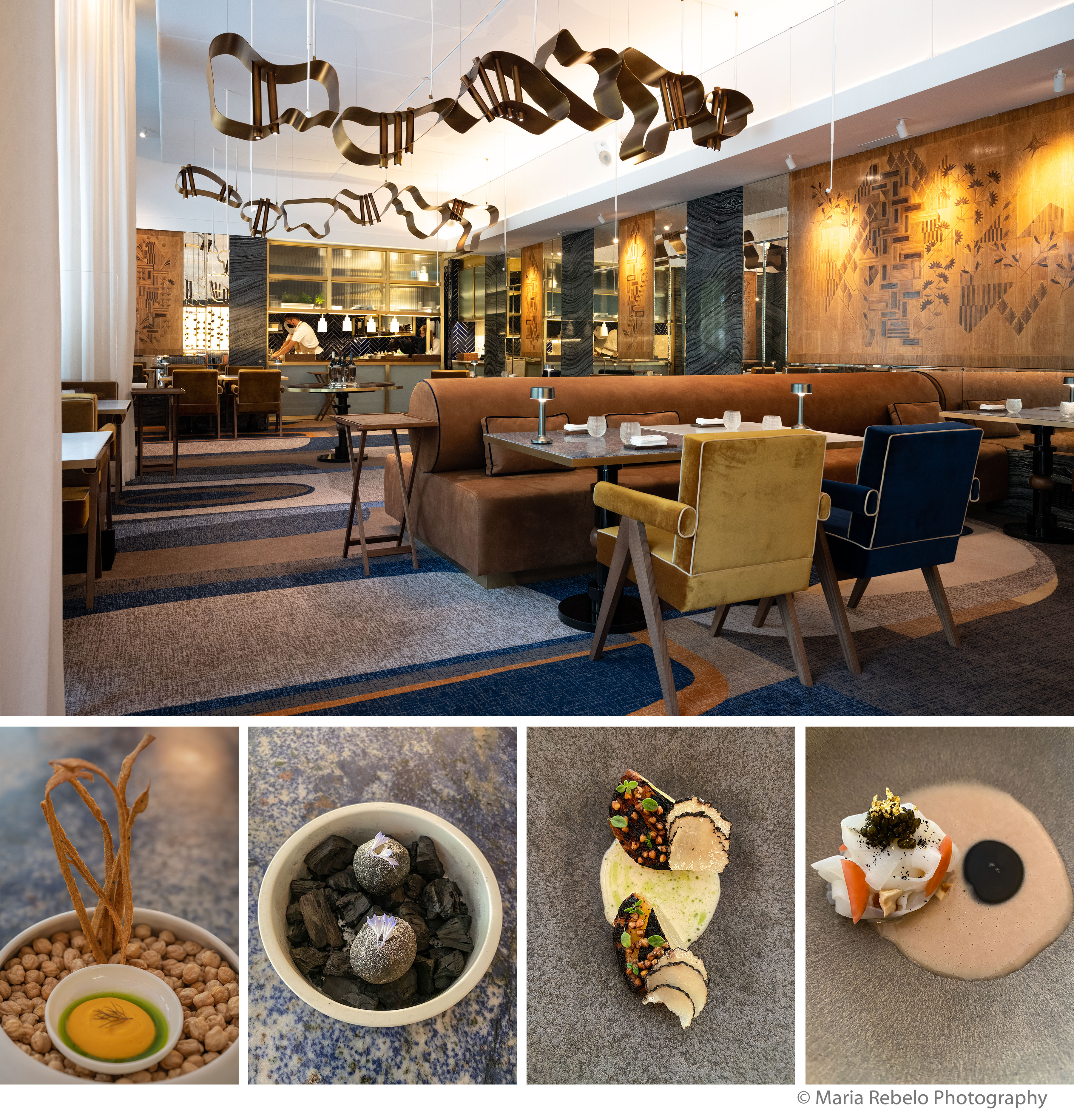
It is difficult to create a new space in the Four Seasons Ritz. Inaugurated in 1959, the building’s modernist geometry serves as the canvas for a stunning art collection that includes works by the great painter Almada Negreiros and many of his contemporaries. Cura’s dining room, decorated by architect Miguel Câncio Martins, integrates well the old and the new. A large metal sculpture hanging from the ceiling harmonizes with the wood panels designed by Fred Kradolfer, a brilliant Swiss graphic design artist who lived in Lisbon. The colorful chairs reference the playful use of color popular in the 1950s. 

While we were chatting with Mário about wine, a plate arrived with long strips made from chickpeas and pumpkin sauce seasoned with marjoram oil. This simple start bears the hallmark of Pedro’s cooking: the constant search for new harmonies and textures that enchant the palate. 

After much pondering, Mário opened a bottle of white Tourónio from Quinta de Tourais in the Douro valley. It is a bright white wine that kept pace with the festival of culinary sensations that followed.

Black pastries filed with veal from the Minho region made a striking appearance on our stone table top. They were pitch black on the outside and succulent on the inside. 

A translucent tagliatelle dressed with a hazelnuts and bergamot sauce came topped with a dollop of caviar.  We recognized this classic trompe l’oeil preparation from Pedro’s repertoire– the “tagliatelle” is made from thin strips of fresh squid.

Slices of breads made from ancient grains were served with butter from the Azores’ Flores island and the magnificent spicy olive oil produced by Pedro’s family. There was also a delicious brioche and some breadsticks made with cheese from the Azores.

Then, a fillet of red snapper came floating on a sauce made from the liver of the fish and perfumed with parsley and saffron. Next, a succulent piece of black pork from Alentejo was accompanied with a beet purée, orange, and foie gras. The dessert featured an original, delightful combination of Jerusalem artichokes, cocoa and arabica coffee. 

We were enjoying one more glass of wine when three little “mignardises” arrived. Mário recommended that we try them in the order, from left to right. The first was made from Belgium biscuit, artichoke and black garlic. The second, made with egg and honey, was an homage to the recipes that came from Portuguese convents. The third, a sphere made from raspberry and lavender, was crispy on the outside and liquid on the inside. It was a final sleight of hand in a dinner full of culinary magic.

Cura is located at Rua Rodrigo da Fonseca 88 in Lisboa. Click here for the restaurant’s website.
A rooftop restaurant in Lisbon

As soon as we exited the elevator, on the 5th floor of Hotel Bairro Alto, we walked to the terrace, attracted by the generous view of the Tagus river. Our waiter suggested that we stay outside and enjoy a few appetizers before going into the living room. And so we sat down and watched the Lisbon skies change into their evening colors. 

The restaurant, called BAHR, offers a menu designed by Nuno Mendes, a Portuguese chef who has earned many accolades in London. It is hard to choose–everything sounds great–so it took us some time to place our order.

After a few minutes wait, a savory aroma heralded the arrival of a plate with rissois de berbigão, fried turnovers with a cockle filling and a hint of curry. We noticed that they were breaded with Japanese panko instead of with traditional bread crumbs. But we were still surprised by the first bite. It was perfect: the crispness of the exterior contrasted with the moist flavorful interior creating an harmonious combination of texture, taste and temperature. 

A plate of percebes (goose barnacles) served on toast arrived next. The percebes looked normal but their smokey taste accentuated by a buttery sauce was exceptional. They were followed by roasted carrots dressed with a mouthwatering citrus sauce.

The temperature was dropping, so we retired to the living room. Our plates were served with a vegetarian version of a Lisbon classic: codfish Brás style. The codfish was replaced by a roasted cauliflower accompanied by a sauce made from broccoli cooked in a salt mass, spinach and parsley. Seldom has a cauliflower shined so brightly. On the table, there were sides of potato chips cut razor thin with a Japanese mandoline.

Next, we tried codfish confit with açorda (a bread-based preparation) from Alentejo. The codfish was superb. When we asked what made it so special sous-chef Nuno Dinis came to the table to explain that we were enjoying skrei, a codfish from Norway that is only available between January and April. It arrives fresh at the restaurant where it is cured with sugar and salt to accentuate the taste of the sea. The codfish was dressed with a savory yellow sauce made with a fricassé of sames (the stomach of the codfish) and a broth made from bones and gelatin.

The meat entrée was black pork with two sauces, one made from clams the other from spinach, parsley and coriander. It is a happy marriage of the flavors of two Portuguese classics: clams Bulhão pato and pork with clams.

The meal ended with queijadas that tasted of lemon and salt. We can’t wait to return to BAHR to enjoy this food that so perfectly combines simplicity, tradition, and refinement.

BAHR is at Hotel Bairro Alto, Praça Luís de Camões nº 2, in Lisbon. Click here for the restaurant’s website.

Guided by the stars

In the early 16th century, Lisbon was one of the world’s richest cities. A constant stream of caravels departed to far-away destinations like India and Brazil. Some of these ships perished tragically on the high seas. The ones that returned brought their hulls crammed with gold, silver, and spices. 

During the day, sailors relied on the sun to measure their latitude. At night, they were guided by the stars. Skilled pilots pointed sextants at the sky to estimate the ship’s position and evaluate its course. On the last night of the year, we too look at the stars for guidance on where we are and what lies ahead. We hope they can point us all to a blissful, healthy New Year that brings us back to Portugal.

Taberna Albricoque

Taberna Albricoque

Albricoque, a quaint word for apricot used in the Algarve, is a great name for a Lisbon restaurant that blends the old with the new. The space is old; it opened in 1905 as a tavern for travelers from the nearby Santa Apolónia train station. The food is rooted in the traditional culinary vocabulary of the Algarve, the birth place of Albricoque’s chef, Bertílio Gomes. But the approach to food and service is new. Every recipe has been refined to make it more appealing. The character of the restaurant, imparted by features such as the original floor paved with hydraulic tiles, was preserved. But modern amenities, unthinkable in 1905, have been added.

Everything on the menu is delicious. Our meal began with a plate of olives that tasted like sausage because of the way in which they were fermented. There was also a salad made with the purple carrots that were common in the Algarve in old times. Then, the feast continued: savory muxama (cured tuna), plump oysters from Ria Formosa, crispy rissois de berbigão (cockle turnovers), silky alhada de raia (manta ray with garlic), extraordinary marinated carapau (horse mackerel) combined with figs and toasted almonds and served on shinzo leafs.

Chef Bertílio likes to explore the methods for preserving food used in the Algarve before refrigerators became common. He salts a fish called abrótea then hangs it in the cold for a couple of days to drain its liquid. The result is an intense, satisfying taste reminiscent of that of salted codfish.

We didn’t order the fried moreia (moray), because it is usually greasy and chewy, but the chef brought a plate to the table for us to try. It was very thinly sliced and perfectly fried, a revelation of flavor, texture and aroma. The meal ended on a sweet note with almere, a dessert made with the liquid that is left from the making of requeijão, flavored with thyme and pine nuts.

If you’re near Santa Apolónia, stop by Taberna Albricoque to try its delicacies. If you’re far, come to Santa Apolónia for the privilege of dining at Taberna de Albricoque.

Taberna Albricoque is located at Rua Caminhos de Ferro nº98, Lisboa, tel. 21 886 1182, email reservas@albricoque.pt.

Culinary bliss at Essencial

Restaurant Essencial_

If the cobblestones of Bairro Alto were not so slippery, we would tell you to run to Essencial, a new restaurant in Bairro Alto. Walk instead as fast as you can because this dinning room that seats only 25 guest will soon be impossible to get into.

The restaurant is headed by André Cordeiro, a chef with impeccable knowledge of French technique. He studied for five years with Alain Ducasse in Paris and then worked with three chefs who earned the coveted title of Meilleurs Ouvriers de France (best craftsmen in France). André came back to Lisbon to combine fine-dining ingredients such as truffles and foie gras with the amazing fresh produce available in Portugal. The results are stunning–elegant food that is a joyful symphony of tastes, textures and aromas.

While we were chatting with chef André, a plate of bread arrived. It came with a blend of butter from Pico in Azores, lard and rosemary. It was the one of several unexpected  combinations that delighted our palates throughout the meal.

The first appetizer was a crowd pleaser: delicate slices of marinated salmon with radishes, crème fraiche and tarragon oil, served with the luscious crêpes vonnassiennes made famous by chef George Blanc. The second appetizer was a sea urchin shell filled with beef tartare, sea urchin and nori seaweed. These dissonant ingredients created a pleasing harmony that made our taste buds sing.

It is customary to serve the fish entrée before the meat but here the latter came first. It was a paté en croute made with duck, pork and foie gras served with smoked carrot purée and beets. How could the fish compete with these gratifying earthy flavors? The answer came in the form of a plate of sole. The freshness of the fish was a canvas that made the truffle stuffing and the Champagne sauce stand out.

The last entrée was a lush journey to the flavors of the woods: hare with foie gras, trumpet mushrooms and Jerusalem artichokes in a reduction of red wine, port wine and chocolate.

A vanilla mille feuilles with salted caramel produced a happy ending to a blissful meal. But our culinary experience was not over. There were still fireworks provided by a buttery French toast with vanilla mouse and a rich choux with praline.

Essencial’s minimalist space, impeccable service and interesting French and Portuguese boutique wines perfectly complement the food. We do not need the Michelin guide to tell us that the culinary stars shine brightly on Essencial’s dinner table.

Essencial is located at Rua da Rosa, 176, tel. 211573713, email info@essencialrestaurant.pt. Click here for the restaurants website. 

Prado: the prairie in Lisbon

Prado Composit

Never underestimate the power of the light of Lisbon. Chef António Galapito was happily working at Nuno Mendes’ Taberna do Mercado in London when he was offered the opportunity to open a restaurant in Lisbon. Galapito said he was not interested. But he agreed to see the space.

It is a place full of memories, from Roman ruins to old fish-canning equipment from a factory that once operated there. The ceilings are high, making room for generous windows that invite the light in. It was impossible for Galapito to say no. He called the restaurant Prado, the Portuguese word for prairie, to signal his intention of bringing the best products from the fields of Portugal to his table.

The light became the inspiration for the menu. The food is simple, fresh, organic and seasonal. The wines are natural and biodynamic. The vibe is relaxed and the decoration minimalist.

We sat at a beautiful common table made from old pine wood. Our dinner started with a refreshing strawberry kombucha. Then, a plate of bread and goat cheese arrived at the table. The bread, fermented for 28 hours at Gleba, fused with the flavorful goat cheese and melted in our mouth.

The menu has many small plates that are perfect for sharing. We sampled several of these delights:  mussels, leeks, parsley and fried bread, cabbage cooked with sour milk and sunflower seeds, pleurotus mushrooms, with pimentão (a traditional pepper-based paste) and crunchy sarraceno wheat, green asparagus, requeijão and azedas, mackerel, mizuna, lettuce and tangerine, and finally, squid from Azores cooked in a pork broth.

Dinning at Prado is a wonderful opportunity to taste pristine produce harmoniously combined to create satisfaction and joy.

Prado is located at Travessa das Pedras Negras, 2, tel. 210 534 649, email info@pradorestaurante.com. Click here for the restaurant’s website. 

Lumiares, our home in Bairro Alto

Hotel Lumiares Composit

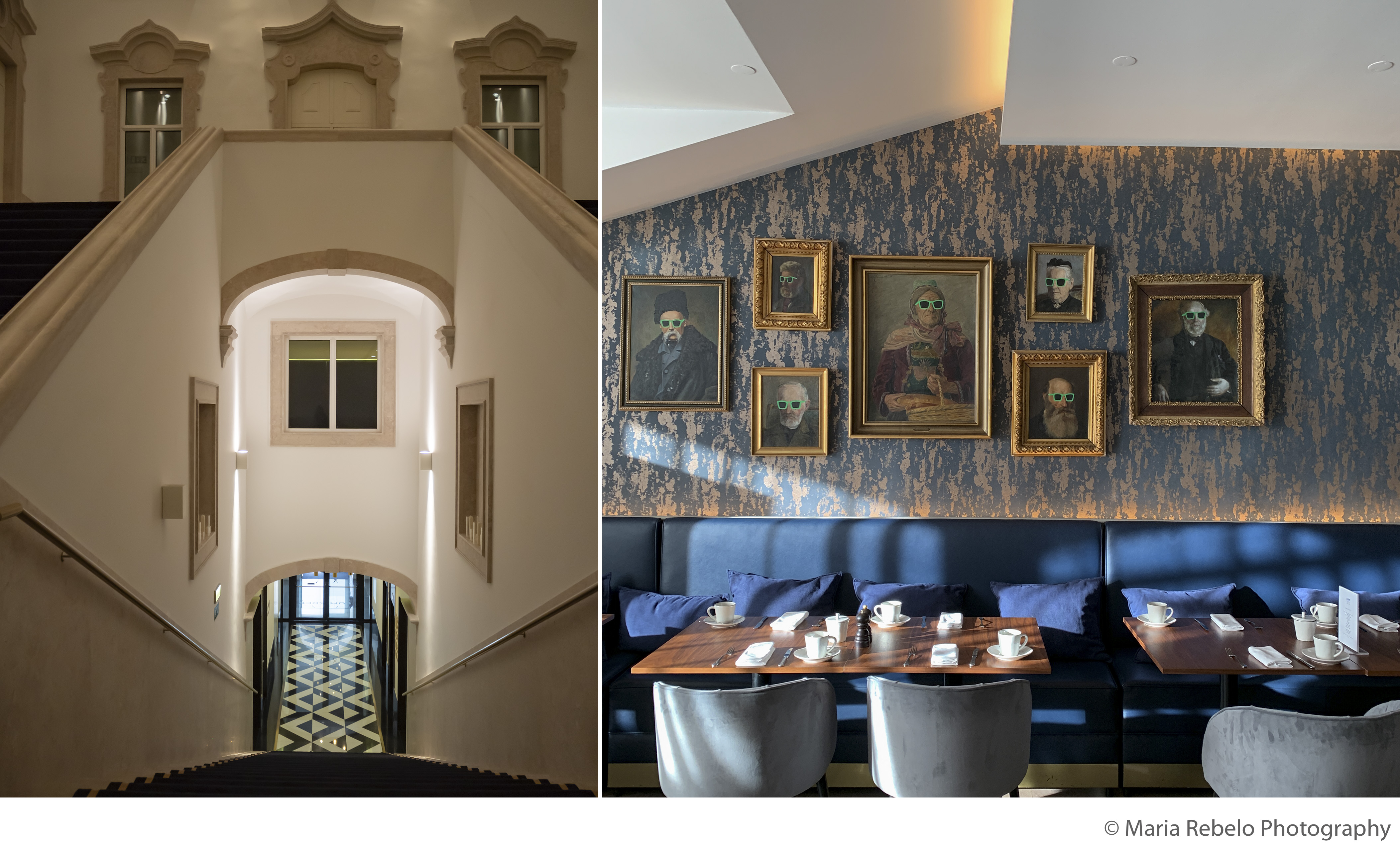
The grand palace built in the 18th century by the powerful widow of the count of Lumiares languished in ruins in the middle of Bairro Alto, an ancient neighborhood in Lisbon. Two years ago, the derelict building was transformed into a boutique hotel. The new structure preserves what remains of the old palace: imposing marble staircases and decorated doorways. But it adds to them a modern decor with humorous touches, such as  the green shades painted on the portraits that hang in the restaurant.

Instead of rooms, the hotel offers small suites equipped with everything we need to feel at home. The walls are adorned with cozy artisanal Portuguese rugs. The fridge is stocked with complimentary white wine, water and beer. The coffee machine is ready to pour a fragrant blend of arabica and robusta into elegant Vista Alegre cups.

The hotel’s best-kept secret is the wonderful rooftop, a place where we can seat above the hustle and bustle of Bairro Alto to enjoy panoramic views of St. Jorge’s castle and the Tagus river. How sweet it is to stay at Lumiares!

The Lumiares hotel is located at Rua do Diário de Notícias 142, Lisbon, tel. 21 116 0200. Click here for the hotel’s website. 

Taberna Sal Grosso

Taberna Sal Grosso

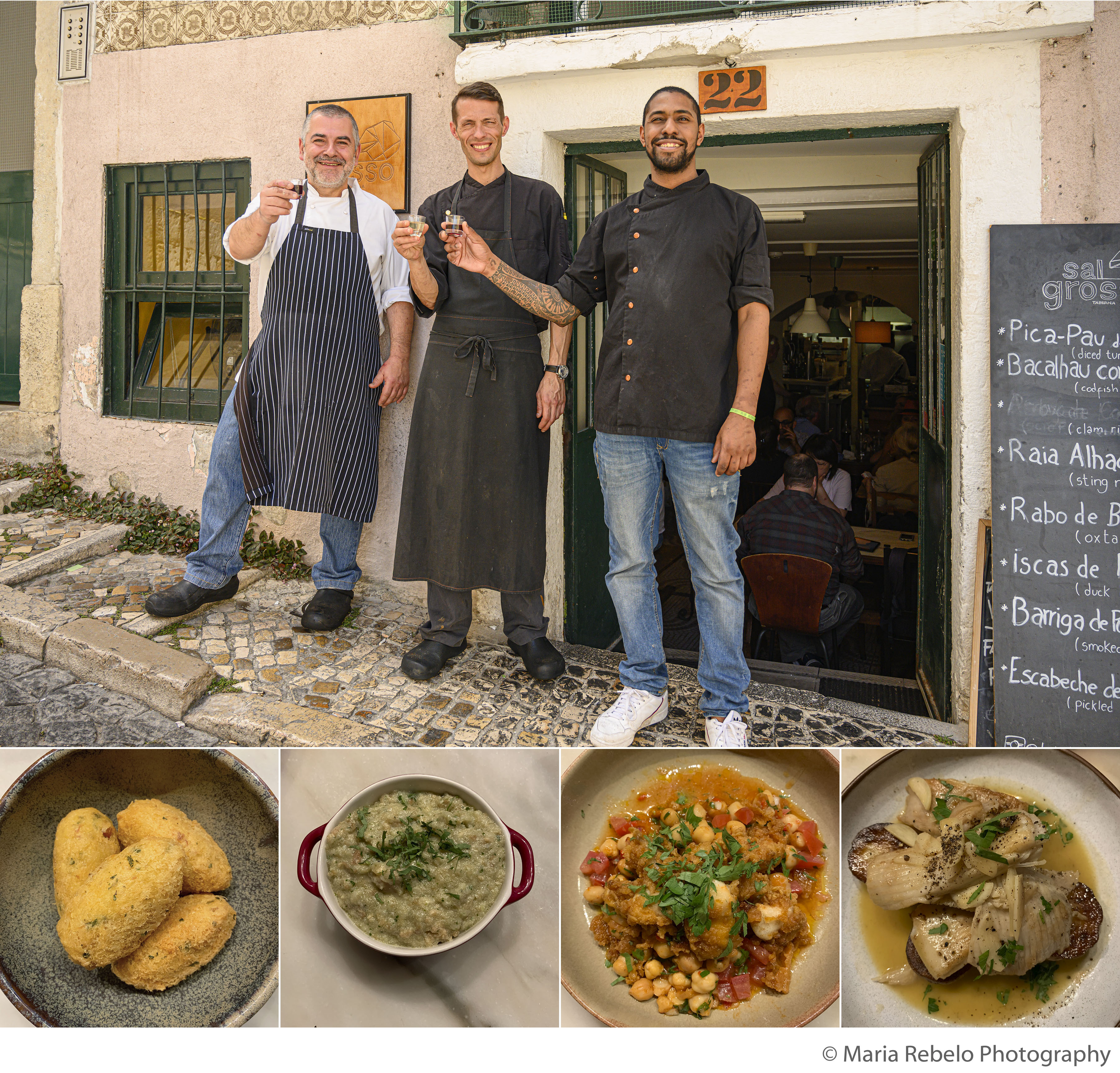
When we arrived at number 22, Calçada do Forte in Lisbon’s old Alfama neighborhood, there was a group of people congregated around the door. They were all trying to get a table in a small restaurant called Taberna do Sal Grosso (Coarse Salt Tavern). An exasperated waiter explained that he could not bend the laws of physics to accommodate more guests. No one was happy with the news that miracles could not be made. We too walked away disappointed. But we were so intrigued by the tavern’s atmosphere that we made reservations for lunch two days later.

As soon as we sat for lunch, it became obvious why the place is so popular. It serves delicious food with a happy vibe at modest prices. This trio of qualities is rare. It is hard to keep the quality of the food consistent and feel happy about serving inexpensive meals. Joaquim Saragga, the chef and owner, manages to do it because because he views his restaurant as more than just a business.

Joaquim lost his job, so he decided to change his life. When he was a student in London,  he used to cook for his roommates. He remembered feeling happy in the kitchen, so he enrolled in culinary school and went on to complete a Masters in gastronomy.

When he opened the tavern in 2015, he shunned the tricks that most eateries use to become more profitable. There are no couvert charges. He serves only two inexpensive but very drinkable house wines and a few artisanal beers. Desserts are modestly priced.

“I’m not trying to innovate, only to serve my favorite traditional recipes prepared with local, seasonal ingredients. I cook the food I like to eat.” he told us. Everything we tried was perfect: a watercress and orange salad, codfish cakes, manta ray and garlic, oxtail with quince, codfish and chickpeas.  “I needed to create my own job,” he explained, “but I also wanted to create a place where people feel at home.”

We proposed to take a photo of the staff at the door of the restaurant but then another wave of guests came in. Joaquim asked one of the chefs and the waiters to pose for us but he stayed inside the restaurant, clearing the tables and welcoming people. It is this dedication to serving others that make Taberna do Sal Grosso such a special place.

Taberna do Sal Grosso is located at Calçada do Forte, 22. Reservations are a must. They do not accept phone reservations. Reservations can only be made by sending a message through Facebook. You need to receive a confirmation in order for the reservation to be valid.

Where great views and delicious food go together

EPUR

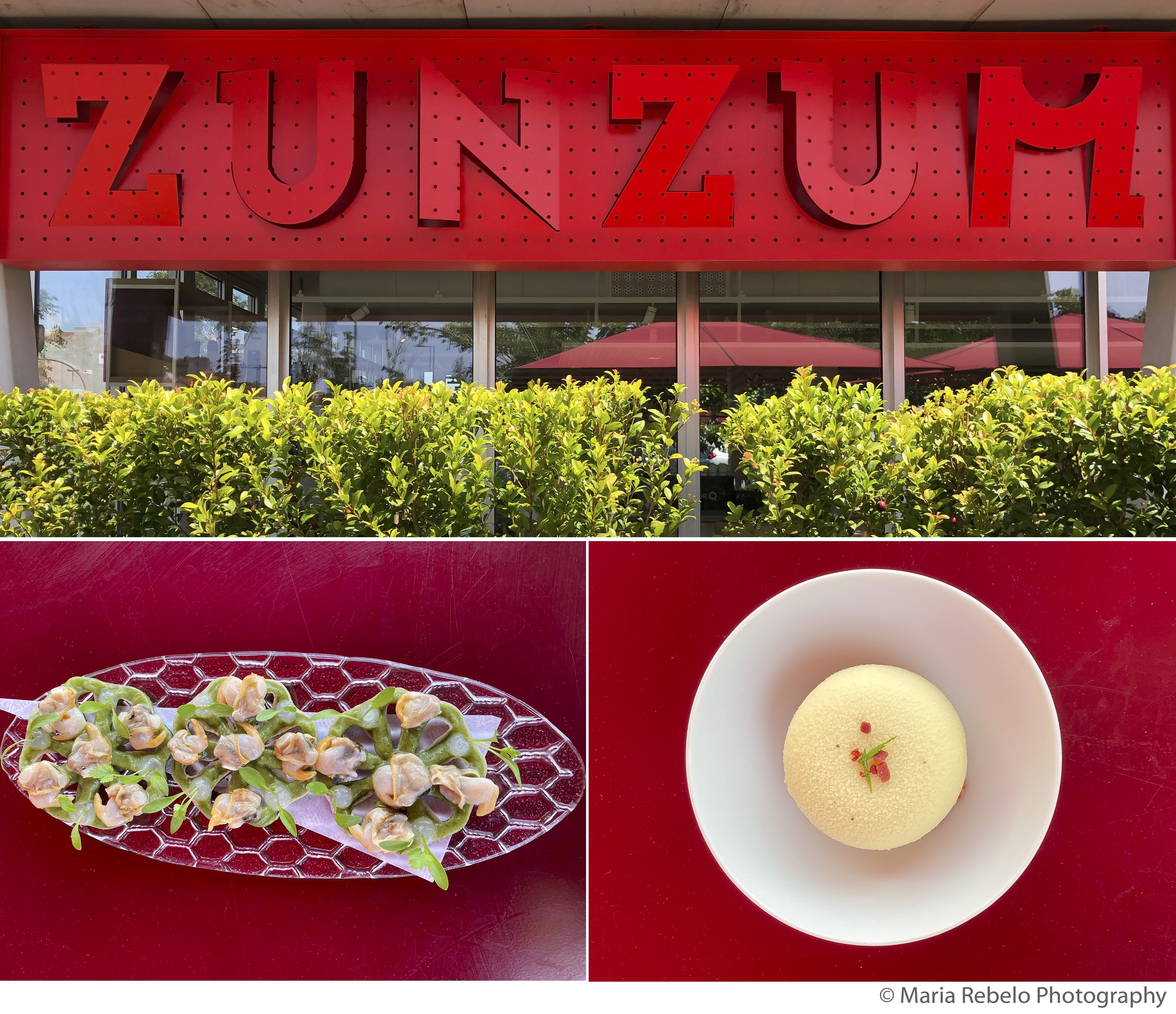
It is often said that restaurants with good views serve lousy food. This aphorism doesn’t apply to EPUR, chef Vincent Farges’ new restaurant in Lisbon. Its windows offer beautiful views of the Tagus river and the rooftops of downtown Lisbon. But, once the food arrives, it is hard to choose between looking out the window and admiring the elegance of the sustenance on our plate. When we taste the food, our brain’s ability to process pleasurable sensations has to stretch even further.

Served on graceful white plates, the food looks ready for a Vogue photoshoot. Its beauty is not superficial, it stems from the quality of the ingredients and the meticulous preparations.

We tried a flavorful rabbit rillette with foie gras, seasoned with pear vinegar, a delicate avocado mousse topped with crispy Galician cabbage, the type of cabbage used to make caldo verde. Our lunch ended with a sumptuous soup starring a trio of marvelous fish: manta ray, sea bass, and monkfish.

It is hard to think of a better place to meet Lisbon for a lunch date than at Vincent Farge’s EPUR.

EPUR is located at Largo da Academia Nacional de Belas Artes 14, Lisboa, tel. 21 346 0519.


Santa Clara 1728

Silent Living Composite - 2

When João Rodrigues opened the doors of Santa Clara to greet us, the sun rushed in, eager to revisit this 1728 building that laid in ruins until two years ago.

João lives a double life. He manages Silent Living, an expanding group of exquisite hotels, while flying around the world as an airline pilot. We expected a short conversation, but instead we spent a leisurely afternoon getting to know him and his project.

This act of making time for his guests tells you why João’s hotels are so unique. “When people stay with us, we receive them as friends. If I could afford it, I wouldn’t charge for the rooms,” João explains in his soft voice. “We ask guests to pay in advance, so we do not have to collect money during their stay. That is also why everything is included, our breakfast, the drinks in the mini bar, all the amenities. Prices are constant throughout the year because our goal is not to generate high returns but to find a sustainable way of offering an extraordinary experience.” João pauses and then he reveals that “We like to surprise guests by picking them up from the airport in a vintage Rolls Royce. It is a gesture that sets the tone for their stay at Santa Clara, a way to tell them they will be cared for.”

We ask João how he finds time to do everything, renovate an historical building, create a team to run the hotel and operate Ceia, a high-end restaurant. He shrugs his shoulders and smiles with the equanimity of someone who often sees the world from above the clouds.

The hotel was designed by architect Aires Mateus, who is João’s habitual collaborator. The interiors are decorated with wood and stone, the same materials used to erect the nearby Pantheon. The colors used in the rooms seem to come from old black and white photographs. These monochromatic hues provide the ideal framing for the glorious views—the contrast of the blue river with the orange roofs punctuated by the white marble of the Pantheon.

A stay at Santa Clara offers the rarest of gifts: ease, simplicity and serenity. It took someone who constantly travels to create a place that is so hard to leave.

Santa Clara 1728 is located at Campo de Santa Clara, 128 in Lisbon, tel. 964 362 816, email booking@silentliving.pt. Click here for the hotel website.