
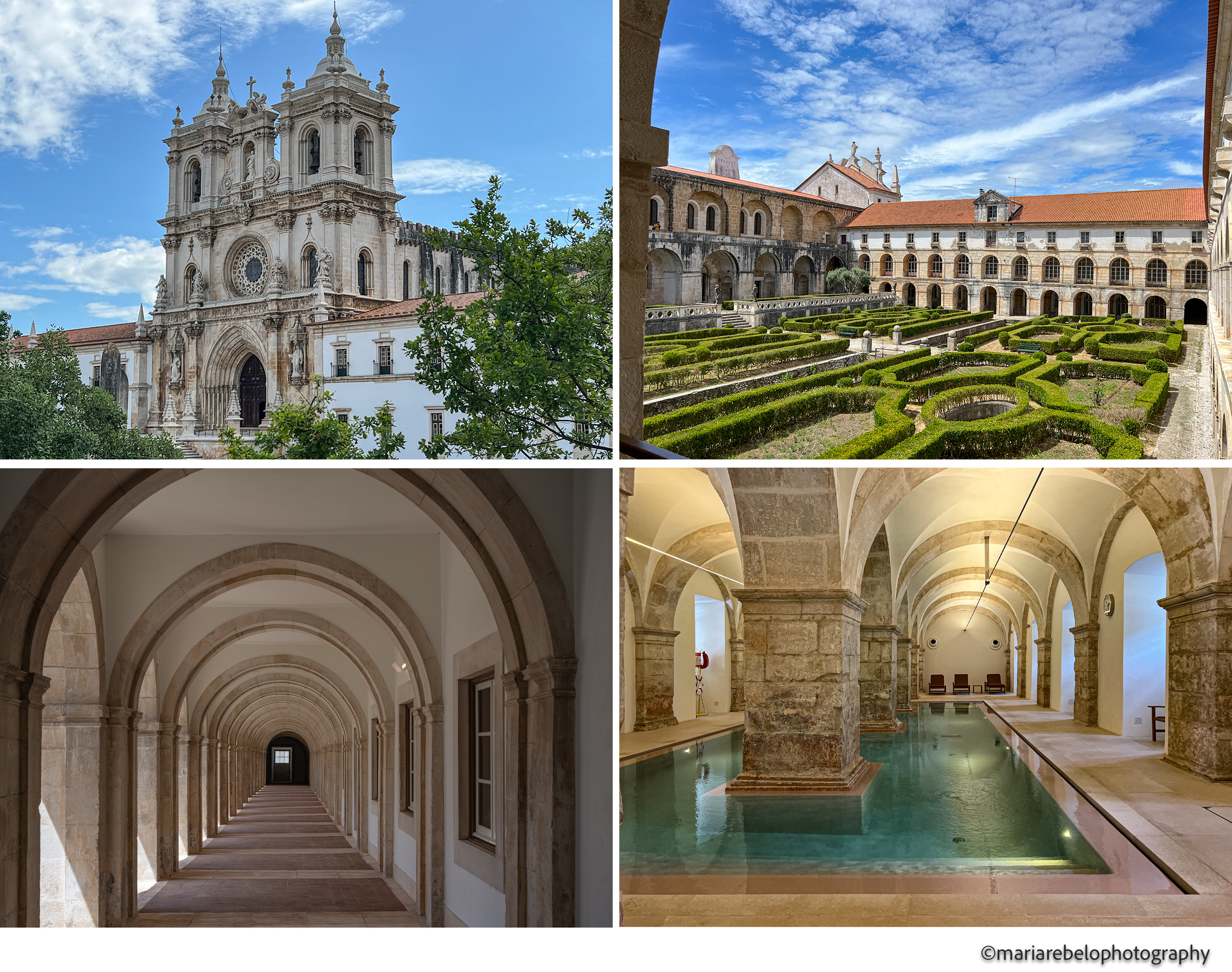
The Montebello Mosteiro de Alcobaça is a graceful new hotel nestled within the ancient walls of a Cistercian monastery. Eduardo Souto Moura, a Portuguese architect who received the Pritzker Prize, oversaw the rehabilitation project. Moura endeavored to preserve most of the monastery’s original structure, skillfully incorporating wood and marble elements that blend with the original materials, creating a seamless fusion of the present and past.
Each guest room has its own distinct character, but they all offer a serene refuge from the demands of modern life. A stunning interior pool where green waters flow amongst imposing arches evokes a sense of grandeur reminiscent of the glorious Caracalla baths.
The hotel’s central location makes it an ideal starting point to explore Nazaré‘s colossal waves, the charming medieval town of Óbidos, and the magnificent Mafra convent.
The history of the monastery intertwines with the birth of Portugal. On February 2, 1140, Dom Afonso Henrique, the first king of Portugal, placed the monastery’s foundation stone near the confluence of the Alcoa and Baça rivers. Later, in 1153, the king bequeathed the Cistercian Order vast expanses of fertile lands, stretching from the Candeeiros mountain range to the sea.
These were gestures of religious devotion but also political acts. The young monarch sought to express gratitude to his cousin Bernard of Clairvaux, the head abbot of the Cistercian Order, for his unwavering support. The king also hoped that Bernard would persuade Pope Alexander III to recognize Portugal as an independent nation.
Bernard succeeded. In 1179, Pope Alexander III issued the Bula Manifestis Probatum, confirming “by the apostolic authority to your exalted domain the kingdom of Portugal with full honors of a kingdom and the dignity befitting kings.”
The architecture of the Alcobaça Monastery drew close inspiration from the Clairvaux Abbey, the spiritual home of the Cistercian monks. Construction began in 1153, but the first Portuguese king did not live long enough to witness its completion. It was Afonso II, his great-grandchild, who inaugurated the monastery 85 years later.
Over the subsequent seven centuries, the Alcobaça Monastery flourished and expanded. Initially constructed in a Gothic style, the church was later decorated with Baroque elements. In 1755, a splendid library was added, featuring gracefully curved walls, evocative paintings, and colorful marble floors. But after the abolition of the religious orders in 1834, the vast building gradually fell into disrepair until the restoration project that resulted in the new hotel started twelve years ago.
Today, the Clairvaux Abbey rests in ruins, but the Alcobaça Monastery still stands. It has withstood the ravages of time, surviving the earthquake of 1755, the floods of 1722, the pillaging by Napoleon’s troops in 1810, and so much more. Meticulously restored, it shares its unique heritage with all those who visit.
The address of the Montebello Mosteiro de Alcobaça is Rua Silvério Raposo 2, Alcobaça, tel. 262 243 310.
 Salt of Portugal
It looks magnificent. We were actually in Alcobaca last Monday, on our way south again. We travelled up for the Tabuleiros at Tomar and stayed in a lovely apartment overlooking the monastery at Batalha. I really enjoyed the Batalha monastery but we didn’t spend a lot of time in Alcobaca, having visited the monastery there last time we came north.
The hotel is wonderful.