
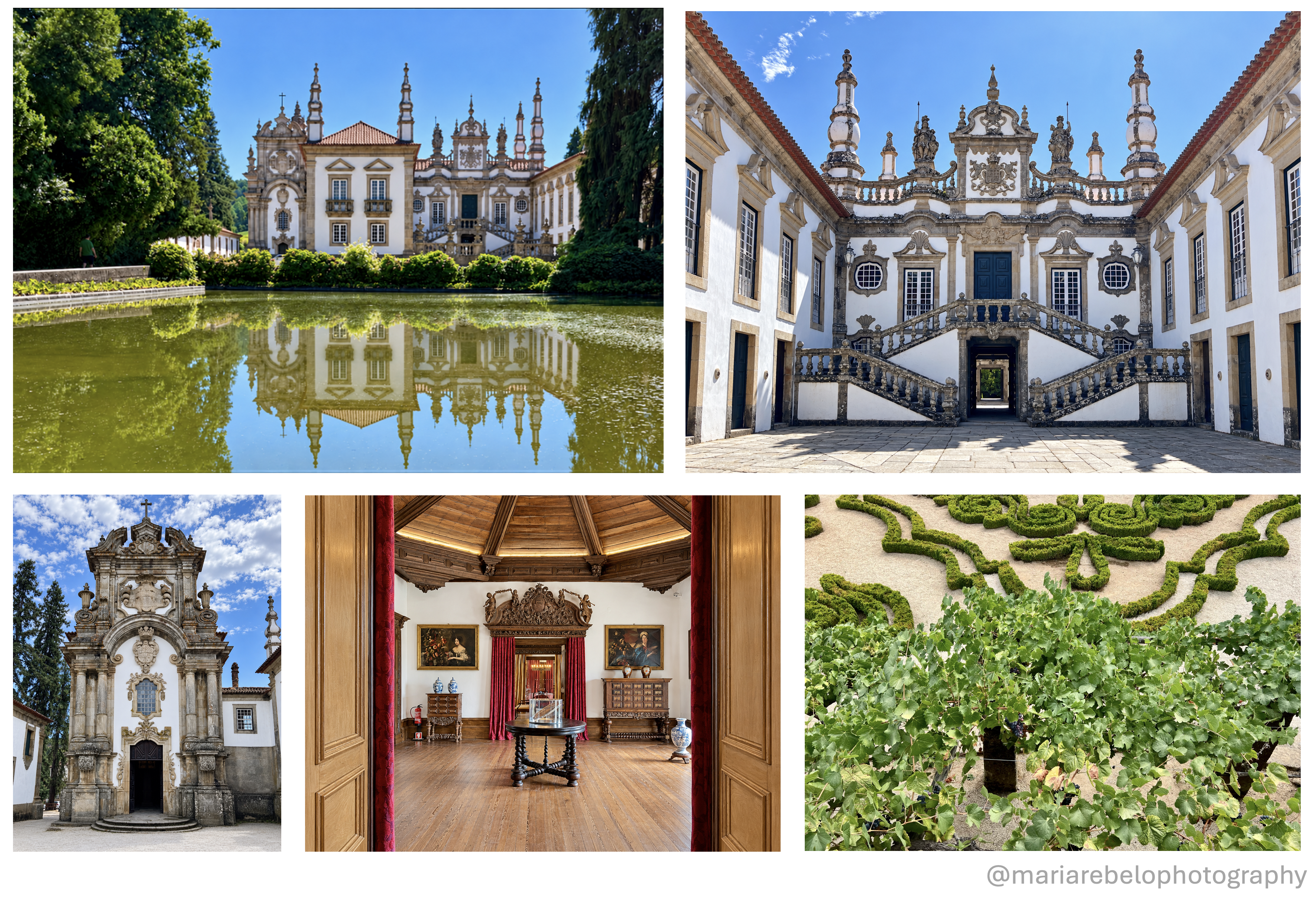
Casa de Mateus, near Vila Real, may be Portugal’s most famous palace. Millions of people around the world have seen its elegant façade on the label of Mateus Rosé.
Fernando van Zeller Guedes created the wine in 1942 and presented it in a distinctive flask-shaped bottle inspired by the canteens carried by soldiers during the First World War.
As the horrors of the Second World War receded, Mateus Rosé offered the perfect way to celebrate. Jimi Hendrix and other celebrities were photographed drinking it. Frank Borman, commander of Apollo 8, remarked: “I only regret that, when I was flying around the Moon, I had no Mateus wine to delight me.”
Some of the grapes used to make the wine came from the estate surrounding the palace. Guedes believed that the Baroque façade would give his creation an unmistakably Portuguese identity, so he approached the Count of Mangualde, husband of the heiress to the House of Mateus, for permission to use the family name and an image of the house.
According to a frequently told story, the Count was initially offered half an escudo for every bottle sold. Doubting that a pink wine would sell well, he soon exchanged the royalty for a single payment—an unfortunate decision, given that Mateus Rosé would go on to sell hundreds of millions of bottles.
The palace itself was built during the first half of the eighteenth century by António José Botelho Mourão, the third Morgado de Mateus. Its Baroque design is attributed to Nicolau Nasoni, the Italian architect who also designed the Clérigos Tower and the Freixo Palace in Porto.
Granite palaces are often austere, but at Mateus, Nasoni created lightness out of stone. Staircases climb playfully toward the first floor, competing for our attention with statues, balustrades and ornamental pinnacles. The reflecting pool added much later heightens the visual enchantment, turning the façade, sky and water into a single composition.
In many palaces, the chapel is concealed within the house. At Mateus, the temporal and the sacred stand apart. The U-shaped residence extends toward a chapel that stands to one side—connected to domestic life yet clearly set apart from it.
Heavy wooden doors guard the entrance to the palace. Stepping inside feels like entering a private world to which the family might return at any moment. The cool austerity of granite gives way to the warmth of wood, while the grandeur of the exterior yields to intimate rooms framed by graceful, vaulted ceilings.
There are family portraits, antique furniture and religious objects, as well as an impressive library. Among its treasures is the monumental edition of Os Lusíadas, by the poet Luís Vaz de Camões, published in Paris in 1817 by José Maria de Sousa Botelho Mourão, the fifth Morgado de Mateus.
Behind the palace lies a garden that welcomes visitors with its serene geometry and restful silence. One expects Baroque music to pour from the palace windows at any moment. And music remains part of life at Mateus. In 1970, D. Francisco de Sousa Botelho de Albuquerque, a descendant of the Morgados de Mateus, established the Casa de Mateus Foundation to preserve the house and open it to the wider world. The foundation now organizes concerts, exhibitions and other cultural events, ensuring that Mateus remains not merely a monument to the past, but a living cultural institution.
Spending a few hours at Mateus offers a glimpse into the aristocratic life of the late eighteenth and early nineteenth centuries. Many of the comforts we now take for granted are absent, but in their place, we find a serenity that has become rare.
Casa de Mateus is 4 km from the centre of Vila Real on National Road 322. Click here to visit the House of Mateus Foundation website.

