The Berlenga island

The Berlenga is one of the crown jewels of the Atlantic Ocean. It is surrounded by small, diamond-shaped islands, adorned by emerald waters, and decorated with sparkling crystal caves. It is a place loved by birds of all stripes. Not just sparrows, crows, pidgeons, seagulls, woodcocks, and turtledoves, but also rare birds with unpronounceable Latin names, like ruticcilia tithys and puffinus kuhlii.

The island is close enough to be visible from the coast, but far enough to be shrouded in mystery.  Fishermen attribute to it all sorts of mystical powers. “Expect good weather if there’s fog on the island and rain if it’s clear,” they say.  But ask a fisherman whether the Berlenga inspired Alfred Hitchcock’s movie The Birds, and he will shrug his shoulders. The island does not need another legend. It is a place where, throughout the centuries, treasures were buried, pirates conspired, and lives were lost in harrowing shipwrecks.

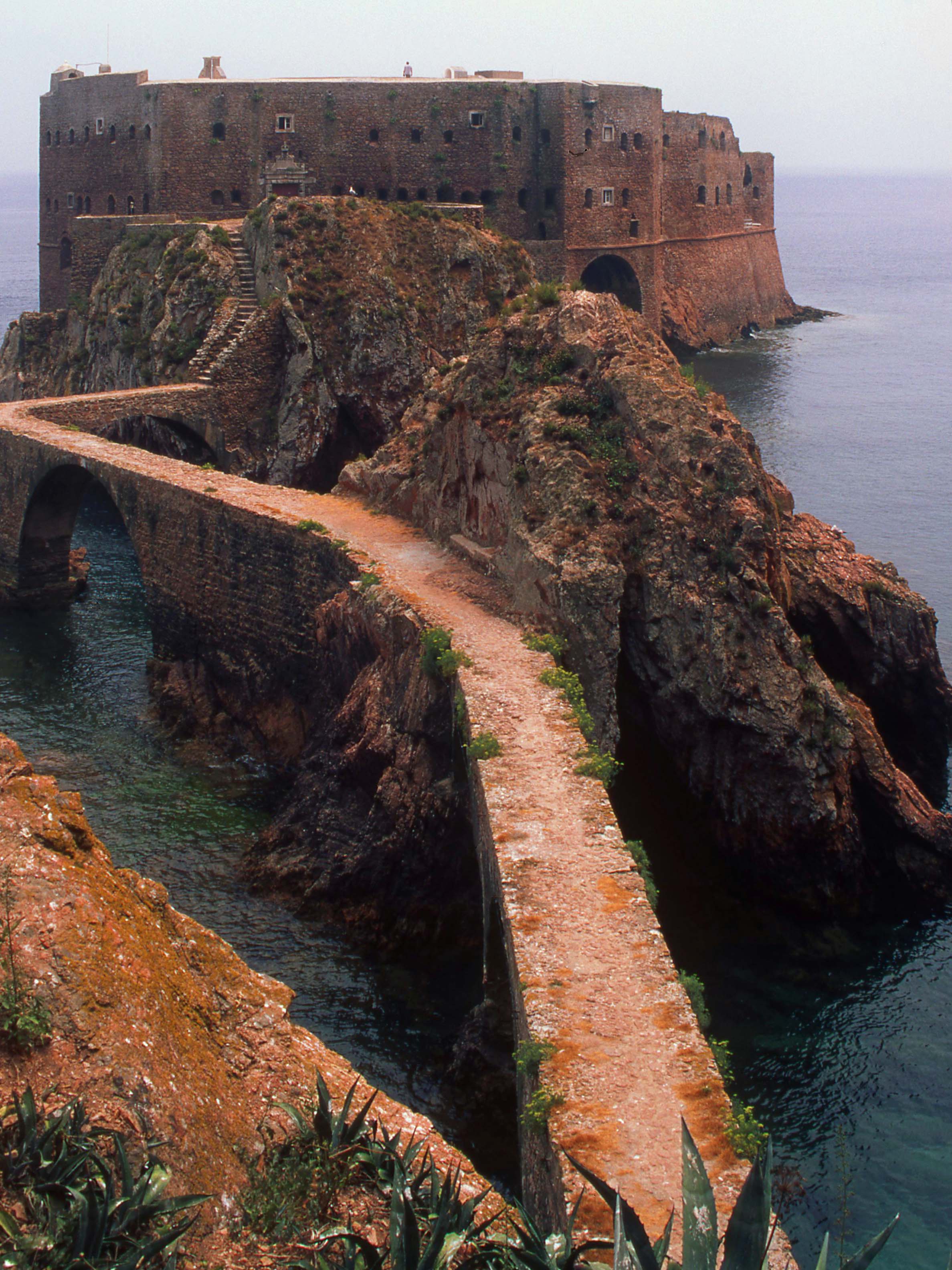
In the Summer, there is a regular ferry between Peniche and the Berlenga. You can visit the 17th century fort (shown in the photo), bathe on white sand beaches with crystalline water, and chart a boat to go around the island. It is a grand adventure.

You can catch amazing sea bass in Berlenga’s waters, but you have to know where to cast your line. Ask a fisherman for the best place to fish for sea bass, and he will quickly change the subject, perhaps by asking you: “Did you know that the Berlenga inspired Hitchcock’s famous movie, The Birds?”

Click here for the schedule of boats from Peniche to Berlengas. Boats depart from the port of Peniche.

Café Nicola

Nicola, a famous café in Lisbon, opened its doors in the late 18th century. Run by an Italian emigrant, it became popular in literary and political circles. Here, you could listen to the latest government gossip, conspire against the prince regent, or hear Bocage, a bohemian poet, improvise brilliant verses.

All this fun came to an end with the Napoleonic invasions—French officers adopted the Nicola as their gathering spot. So, when the French retreated in 1808, Nicola threw a grand independence party.

In 1929, Nicola moved to its current location, featuring the art deco architecture that you can see today.

At Nicola you can do it all, improvise poetry, start an insurrection, celebrate independence, and have a great cup of coffee.

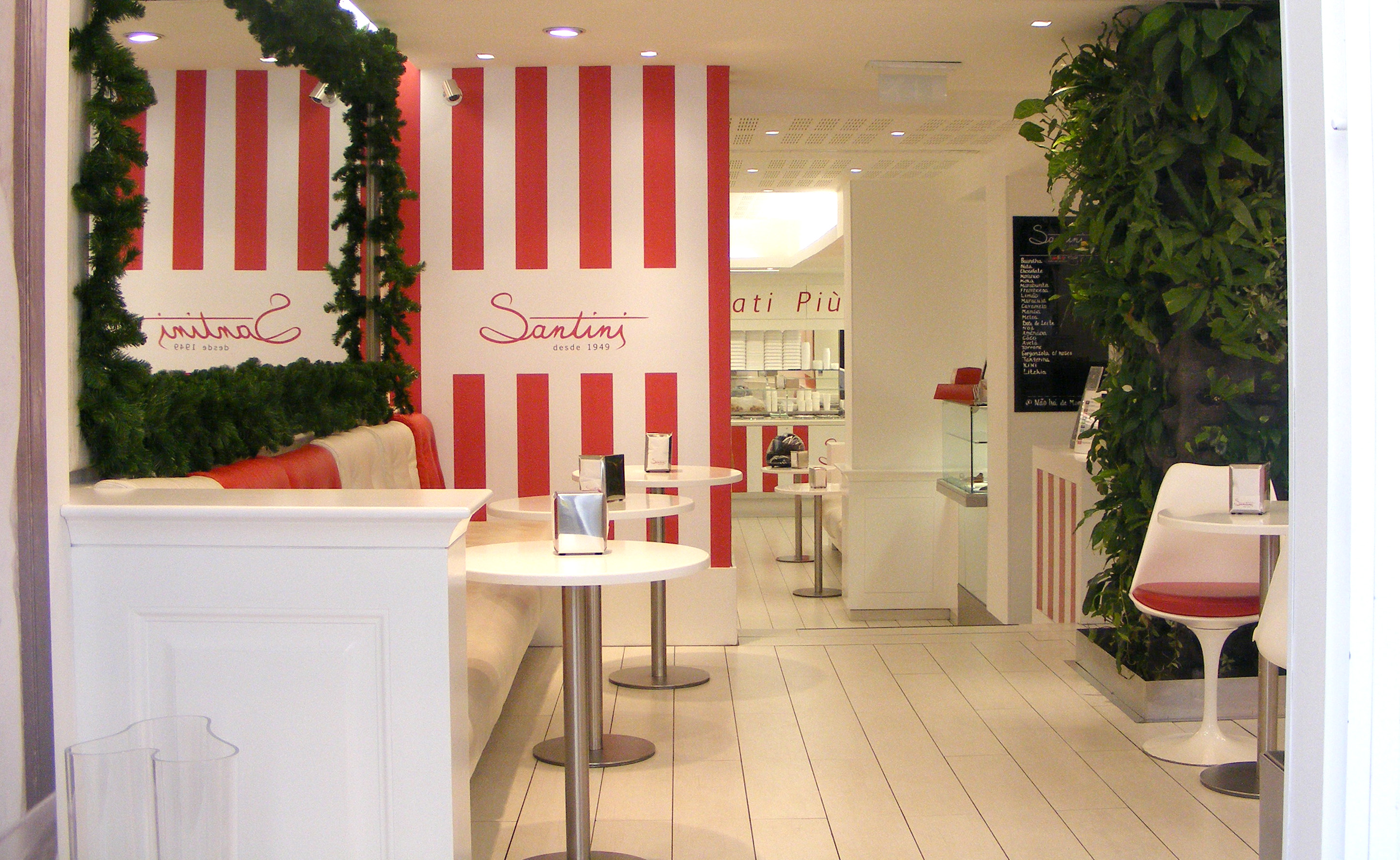
Santini’s artisan gelato

In 1949 an Italian called Attilio Santini opened a gelato store in Estoril, an idyllic beach resort near Lisbon. There was a tradition of gelato making in his family; his great grandfather had a gelato store in Vienna. Santini’s approach was simple: make the gelato fresh every day using only the very best cream and fruit. Word of mouth quickly made Santini famous in the 1950s. It helped that many of Europe’s dethroned kings and queens lived in Estoril and became loyal customers. One of these customers, Juanito, is now better known as King Juan Carlos of Spain.

There was a feeling of elegance, of relaxed optimism about the 1950s that you can see in the lines of the Fiat cinquecento or hear in Miles Davis’ recording of ‘Round Midnight. It is this sweet feeling that you can still taste today in a Santini gelato.

Santini has currently three locations, one in Lisbon, near Chiado (Rua do Carmo, 9) and two others in beach resorts near Lisbon (S. João do Estoril, Rua Nova da Estação, 5, and Cascais, Av. Valbom, 28F). There can be long lines in the Summer. The wait is an opportunity to consider which of the more than 50 varieties we are going to try. We don’t want to rush into this decision! Click here for Santini’s website.

In love with Lisbon

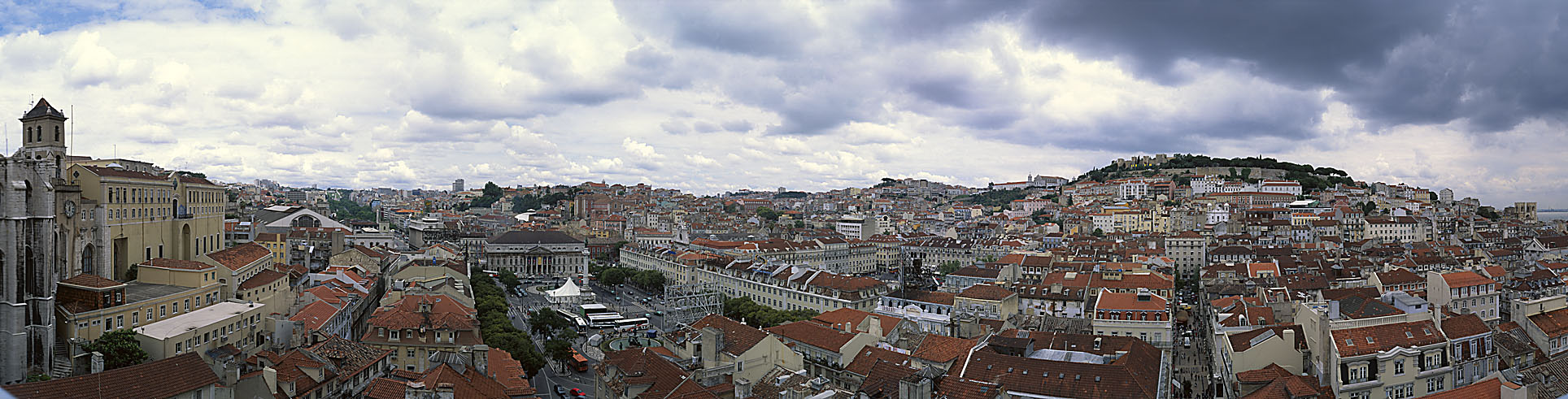
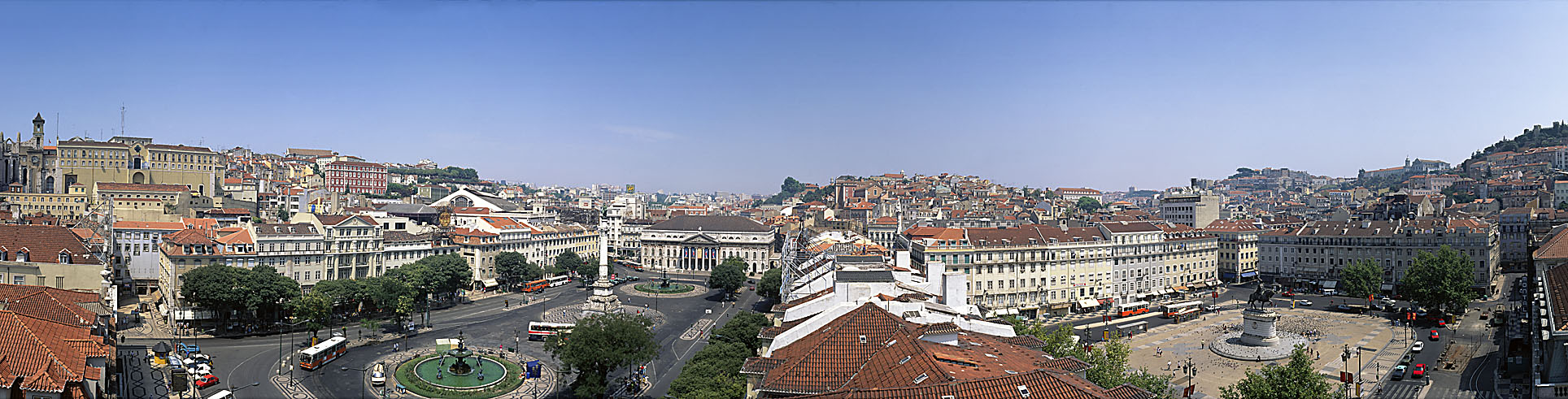
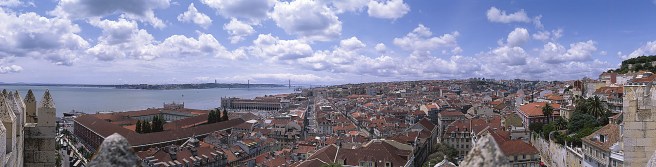
Panoramic views of Lisbon, Luis Pavão, chromogenic prints, 1990.

In 1581 a Spaniard came to Lisbon and fell madly in love with a Portuguese woman. There is nothing unusual about this incident; it happens all the time. What is uncommon, is that this Spaniard was also a great writer: his name is Miguel Cervantes. Here’s how Cervantes describes Lisbon in his novel, The Trials of Persiles and Sigismunda:

“Here love and honesty go hand in hand, courtesy never lets arrogance swagger, and bravery keeps frailty away. Its residents are pleasant, polite and discrete in matters of love. This is Europe’s largest city, the gateway to the treasures of the Orient, which from here flow to the world. Its busy harbor accommodates countless vessels and an undulating forest of ship masts. The beauty of the women enchants and arouses, the bravery of the men astonishes. In sum, this is the land that offers the most copious and holy tribute to heaven.’’

We do not have a portrait of the Portuguese woman who enchanted Cervantes, but the photos above show the splendor of the city that so impressed him (if you click on the images, you’ll see them on a larger scale).  Luis Pavão, a wonderful Portuguese photographer, created these panoramic views without any digital gimmickry. He took these photos with a camera that he built using a design proposed by the Lumiére brothers in 1901 .

This is Europe at its best: a place where a Portuguese photographer uses the forgotten plans of two French dreamers to illuminate the words of a Spanish writer who fell in love with Lisbon at first sight.

Click here to see more work by Luis Pavão on his website. You can see a photo of his panoramic camera on the top left side of his homepage.

The tower of Belém

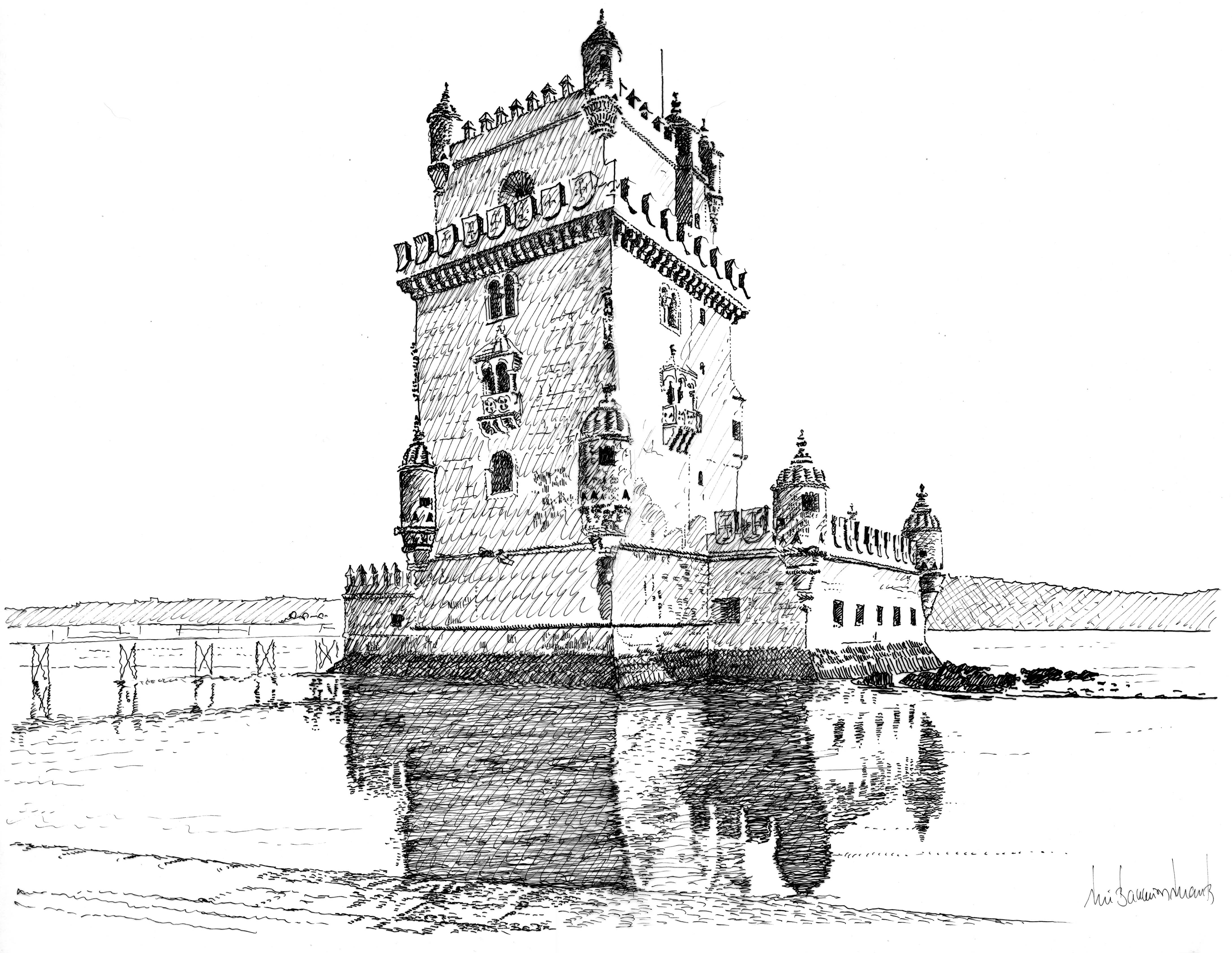
The Belém tower, Rui Barreiros Duarte, ink on paper, 2011.

Many guidebooks describe the tower of Belém as a chess piece forgotten on the Tagus river. The poet Fernando Pessoa thought that there is much more to the tower than this first impression. In 1925, he wrote an English-language guide to Lisbon, titled “What the Tourist Should See.” This book, discovered only in 1988, was meant to restore Lisbon to its rightful place as one of the great European cities. Here’s what Pessoa writes about the tower of Belém:

“This marvel of oriental architecture was erected in the Restelo beach, famous as the point from which the ships sailed forth for the Great Discoveries, and was meant for the defense of the river and of the Portuguese capital. It was King Manuel I who ordered its erection; its was built within the river, and the project is due to the great master of “laced” architecture, Francisco de Arruda. It was begun in 1515 and completed six years afterwards. Later the river sank away, from that point, leaving the Tower definitely connected with the shore. […]

The Tower of Belem, seen from the outside, is a magnificent stone-jewel, and it is with astonishment and a growing appreciation that the stranger beholds its peculiar beauty. It is lace, and fine lace at that, in its delicate stonework which glimmers white afar, striking at once the sight of those on board ships entering the river. It is no less beautiful inside; and from its balconies and terraces there is a view of the river and of the sea beyond, which is not easily forgotten.”


Berrio: a romantic esplanade

Berrio is the name of a spectacular esplanade in the beach of Parede, 20 km from Lisbon. It is the perfect place to go for coffee on a sunny afternoon. Even though it is located by the “marginal,” the coastal road that connects Lisbon to Cascais, when you are there, you feel like you are on a sea voyage.

If you take a date to Berrio, choose your date very carefully. Swept by the beauty of the sea and sky, you might find yourself speaking words chosen by the waves and whispered by the wind; words like: “You know, Berrio was the first ship from Vasco da Gama’s fleet to come back with news that they had found the seaway to India. It arrived in Cascais, not far from here. I could say that I, too, have been on a journey, and that I found my way in you. But I would never liken a search for cardamom and pepper to my quest for you. How could I compare earthly dust with your ethereal beauty?”

Berrio, Avenida Marginal, Praia da Parede, Tel. 21-457-7356, email: geral@berrio,net. Click here for website.

Tea and scones at the Vicentinas

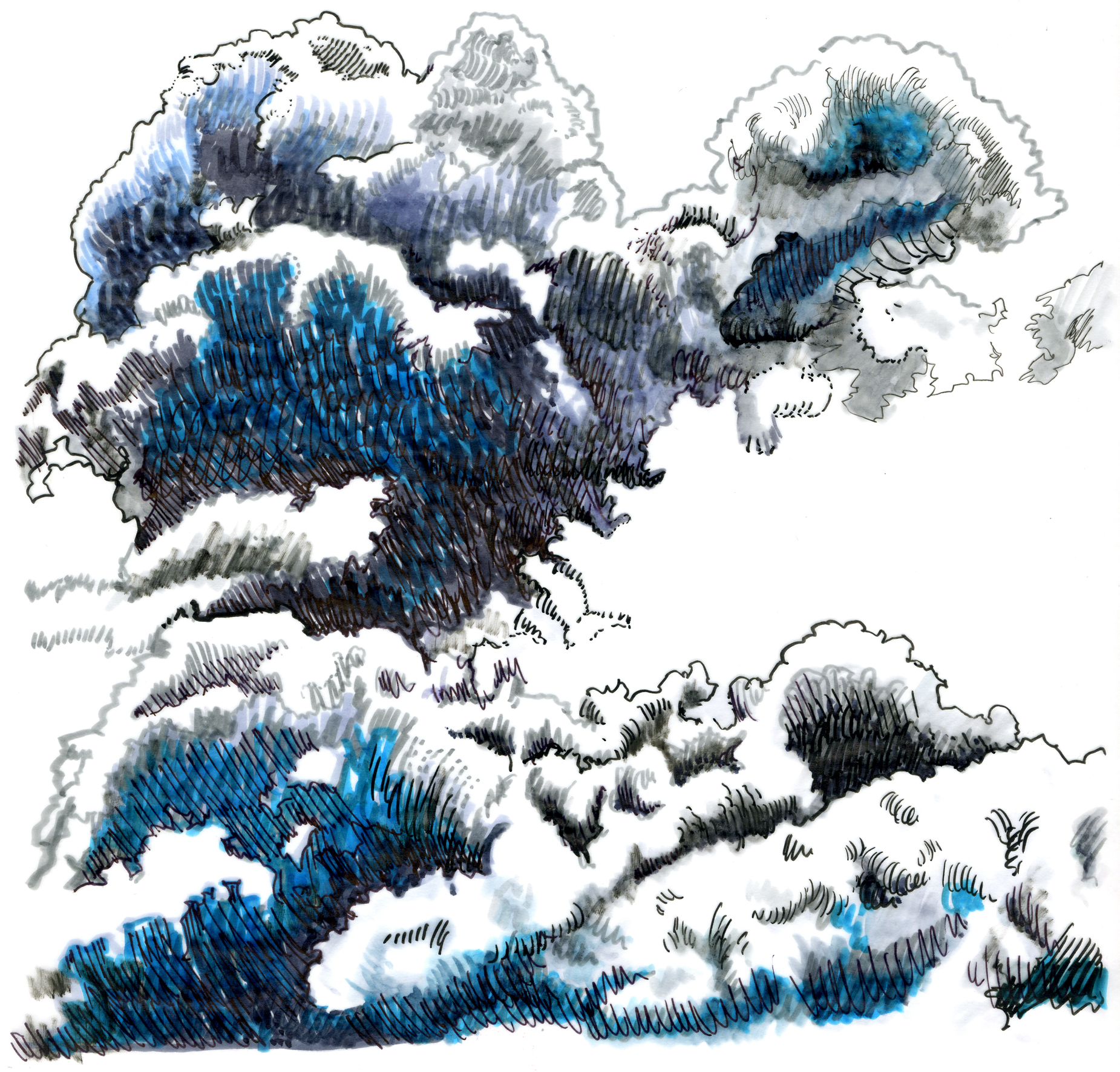
Nuvens, Rui Barreiros Duarte, ink on paper, 2011.

Clouds also deserve a break and, on their day off, they occasionally travel to Lisbon. Mostly, it’s the cirrus and stratus, the pretty, socialite clouds that come looking for a good time. But, sometimes, they let the nimbus clouds tag along and then it rains.

These rainy days are a blessing to the ancient trees scattered throughout the city, fruits of the seeds that Portuguese sailors brought from all over the world. For the tourist, a rainy day is an opportunity to try some of the best tea and scones in Lisbon. These have been served for more than 30 years at the Vicentinas, a tea shop in Rua de São Bento. The proceeds go to charity, which makes these wonderful scones taste even better.

As Vicentinas, Rua de São Bento, 700
, Lisboa

, Tel: 213 887040.

Lamprey is in season!

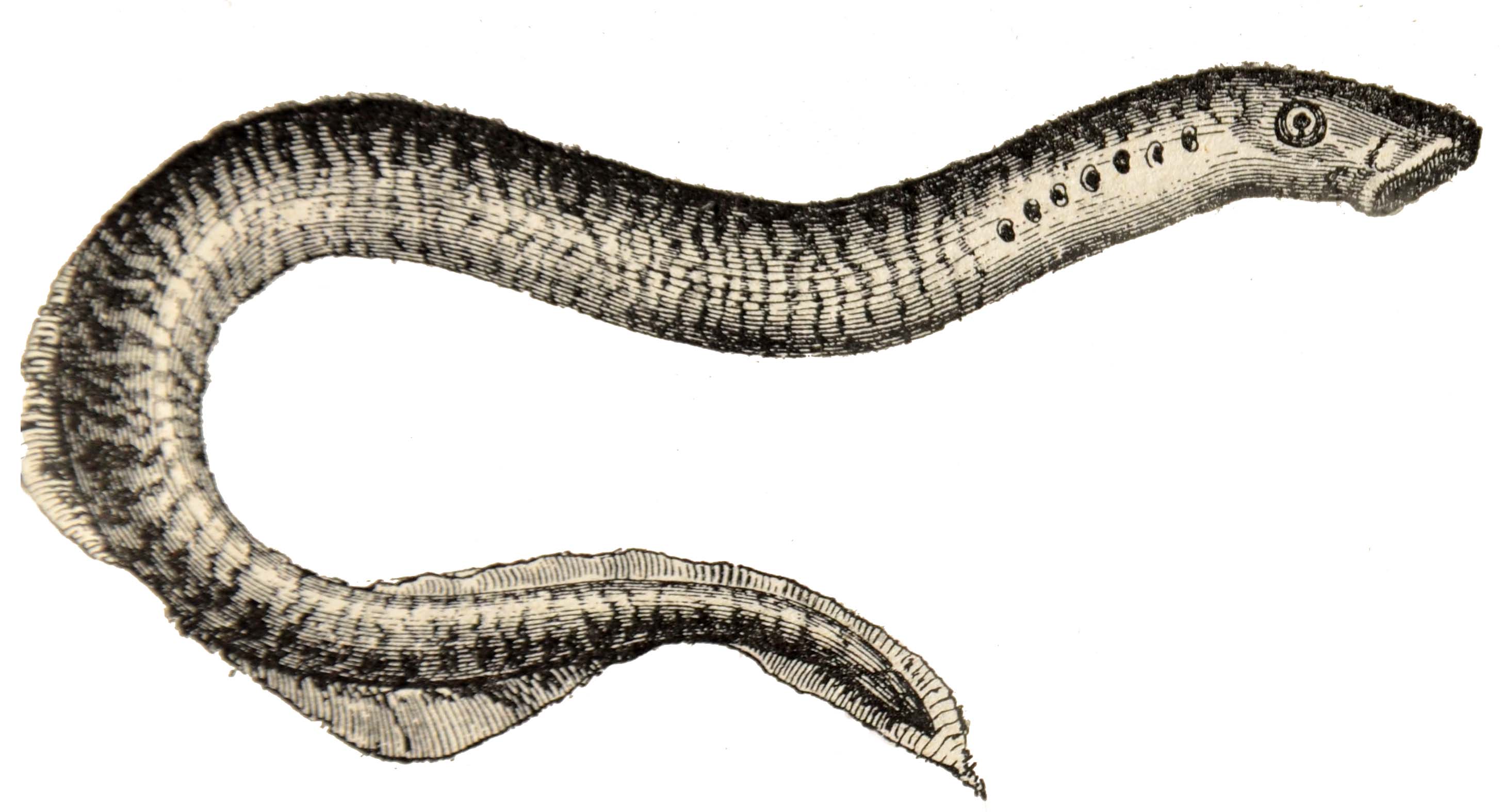
Lampreia (lamprey) is a very strange fish that, somehow, gained favor with emperors and kings. The Romans included it in banquets prepared for Julius Caesar. The oldest known Portuguese cookbook, a 16th century collection of recipes attributed to Infanta D. Maria, has a single fish recipe that describes how to prepare and cook lamprey.

You don’t have to conquer Gaul or marry royalty to eat lamprey. Many Portuguese restaurants offer this delicacy between January and April. It is usually served stewed, accompanied with rice. You find excellent lamprey at Solar dos Presuntos, a traditional Lisbon restaurant where you can dine like a king.

Restaurante Solar dos Presuntos, Rua das Portas de Stº Antão, 150, Lisbon. Tel. 21 342 42 53, GPS coordinates: 38º43’07″N and 9º08’51″O. Click here for their website. 

Coimbra

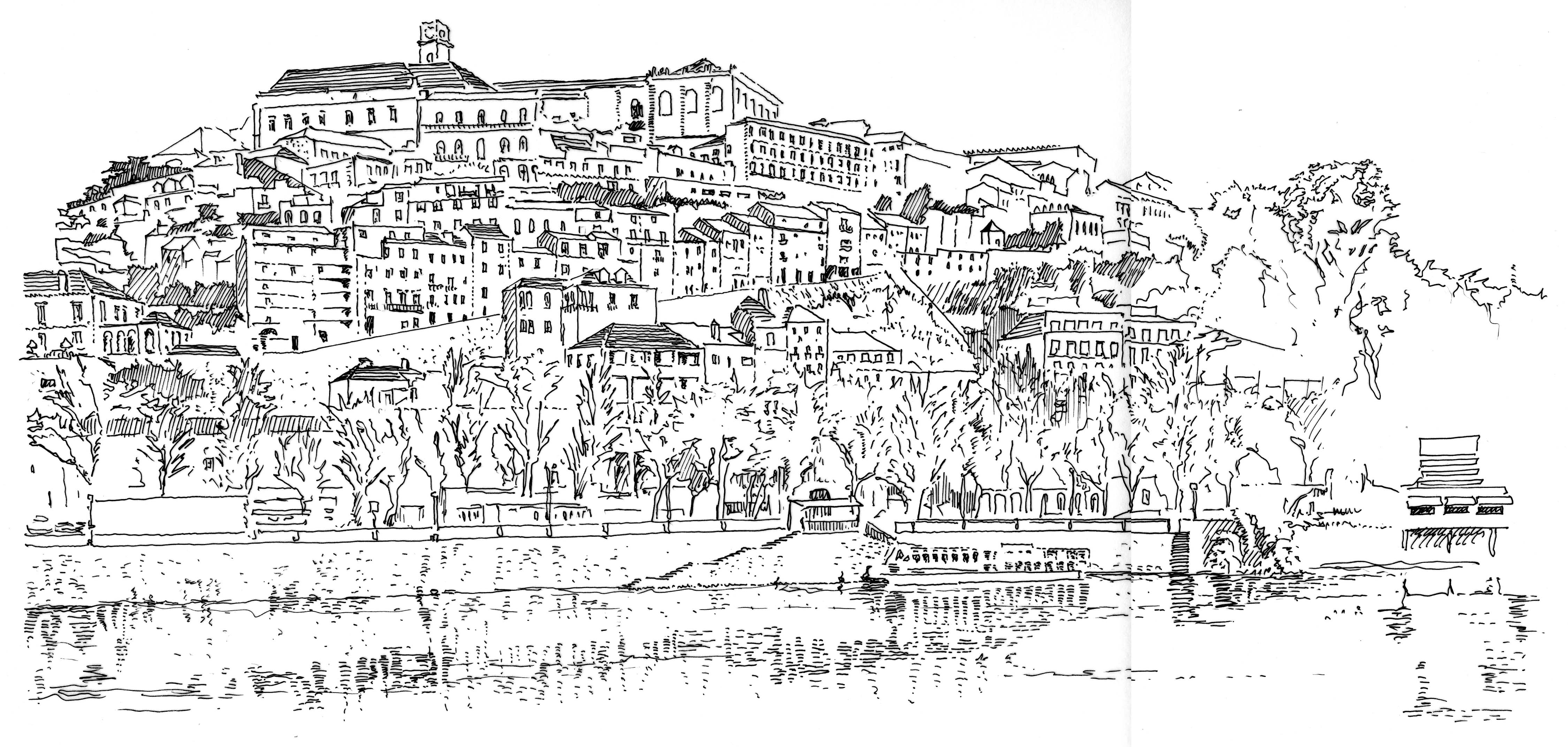
Coimbra, Rui Barreiros Duarte, ink on paper, 2011.

Coimbra is famous for its university, one of the oldest in the world. It is a beautiful city that seduces its visitors slowly, with its winding streets, ancient buildings, and academic traditions. According to an old folk song “Coimbra is most alluring when you try to say goodbye.” Hans Christian Andersen, the author of “The Little Mermaid” and other popular fairytales, visited Coimbra in 1866 and fell under its spell. Here’s what he wrote:

“We drove along the Mondego river whose broad bed displayed more dry sand than running water. Yet, what freshness and forest charm all around! The city rose as the loveliest flower in the whole bouquet. Coimbra rests upon the mountain side, one street higher than another. The streets are narrow, crooked, and rise continually. Shops and bookstores are here in abundance.

From the cloister of Santa Cruz the streets ascend towards the university, an extensive building that occupies the highest site in the city. Up there, through the dilapidated walls of the fortress, one enters the botanical garden, which is rich in rare flowers and trees.

I met some students all in their medieval garb: one went by himself, reading; three others passed in lively conversation with the guitar strung over the shoulder; their wild pranks in these surroundings put me in a cheerful mood; it was as if I lived back in an earlier century.”

The world’s best chocolate cake

Who created the world’s best chocolate cake?  Gaston Lenôtre? Pierre Hermé? Jacques Torres? Guess again. The cake is made with French chocolate, but the chef’s name is Portuguese: Carlos Braz Lopes.

His cake has three chocolate meringue disks layered with chocolate mousse and topped with a chocolate ganache. He started selling it in a tiny store in an obscure corner of Lisbon’s Campo d’Ourique neighborhood. But the cake is so good that word of mouth attracted chocolate lovers from all over the world.

The French gourmet Brillat-Savarin wrote that discovering a new recipe brings more happiness than discovering a new star. There is no better way to savor the truth in this aphorism than to taste a slice of Carlos Braz Lopes’ wondrous cake.

O Melhor Bolo de Chocolate do Mundo by Carlos Braz Lopes, Rua Coelho da Rocha 99, Campo de Ourique, Lisboa, tel. 21 396 53 72, email: geral@omelhorbolodechocolatedomundobycbl.com.