Holiday cabbages

Couves de Natal

Codfish is the star of the Portuguese Christmas-eve supper, but a cabbage called “penca” plays an essential supporting role. It is a hardy variety, capable of surviving the frost that usually covers the fields in December.

Penca is often planted next to “couve galega” a cabbage similar to kale used to make the traditional “caldo verde” (green soup) served at midnight on New Year’s Eve.

We love to see the fields of Portugal planted with these cabbages, dressed for the holidays in stunning green hues.

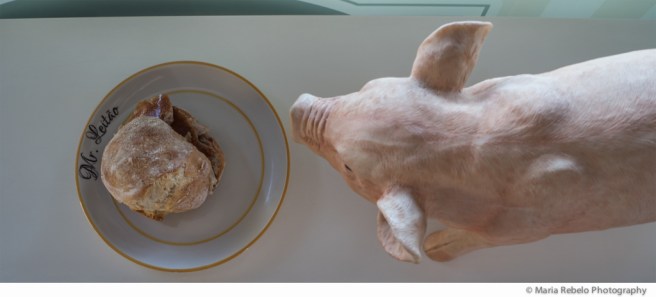
Mister leitão

Mr. Leitão

A completely reliable source told us that the best roasted suckling pig sandwich came not from Bairrada, the region famous for this culinary delicacy, but from a small café in Fátima called Mister Leitão. We couldn’t ignore this tantalizing tip, so we got on the road to Fátima to investigate.

We were advised to call in advance to reserve our sandwiches and we duly contacted José Miguel Vitório, the restaurant owner. He confirmed that they always run out of roasted suckling pig at some point in the early afternoon and that a reservation is indeed wise.

Mister Leitão has no place to sit, just a few counters where the sandwiches can be enjoyed. There’s always a line because the sandwiches are made to order. The air is filed with the smell of the roasted suckling pig and the bread baked in the premises. These appetizing aromas make the few minutes we waited seem like hours.

But the wait was well worth it. The sandwiches are amazing: the warm, crispy bread enfolds the succulent meat that is lean and has a deep taste reminiscent of prosciutto.

José Miguel is the heir to a tradition that started with his father in 1956. It takes a lifetime to learn how to roast a suckling pig. There are many details, seasoning the meat, sowing the animal, choosing the right fire wood, learning how to read and adjust the temperature of the oven. “But all the technique in the world will not matter if the ingredients are not great,” says José. He uses only fresh ingredients bought directly from selected farmers. “We peel by hand large quantities of fresh garlic. But that is what it takes to get the flavor we strive for,” he says. José carefully selects all the suckling pigs he uses, making sure that they were not fed with grain but were breastfed by their mothers.

After talking to José we felt hungry again. So we went back in line for another dose of suckling pig perfection.

Mister Leitão is located at Estrada da Batalha, 6, 2495 Fátima, tel. 249-538-120.


A rhyming guide to Lisbon

RBD_Lisboa_Sé
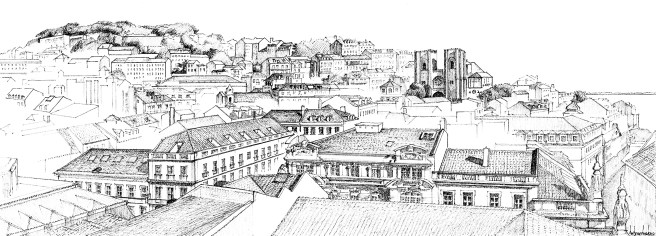
Lisbon, ink on paper, Rui Barreiros Duarte December 2017.

It you come to Lisbon by boat or by plane
As soon as you land, you must go to Belém
For there you can try sweet pastries so fine 
They serve them in heaven since 1837

There’s an old monastery, majestic and faery
And a tower that’s built with such precious marbles
Fish jump from the Tagus to see how it sparkles

If it is time for lunch
You do as you wish
But do not go home
Without trying codfish

Clams Bullhão Pato you also must try
It’s a dish so sublime
Foodies rave about it in prose and in rhyme

Which restaurant to choose?
If you really insist
We’ll tell you our favorites
Click here for a list

There are three main plazas that are worthy to see
Terreiro do Paço where the king used to live
Rossio that’s spacious and pretty like few
And then there’s Chiado with shops old and new

You must go to Alfama
The sole place to survive
The Lisbon earthquake of 1755

Then you can relax in an old coffee shop
And pencil a poem about love or loss
If you need inspiration, we know where to go
For a glass of “ginginha” that’ll make your words flow.

You can shop for a gift
For whomever you pick
Here’s a list of suggestions
Diverse and unique

If you’d like to hear fado, stop by Sr. Vinho
To see singers in black make their voices go far
Embraced by the sound of an ancient guitar

Lisbon forgives if you leave for a day
To see Sintra‘s palaces
Cascais and its bay

But you must come back soon
For the city has charms that it only reveals
To those who spend time in its seven hills

Mesa de Lemos

Composit Quinta de Lemos

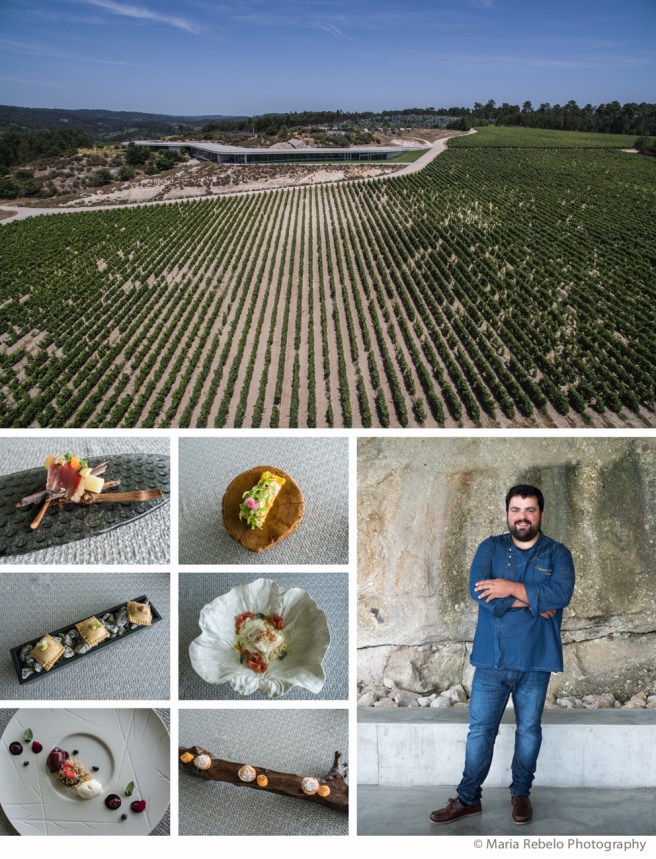
The most elegant place to dine in the Beira region is called Mesa de Lemos. Located near the village of Canas de Senhorim, the building is ensconced in the ancient granite boulders and looks like an integral part of the landscape. It was built three years ago by Celso de Lemos to showcase the wonderful wines he produces in the winery that also bears his name.

The restaurant tables overlook the surrounding vineyards, making us feel as if we are dining in the middle of the vines. There’s a fixed menu with optional, but indispensable, wine pairings. The delicious food is created by chef Diogo Rocha who was born in Canas de Senhorim. He draws inspirations from local traditional recipes to produce food that is elegant and satisfying.

Our meal started with a joyous sparkling wine called Geraldine in honor of Celso’s daughter. It has very fine bubbles and an elegant brioche aroma that combines perfectly with Diogo Rocha’s appetizers, a set of preparations reminiscent of a picnic in the countryside.

Next came Dona Santana, a complex red made from the four emblematic varietals cultivated in the Dão region: Touriga Nacional, Tinta Roriz, Jaen, and Afrocheiro. It paired perfectly with the braised bízaro pork. The last entrée was codfish adorned with an ethereal parsley foam and paired with an elegant red wine made from a single varietal, Afrocheiro.

The dessert feast started with an interesting experimental fortified wine produced by the quinta. It continued with a cherry pudding and a salty ice cream made from requeijão, a pastry filled with a sweet bean paste and a chestnut-shaped concoction made from egg yolks.

The wines of Quinta de Lemos are diamonds that sparkle anywhere. But at Mesa de Lemos they have their perfect setting.

Click here for the Mesa de Lemos web site. The restaurant is located at Quinta de Lemos, Passos de Silgueiros, near Viseu, tel 961 158 503.

The governor’s palace

Palácio do Governador

Just when we think that Lisbon told us all her secrets, the city finds new ways to surprise and delight us. This time we discovered a new hotel called Palácio do Governador (the governor’s palace).  Located near the Tagus river, it occupies a 16th century manor house that once belonged to the governor of the Belém neighborhood.

The governor’s room overlooks the Tower of Belém which used to be connected to the house through an underground passage. Near this passage, you can find the ruins of a Roman factory that produced garum, a fish sauce used in Roman cuisine.

We had a wonderful stay. The hotel integrates old and new with ease, offering  comfortable rooms and elegant public spaces. The service is attentive and the location is perfect.

Our only source of anxiety was the temptation to forego breakfast at the hotel and walk over to the Confeitaria dos Pasteis de Bélem to start the day with a heavenly pastel de Belém.


Palácio do Governador is located on Rua Bartolomeu Dias 117, in Lisboa, tel. 212 467 800. Click here for the hotel’s website.

Discovering the Beira Interior wine region

Quinta dos termos 2

It was a week full of discoveries. We met Manuel Malfeito, a wonderful enologist with a gift for explaining the mysteries of wine. Manuel told us about Beira Interior, “a wine region around the Estrela Mountain that has a great future.” He introduced us to João and Lurdes Carvalho, the owners of Quinta dos Termos and off we went in search of new vinic sensations. At Quinta dos Termos we learned about two indigenous varietals that produce elegant, aromatic wines, the white Fonte de Cal and the red Rufete.

Both João and Lurdes come from agricultural families but their careers took them in a different direction. After studying engineering, they started a very successful textile business.

João inherited a farm called Quinta dos Termos with a few hectares of vines planted in 1931. His father had bought the farm in 1945 to produce wine for the local taverns. João hired someone to oversee the vineyard and sell the grapes to the local cooperative.

In 2001 Virgílio Loureiro, a well-known enologist, came for a visit. He told João and Lurdes that the farm had ideal conditions to produce great wine, some of the best in Portugal, perhaps some of the best in the world. The region is blessed with high altitude. The dry climate and the steady breeze keep the grapes free of fungi. And the large thermic amplitude during Spring and Summer produce natural acidity that allows the wines to age gracefully and gain complexity. João told the enologist that his textile business was very demanding and left him no time to devote to wine production.

A week later, Virgilio Loureiro called with a request: “Can I buy a few tons of grapes to produce some wine as an experiment?” “Where will you produce the wine?” João asked. “I could produce it at the local cooperative, but the ideal would be to buy some basic equipment and produce it right on the farm. I can send you a list of what we would need,” the enologist suggested. João ordered the equipment. Virgilio Loureiro produced the wine and staged it in oak until October 2002.

Once the wine was bottled, João took a few bottles to a favorite local restaurant. The next day, the restaurant owner called back and ordered 20 cases. A few days later, another restaurant owner called. He had tried the new wine and he also wanted 20 cases. In February 2003 the wine received a glowing review from a wine magazine.

João and Lurdes were hooked. They planted 56 hectares of vines and Lurdes started working full time at the winery. Now Pedro, one of the couple’s sons has joined her. Their goal is to showcase the excellence of the grapes with nothing added or subtracted. The cultivation and production process adhere strictly to organic principles. The harvest is manual with the grapes are loaded in small cases to avoid crushing the fruit.

One of the ironies of history is that this region far from the sea is the birth place of great navigators like Pedro Alvares Cabral, the discoverer of Brazil. The bottles of local wine these navigators took with them survived the long ocean voyages and were greatly appreciated. Five centuries later, it is our turn to discover the wines from this place that can produce great wine, some of the best in Portugal, perhaps some of the best in the world.

Click here for the website of Quinta dos Termos.


Worshiping the sun in Belém

MAAT Composit

If you’re visiting Lisbon, we recommend spending an afternoon in the Belém neighborhood. We like to start by sitting at one of the tables of the old Confeitaria de Belém to enjoy an espresso with a warm pastel de Belém. We eat the pastry slowly, taking small bites while the aroma of cinnamon and vanilla surround us and the taste of cream, eggs and sugar melts in our mouth.

We are then ready to stroll by the river to the Belém tower. Before the 1755 earthquake, the tower was close to the middle of the river. It was equipped with cannons meant to protect the city from pirates. But instead of scaring marauders, the beautiful tower made Lisbon more alluring and desirable.

Our next stop is the Monument to the Discoveries. It marks the point of departure of the caravels that sailed into the unknown seas to discover new lands.  From there, we cross the garden surrounded by olive trees to visit the Jerónimos Monastery. It is a majestic monument that celebrates the age of discovery in a gothic style that makes exuberant use of maritime motifs.

After spending much of the afternoon visiting the past, it’s time to look at the future. We like to arrive 45 minutes before sunset to the next destination: the new Museum of Art, Architecture and Technology, known as MAAT. Designed by British architect Amanda Levet, the sensuous building looks like a ship that could sail into space. Its roof has become a favorite destination for sun worshipers. Standing there, we see the Tagus river change into orange vests to praise the star that divides night and day while the white museum glows in the golden light. Five centuries after the construction of the Belém tower the MAAT makes Lisbon feel young and desirable again.

The MAAT is located at Av. Brasília, Central Tejo in Belém, Lisbon. Click here for the MAAT’s website. 


Santa Maria do Bouro in the light of eternity

Composit Amares, exposição

The granite walls of the Santa Maria do Bouro Pousada belong to a Cistercian monastery built in 1162 by the first king of Portugal. They aged perfumed by incense and lulled by religious chants.

The monks enjoyed their meals sitting around an imposing stone table. The kitchen had two fountains that supplied water, several wood-fire stoves and a fireplace used for roasting. A large chimney released the appetizing food aromas to the skies above. Perhaps the monks wanted to advertise their talents, in case there were opportunities for good cooks in heaven.

This golden age gave way to an era of slow decline. Eventually, the monks moved out. Wild animals and vegetation moved in.

Just when the old monastery had gotten used to oblivion, a small group came for a visit. They wanted to turn the ruins into an historical hotel.  Among them was a quiet man who stared in silence at the granite walls. He is an architect called Eduardo Souto de Moura who would one day win the Pritzker prize.

In his reconstruction plan, Souto Moura left the walls exposed to showcase their beauty. He avoided imitating the old, so he complemented the granite with new materials. The ivy that embraced windows and columns was allowed to stay and a green roof was built to welcome the vegetation back to the building.

Everything in this beautiful hotel breathes harmony and tranquility. The rooms have expansive views of the surrounding mountains.  And there are many spaces, indoors and outdoors where we can enjoy a glass of wine or a cup of tea.

The kitchen was transformed into an elegant dining room and the large chimney became a skylight. The ancient stone table is still there, covered with irresistible desserts that would make the old monks proud.

Today, the walls of Santa Maria do Bouro stand with the confidence they will be beautiful in the light of eternity. And we think they’re right.

Here’s a link to the pousadas’ website. You can find a large collection of photos of the pousadas at www.mariarebelophotography.com.

Mister Baga

Luis Pato Composit

Bairrada is a region in the center of Portugal with unique conditions for wine production. Close to the Atlantic Ocean, it has sandy soils like those of Bordeaux and chalky soils like those of Burgundy. The vineyards are surrounded by pine trees and eucalyptuses that infuse the grapes with delicate flavors.

The queen varietal of the Bairrada region is the indigenous baga and the king of the baga is Luís Pato. The heir to a line of Bairrada wine makers that can be traced back to 1860, he rebelled against the idea of planting foreign varietals. “Mister Baga,” as people like to call him, has been proved right: today his baga wines are served in many of the world’s great restaurants.

On our first visit, we were received by his daughter Maria Pato. She talks about her father’s wines as if they are part of the family. Her green eyes shined when she opened two bottles of wine from a vineyard called Vinha Formal. The first was a sparkling wine with an enticing brioche aroma. The second was an elegant white made only with bical, a local white varietal.

Next, we tried a 2000 Quinta dos Moínhos, a captivating red wine made with baga. It tastes to red fruit but the tannins have been tamed by the aging process, giving the wine an aristocratic feel.

We sampled a very interesting fortified wine. Luís Pato stopped fermentation before the yeast converted all the sugar into alcohol by freezing the grape must instead of following the traditional process of adding alcohol to kill the yeast.

On our second visit, Luís Pato took us to the cellar to sample some Pé Franco wines made from ungrafted vines that predate the onset of phylloxera. They are complex and have a wonderful acidity that will help them age gracefully.

Pato talked about how much he has learned over the years. “People in Bairrada used to say that baga wines are good in only two years out of ten. When it rained before the harvest, the grapes gained a watery taste which together with rot ruined the wine.” He had the idea of pruning the grapes early in the season and use the pruned grapes to make sparkling wine. “Pruning gives the grapes more space to breathe, preventing rot and allowing me to make good wines in years with rainy Summers.”

Some of Pato’s new projects, like his 19th century-style wines, are inspired by tradition. Others, like his sweet white wine made with from red grapes using hyper-oxygenation, defy tradition.

We asked him about his daughter Filipa Pato, who is also a wine maker. “Our wines are quite different, but we share a lot of information. In New York they know me better for being Luisa’s father than for my wines.” he said with pride.

Both wine makers are experimenting with sercealinho, a grape varietal that only exists in their properties. These vines have to be watched closely because they are highly susceptible to disease. Luís’s father kept a plot of sercealinho alive that shows great potential.

Pato told us that “As a wine maker I cannot stop, I have to continue to evolve and accept new challenges. I want to make wines that my grandchildren will drink in 30 years and say, wow this wine is great.”

Every time we try Luís Pato’s brilliant, original wines we wonder: is Bairrada the best wine region in Portugal and one of the best in the world?  If you’re a wine lover, visit Luís Pato’s winery to find out.

Click here for information on how to schedule a visit to Luís Pato. 

A pão de ló recipe

Pão-de-Ló QG

Fernanda Pinto is an extraordinary cook who knows how to make the most from the ingredients produced at Quinta de Guimarães. Every day at breakfast she offered us either “pão de ló” or “fatias de Resende.” Both desserts have the same base, a concoction of flour, sugar and eggs. Fatias are covered with a light sugar glaze that is sinfully delicious.

Fernanda’s versions of these traditional recipes are light and elegant. We asked her whether she would give us her pão de ló recipe to share with our readers and she agreed. What makes the cake airy and light is that the egg whites are beat separately from the yolks. Here’s the recipe:

Separate the whites and yolks of 12 eggs. Beat the whites until they are firm. Mix the yolks with 250 grams of sugar. Strain 100 grams of white flour though a fine sieve and add to the yolk mixture. Fold the whites with the yolks.  Place the batter in a cake pan lined with paper. Bake in the oven for 40 minutes at 200 degrees Centigrade (390 Fahrenheit),

This recipe produces a great pão de ló. But it does not compare with the original version because Fernanda uses three unique ingredients: the wonderful eggs laid by the chicken that roam the farm, a large cake pan with a round clay cover, and her magic touch.

Quinta de Guimarães is located at Lugar de Miguas, Sta. Marinha do Zézere, tel. 912 915 699. Click here for the quinta’s website.