Café Nicola

Nicola, a famous café in Lisbon, opened its doors in the late 18th century. Run by an Italian emigrant, it became popular in literary and political circles. Here, you could listen to the latest government gossip, conspire against the prince regent, or hear Bocage, a bohemian poet, improvise brilliant verses.

All this fun came to an end with the Napoleonic invasions—French officers adopted the Nicola as their gathering spot. So, when the French retreated in 1808, Nicola threw a grand independence party.

In 1929, Nicola moved to its current location, featuring the art deco architecture that you can see today.

At Nicola you can do it all, improvise poetry, start an insurrection, celebrate independence, and have a great cup of coffee.

Chryseia

Even though Douro is the world’s oldest demarcated wine region, it is not know for its table wines. Douro winemakers produced port wine in part because of climatic conditions. The weather can be very hot during the harvest season, raising wine fermentation temperatures and killing the yeast that converts sugar into alcohol. When Fernando Nicolau de Almeida produced the first Barca Velha, in 1952, he famously carted blocks of ice at great expense to control the fermentation temperature.

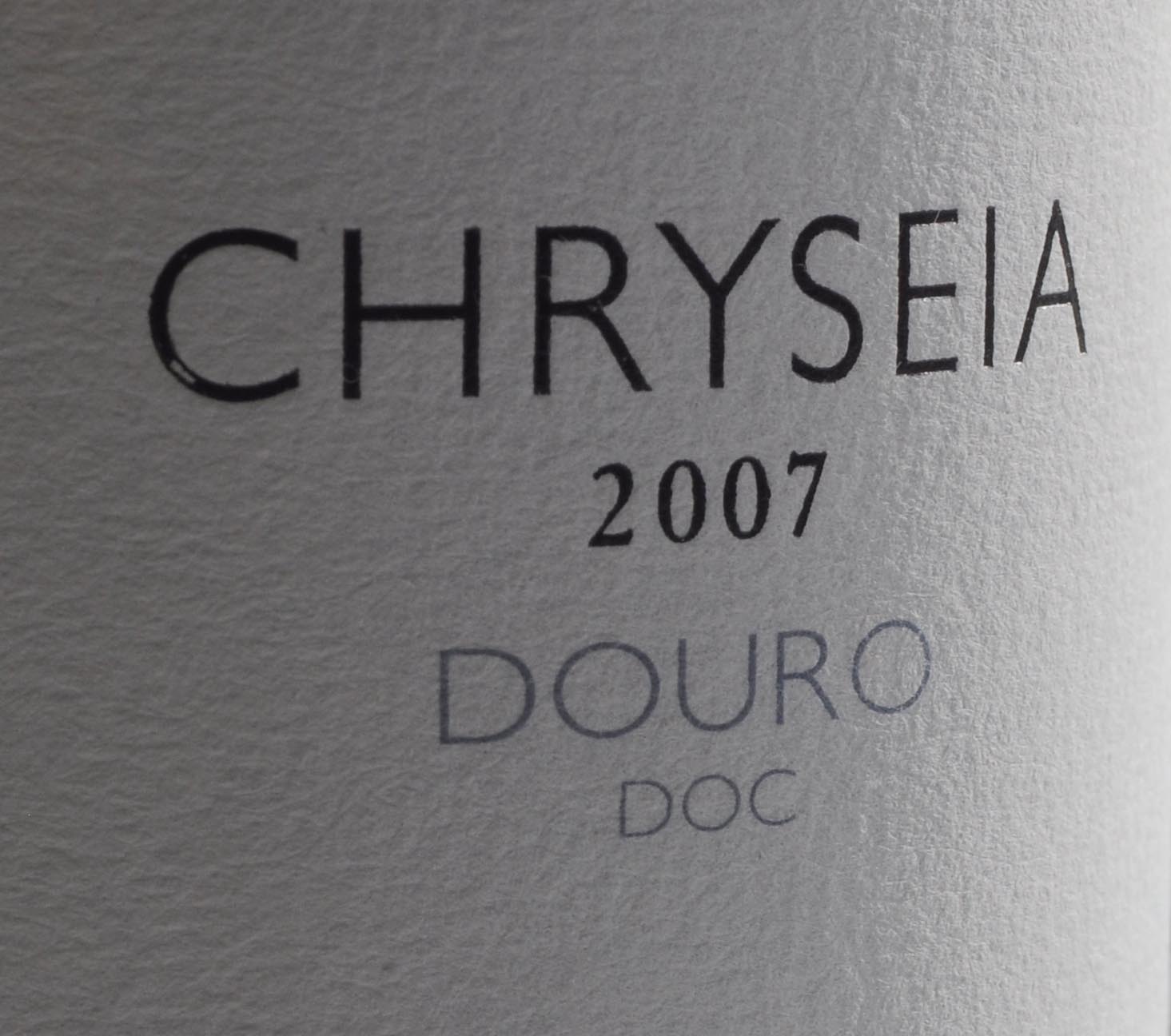
The combination of modern wine-making technology and the Douro’s unique grapes is heralding a new era for the region. One example of this new beginning is Chryseia, a wonderfully elegant table wine made with grapes traditionally reserved for the great vintage Ports. It is produced by Bruno Prats, the famous wine maker from Bordeaux, and the Symington family, renowned for their port wines.

Chryseia means golden in Greek. The name is a reference to the Douro region (Douro means “made of gold” in Portuguese). But it is also a sign that, when two great wine names get together, they’ll settle for nothing less than brilliant.

Santini’s artisan gelato

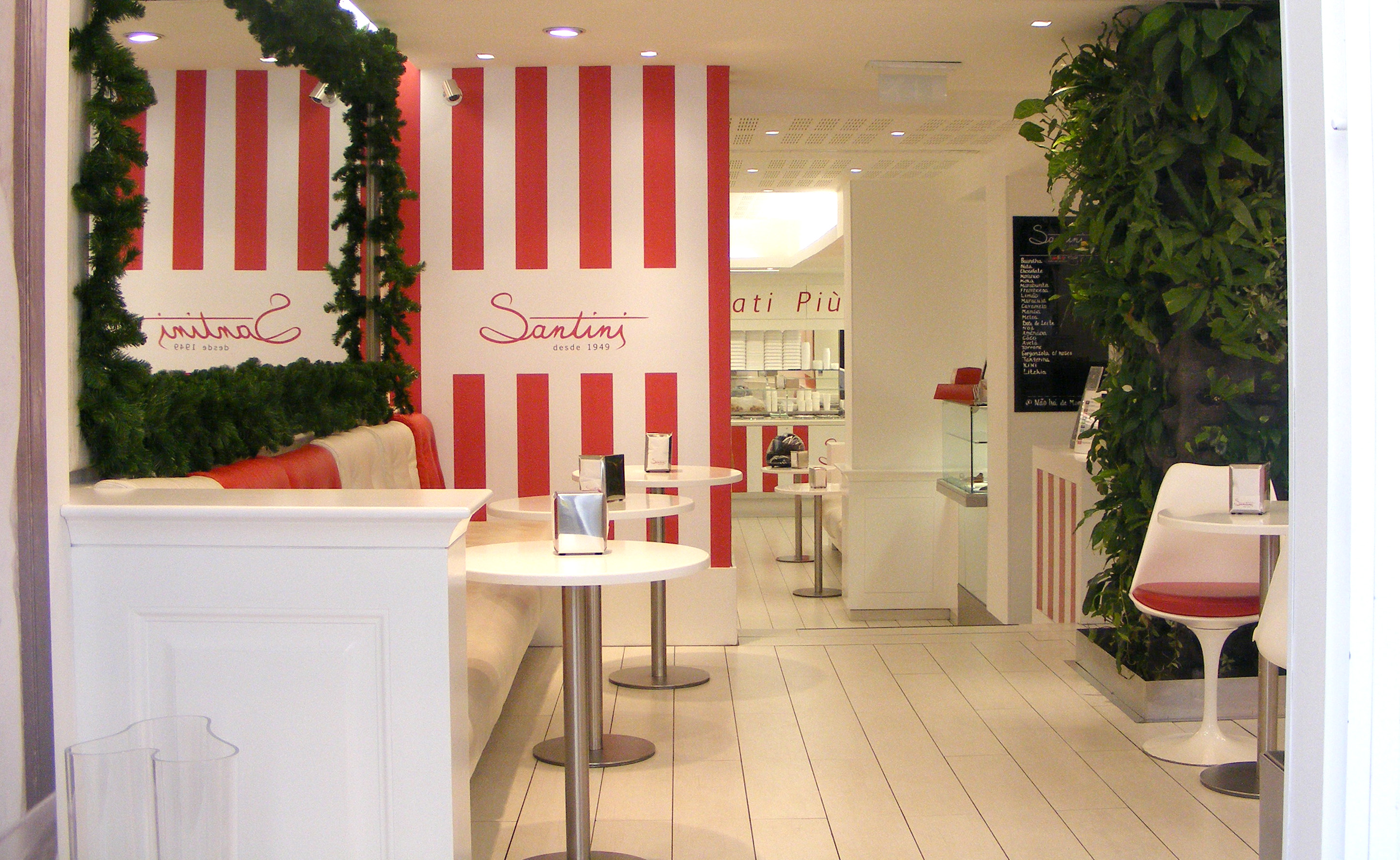
In 1949 an Italian called Attilio Santini opened a gelato store in Estoril, an idyllic beach resort near Lisbon. There was a tradition of gelato making in his family; his great grandfather had a gelato store in Vienna. Santini’s approach was simple: make the gelato fresh every day using only the very best cream and fruit. Word of mouth quickly made Santini famous in the 1950s. It helped that many of Europe’s dethroned kings and queens lived in Estoril and became loyal customers. One of these customers, Juanito, is now better known as King Juan Carlos of Spain.

There was a feeling of elegance, of relaxed optimism about the 1950s that you can see in the lines of the Fiat cinquecento or hear in Miles Davis’ recording of ‘Round Midnight. It is this sweet feeling that you can still taste today in a Santini gelato.

Santini has currently three locations, one in Lisbon, near Chiado (Rua do Carmo, 9) and two others in beach resorts near Lisbon (S. João do Estoril, Rua Nova da Estação, 5, and Cascais, Av. Valbom, 28F). There can be long lines in the Summer. The wait is an opportunity to consider which of the more than 50 varieties we are going to try. We don’t want to rush into this decision! Click here for Santini’s website.

In love with Lisbon

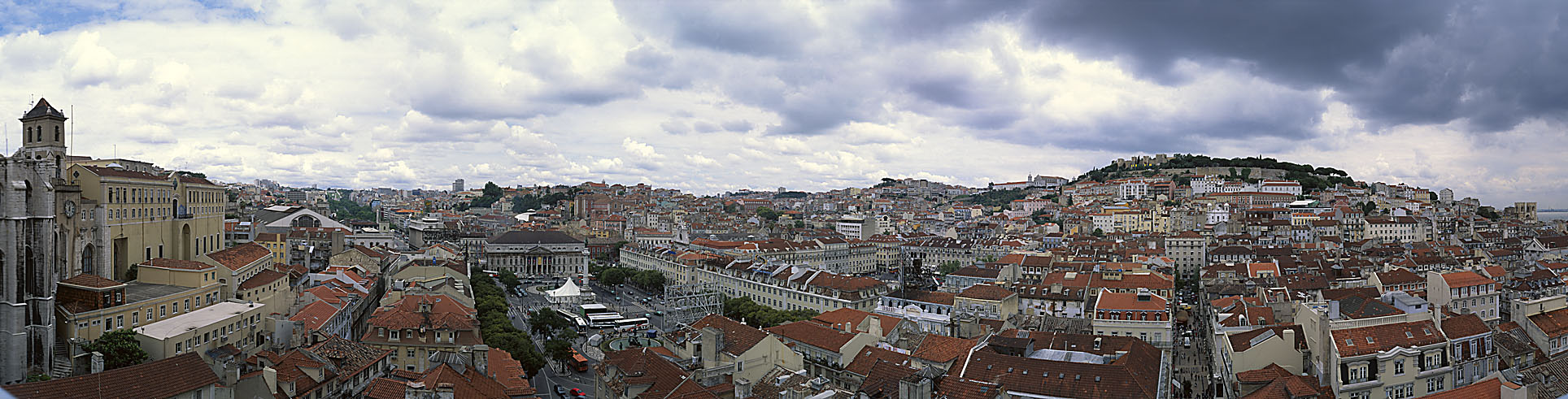
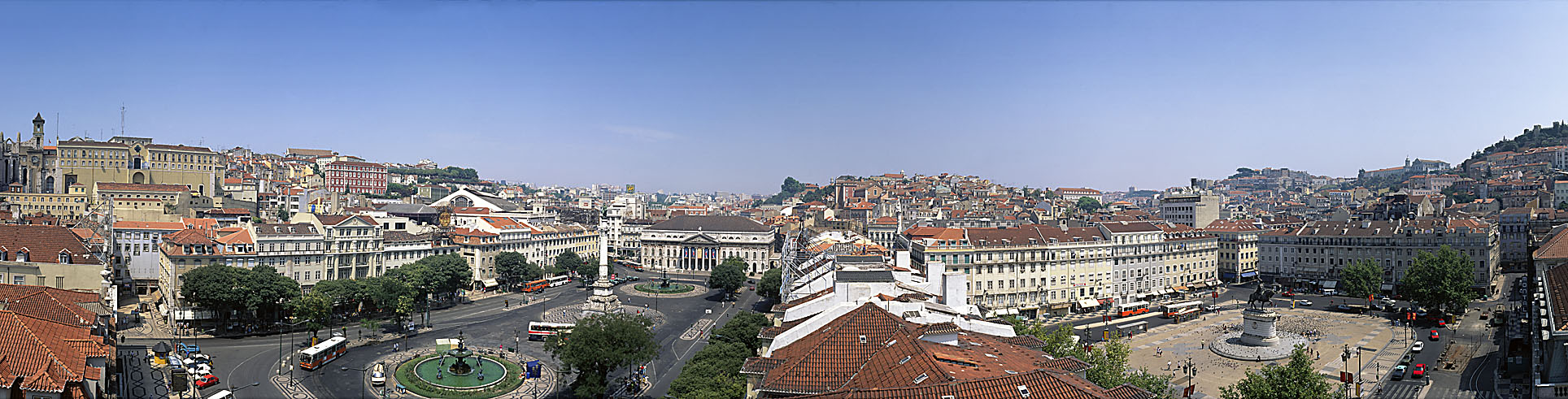
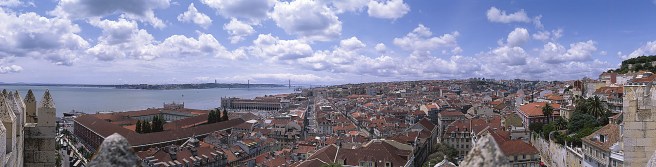
Panoramic views of Lisbon, Luis Pavão, chromogenic prints, 1990.

In 1581 a Spaniard came to Lisbon and fell madly in love with a Portuguese woman. There is nothing unusual about this incident; it happens all the time. What is uncommon, is that this Spaniard was also a great writer: his name is Miguel Cervantes. Here’s how Cervantes describes Lisbon in his novel, The Trials of Persiles and Sigismunda:

“Here love and honesty go hand in hand, courtesy never lets arrogance swagger, and bravery keeps frailty away. Its residents are pleasant, polite and discrete in matters of love. This is Europe’s largest city, the gateway to the treasures of the Orient, which from here flow to the world. Its busy harbor accommodates countless vessels and an undulating forest of ship masts. The beauty of the women enchants and arouses, the bravery of the men astonishes. In sum, this is the land that offers the most copious and holy tribute to heaven.’’

We do not have a portrait of the Portuguese woman who enchanted Cervantes, but the photos above show the splendor of the city that so impressed him (if you click on the images, you’ll see them on a larger scale).  Luis Pavão, a wonderful Portuguese photographer, created these panoramic views without any digital gimmickry. He took these photos with a camera that he built using a design proposed by the Lumiére brothers in 1901 .

This is Europe at its best: a place where a Portuguese photographer uses the forgotten plans of two French dreamers to illuminate the words of a Spanish writer who fell in love with Lisbon at first sight.

Click here to see more work by Luis Pavão on his website. You can see a photo of his panoramic camera on the top left side of his homepage.

Portuguese canned sardines

Portugal’s wonderful canned sardines have, according to legend, a French origin. Britanny had a thriving canned sardine industry in the late 19th century. But fish stocks started to dwindle, forcing Breton fishermen to venture farther from the coast. A fishing boat that sailed west to avoid a raging storm, ended up on the Portuguese shore. There, the French fishermen hauled the biggest sardine catch they had ever seen. They all promised to keep their discovery secret but, eventually, word got out.

Brittany canners came to Portugal and set up operations in Lagos, Setúbal, and Olhão. Soon, Portuguese brands started to compete with the French and an industry was born.

A can of Portuguese sardines contains much more than delicious fish. It has the story of an old sea storm and of a crew of fishermen who couldn’t keep a secret.

The tower of Belém

The Belém tower, Rui Barreiros Duarte, ink on paper, 2011.

Many guidebooks describe the tower of Belém as a chess piece forgotten on the Tagus river. The poet Fernando Pessoa thought that there is much more to the tower than this first impression. In 1925, he wrote an English-language guide to Lisbon, titled “What the Tourist Should See.” This book, discovered only in 1988, was meant to restore Lisbon to its rightful place as one of the great European cities. Here’s what Pessoa writes about the tower of Belém:

“This marvel of oriental architecture was erected in the Restelo beach, famous as the point from which the ships sailed forth for the Great Discoveries, and was meant for the defense of the river and of the Portuguese capital. It was King Manuel I who ordered its erection; its was built within the river, and the project is due to the great master of “laced” architecture, Francisco de Arruda. It was begun in 1515 and completed six years afterwards. Later the river sank away, from that point, leaving the Tower definitely connected with the shore. […]

The Tower of Belem, seen from the outside, is a magnificent stone-jewel, and it is with astonishment and a growing appreciation that the stranger beholds its peculiar beauty. It is lace, and fine lace at that, in its delicate stonework which glimmers white afar, striking at once the sight of those on board ships entering the river. It is no less beautiful inside; and from its balconies and terraces there is a view of the river and of the sea beyond, which is not easily forgotten.”


Berrio: a romantic esplanade

Berrio is the name of a spectacular esplanade in the beach of Parede, 20 km from Lisbon. It is the perfect place to go for coffee on a sunny afternoon. Even though it is located by the “marginal,” the coastal road that connects Lisbon to Cascais, when you are there, you feel like you are on a sea voyage.

If you take a date to Berrio, choose your date very carefully. Swept by the beauty of the sea and sky, you might find yourself speaking words chosen by the waves and whispered by the wind; words like: “You know, Berrio was the first ship from Vasco da Gama’s fleet to come back with news that they had found the seaway to India. It arrived in Cascais, not far from here. I could say that I, too, have been on a journey, and that I found my way in you. But I would never liken a search for cardamom and pepper to my quest for you. How could I compare earthly dust with your ethereal beauty?”

Berrio, Avenida Marginal, Praia da Parede, Tel. 21-457-7356, email: geral@berrio,net. Click here for website.

Pão com chouriço (chouriço bread)

No one recorded the moment of sublime inspiration when an unsung genius thought of taking a delicious “chouriço” (a smoked sausage made of pork marinated in red wine), place it inside bread dough, and cook it in a wood oven. The result is incredible. You can buy chouriço bread at bakeries and fairs. But think twice before you try it: it is wildly addictive.

Many visitors keep returning to Portugal on their vacations. They say they are attracted by the majesty of the cities, the beauty of the countryside, the stunning beaches, the perfect weather, the wine, the food, the hospitality, the culture. But we know they come for one thing only: the chouriço bread.

The future of Bairrada

When we have something great to celebrate, we do not drink French Champagne or Italian Prosecco. We much prefer to get our sparkles sipping Espumante from Bairrada, a region that has produced wine since the 10th century. Our favorite Espumante is made by Luís Pato with a white varietal known in Bairrada as Maria Gomes and elsewhere as Fernão Pires.

We just heard from Luís Pato that his newest creation is a red wine made with this white grape. The wine marks the birth in 2011 of his new grandson, Fernão. And it celebrates the future of Bairrada as one of the world’s premier wine regions. Cheers!

Palácio Belmonte

To stay in this 15th century palace in Alfama, the ancient neighborhood around St. Jorge’s Castle, you first have to find it. Despite its bright red doors, this small luxury hotel is so discrete that no one knows where it is.

The palace, one of the few to survive the 1755 earthquake, incorporates castle walls that go back to Roman and Moorish times. It was at one point the residence of Pedro Álvares Cabral, the navigator who discovered Brazil.  Five centuries later, the German director Wim Wenders used it in his movie The Lisbon Story. Sostiene Pereira, a movie with Marcello Mastroianni, was also shot here.

In 1994 the French entrepreneur Frédérique Coustols saw the palace in disrepair during a stroll in Alfama. He bought it and restored it with impeccable sensitivity and taste.

When you stay at Palácio Belmonte, you feel like royalty. Siting in the terrace in the late afternoon, drinking chilled white port and enjoying the stunning views of Lisbon, you quickly realize that it is good to be king.

Palácio Belmonte, Páteo Dom Fradique, 14, Lisboa, Tel: 21 881 66 00,  e-mail: office@palaciobelmonte.com. Click here for the palace’s website.