The abbot’s pudding

Pudim Abade de Priscos-3

One of the most original Portuguese recipes is a pudding created in the 19th century by the priest of Priscos, a small parish near Braga. He was called Manuel Rebelo but became known as the Abade de Priscos (Prisco’s abbot). His fame as a cook and gourmet earned him the invitation to prepare banquets for the royal family and the title of Honorary Chaplain of the Royal House.

The pudding combines egg yolks, sugar, cinnamon, lemon, port wine, and fresh bacon (yes, bacon!). The abbot liked to say that the pudding is easy to make but hard to make perfectly and that when well prepared, it has a unique taste. Paired with a glass of port wine, a slice of this pudding is a culinary delight.

Born in 1834, the abbot lived almost 100 years, dying in 1930. Could the abbot’s pudding be the secret of his longevity? We order it every time we see it on the menu to try to find out!

The scrumptious Pudim Abade de Priscos in the photograph was prepared at the restaurant of the majestic Pousada of Viana do Castelo.

Ilda Vinagre shares a recipe

Ilda Vinagre

Ilda Vinagre is a legendary chef. In the 1980s, she opened a restaurant called Bolota (acorn) in Terrugem, a small town in Alentejo. The restaurant earned her two Michelin stars, attracting gourmets from Portugal and beyond. After this feat, she traveled the world cooking, heading restaurants in the United States and Brazil, and preparing banquets that showcased the cuisine of Alentejo in lands as far away as China.

The good news is that Ilda is back in Alentejo. We met with her at the restaurant of Herdade dos Adeans where she oversees the kitchen. Ilda told us about her life and her love of cooking. That these days she enjoys decorating her plates with edible flowers. And that there are four herbs no Alentejo chef can do without: mint, coriander, oregano and “poejo” (pennyroyal). In the end of our conversation, she generously gave us one of her favorite octopus recipes so we could share it with our readers. Here it is!

Country-style Octopus

Cook “al dente” the octopus in water with salt, onion, coriander, pepper and oregano. Cut it in pieces and grill the pieces in a hot griddle with bacon and a little olive oil. Dress with lemon juice, lemon rind and oregano. Accompany with a sweet potato puree. To make the puree, roast the sweet potato with the peel on. Take the peel, mash the pulp and mix it with butter.


Dining with the minister at Campo Maior

Taberna O Ministro

We strolled around in Campo Maior, a small town in Alentejo close to the border with Spain, looking for a place for lunch. We noticed a tavern called O Ministro (the minister) which was full of locals. There was a bottle of Caiado–the wonderful entry wine from Adega Mayor—on every table. Encouraged by these favorable omens, we decided to enter.

Traditional music played in the background, mostly fado tunes about the travails of love and the fickleness of life. Every now and then, a folk song from Alentejo came on and the locals raised their voices to sing along.

A plate with codfish cakes, slices of sausage, and green olives arrived at the table. We ordered “migas” made with bread and turnips and fried cação, a small shark that somehow manages to swim from the coast to the menus of Alentejo. We also ordered “carne do alguidar,” marinated pork loin. We were astonished by the quality of everything that came to the table. It was delicious and deeply satisfying food, with a perfect sense of time and place.

João Paulo Borrega, the chef and owner of this magical restaurant came out of the kitchen, and stoped by each table to ask whether people liked his food. “The food is fantastic,” we told him. “Can we make reservations for dinner and arrive a little early to talk to you?” Sure, he said with a bemused smile.

Late in the afternoon, he sat down to talk with us. Like most Alentejo cooks, he learned cooking from his mother and grandmother. His restaurant opened in 1989 and has changed location over the years. It is named after João Paulo’s father, a man whose role in the revolutionary days after April 1974 earned him the nickname “the minister.”

João Paulo tells us that the current restaurant location is ideal. “I want to cook by myself, and this space has the maximum number of tables I can comfortably handle.” He talks enthusiastically about his favorite recipes: fried rabbit, toasted chicken, chickpea soup, and ensopado de borrego (lamb stew).

“Why does your food taste so good?,” we asked. “I am going to show you my secret,” he said, inviting us into the small kitchen. He pointed to an old, tiny refrigerator. “Everything I use I buy fresh every day. That is why I have no freezer, just this small refrigerator. At the end of the day I give away any leftovers to my friends. The next day I start everything from scratch. Meats, fish, vegetables, herbs, sauces, everything has to be fresh.”

All his products are local and seasonal, produced by people he knows. He rattled off the names of the friends who supply him: the olive-oil maker, the farmer who plants the potatoes and onions, the person who chooses ripe melons for his table; the list goes on. The quality of his sourcing would make many three-star chefs envious.

João Paulo talks with great knowledge about the details of the different recipes and the properties of various herbs and spices. “People often use too much laurel. That is a mistake,” he says. “Laurel is very powerful and can overwhelm other ingredients.” “The cuisine of Alentejo does not require much fussing around,” he explains. “But the ingredients need to be first rate and the last flourishes before the dish is brought to the table have to be perfect. Some dishes are finished with white wine, others with vinegar, herbs play a key role.”

We sat down for a wonderful dinner. It started with toasted chicken perfumed with vinegar and prepared with olive oil, garlic and parsley. Then came a steaming chickpea soup with Alentejo sausages, Savoy cabbage, carrots, and mint. Next, we tried the fried rabbit. The meat had been  marinated with rosemary, thyme, pepper, white and red wine. Then it was stewed to perfection in a large iron-cast pan with olive oil, garlic, and some more wine. Delicious slices of ripe melon brought this memorable meal to a sweet finale.

No matter how much you travel, it is hard to find food that is as simply satisfying as the one served in this little tavern in Alentejo. If you have a chance, come to Campo Maior to dine with the minister.

Taberna O Ministro is located at Travessa dos Combatentes da Grande Guerra
Campo Maior, Portalegre, tel. 351-965-421-326.

Caldo verde

Caldo Verde

Caldo verde (green broth) is the most Portuguese of soups. It comes in different versions but Maria de Lurdes Modesto, the doyenne of traditional Portuguese cooking, recommends a simple preparation used in the village of Marco de Canaveses.  Here’s the recipe.

Gently boil 500 grams of potatoes, 3 garlic cloves, one sliced chouriço (meat sausage) and some olive oil.  Crush the potatoes with a masher. Add the shredded Galician cabbage for just a couple of minutes (avoid overcooking the cabbage). Dress the soup with olive oil. Serve, preferably in a clay bowl, and accompany with broa, a Portuguese corn bread.

The soup has the colors of the Portuguese flag: green from the cabbage, red from the sausage, and yellow from the olive oil. You find caldo verde everywhere: in homes and restaurants, in places where fado singers gather, and in festivals and fairs. The soup is so popular that vendors in farmers’ markets have a special shredder to make the distinctive strips of Galician cabbage that are the hallmark of caldo verde.

As with many traditional recipes, the origin of this soup is lost in time. There’s no recipe for caldo verde in the cookbooks written by Domingos Rodrigues in 1680 or by Lucas Rigaud in 1780. But these chefs worked for the royal family, so they probably shunned peasant cooking. The soup is mentioned in several 19th century literary works and it is the first recipe in Culinária, an influential cookbook published in 1928 by António Maria de Oliveira Bello.

Caldo verde is often served at midnight on New Year’s eve. Its comforting taste helps everyone feel warm and optimistic about the New Year!


Two recipes from Ílhavo

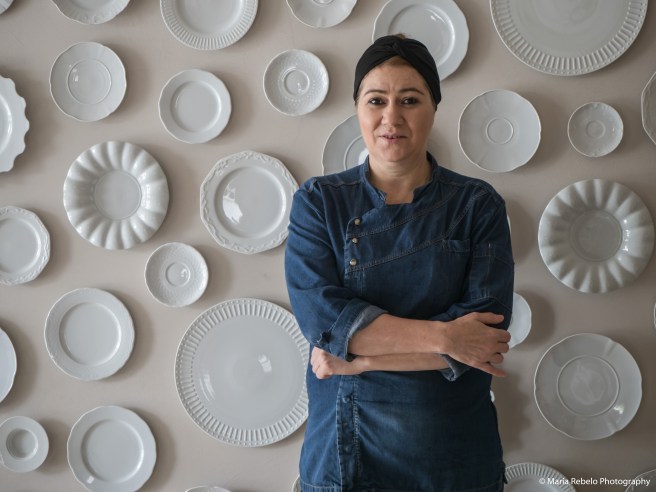
16 - Chefe Cristina Almeida - @mariarebelophotography.com

The Montebelo Vista Alegre hotel in Ílhavo is a hidden travel-destination gem in the center of Portugal. The hotel has a stunning location on the marshes where river and sea water meet.

The building complex incorporates the elegant manor house of José Pinto Bastos, the entrepreneur who two centuries ago pioneered the production of porcelain in Portugal. You can visit an interesting museum that traces the evolution of Vista Alegre from a risky experiment to a renowned porcelain brand. It is also wonderful to visit the porcelain factory, the place where earth and fire combine to serve the imagination of designers and sculptors.

One of the pleasures of a stay at the Vista Alegre hotel are the appetizing meals served in the restaurant headed by chef Cristina Almeida. For the last three decades, Cristina has been creating and refining recipes based on Portugal’s culinary tradition. Since she opened the hotel’s restaurant in 2016, Cristina has had the luxury of serving her food in the elegant dinnerware produced by Vista Alegre.

Two of our favorite dishes at the Vista Alegre restaurant are lamb rice with mushrooms and chestnuts and velvety codfish. We enjoyed these culinary treasures so much that we dared to ask Cristina whether she would share the recipe with our readers. She graciously agreed, so here they are.

Lamb rice with mushrooms and chestnuts

Ingredients for four people

  1. 600 grams of baby lamb
  2. 400 grams of rice (Cristina uses the Carolino variety produced in Portugal)
  3. 1 garlic clove
  4. 250 grams of onions
  5. 100 grams of chestnuts
  6. 100 grams of mushrooms
  7. 0.2 liters of white wine
  8. 0.1 liters of red wine
  9. 0.1 liters of olive oil
  10. Seasonings: thyme, bay leaf, piri-piri, and salt

Cut the lamb into small pieces. Marinate it with garlic, bay leaf, the two wines, thyme and salt. Dice the onion and fry it in olive oil. Add the lamb and fry with the onion. Add the chestnuts, mushrooms, and let the mixture cook a bit more. Add enough water to cook the rice and make plenty of sauce. Wait until the mixture boils and add the rice. As soon as the rice is cooked, serve immediately.

Velvety codfish

Ingredients for five people

  1. 200 grams of codfish without bones
  2. 0ne leek
  3. 1 garlic clove
  4. 150 grams of onion
  5. 1 kg. of potatoes
  6. 0.15 liters of olive oil
  7. Seasonings: parsley and coriander.
  8. Garnish: roasted peppers

Cut the codfish in cubes. Place the codfish, leek, onion, potatoes, parsley, and coriander in a pot. Cover the ingredients with water and let them boil until cooked. In a frying pan, fry the garlic with 1/3 of the olive oil. Add to the boiling mixture. Put the mixture in a blender and blend until smooth. Serve garnished with roasted peppers.

Click here for the website of the Montebelo Vista Alegre hotel. 


A noble crab soup

IMG_1905 2

Almost three decades ago, a friend took us to a new restaurant called Nobre in the Ajuda neighborhood. The name, which means noble, came from the surname of the chef, Justa Nobre. We recall with fondness the meals we enjoyed there. After a successful run, Nobre closed so that the chef could pursue other projects,

Last week, the same friend invited us for lunch. We were delighted to discover that we were going to a new restaurant that marks Justa Nobre’s return to Ajuda. It is called “À Justa,” an expression based on the chef’s first name that means “just right.”

The menu offers a cuisine without foreign accents that has the satisfying taste of authenticity. The recipes are grounded in the cooking of Justa’s grandmothers. But they are not a copy of the past. They reflect years of refinements shaped by the personality and creativity of this self-taught chef.

The restaurant was full. The Portuguese like to flirt with contemporary food trends but they always come back to their one true love, which is the traditional cooking of Portugal.

We had a great meal that included bright green fava beans, chickpeas with codfish, codfish “pataniscas,” and fried cuttlefish. These delights were preceded by a classic of Justa Nobre’s repertoire: the spider crab soup. Its aristocratic taste makes all other seafood soups in Lisbon look common by comparison.

Many chefs keep their secrets, but Justa generously shared some of her recipes in a book titled Passion for Cooking. We translate her recipe for spider crab soup below. But you must try the original at À Justa where they make it just right.


Justa Nobre’s spider crab soup

Ingredients: 2 large spider crabs weighing about 1 kg. each, 3 liters of water, 3 tablespoons of sea salt, 150 grams of margarine, a large onion, 2 cloves of garlic, a parsley bunch, a sliced fennel head, 4 tablespoons of tomato paste, half liter of cream, 0.1 liter of dry white port, one teaspoon of powdered ginger, one teaspoon of saffron, 2 tablespoons of potato starch.

Preparation: Boil the crabs in the salted water for 8 minutes. Remove them, let then cool off and extract all the meat. Return the shells to the pan. Add some shrimp shells and let them boil for 10 minutes. In a large pot, melt the margarine and add the sliced onion, fennel and garlic. Let these ingredients cook briefly and then add the white port, the cream, the tomato paste, the spices, and two liters of the crab broth. Mix the potato starch with some cold water and add it to the soup. Check the seasoning and strain the soup. Add the crab meat and serve the soup it in the shell of the spider crab.

À Justa is located at Calçada Ajuda 107, in Lisbon. The restaurant seats only 36 people, so reservations are a must. Call 21 363 0993 or email reservas@ajusta.pt. Click here for Justa Nobre’s web site.


A pão de ló recipe

Pão-de-Ló QG

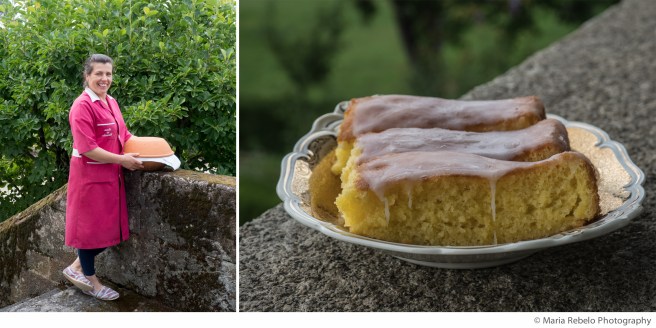
Fernanda Pinto is an extraordinary cook who knows how to make the most from the ingredients produced at Quinta de Guimarães. Every day at breakfast she offered us either “pão de ló” or “fatias de Resende.” Both desserts have the same base, a concoction of flour, sugar and eggs. Fatias are covered with a light sugar glaze that is sinfully delicious.

Fernanda’s versions of these traditional recipes are light and elegant. We asked her whether she would give us her pão de ló recipe to share with our readers and she agreed. What makes the cake airy and light is that the egg whites are beat separately from the yolks. Here’s the recipe:

Separate the whites and yolks of 12 eggs. Beat the whites until they are firm. Mix the yolks with 250 grams of sugar. Strain 100 grams of white flour though a fine sieve and add to the yolk mixture. Fold the whites with the yolks.  Place the batter in a cake pan lined with paper. Bake in the oven for 40 minutes at 200 degrees Centigrade (390 Fahrenheit),

This recipe produces a great pão de ló. But it does not compare with the original version because Fernanda uses three unique ingredients: the wonderful eggs laid by the chicken that roam the farm, a large cake pan with a round clay cover, and her magic touch.

Quinta de Guimarães is located at Lugar de Miguas, Sta. Marinha do Zézere, tel. 912 915 699. Click here for the quinta’s website.

Sainthood is great but so are partridges

Perdiz Escabeche

We had lunch at the São Lourenço do Barrocal restaurant in a beautiful room overlooking the fields.  The house wines, produced on the property by Susana Esteban, a Spanish enologist who fell in love with Portugal, are interesting and full of character.

The food is simple but delicious. We tried the grilled beef with “migas” and the wild boar. The desserts are delightful:  traditional “gadanhas,” lemon and olive oil pudding, and a cake made with nuts and honey.

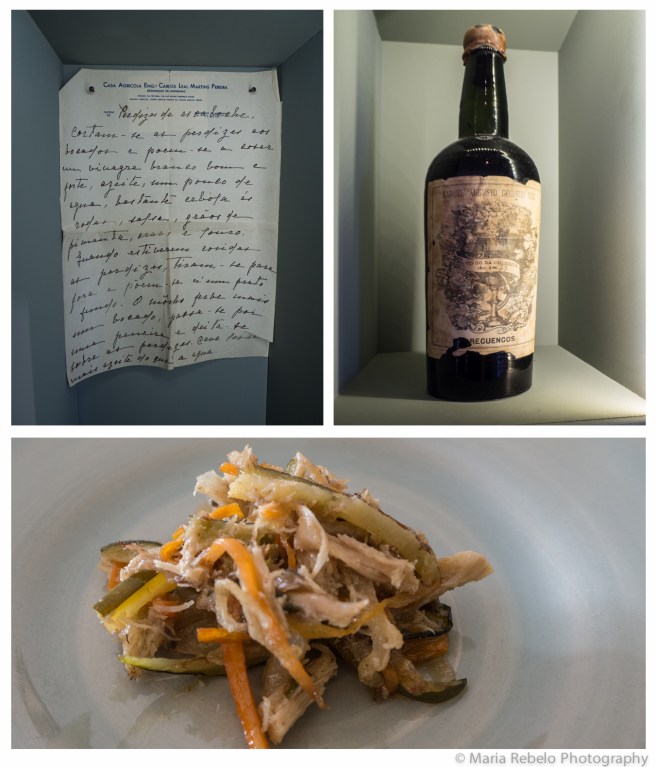
The highlight of the meal was the marinated partridge. The texture was perfect and each bite had layers of tangy vinegar and wholesome olive oil.

We were reminded of Saint Teresa of Ávila who once accepted an invitation to eat partridges. When people expressed surprise that a nun known for her poverty vows agreed to a luxurious meal, Teresa explained that “santidad es santidad mas perdices son perdices,” meaning sainthood is great but so are partridges.

The partridges at São Lourenço do Barrocal are prepared according to a recipe written by the great-grand mother of the owner of the estate, José António Uva. The recipe is on display in the dining room, next to a precious 1875 bottle of fortified wine from Reguengos de Monsaraz. It is a privilege to share this treasured recipe from the heart of Alentejo with you, dear reader:

Marinated partridges

Cut the partridge in pieces and cook it in strong white wine vinegar, olive oil, a small amount of water, and plenty of onion slices (use more olive oil than water). Season with whole black peppercorns, cloves and bay leafs. When the partridge is cooked, remove it from the pot and place it in a deep dish. Reduce the sauce left in the pot, strain it and pour it over the partridge.

Click here for the web site of São Lourenço do Barrocal.


Dona Luisa’s famous codfish recipe

composit-solar-dos-amigos-2

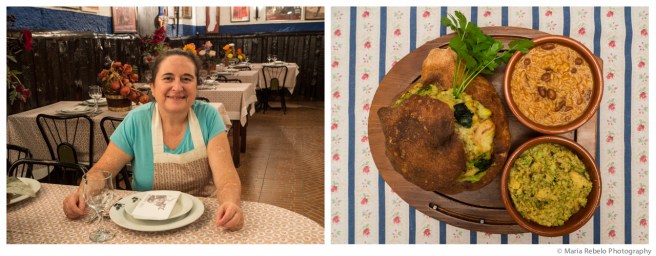
A year ago, we had a memorable meal at Solar dos Amigos, a restaurant in the small village of Guisado near Caldas da Rainha. We returned this year for another great experience. Our lunch started with succulent lamb chops, grilled to perfection. They were followed by a wispy, tasty “Bacalhau à Campino” (peasant style codfish) served inside the hearty country bread that is baked at the restaurant.

Dona Luisa Nunes, the restaurant’s owner and chef, is in great form and so is her octogenarian father who continues to produce a delightful wine that pairs perfectly with the food served at the Solar.

When we praised her famous codfish Campino style, dona Luisa offered to give us the recipe so we could share it with you, dear reader. Follow the instructions and you’ll have a delicious codfish meal. But, will it taste as good as when dona Luisa prepares it?  Not a chance!

Codfish Campino style

Soak 4 slices of salted codfish for two days, changing the water periodically to remove the salt.

Boil the cod for 15 minutes. Reserve the water, remove the skin and the bones, and shred the fish by hand. Boil a green cabbage and drain the water (dona Luisa favors a pusa-drum-head cabbage, known in Portugal as “repolho coração de boi”).  Open the top of a country bread, remove the inside of the bread and soak it for 5 minutes in the water used to boil the codfish. Carefully drain the water from the bread.

Combine olive oil and sliced garlic in a frying pan. Add the soaked bread, the shredded codfish, the cabbage and 2 pounds of cooked red beans. Season with salt and pepper and let the mixture simmer gently for a few minutes. Place the mixture inside the country bread, cover with the bread lid, season with olive oil and place in the oven for a few minutes, until the bread turns golden. Decorate with parsley sprigs and serve.

Solar dos Amigos is located on a small village called Guisado, 100 km north of Lisbon. The restaurant’s address is Rua Principal, 49, Guisado, Caldas da Rainha. Even though the restaurant is large, it is a good idea to make reservations. Their telephone number is 262-877-135. Click here for their website.

Silent inspiration

OLYMPUS DIGITAL CAMERA
Carmelite nuns lived most of their days in silence and solitude. The local peasants offered them agricultural products, including numerous eggs. The nuns used the egg whites to starch their clothes and the egg yolks to make desserts.

One day, the nuns received a bag of the finest, whitest wheat flour they had ever seen. They decided to try to make something special with this gift. The flour was combined with water to create a “virgin dough” that was left to rest. The nuns then stretched the dough and let it rest again. To get the most out of the rare flour, they repeated this stretching-resting cycle until the dough was so thin they could read the bible through it.

The dough was cut into rectangles and used to wrap a delicate mixture of egg yolks and sugar. The nuns used a feather to spread some melted butter over the dough and baked the pastries in the oven. Finally, they dusted them with powdered sugar. The result was so extraordinary that a new tradition was born. Whenever the nuns received fine white flour, they made these unique pastries and offered them to the sick and the poor.

When the religious orders were abolished in Portugal in 1834, the Carmelite nuns shared the recipe for this exquisite pastry with the families that gave them shelter. Two Portuguese towns, Tentúgal and Vouzela have competing versions of the original Carmelite recipe. Each town claims their pastry is the best. They are both extraordinary expressions of the silent inspiration of Carmelite nuns.

The pastries produced in Tentúgal are sold in many coffee and pastry shops throughout Portugal. Vouzela pastries are harder to find, they are mostly sold in Viseu and other locations close to Vouzela. They are well worth a special trip.