
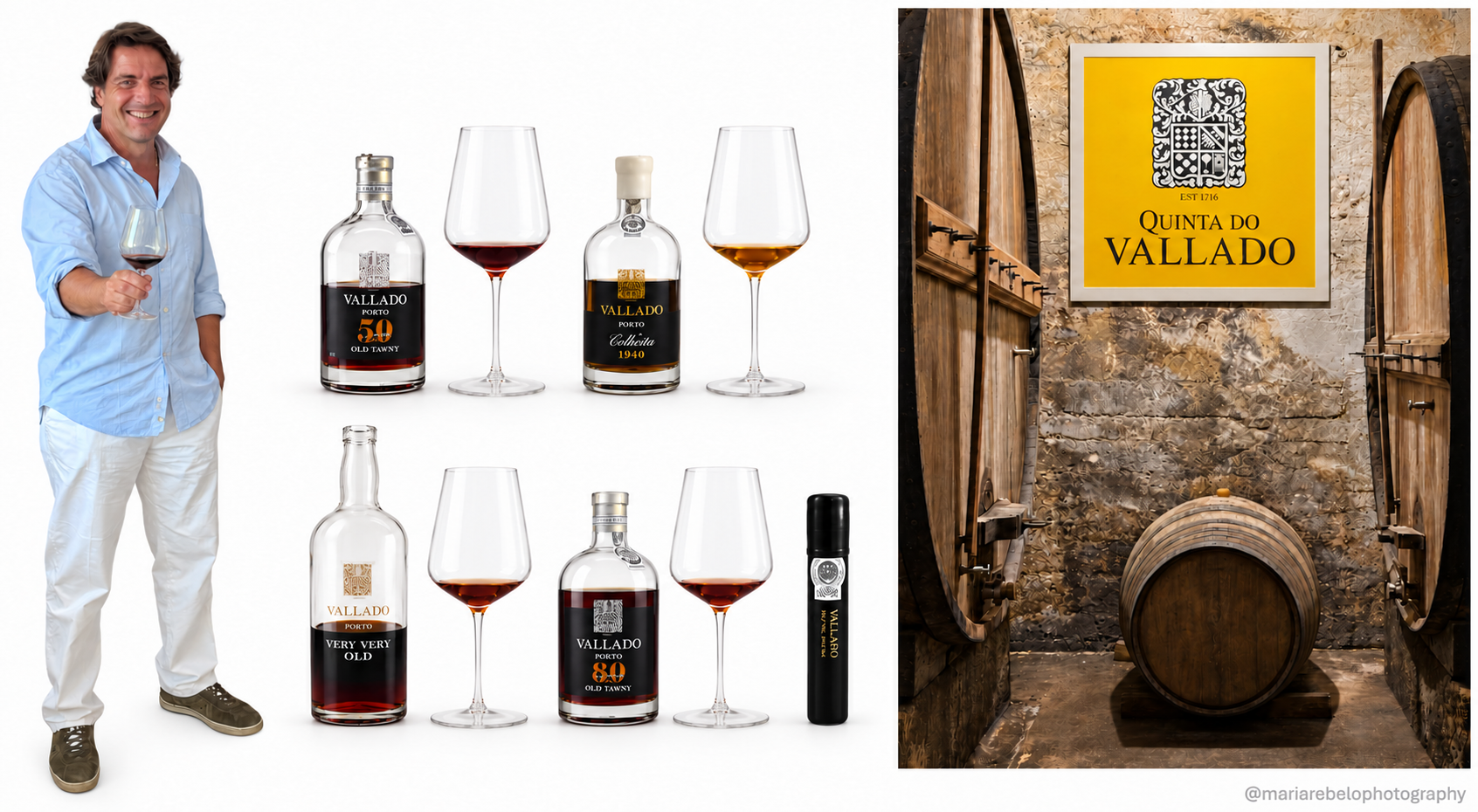
Francisco Ferreira, Quinta do Vallado’s winemaker, had been up since six in the morning, overseeing the harvest. We exchanged messages throughout the day to see whether he was still up to tasting some Ports. He encouraged us to come late in the afternoon, so we set off for the quinta along the narrow, winding road, under repair after the heavy winter rains.
Francisco greeted us in his trademark attire: white trousers and an untucked shirt with rolled-up sleeves. Around him, the harvest was in full swing. Grapes were being unloaded and crushed; laboratory results awaited review. His phone rang constantly with questions to answer and decisions to make.
He looked tired, but wore the quiet smile of someone who loves his work: making great wine. That devotion runs in the family. Francisco is a great-great-great-grandson of Dona Antónia Adelaide Ferreira, who played a decisive role in helping the region overcome the twin scourges of oidium and phylloxera. Like Dona Antónia, Francisco combines a modest manner with a deep knowledge of wine and a passion for the Douro.
Quinta do Vallado, established in 1716, was acquired in 1818 by António Bernardo Ferreira, Dona Antónia’s uncle and father-in-law. The estate produced Port for Casa Ferreira until the company’s sale to Sogrape in 1987. The family retained Vallado and began producing, bottling, and marketing wines under the estate’s own name in 1993.
Francisco led us into the room where he and his team taste samples from the barrels. As the door closed, the winery’s commotion disappeared. So did every trace of fatigue from Francisco’s face. His eyes lit up with the delight of a child about to show friends some favorite toys.
He began by seasoning the elegant Zalto glasses with a splash of 50-year-old Tawny, swirling the wine in each glass before emptying it. This gesture ensured that the first aromas we encountered would belong to the wine. He refilled the glasses, and the tasting began.
The 50-year-old Tawny was a blend of wines aged in the Douro Valley. Orange peel led the aromas; the palate offered layers of citrus and honey. It was complex and concentrated, yet remarkably vibrant and fresh.
“Could growing old in the Douro be the secret of its vitality?” we asked. Francisco laughed and replaced poetry with chemistry. He explained that, in cool, humid Vila Nova de Gaia, Port tends to mature more slowly, and alcohol accounts for a greater share of the evaporation. In the warmer, drier Douro, evaporation is greater and water loss more pronounced, concentrating the wine’s residual sugar and acidity and helping to explain its intensity and astonishing freshness.
We were still savoring the wine when Francisco poured an 80-year-old Tawny blended from four wines: the youngest was around fifty years old; the oldest dated from 1888. Tobacco and coffee dominated the aromas; on the palate, the wine displayed immense complexity, freshness, and length. It was utterly seductive.
Next, we tasted a single-harvest Port from 1940. It was extraordinary. Francisco tried to conceal the label, but we caught a glimpse. To our surprise, it was a white Port. As wines age in cask, red Ports gradually lose their color while white Ports deepen to amber and mahogany. Traditionally, producers blended small quantities of old white Ports into red tawnies to add further layers of aroma and flavor. Fortunately, many whites are now bottled on their own, allowing us to discover just how remarkable they can be.
A rich, complex 1934 Port followed, still full of life after spending more than eighty years in wooden casks. Then Francisco unveiled another relic of the past: a Very Very Old Port, a blend with an average age of one hundred years. Its elegance and harmony were striking, but conventional tasting notes seemed beside the point. Drinking a century-old wine is tasting time itself.
Just when we thought the tasting was over, Francisco announced that he had one more wine. It was the Vallado ABF 1843, bottled in 2025 to honor the estate’s history and legacy. Its crystal decanter is modeled on the one António Bernardo Ferreira used in 1830, when he received Prince Friedrich of Hesse-Cassel. Made by a small producer near Vallado, the wine came from ungrafted, pre-phylloxera vines, before the region’s vineyards were devastated and grafting onto American rootstock became common practice.
Until it was bottled in 2025, the wine had aged in the same 650-liter wooden cask. Only about 200 liters remained; the rest had vanished through evaporation, a loss whimsically called the angels’ share. Its intensity and harmony were qualities that only time could produce. It was as if the years had stripped away everything superfluous, leaving only what was essential.
Dona Antónia Ferreira was only 32 when this wine was made. She could hardly have imagined the challenges ahead, her role in overcoming them, or the devotion to the Douro Valley her descendants would inherit.
Quinta do Vallado is located in Vilarinho dos Freires, Peso da Régua, tel. 254 323 147. Click here for their website.


You were so lucky to taste these. What an opportunity!
A great privilege indeed!