Mizette’s rugs

Composit Tapetes Mizette

Mizette Nielsen moved from Holland to Portugal and got into the production of textiles.  In 1976, she received a large order and started looking for a factory to execute it.

She traveled to Reguengos de Monsaraz to visit the Fábrica Alentejana de Lanifícios (Wool Factory of Alentejo). Entering the factory was like stepping into the 19th century. Inside, she found the last manual looms of the Iberian peninsula. Old weavers operated these looms with confidence and grace to make wool blankets traditionally used by shepherds to keep warm during Winter.

In the early 20th century, these blankets were often included in the trousseaux of Alentejo brides. But they had since fallen out of fashion.

Realizing that the factory might close soon, Mizette decided to buy it. “I could not stand the idea that the knowledge of these master weavers would be lost forever,” she said with quiet intensity. “I got them to teach the next generation of weavers. And this generation will teach the next, so that this chain that goes back centuries will be unbroken.”

The blankets produced in the factory are too heavy to be used in houses with modern heating and insulation. But they are sturdy, so they became popular as rugs. Mizette started by producing the traditional designs inspired by the colors of the Alentejo landscape. Then, in collaboration with Gil Kalisvaart, she added new designs that combine well with contemporary furniture.

Mizette’s rugs are one of the most beautiful thing you can buy in Portugal. They are works of art that link past, present, and future.

Mizette has a store in Monsaraz at Rua do Celeiro, tel. 266-557-159, email mizettenielsen@yahoo.com. 

Lunch at Herdade do Esporão

composit Herdade do Esporão

We should have known that it is hard to get to paradise. We drove from Vila Viçosa to Herdade do Esporão guided by a GPS system that chose an old dirt road over the new road from Reguengos. Taking the slow road helped us understand that Esporão is an oasis. A place in the dusty interior of Alentejo where a blue lake nurtures pristine vines that produce some of Portugal’s best wines.

The road to the success of Esporão was also slow. José Roquette bought the estate in 1973 at a time when Alentejo was not a major producer of great wines. Shortly after the 1974 revolution, the estate was nationalized. It was returned to its owner only in 1984. The first wine was bottled in 1985 and released in 1987. The success of this vintage and of those that followed put Alentejo on the world wine map.

Maria Roquette, José’s daughter in law, welcomed us to the dinning room. It is a tranquil space that overlooks the lake and the vines. The walls are decorated with art that Esporão commissioned over the years to use in the labels of its reserve wine.

Maria introduced us to the chef, Pedro Pena Bastos. We did not guess that this unassuming 25-year-old was about to take us on an extraordinary culinary journey.

To prepare our senses, Pedro brought us a heavenly concoction of chick peas, seaweed, codfish eggs, and citrus caviar.  Next, came a marriage of peasant food and contemporary cuisine: pig’s feet with coriander in a red shiso gelatin. We visited the woods to taste wild mushroom beignets and a green garlic custard with truffles. We cruised rivers to enjoy crayfish and sailed seas to eat mackerel and porgy. Back on land, we had lamb from Alentejo with artichokes and apricots.

Finally, we entered the garden of delights: a green-almond ice cream, a lavender and peach tart, a gelatin of late-harvest wine, and marshmallows made of hazelnuts and chocolate.

Our traveling companions were the wonderful wines of Esporão. There were many different personalities and styles. Some, like the experimental white made from the Sardinian varietal Vermentino, were new and festive. Others, like the classic reserve red, were gracious and wise. The meal ended with fireworks provided by a wonderful tawny-style dessert wine.

If you’re visiting Portugal, travel the road to Herdade do Esporão, a place where you can taste the food and wine of paradise.

The Herdade do Esporão is located at Reguengos de Monsara, near Évora, Alentejo. Their telephone and email are 266 509 280
 and reservas@esporao.com , respectively. The Herdade’s GPS coordinates are: latitude: 38.398611 and longitude: -7.546111. Chef Pedro Pena Bastos is the fifth from the left on the photo above.

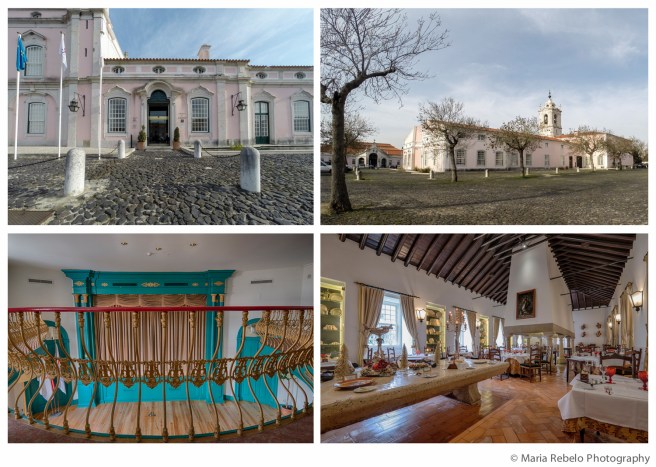
The Queluz pousada

Composit Queluz.JPG

Once upon a time, there was a prince called Pedro who was calm and handsome. As the younger brother of the king, he did not expect to have to perform royal duties. So he devoted his energies to the construction of a palace in the village of Queluz where he could host hunting parties.

The king died and his daughter Maria inherited the throne. Her volatile temperament made many fear for the future of the kingdom. Pedro was asked to marry his niece, so that he could help rule Portugal. The prince accepted this arranged marriage as an obligation. But the queen fell in love with her dashing prince and her devotion was such that he fell in love with her.

The Queluz palace became a royal project, financed by the river of gold and diamonds that flowed from Brazil. A French architect, Jean Baptiste Robillon, was hired to build a palace that would rival Versailles. The original plan was inspired by the harmonious royal marriage: it included two symmetrical buildings that complemented each other.

After the first edifice was built, the royal couple spent as much time as they could at Queluz. They lived a blissful life, surrounded by their six children in one the world’s most graceful palaces.

Before the construction of the second building began, these happy times came to an end: Dom Pedro died of a stroke. The queen never recovered from this loss and her elder son replaced her as the prince regent.

In 1819, to mark the birth of a granddaughter of the old queen, the royal family built the watch tower of the second building planned for Queluz. Later, a private theater and servant quarters were later added to the tower.

In 1995, the watch-tower building and the old palace kitchen were converted into an historical hotel called Pousada Dona Maria I.

If you’re planning to divide your time between Lisbon and Sintra, Queluz is a superb location. You can wake up in the morning to the singing of birds, enjoy a wonderful breakfast, and walk to the Queluz palace before other visitors crowd in. You can drive or take the train to Lisbon (12 km) or Sintra (16 km). And return in the evening to this enchanting place that preserves the romance and splendor of an age gone by.


The Pousada Dona Maria I is located at Largo do Palácio Nacional, Queluz, tel. 351 21 435 6158. Click here for the pousadas’ website and here for a large collection of photos of the hotel.

Ephemeral gardens in Viseu

OLYMPUS DIGITAL CAMERA

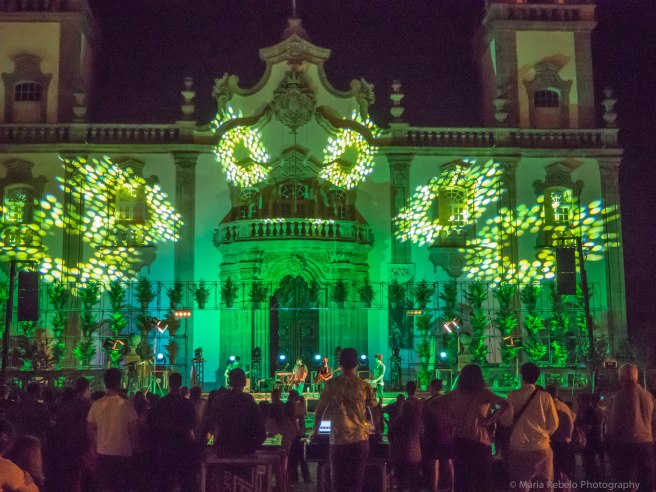
Every year, the Ephemeral Gardens festival jolts Viseu, a serene city in the interior of Portugal. Sandra Oliveira organizes this grand event, inspiring a large troupe of collaborators to adorn Viseu with modern art and serenade it with contemporary music.

Shops become installation spaces, ancient churches double as music venues, old walls serve as canvases for street art. Every plaza seems to have its own DJ, every garden its own sculpture show.

Stores, bookshops, restaurants, and bars stay open until late. The flowers of the linden trees blend their fragrance with the aromas of chocolate, vanilla and popcorn. There are workshops to attend, movies to watch, performances not to miss. It is a wonderful celebration of the many ways in which the old inspires the new.

The Ephemeral Gardens (Jardins Efémeros) festival runs from July 1 to 10, 2016. All events are free. Click here to see the program. 

A cheese revolution

Composit Queijaria 2016

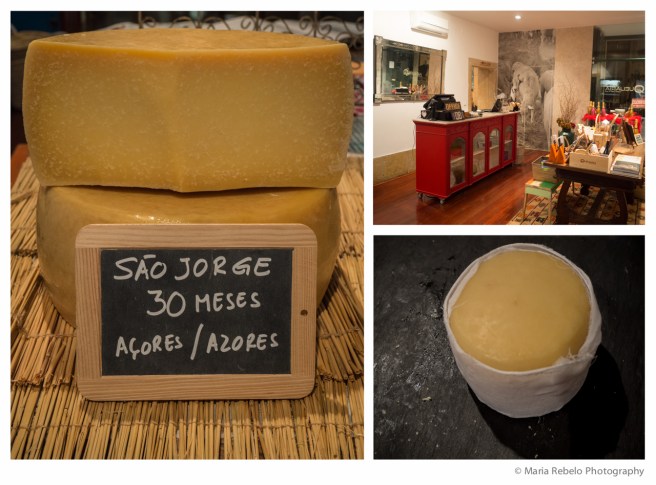
Queijaria, our favorite cheese store in Lisbon, keeps getting better. It is a place where the ordinary is banned to make room for extraordinary artisanal cheeses made in small batches by traditional producers.

On our last visit Pedro Cardoso, one of the owners, invited us to taste two unique cheeses. The first was from São Jorge, an island in the Azores archipelago. It is made with the milk of happy cows that roam free on the island. São Jorge cheese is always delicious but this one was the best we ever had–sharp, peppery and full of flavor. “This cheese is aged for 30 months which makes all the difference. It is very hard to find because the production is tiny and almost all consumed locally,” said Pedro.

The second cheese was from Serra da Estrela. It melted in our mouths leaving an amazing buttery after taste. It is made with milk from “bordalesa” sheep. This breed is being replaced with sheep whose milk is less flavorful but more abundant. “Eating this cheese is an act of defiance. It is saying that we don’t want this wonderful taste to disappear; that quality trumps quantity.”

Pedro speaks with revolutionary zeal. He wants to preserve and enrich Portugal’s wonderful cheese heritage. Will you support his cause?

Queijaria is in the Principe Real neighborhood at Rua do Monte Olivete, 40, tel. 21 346 0474. Click here for their web site.


Bussaco’s mystical wines

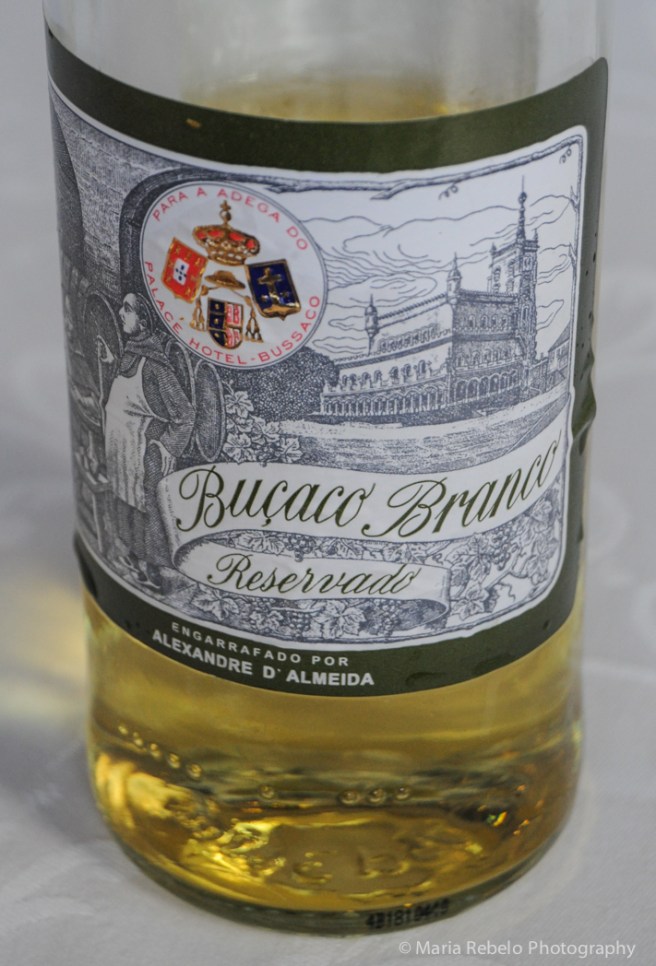
Buçaco Branco

Karl Baedeker, the famous guidebook writer, recommended a visit to Bussaco in his “Spain and Portugal, a Handbook for Travelers,” published in 1908. Here’s what he wrote:

“The royal domain of Bussaco vies with Sintra in natural beauty. In variety of trees and shrubs, the woods are without a rival in Europe and the views ranging from the Atlantic to the Estrela mountain are as picturesque as they are extensive. […] The woods […] include not only trees indigenous to Portugal but also a large number of exotic varieties, some brought home by the Portuguese navigators as early as the 16th century.”

Baedeker arrived too early to appreciate one of the great pleasures of Bussaco, which is the wine produced by the Bussaco Palace Hotel. The first bottles date back to 1917.

The Palace Hotel owns no vineyards, it buys its grapes from the Bairrada and Dão region. The quality of the wine comes from the careful grape selection and the meticulous traditional methods used in production. Bussaco wines taste great when they are young and taste even better when they lived for some decades. Both whites and reds are famous for their longevity.

These wines are difficult to buy, the easiest way to try them is to stay at the magnificent Palace Hotel. The cellar of the palace stores thousands of bottles going back to the 1920s. Trying these old Bussacos can be a mystical experience. The cellar walls are used to hearing visitors say words like divine, blessed, and sacred. These words would have delighted Friar João Batista, the Carmelite monk who started making wine in Bussaco in the 17th century.

Click here, for the Bussaco Palace web site.

Portuguese pop art

RBD_Pastéis de nata edit
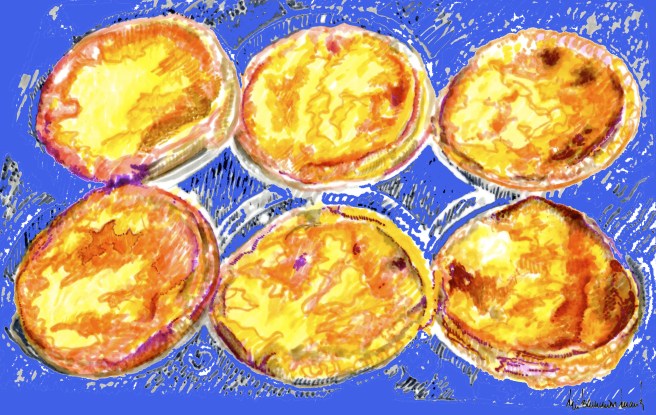
Pasteis de nata, Rui Barreiros Duarte, ink on paper, 2014.

Andy Warhol captured the essence of American culture using simple images: the appeal of convenience with cans of soup, the allure of fame with portraits of Marilyn Monroe, the love of brands with bottles of Coca Cola.

We wonder how Warhol would have captured the essence of Portugal. A good candidate image is the pastel de nata. It is sweet, with an exotic touch lent by vanilla and cinnamon. The crust gives it substance and the combination is unforgettable.

A school lunch

OLYMPUS DIGITAL CAMERA

In 1940, the Portuguese government announced its “centennial plan,” a program to build a large number of primary schools. The schools in the north of the country, designed by Rogério de Azevedo, look austere with their granite and schist exteriors. The schools in the south, designed by Raul Lino, have graceful arches and whitewashed walls. Both designs used elements of the vernacular architecture and became integral parts of the Portuguese landscape.

With the number of children in decline, some of these schools have been closing. The school in the village of Cachopos near Comporta in Alentejo closed in the late 1990s but found new life as a restaurant appropriately called A Escola (the school).

The building is located in a beautiful woodland. Our arrival was greeted by the chirping of birds and perfumed by the scent of eucalyptus.

As we sat at the table remembering learning the three Rs, a plate of marinated rabbit and a carrot salad arrived. The menu has lots of great offerings, including cuttlefish rice with shrimp, fried eels, pasta with sea bass, stewed partridge, and rabbit pie with pine nut rice. The portions are generous and the food is delicious. A Escola is a great place to enjoy the simple, hearty cuisine of Alentejo.

On the school wall there’s an old map of the Portuguese empire. Those vast possessions of land and sea are long gone. But the empire of the senses–Portugal’s wonderful culinary tradition–continues to thrive.

A Escola is located at Estrada Nacional 253, Cachopos, Alcácer do Sal, tel. 265 612 816.


The great Vasco

OLYMPUS DIGITAL CAMERA

Vasco Fernandes worked as a painter in Viseu during the first half of the 16th century. His prodigious talent earned him the nickname Grão Vasco, the great Vasco. According to legend, he once painted a fly that looked so real that his apprentices tried to shoo it away.

It is easy to believe this story when you’re standing in front of his masterpiece, a painting called Saint Peter that is the crown jewel of Viseu’s Grão Vasco Museum. The intricate architectural elements and background scenes are influenced by the work of Italian, German and Flemish painters. But the pope’s rugged face and gentle look are Portuguese.

Who was the model for the painting?  We like to think that it was a shepherd from the Estrela mountain. That the great painter trusted the keys of heaven to someone who on earth lived a simple life.

The Grão Vasco museum is located at Adro Sé in Viseu, tel 232 422 049.


Liquid inspiration

Ginginha

“Com elas ou sem elas?” with or without, asked the waiter as we got to the front of the line at “A Ginjinha,” a small bar in Lisbon’s Largo of São Domingos. “With” we answered. He nodded with approval, picking up a bottle with a cherry infusion to pour the liquid into a small glass, deftly lifting a wood stopper to let a single cherry go by.

The bar’s specialty is a delicious liqueur called “ginjinha” made of sour cherries. It is produced in the nearby village of Arruda dos Vinhos and bottled under the brand Espinheira. The name is a tribute to Francisco Espinheira, the monk who, according to legend, had the brilliant idea of macerating sour cherries (ginjas) in brandy, sugar, and cinnamon.

A Galician entrepreneur opened the bar in 1840 to serve ginjinha to the public. Five generations later, the bar still belongs to his family.

Fernando Pessoa, the great poet, was a regular customer at A Ginjinha.  What a privilege it is to drink from the same source of inspiration!

A Ginjinha is located on Largo de São Domingos, 8, Lisbon.