A diamond house

Casa dos Bicos

Casa dos Bicos is famous for its pyramid-stone facade. Brás de Albuquerque built the house in 1523 with the riches accumulated by his father, the Viceroy of India, Afonso de Albuquerque.

Like so many other homes, Casa dos Bicos was severely damaged by the earthquake that hit Lisbon on November 1, 1755. The house’s first two floors were restored after the quake, but the top two floors were rebuilt only in the 20th century.

In a poetic twist of fate, Casa dos Bicos became the headquarters of the José Saramago Foundation. Saramago received in 1998 the Literature Nobel prize for his brilliantly original novels. So, a house built with the spoils of imperial conquests is now devoted to celebrating a writer’s feats of imagination. Is the pen mightier than the sword?

Casa dos Bicos is on Rua dos Bacalhoeiros, near Terreiro do Paço. Click here for the José Saramago Foundation web site.

Jazz in Lisbon

Hot Club-Lisboa_787The Hot Club of Portugal is a famous gathering place for lovers of improvised music. The club, founded by Luiz Villas-Boas in 1948, has welcomed many renowned musicians, including Count Basie, Dexter Gordon, Max Roach, and Sarah Vaughan. The Hot continues to thrive, hosting regular performances by a new generation of jazz artists.

If you’re visiting Lisbon and you enjoy live jazz, head to the Hot Club and watch what happens.

The Hot Club is at Praça da Alegria, 48, Lisbon, tel: 213460305. Click here for the club’s web site.

A famous beach house

CasaBranca

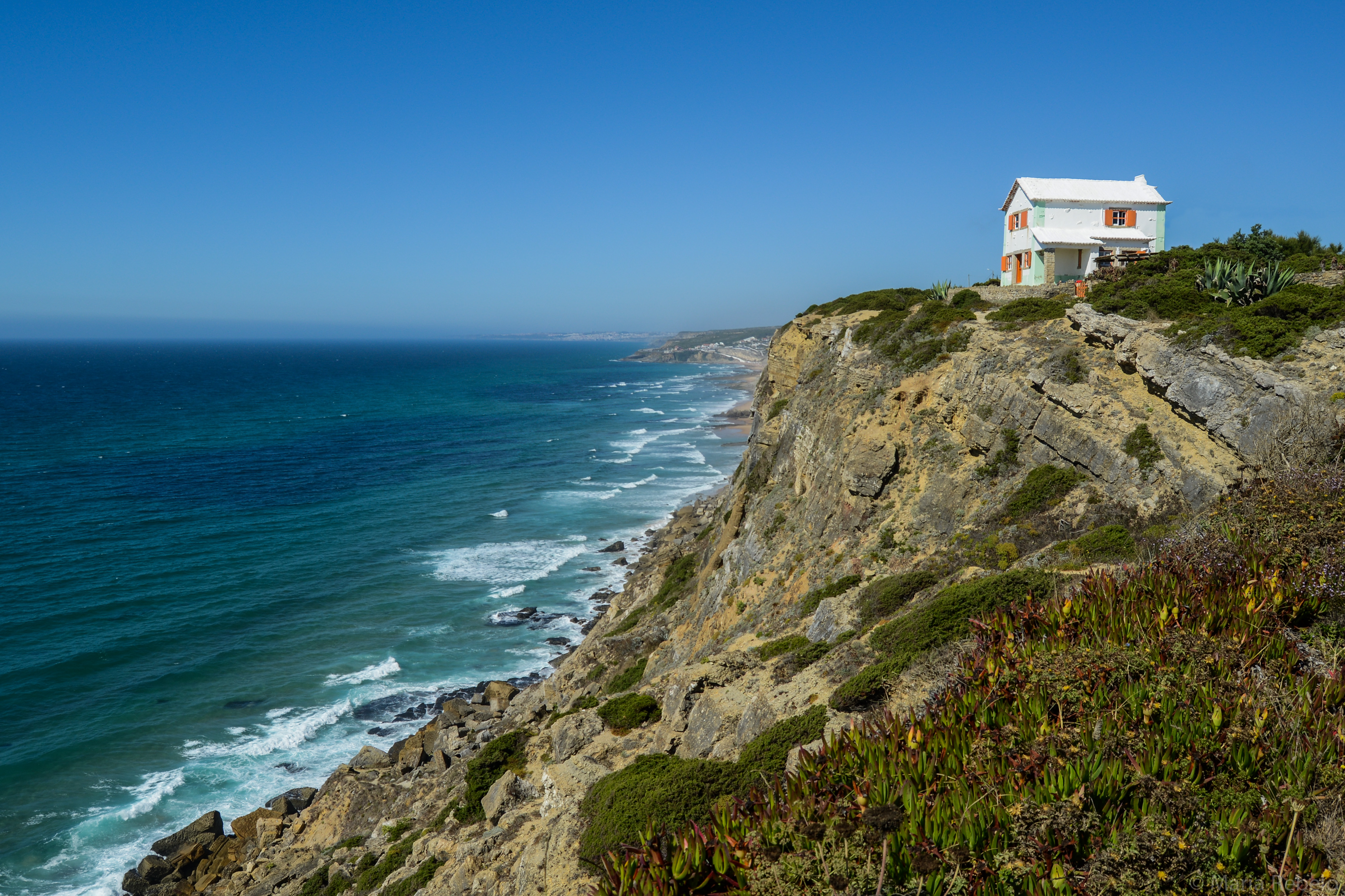
One of the most famous beach houses in Portugal is Casa Branca (white house) in the village of Azenhas do Mar. Architect Raul Lino designed it in 1920 to be his Summer home. Lino had to choose between building within the village perimeter to gain access to electricity and running water, or to forego these modern comforts and place the house on a cliff with an incredible ocean view. For him, the choice was obvious.

Raul Lino is famous for synthesizing the vernacular traditions that go back to Roman times to create the archetypal Portuguese house. The Casa Branca is based on this archetype, but Lino made two surprising choices. Instead of using the traditional green color for the windows, he chose bright orange. Then, he painted the orange roof tiles white, thus accentuating the orange of the windows.

Orange is the complementary of blue and so the windows of Casa Branca became the complement of the sea. It’s as if, to be beautiful, the sea needs someone admiring it from the window.

The place to ask

AzenhasMar2

On the steps of the stairs that lead to the lookout point at Azenhas do Mar, gently inscribed in white chalk, are the words: “eu vou casar contigo” (I’m going to marry you).

Was this promise well received? Did they exchange wedding vows and live happily ever after? We’ll never know. What we do know is that Azenhas do Mar is a perfect place for a marriage proposal.

A village by the sea

AzenhadoMar

The French use the expression “village perché” to describe a village on top of a hill, overlooking the surrounding landscape.  One of the prettiest village perchés in Portugal is Azenhas do Mar. Built on a cliff in the Colares region near Sintra, it has amazing views of the Atlantic ocean.

If you rent a house in Azenhas do Mar, you can spend the day listening to the waves and watching the sea try different shades of blue and green. It’s a very fine use of time.

Romantic lakes

Lagoa 7 cidades

Azores, a Portuguese archipelago, is a place of immense beauty. One example of the rare gifts that nature bestowed on Azores is the Lagoa das Sete Cidades (seven-cities lake) in the São Miguel island. It consists of a green and a blue lake located inside an ancient volcano.

According to a local legend, there was a princess with green eyes who fell in love with a shepherd with blue eyes. When the king did not approve their marriage, the princess and the shepherd cried and cried. Their love bore no fruit but their tears formed two adjacent lakes, one green and one blue.

Nannarella

Nannarella

Why would an Italian couple move with their children from Rome to Lisbon to open a gelato store? And why would they name it after a 1950s actress that no one remembers? We don’t know, but what’s important is that they came.

They use Italian technology and the best Portuguese ingredients, such as water from the Estrela mountain, Vigor milk, Delta coffee, Pantagruel chocolate, rocha pears, Port wine, and Óbidos ginja. The result is gelato so indescribably delicious that we feel the urge to sing: con Nannarella la vita è bella!

Nannarella is located on Rua Nova da Piedade, 68 in Lisbon in the Principe Real neighborhood.

A great start

Tartine

Any nutritionist will tell you that breakfast is the most important meal. It gets our body ready and sets the mood for the day. A lousy breakfast is like a bad haircut, it makes us look weird and feel awkward.

If you’re staying near Chiado, you can start your day with the right foot by walking into Tartine, a wonderful new café. We like to order coffee with toasts made from one of the delicious whole grain breads that are so healthy. After being nutritionally savvy, we reward ourselves with one of the amazing pastries or fruit tarts. When we walk out, the sun is shining and the future looks bright.

Tartine is located on Rua Serpa Pinto, 15-A, tel 21-342-9108. Click here for their web site.

Flying over Lisbon

Bartolomeu Gusmão, a priest born in Brazil in 1685, was probably the first human to fly. On August 8, 1709, in the presence of King John V and his court, Gusmão soared four meters above the ground, held by a paper balloon full of hot air.

This moment of triumph was followed by years of failure and disappointment. Gusmão worked tirelessly on an airship called Passarola. He planned to fly it over Lisbon, but his invention never left the ground. Gusmão’s contemporaries considered him a fool for thinking that a heavy machine could fly. What would they say if they saw us land in Lisbon aboard a modern version of the Passarola?

The most beautiful esplanade in Lisbon

DSC_9092F

Ribeira das Naus is the place where the caravels were once built and repaired. These ships sailed as far as Goa and Cochim in search of cinnamon and other spices. Lisbon has recently transformed the Ribeira das Naus site into a wonderful promenade that extends from Terreiro do Paço to Cais do Sodré.

The part of the promenade close to Terreiro do Paço, has a beautiful esplanade. Here, you can drink a cup of coffee and eat a “pastel de nata” while enjoying the wonderful river view. Don’t forget to ask for a sprinkle of cinnamon on your pastel, for old time sake.