The Art of Savoring Port Wine

António Magalhães closed his lecture on the Douro’s grape varieties with a provocative question: “But who can hope to understand so many grapes without tasting Port?”

Port wine is the ultimate expression of the vineyards of the Douro Valley. As scholar Alfredo Guerra Tenreiro famously observed, “There is a uniqueness in the Douro climate that one can recognize and feel in the uniqueness of Port wine.” 

Here are António’s recommendations for enjoying Port wine at its best.

Five Golden Rules

1) Choose the proper glass
A classic white wine glass made of thin glass is ideal for Port. It lifts the aromas, focuses the flavors, and makes every sip a celebration.

2) Serve Port properly chilled
The ideal serving temperatures for each style of Port are:
• White Ports: 6–10 °C (43–50 °F)
• Tawnies: 10–12 °C (50–54 °F)
• Rubies: 12–16 °C (54–61 °F)

Once opened, White Ports and Tawnies should be stored in the refrigerator door. Ruby Ports, especially Vintage Ports, are best enjoyed soon after the cork is pulled. 

The British have a tradition of passing the Vintage Port bottle or decanter from right to left, keeping it in motion. If someone forgets, the other guests often ask, “Do you know the Bishop of Norwich?”—a nod to Henry Bathurst, the early-19th-century bishop known for dozing off at dinner and neglecting to pass the Port.

3) Keep a 20-Year-Old Tawny in the refrigerator
Tawnies are generally crafted from wines of various harvests, aged patiently in oak casks until the perfect moment for blending and bottling. A 20-year-old Tawny brings together wines with a weighted average age of twenty years, creating an alchemy of time and winemaking artistry. António’s longtime favorite is the magnificent Taylor’s 20-Year-Old Tawny Port.

4) Always decant Vintage and Crusted Ports
Vintage Ports are bottled without filtration, which allows them to continue evolving in the bottle. Over time, sediment naturally accumulates. Decanting separates the clear wine from this sediment—harmless, yet coarse and unwelcome in the glass. It also allows the wine to breathe, letting oxygen gently soften its structure and release its full array of aromas.

When Port was shipped in barrels, British merchants crafted Crusted Ports by blending more than one Vintage, aging the wines in large wooden vats, and bottling them unfiltered for cellaring. After Portugal banned bulk exports of Vintage Port in 1974 (extended to all Ports in 1997), this style became rare. Today, only a few houses, like Fonseca, continue the tradition. Like Vintage Ports, Crusted Ports develop a natural “crust” as they mature and should always be decanted before serving.

5) Port is to be shared
Port invites conversation and brings out sincerity. Violette Toussaint, the unforgettable protagonist of Valérie Perrin’s Fresh Water for Flowers, put it best: “My port wine has the same effect on everyone. It acts like a truth serum.”

How to Decant a Vintage or Crusted Port at Home

The day before serving, select the bottle you wish to open and stand it upright so the sediment can settle at the bottom. Leave it somewhere convenient—on a sideboard or on the kitchen counter.

Use a suitable corkscrew; a two-pronged cork puller is ideal for opening older bottles, whose corks are often fragile. Once opened, pour the wine slowly into a decanter or glass jug. 

Strain the wine through a small flannel filter to ensure perfect clarity. Take a moment to taste the wine and enjoy that first impression.

Rinse the bottle and let it drain completely. Return the decanted wine to the original bottle. Keep the bottle in a cool place and check the temperature before bringing it to the table. If needed, a brief rest, fifteen minutes or so, in the refrigerator door will bring it to the ideal 16–18 ºC, with the higher end recommended for older Ports.

Magical Pairings

White Port

White Port is typically enjoyed as an aperitif and is made in a range of styles, from extra-dry to sweet. Even the sweeter versions remain balanced and never feel cloying on the palate.

There are two production approaches: oxidative and non-oxidative. In the non-oxidative style, winemakers shield the wine from oxygen to preserve its vibrancy. These Ports are bright and citrusy, ideal for the popular Port Tonic cocktail.

In contrast, the oxidative school relies on controlled exposure to air. Depending on the winemaker’s approach, this exposure may begin during fermentation and continue throughout aging in wooden vessels ranging from small casks to larger vats such as toneis and balseiros. Over time, this gentle oxidation deepens the wine’s character, imparting a golden hue and nuanced layers of nuts, caramel, butterscotch, and dried fruits.

António favors the oxidative style. His preferred White Ports, both made from blends that include Malvasia Fina, are the Fonseca Guimaraes Siroco—crisp and extra-dry—and the Ramos Pinto Finest White Reserve, which offers a discreet, delicate sweetness.

White Port pairs beautifully with toasted almonds, especially those from the Douro Superior, and with codfish cakes. It also harmonizes with soft-ripened cheeses, lending a bright acidity that lifts their richness.

Tawny Port

Tawnies pair blissfully with sweet desserts. In the Douro Valley, they are often served with crème brûlée—torched before serving—or almond tart.  Egg pudding and Tawny Port are made for each other; tradition even calls for two glasses of Port instead of one: the first to honor the pudding, and the second to toast the cook who prepared it. 

Another indulgence that pairs perfectly with Tawny Port is Toucinho do Céu (bacon from heaven), a convent sweet made with almonds, egg yolks, sugar, and a touch of lard that lends a soft, velvety texture. Murça, near Vila Real, is renowned for the version created at the Santa Maria Monastery and now made by Casa das Queijadas e Toucinho do Céu. The town is also celebrated for the vineyards that surround it, which produce some of the Douro’s finest white grapes—coveted by both Port and DOC Douro winemakers.

Tawnies also shine alongside nuts, dried fruit, or simply on their own, paired only with the quiet luxury of time and good conversation. 

Ruby Port

Ruby Ports are excellent companions for cured cheeses. Portugal offers a rich array of these cheeses from regions such as the Estrela Mountain near Seia, Serpa in Alentejo, Azeitão near Lisbon, and São Jorge in the Azores.

English Port merchants traditionally pair Ruby Ports, particularly Vintage Ports, with Stilton cheese. Vintage Port is made only in exceptional years, aged in wood for one or two winters, and then bottled to mature slowly and majestically.

For an unforgettable experience, seek out the Vintage Vargellas Vinhas Velhas 2004, crafted in a superb year from a field blend of vines planted soon after phylloxera. António believes old vineyards like the one that produces this wine hold the key to understanding the future of viticulture in the Douro Valley.

Late Bottled Vintage (LBV)

António enjoys pairing LBVs (rubies aged four to six years in oak and then bottled), with chocolate mousse. His favorite mousse replaces butter with extra-virgin olive oil from the Douro Valley. He generously shares his recipe below.

Mousse de Perdição (Sinful Chocolate Mousse)

Ingredients
• 150 g dark chocolate (70% cocoa)
• 100 ml extra-virgin olive oil (preferably from the olive groves that frame Douro vineyards)
• 5 tablespoons sugar
• 4 eggs, with yolks and whites separated

Instructions

1. Melt the chocolate
Break the chocolate into small pieces and melt gently in a bain-marie or in short microwave intervals. Allow it to cool slightly.

2. Add the olive oil
Whisk in the olive oil until the mixture is smooth and glossy.

3. Prepare the yolks
Beat the egg yolks with the sugar until pale and creamy. Fold into the chocolate mixture.

4. Whip the egg whites
Beat the whites until firm peaks form, then gently fold them into the chocolate base, preserving as much lightness as possible.

5. Chill
Spoon into serving cups or a single bowl. Refrigerate for at least 3 hours, ideally overnight.

Enjoy with a perfectly chilled glass of LBV Port.

Maria Doroteia’s famous Douro biscuits

Jorge Seródio Borges and Sandra Tavares da Silva, the husband-and-wife team behind Wine & Soul, craft some of the Douro Valley’s most iconic wines—among them the extraordinary Guru, Pintas, and Manoella Vinhas Velhas. Jorge’s roots in the valley run deep: his family has been making wine there for five generations.

His mother, Maria Doroteia, devoted her life to teaching the children of the Douro Valley how to read and write. She also has a deep love for animals; at 87 years of age, she still tends to ten hens, who reward her with fresh eggs.

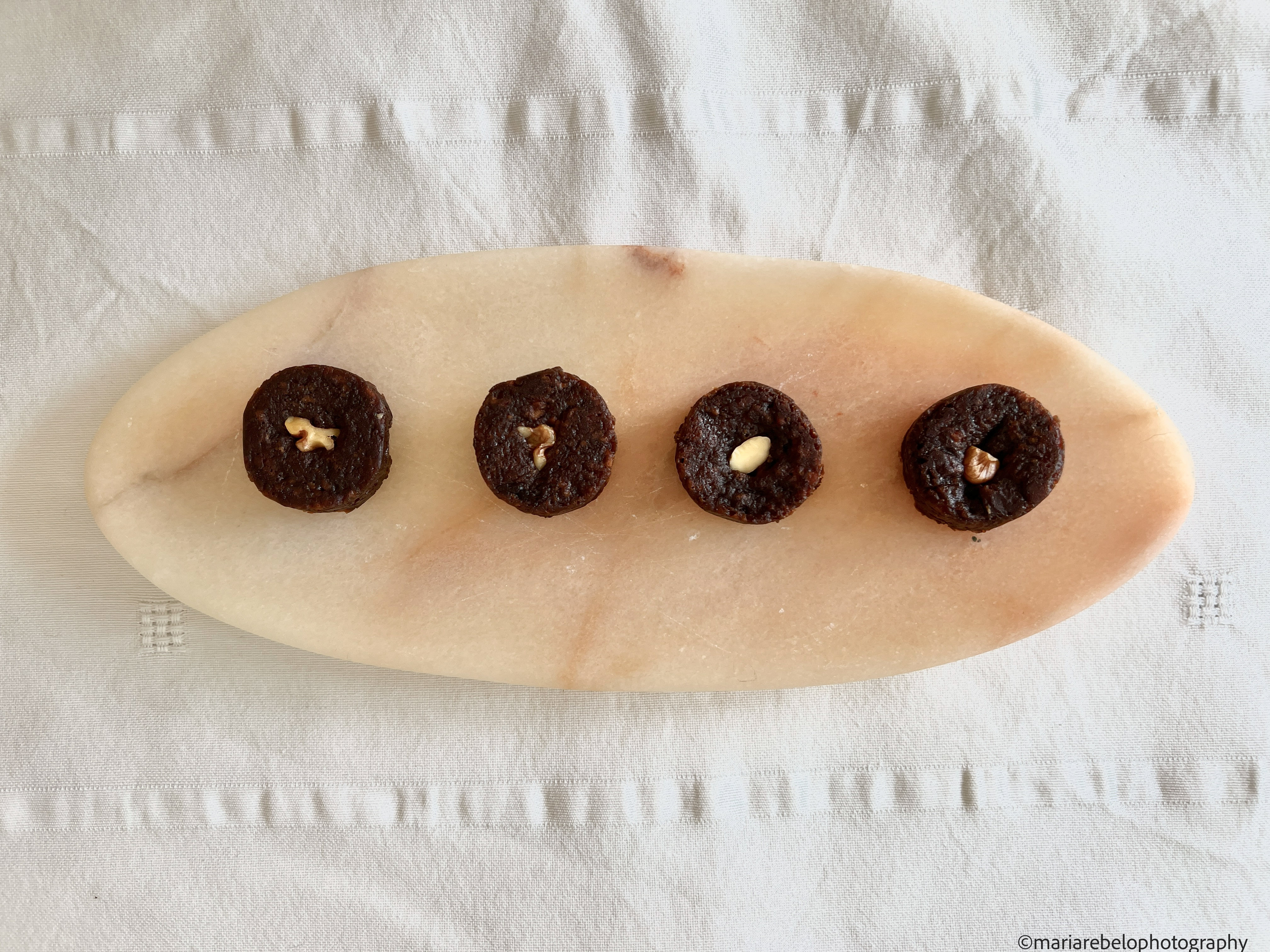
Maria Doroteia is renowned for her cooking. When Jorge and his sister were little, she would bake biscuits and hide them away in tins. As soon as the children caught the first whiff of the delicious aromas, they would set off on a treasure hunt until they found the precious trove of cookies, savoring them with delight.

We recently had the joy of having lunch with Maria Doroteia. With her characteristic generosity, she shared one of her cherished recipes, which we are happy to pass on to you, dear reader.

Douro Biscuits

Ingredients

  • 230 g self-raising flour
  • 200 g sugar
  • 1 egg
  • 80 g butter
  • 90 g cocoa

Instructions

  1. Mix the sugar, egg, and butter.
  2. Add the flour and cocoa, mixing well.
  3. Let the dough rest for 90 minutes to 2 hours.
  4. Roll out on a marble surface until paper-thin.
  5. Cut with a cookie cutter and bake at a low temperature until crisp.
  6. Store in a tin and hide it well! 

A fisherman’s stew

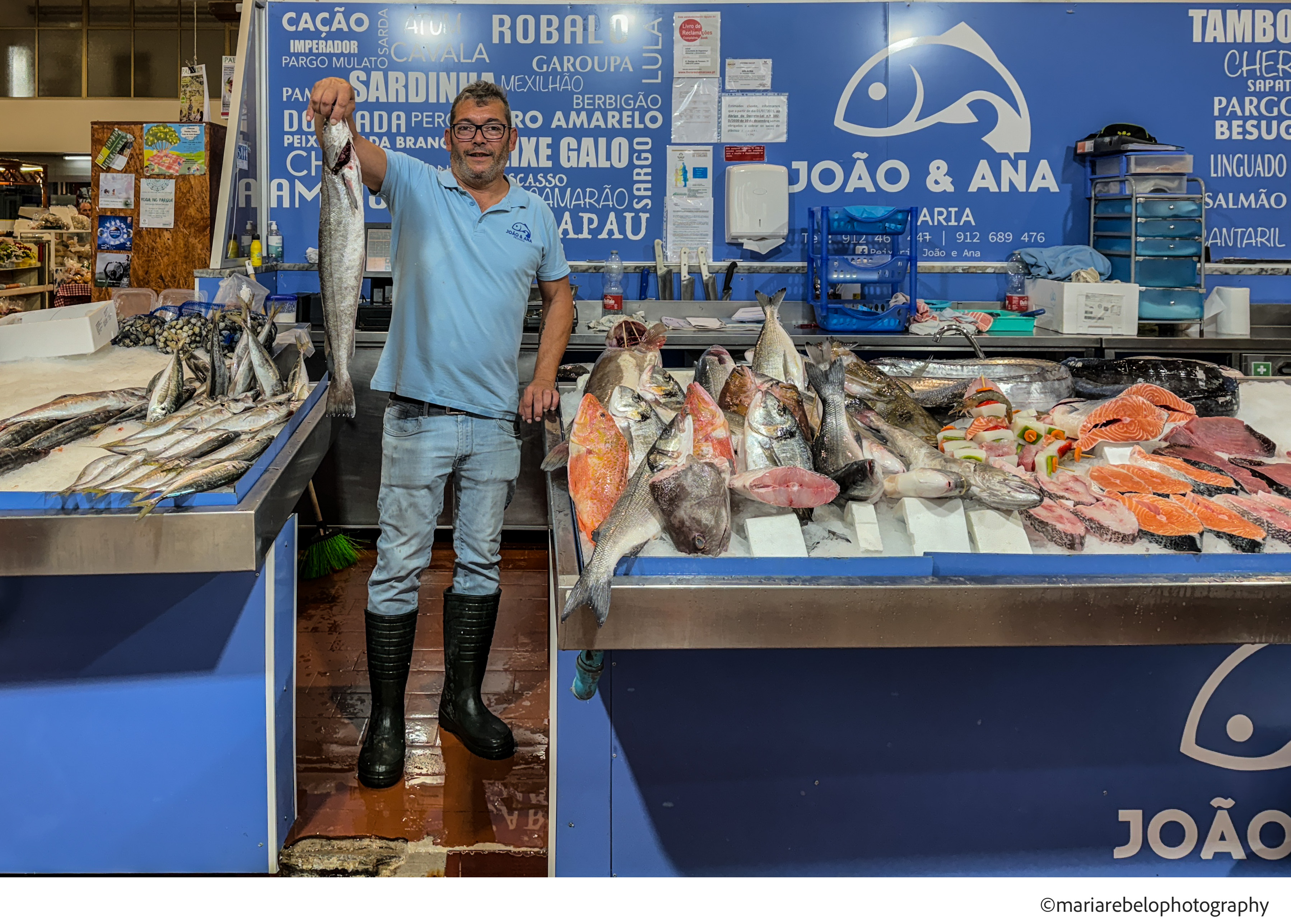
João Branco owns a fish stall in the Lourinhã market where he sells the freshest fish and finest seafood. He knows a lot about the fruits of the sea because his family has been in the fish business for nearly a century–both his mother and grandmother were fishmongers.

João shared a story about a couple who had friends coming over for a “caldeirada,” a traditional fish stew, but had never prepared it before and found the task daunting. João reassured them, saying, “No worries. Bring me a large pot, and I’ll prepare everything. All you need to do is put it on the stove until it’s cooked.” The next day, the customers called to tell João that their guests thought it was the best caldeirada they’d ever had. Whenever their friends return for the famous caldeirada, João prepares the pot, ensuring success every time. João generously shared his recipe with us so you, too, can impress your friends.

João Branco’s Fisherman Stew

João only uses fish without scales because finding scales in the stew can detract from the culinary experience. He also advises against using sardines because their strong taste can overpower the other fish. João does not use laurel because it can also overshadow the delicate flavors of the fish.

He arranges the vegetable layers at the bottom of the pot and places the fish on top. This technique allows the fish to cook in steam, ensuring it is ready at the same time.

Ingredients:

  • Olive oil (100 ml)
  • 2 sliced onions 
  • 4 minced garlic cloves
  • One sliced red pepper 
  • One sliced green pepper
  • 2 ripe sliced tomatoes
  • 500 grams of sliced potatoes 
  • A teaspoon of smoked paprika
  • Cayenne pepper
  • White wine (100 ml)
  • Beer (100 ml)
  • Parsley
  • Coriander
  • Salt
  • Navalheiras (small crabs, cut in half, optional)
  • Shrimp (optional)
  • Squid or cuttlefish (optional)
  • One kilogram of assorted fish including tamboril (monkfish), safio (conger eel), raia (skate), and cação (dogfish).

Instructions:

  1. Choose a pot large enough to accommodate two or three layers of potatoes and the fish.
  2. Wash all the ingredients.
  3. Cover the bottom of the pot with olive oil.
  4. Add a layer of sliced onions, garlic, tomatoes, and red and green peppers.
  5. Add a layer of sliced potatoes.
  6. Repeat the layers of onions, garlic, peppers, tomatoes, and potatoes.
  7. Place the fish on top of these layers, ensuring it cooks in the steam from the layers below.
  8. Drizzle the white wine and beer on top of everything. 
  9. Season with salt, smoked paprika, and cayenne pepper.
  10. Optionally, you can add navalheiras (small crabs) cut in half for extra flavor. You can also add some sliced cuttlefish or squid and top the fish with shrimp. The shrimp cooks faster than the fish. Once it is cooked, remove the shrimp, peel it, and serve it with the stew.
  11. Cover the pot and cook over medium heat. You don’t need to add any water because the vegetables naturally release plenty of it.
  12. Season with parsley and coriander before serving.

If preparing this delicious stew feels like too much work, bring a large pot to the Lourinhã market and ask João if he’ll prepare it for you.

Madeira’s honey cake

The origin of the honey cake remounts to Madeira‘s “white gold” era. This period began in the 15th century when Henry the Navigator brought sugar cane from Sicily to plant in Madeira. The island became Europe’s main sugar supplier until the first half of the 16th century when Brazil took over this role. 

The honey cake recipe has been refined over the years. Despite its name, the cake does not contain honey. It combines flour, yeast, nuts, dried fruit, spices, and Madeira wine with sugar cane molasses, known in Madeira as sugar cane honey. 

The molasses imparts a rich flavor and contributes to a long shelf life–the cake lasts about a year. Historically, these cakes provided sailors with a sweet reminder of home during lengthy sea voyages.

Ringing in the New Year with a slice of Madeira honey cake is a delightful experience.

Below, we share a version of the recipe created by the great Maria de Lurdes Modesto. It takes more than a week to make a Madeira cake. But there’s an easier way to taste this wonderful dessert: visit Madeira in 2024!

We wish you a happy New Year that is as sweet as a Madeira honey cake.

Madeira’s honey cake (recipe by Maria de Lurdes Modesto)

Ingredients

  • Wheat Flour: 160g
  • Baker’s Yeast: 5g
  • Lukewarm Water: 0.25dl
  • Lard: 200g
  • Butter: 125g
  • Cane Honey: 450ml
  • Flour: 465g
  • Sugar: 250g
  • Orange Zest and Juice: From one large orange
  • Walnuts (Chopped): 250g
  • Almonds (Chopped): 75g
  • Fennel Seeds: 10g
  • Cinnamon: 20g
  • Cloves: 5g
  • Sweet Madeira Wine (Bual or Malmsey): 1 tablespoon
  • Additional Decorations: Walnuts, citron (optional), almonds
  • Grease: For the baking pans

Preparation

Start a day before baking. Prepare the yeast mixture with 160g of wheat flour, 5g of baker’s yeast, and 0.25dl of lukewarm water. Mix well, cover, and leave in a warm, draft-free area.

On the day of baking

Gently melt 200g of lard and 125g of butter in a saucepan. Once melted, add 450ml of cane honey.

Sift 465g of flour with 250g of sugar into a large bowl (traditionally an “alguidar”). Make a well in the center. Pour the prepared yeast mixture into the well. Add the melted fats and honey (which should now be warm) to the well. Start mixing the ingredients. Add the zest and juice of one large orange. Knead well until the dough is smooth and lump-free.

Mix in 250g of chopped walnuts, 75g of almonds, and 12g of citron (called cidrão in Portuguese, it is a citrus fruit often candied and used in cakes like Bolo Rei). Add the spices: 10g of fennel seeds, 20g of cinnamon, and 5g of cloves. Stir in a generous tablespoon of sweet Madeira wine. Knead the mixture thoroughly by hand. Cover the bowl and place it in a warm, draft-free spot.

Let it rest for 2 to 4 days. After the resting period, portion the dough into 250g or 500g amounts, depending on the desired size of the cakes. Use round, shallow, well-greased baking pans without a hole in the center. Decorate the cakes with walnuts, citron (if available), and/or almonds.

Preheat the oven to 190°C (approximately 374°F). Bake for about 30 minutes or until done. Place the baked cakes on wire racks to cool. Once cooled, cover them with a cloth and let them rest for 2 to 3 days. Finally, wrap the cakes in parchment paper and store them in airtight containers.

A potato called raíz de cana

On the night before Christmas, Portuguese tables are graced with food from near and far. Local staples like cabbage and olive oil accompany codfish from the icy waters of Norway, Iceland, and Newfoundland. Potatoes, originally brought from South America in the 16th century, are a mainstay of the culinary feast.

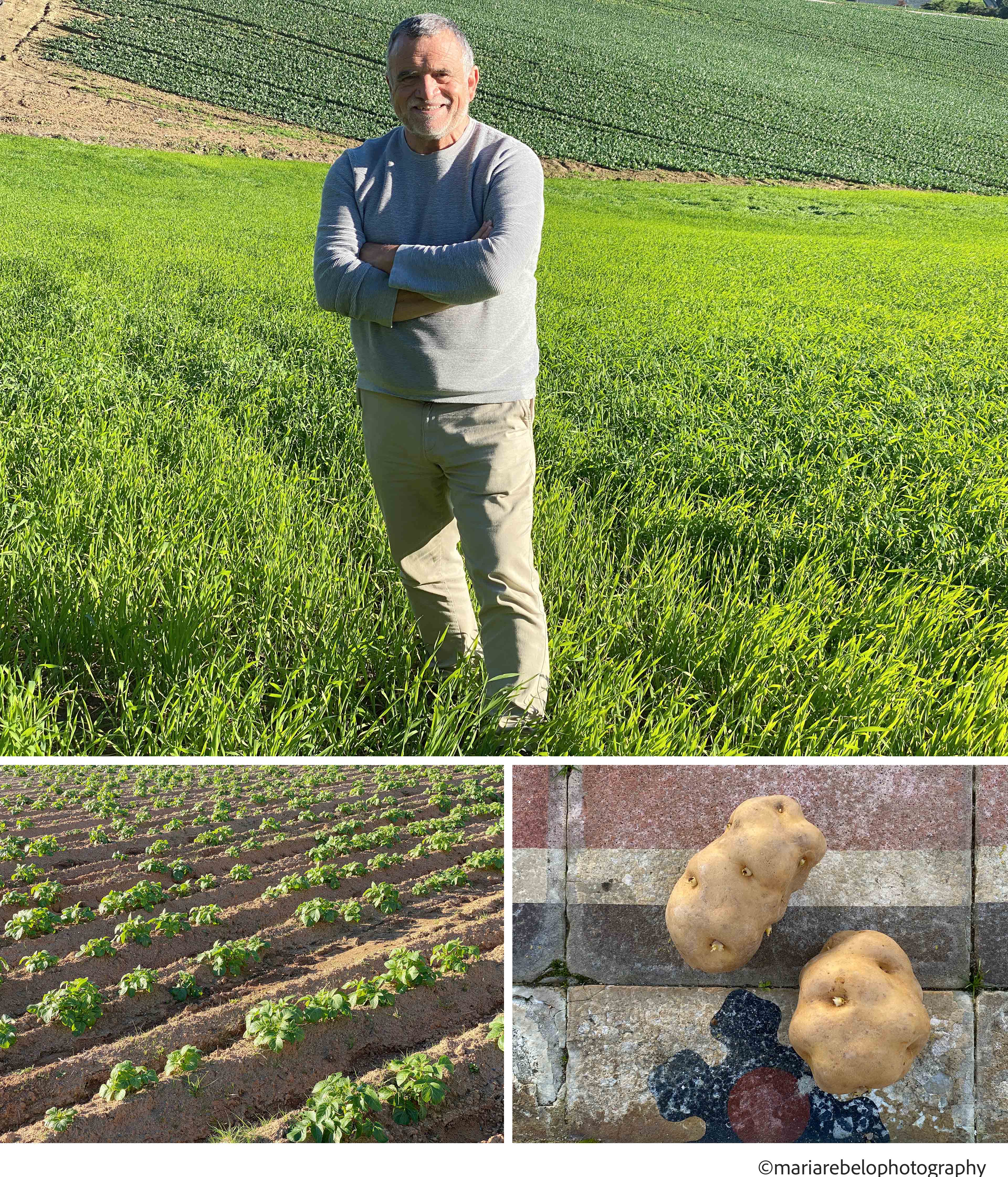
It is thought that the first potato planted on Portuguese soil was “raíz de cana.” It became popular on the west coast of Portugal because its firm texture makes it ideal to use in fish stews or cook with salted skate, a local delicacy.

Raiz de cana has an irregular shape that makes it difficult to peel, so over time, it lost favor with cooks. It might have vanished if it weren’t for Raul Reis, an entrepreneur who moved from Luxembourg to Sobral, near Lourinhã. He discovered raíz de cana in a small village called Cesaredas and began cultivating it. Thanks to Raul, these potatoes are now featured in Portugal’s finest restaurants.

João Rodrigues, a famous Portuguese chef, liked raíz de cana so much that he created some recipes that showcase it. One of them is the recipe for potato salad we share below. 

You can try the recipe with another potato variety or visit João Rodrigues’ new restaurant in Lisbon (Canalha) to taste the real thing!

Potato salad

Ingredients

  • 8 raíz de cana potatoes
  • 2 large pickled cucumbers (cornichons)
  • One rose onion
  • 3 tablespoons of chives
  • One egg
  • ½ garlic clove
  • Sweetened yogurt
  • 1 tablespoon of mustard
  • Water from the pickles
  • White wine vinegar
  • Sunflower oil
  • Salt
  • Fleur de sel
  • Pepper
  • Olive oil

Preparation

  1. In a glass, combine the egg, mustard, sunflower oil, olive oil, and vinegar. Use an immersion blender to mix everything very slowly and thoroughly.
  2. Season the mixture with salt and pepper.
  3. Add yogurt, grate the garlic into it, and put in a little bit of the pickle juice to taste. Mix everything well.
  4. Thoroughly wash the potatoes with their skins on.
  5. Place the potatoes in a pot with cold water and salt, then bring them to a boil to cook.
  6. Once cooked, remove the potatoes, peel them, and season with olive oil and fleu de sel.
  7. Cut the potatoes in halves and arrange them on a serving dish.
  8. Top the potatoes with the previously prepared mayonnaise.
  9. Finish by sprinkling chopped red onion, cucumber pickles, and chives over the top.

The professor’s partridges

The best partridges we ever tasted were cooked by a professor. His name is Emídio Gomes. He is the rector of the UTAD, the university that trained many of the star enologists who work in the Douro valley. 

Emídio learned to cook while studying in France on a meager scholarship. He asked his grandmother to teach him some of her recipes so that he could eat at home. Cooking was so relaxing that he continued to cook regularly after returning to Portugal.

Emídio’s stewed partridges are renowned throughout the Douro valley. The professor generously gave us his grandmother’s recipe and allowed us to share it with our readers. 

The recipe starts with an admonition: “If the partridges are good, make sure you don’t ruin them.” Here’s the rest. 

Remove the feathers and the tripes of the wild partridges and cut them into pieces. Marinate them for twelve hours in a small amount of white wine, laurel, parsley, and a little thyme.

Heat a cast iron pot. Pour a generous amount of olive oil. The quality of the olive oil is paramount. Choose an olive oil with low acidity, ideally from the Douro valley. Slice enough onions to cover the bottom 2 inches of the pot. Slowly sweat the onions. Remove the thyme, laurel, and parsley, and place the partridges in the pot. Add a small amount of water to prevent the stew from drying.

Cover the pot with the lid and slowly stew the partridges for four to five hours. Monitor periodically to ensure the stew does not dry; add small amounts of water as necessary. Season with salt towards the end of the cooking period. After the first four hours, regularly pierce the meat with a fork. The partridge is ready when the meat offers no resistance. Serve with white rice and toasts.

Like a top scientific paper, the recipe requires high-quality content and flawless execution. And in the end, the results look deceptively simple.

Marlene Vieira’s Codfish Recipe

The Portuguese culinary tradition does not come from palace kitchens. It comes from the cooking of humble people who, in every season, took the best ingredients that nature offered and prepared them using recipes perfected over centuries. The food presentation is often rustic, but the taste is delicious because everything is harmonious and natural.

Many chefs are reinventing the cuisine of Portugal. But the truth is that there’s no need for reinvention. What we need is an evolution, the creation of new recipes that, like clams Bulhão Pato and Caldo Verde, bring joy to the dining tables of Portugal. Easy to say, but who can do it? 

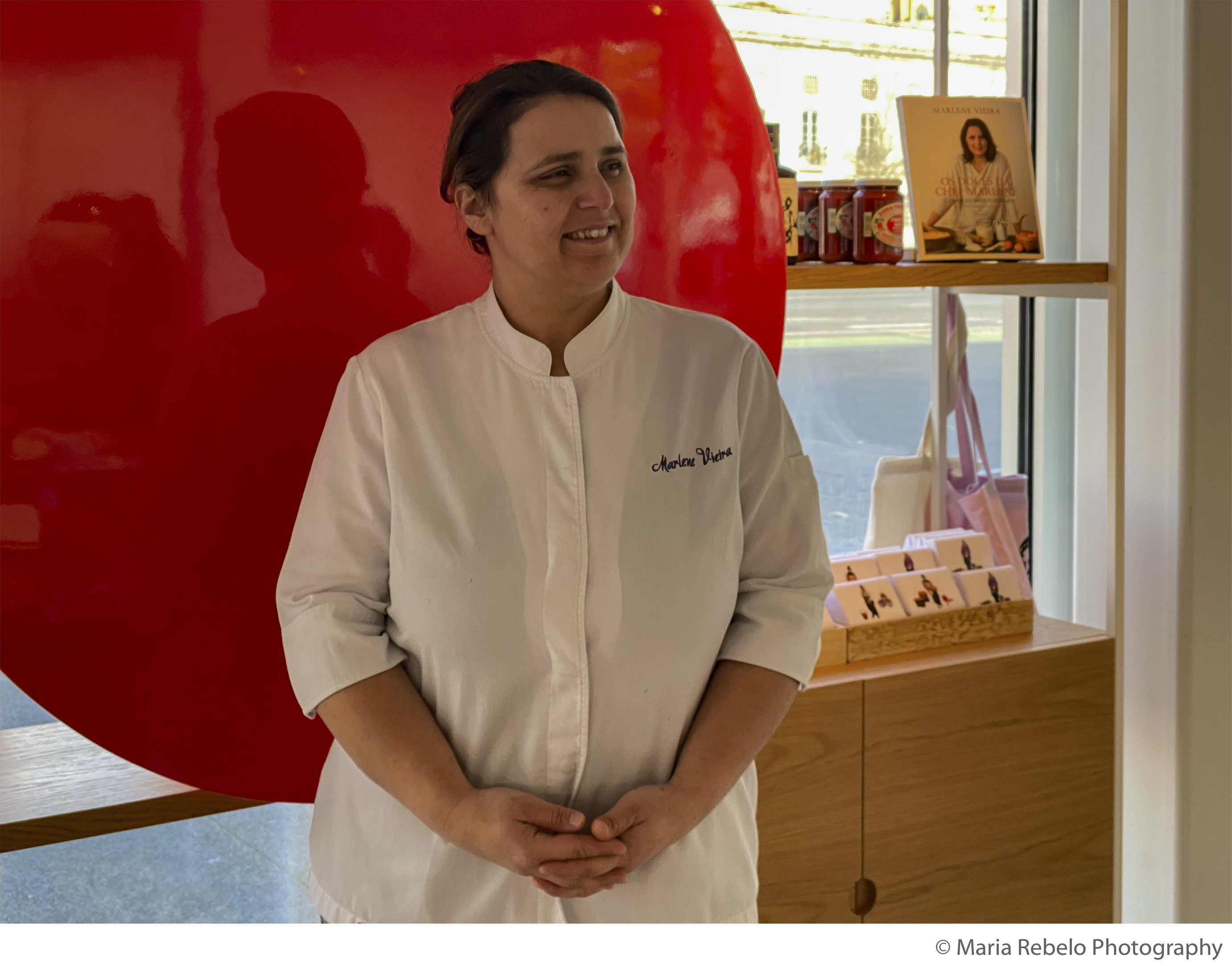
We know one chef who can: Marlene Vieira. Her Zun Zum and Time Out restaurants are indispensable stops in any culinary tour of Lisbon. Her food is creative, not because she wants to surprise or shock. Marlene’s originality stems from her ability to intuit new, delicious ways of preparing Portugal’s great food products. 

Marlene started cooking at age 12. Her father, who owned a butcher shop, took her on a delivery to an Oporto restaurant that served French-inspired food. The chef invited Marlene to sample what they were preparing, and she was hooked. She loved the taste, the refinement, and elegance. Marlene spent holidays and school vacations helping out at the restaurant. She relishes the organized chaos of a professional kitchen, and cooking proved to be an ideal outlet for her bountiful energy. 

At age 16, Marlene went to culinary school. She graduated as the best student and stayed as a teaching assistant, while working as a pastry chef at a boutique hotel. Up to this point, all her cooking had revolved around French techniques. 

At age 20, a friend invited her to work at a Portuguese restaurant in New York. For the first time, Marlene had to cook traditional Portuguese food. She remembered fondly the food that her mother and grandmother prepared, but she did not know how to cook it. More than three thousand miles away from home, this young chef started to study the cuisine of Portugal. And for the first time, she realized that she had a role to play: embrace Portuguese cuisine and make it her own.

Marlene returned to Portugal inspired to learn more about traditional cooking. She continued to work in fine dining, but her cooking became more and more Portuguese. A breakthrough moment came when Time Out magazine chose her dish featuring a large shrimp called “carabineiro” served with an almond brulée as the year’s best recipe. This dish has the hallmark of Marlene’s cooking: it draws on combinations of ingredients and techniques that are hard to envision but feel utterly natural once you try them. 

We asked Marlene whether she could share a recipe with our readers. She generously gave us a codfish recipe. 

Portugal has many codfish recipes, but only a few have stood the test of time, like those of Brás, Zé do Pipo, and Gomes de Sá. Perhaps one day, this recipe will be known as Codfish Marlene. Enjoy!

Codfish Confit with Sweet Potatoes Gnocchi, Low-temperature Egg, and Pea Emulsion

Ingredients for four people

600 grams of codfish filets

2 garlic cloves

1 laurel leaf

400 grams of sweet potatoes

5 eggs

100 grams of flour

70 grams of onion

70 grams of leaks

300 grams of peas

Microgreens for garnish

3 deciliters of olive oil

200 milliliters of whole milk

Sea salt

Preparation

Pre-heat the oven at 150 ºC.

Clean the codfish fillets, removing the bones. Divide into 12 portions. Smash the garlic, leaving the skin. Place the garlic, the codfish, the laurel leaf, and 2 dl of olive oil on a tray. Set aside.

Place 4 eggs in a pot with water. Heat the pot until the temperature reaches 63.5 ºC. Use a thermometer to control the temperature and keep it steady for 45 minutes. Once the time is up, place the eggs in an ice bowl to lower the temperature.

Cook the sweet potatoes with the skin on. Let them cool, peel them, and make a purée. Mix in a bowl the flour, the purée, and one egg. Blend until the mixture is homogeneous. Make small cylinders and cut them into gnocchi. Bring water and salt to a boil. Once it is boiling, add the gnocchi, cooking for 3 minutes. Remove them with a slotted spoon and drain the remaining water by placing the gnocchi on paper towels.    

Slice the onions and leek. Put olive oil, the onion, and leek in a pot and let the vegetables sweat for 10 minutes in low heat. Add the peas, season with salt, cover with milk and cook for another 15 minutes. Blend the mixture with a hand blender and strain.

Place the codfish in the oven for 10 minutes. Heat a frying pan with a bit of olive oil. Once the oil is warm, add the gnocchi and let them cook—season with salt and pepper. 

Heat up the eggs in tepid water for 10 minutes. Remove the eggshell.

Warm the pea emulsion and blend with a hand blender until it makes foam. 

Serve on a deep plate, placing the gnocchi at the bottom, then the codfish and the egg. Finalize using the pea emulsion and some microgreens. 

Click here for Marlene Vieira’s website.

A rested pudding

One of our favorite destinations in the Douro valley is a charming village called Ervedosa do Douro. Its main attraction is Toca da Raposa, a restaurant that prepares the traditional food served in local aristocratic homes. 

The ingredients are immaculate and the cooking is sublime. The preparations look deceptively simple, but they require knowledge of all the small details that make the difference between good and exceptional.

Dona Graça, a cook who worked for Douro families before opening Toca da Raposa with her children, has a large repertoire of recipes from the time when food was prepared in wood-fired ovens and cast-iron pans. We’ve been trying to convince her to collect these recipes in a cookbook. But codifying all her experience is a huge task and she has no time–the restaurant is always full.

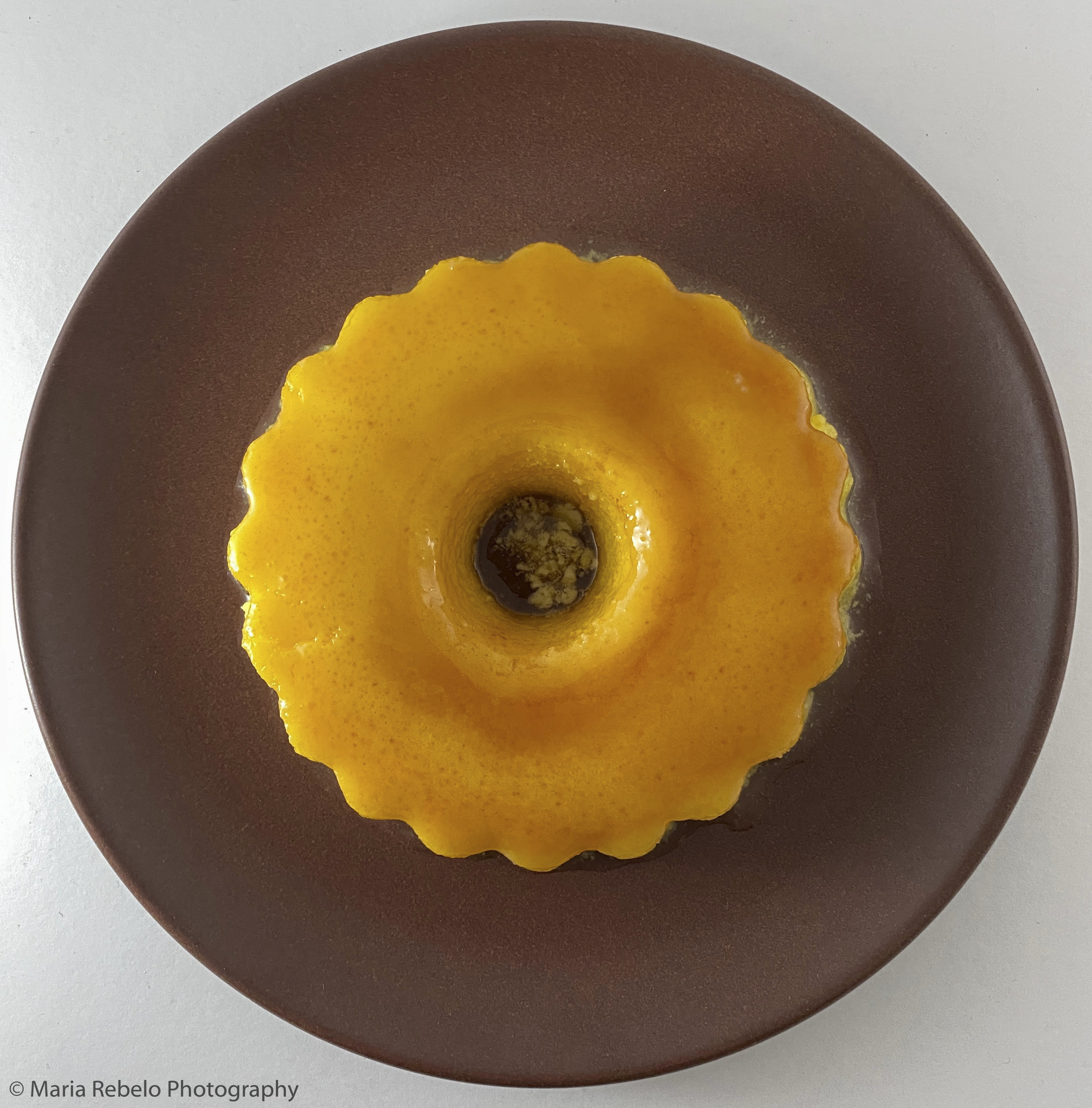
Recently, Dona Graça started writing down some recipes. She shared one of these recipes with us. It is called Pudim de Laranja Descansado (rested orange pudding) because it takes time to prepare. You should try it only when you’re not in a hurry. We hope this recipe is the first of many pages that preserve Dona Graças’s culinary artistry.

Rested Orange Pudding

Pudding ingredients

7 eggs

300 grams of sugar

250 ml of freshly squeezed orange juice

Port-wine caramel

150 grams of sugar

50 ml of port wine

Mix the pudding ingredients at night and let the mixture rest. Cook the pudding in the morning.

To prepare the mixture, combine the eggs and sugar in a mixer. Three seconds after you start the mixer at medium speed, slowly pour the orange juice into the mixture. Once all the juice has been added, keep the mixer on for an extra 30 seconds or so, until you see foam made from small bubbles. Stop the mixer and use a wooden spoon to the pudding ingredients with a movement from top to bottom until you no longer feel any sugar at the bottom of the bowl.

Once the mixture has rested, make the port-wine caramel and use it to coat the pudding mold. Pour the mixture into the mold and place the mold inside a pan filled with two fingers of water surrounding the pan. Cook on the stove on a small burner at medium heat for 40 minutes. Take it out of the mold and let it cool. Enjoy!

Toca da Raposa is located at Rua da Praça in Ervedosa do Douro, tel. 254 423 466.

Making pasteis de nata

Do not try this recipe at home unless you’re desperate! Which is how we feel. Far from a purveyor of “pasteis de nata,” how else can we satiate our craving for these divine custard tarts?

We opened with trepidation “Cozinha Tradicional Portuguesa” (Portuguese Traditional Cooking), the imposing tome of vernacular recipes compiled by the legendary Maria de Lurdes Modesto. The old pages creaked, surprised to be turned with such urgency.

Modesto’s instructions assume we know what we’re doing. They’re more like jazz lead sheets than classical music scores. She tells us the key elements of the recipe and expects us to improvise the rest.

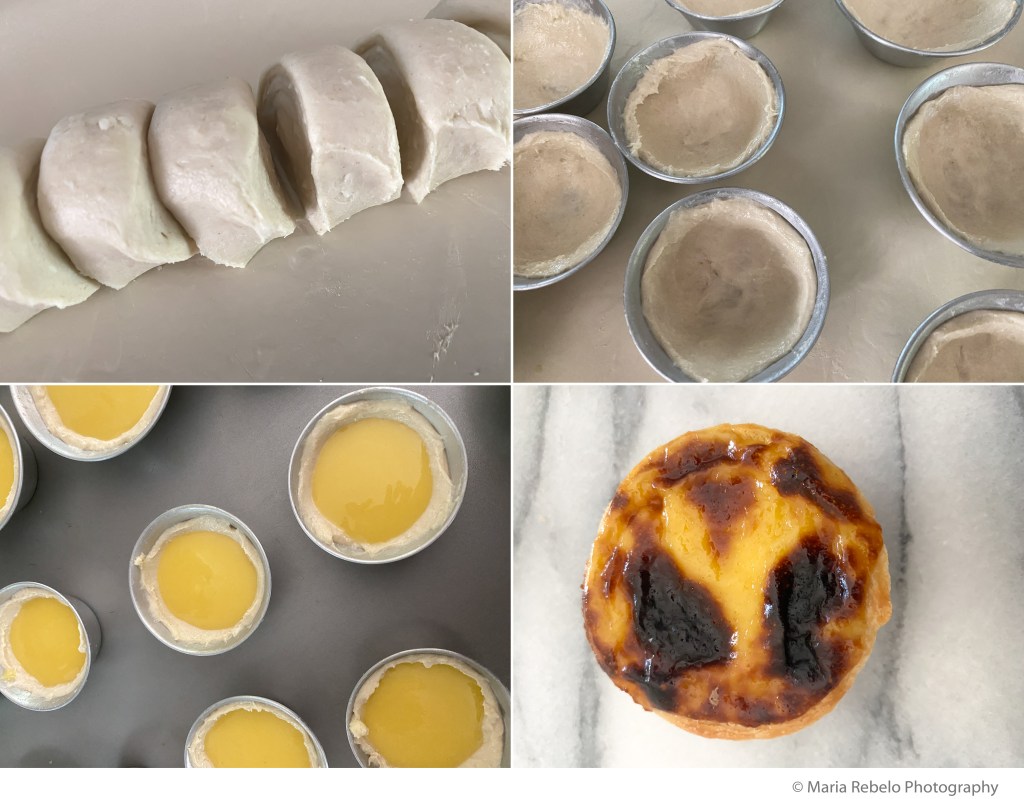
The ingredients are humble:  flour, butter, cream, eggs, sugar, water, and lemon. We started by making a version of rough puff pastry, folding the dough to create delicate layers of butter and flour.  After a few hours of work, we were rewarded with two dozen delicious pasteis de nata. 

All the effort that went into making these pastries made us appreciate Portugal even more. It is a place where it is ordinary to find the extraordinary: heavenly pasteis de nata sold for a modest price in every street corner. 

Here’s the recipe.

Ingredients for the puff pastry: 500 grams of flour, 500 grams of butter, 2 to 3 deciliters of water, and salt. 

Ingredients for the filling: 5 deciliters of cream, 8 egg yolks, 3 tablespoons of flour, 200 grams of sugar, and one lemon peel.

Melt the salt in warm water and divide the butter into three equal portions. Place the flour on a stone table and make a hole in the middle of the flour to pour the water. Kneed the mixture until it becomes homogeneous and let it rest for 20 minutes.

Next, stretch the dough into a square form.  Knead some of the butter until it has the same consistency as the dough. Spread one third of the butter over the dough, leaving a strip of one inch at the edges of the square. Fold the dough from bottom to top and from left to right, making sure that the fold fits perfectly at edges and on the sides. Stretch the dough again forming a square. Repeat the operation twice, first using the second third and then the last third of the butter.

Stretch the dough as thinly as possible. Cut it in stripes and fold into long rolls. Cut the rolls into pieces of 2 to 3 centimeters. Place the dough at the center of a small mold. Moist your thumb in water and spread the dough to the edges of the mold. 

To prepare the filling, mix all the ingredients and bring them to a boil. Remove from the heat and wait until the mixture cools down. Fill the molds with the cream. Place the molds in a very hot oven (250 to 300 degrees centigrade). Once the custards come out of the oven and cool, you can sprinkle them with icing sugar and cinnamon.

Ilda Vinagre shares a recipe

Ilda Vinagre

Ilda Vinagre is a legendary chef. In the 1980s, she opened a restaurant called Bolota (acorn) in Terrugem, a small town in Alentejo. The restaurant earned her two Michelin stars, attracting gourmets from Portugal and beyond. After this feat, she traveled the world cooking, heading restaurants in the United States and Brazil, and preparing banquets that showcased the cuisine of Alentejo in lands as far away as China.

The good news is that Ilda is back in Alentejo. We met with her at the restaurant of Herdade dos Adeans where she oversees the kitchen. Ilda told us about her life and her love of cooking. That these days she enjoys decorating her plates with edible flowers. And that there are four herbs no Alentejo chef can do without: mint, coriander, oregano and “poejo” (pennyroyal). In the end of our conversation, she generously gave us one of her favorite octopus recipes so we could share it with our readers. Here it is!

Country-style Octopus

Cook “al dente” the octopus in water with salt, onion, coriander, pepper and oregano. Cut it in pieces and grill the pieces in a hot griddle with bacon and a little olive oil. Dress with lemon juice, lemon rind and oregano. Accompany with a sweet potato puree. To make the puree, roast the sweet potato with the peel on. Take the peel, mash the pulp and mix it with butter.