Culinary bliss at Essencial

Restaurant Essencial_

If the cobblestones of Bairro Alto were not so slippery, we would tell you to run to Essencial, a new restaurant in Bairro Alto. Walk instead as fast as you can because this dinning room that seats only 25 guest will soon be impossible to get into.

The restaurant is headed by André Cordeiro, a chef with impeccable knowledge of French technique. He studied for five years with Alain Ducasse in Paris and then worked with three chefs who earned the coveted title of Meilleurs Ouvriers de France (best craftsmen in France). André came back to Lisbon to combine fine-dining ingredients such as truffles and foie gras with the amazing fresh produce available in Portugal. The results are stunning–elegant food that is a joyful symphony of tastes, textures and aromas.

While we were chatting with chef André, a plate of bread arrived. It came with a blend of butter from Pico in Azores, lard and rosemary. It was the one of several unexpected  combinations that delighted our palates throughout the meal.

The first appetizer was a crowd pleaser: delicate slices of marinated salmon with radishes, crème fraiche and tarragon oil, served with the luscious crêpes vonnassiennes made famous by chef George Blanc. The second appetizer was a sea urchin shell filled with beef tartare, sea urchin and nori seaweed. These dissonant ingredients created a pleasing harmony that made our taste buds sing.

It is customary to serve the fish entrée before the meat but here the latter came first. It was a paté en croute made with duck, pork and foie gras served with smoked carrot purée and beets. How could the fish compete with these gratifying earthy flavors? The answer came in the form of a plate of sole. The freshness of the fish was a canvas that made the truffle stuffing and the Champagne sauce stand out.

The last entrée was a lush journey to the flavors of the woods: hare with foie gras, trumpet mushrooms and Jerusalem artichokes in a reduction of red wine, port wine and chocolate.

A vanilla mille feuilles with salted caramel produced a happy ending to a blissful meal. But our culinary experience was not over. There were still fireworks provided by a buttery French toast with vanilla mouse and a rich choux with praline.

Essencial’s minimalist space, impeccable service and interesting French and Portuguese boutique wines perfectly complement the food. We do not need the Michelin guide to tell us that the culinary stars shine brightly on Essencial’s dinner table.

Essencial is located at Rua da Rosa, 176, tel. 211573713, email info@essencialrestaurant.pt. Click here for the restaurants website. 

Prado: the prairie in Lisbon

Prado Composit

Never underestimate the power of the light of Lisbon. Chef António Galapito was happily working at Nuno Mendes’ Taberna do Mercado in London when he was offered the opportunity to open a restaurant in Lisbon. Galapito said he was not interested. But he agreed to see the space.

It is a place full of memories, from Roman ruins to old fish-canning equipment from a factory that once operated there. The ceilings are high, making room for generous windows that invite the light in. It was impossible for Galapito to say no. He called the restaurant Prado, the Portuguese word for prairie, to signal his intention of bringing the best products from the fields of Portugal to his table.

The light became the inspiration for the menu. The food is simple, fresh, organic and seasonal. The wines are natural and biodynamic. The vibe is relaxed and the decoration minimalist.

We sat at a beautiful common table made from old pine wood. Our dinner started with a refreshing strawberry kombucha. Then, a plate of bread and goat cheese arrived at the table. The bread, fermented for 28 hours at Gleba, fused with the flavorful goat cheese and melted in our mouth.

The menu has many small plates that are perfect for sharing. We sampled several of these delights:  mussels, leeks, parsley and fried bread, cabbage cooked with sour milk and sunflower seeds, pleurotus mushrooms, with pimentão (a traditional pepper-based paste) and crunchy sarraceno wheat, green asparagus, requeijão and azedas, mackerel, mizuna, lettuce and tangerine, and finally, squid from Azores cooked in a pork broth.

Dinning at Prado is a wonderful opportunity to taste pristine produce harmoniously combined to create satisfaction and joy.

Prado is located at Travessa das Pedras Negras, 2, tel. 210 534 649, email info@pradorestaurante.com. Click here for the restaurant’s website. 

Taberna Sal Grosso

Taberna Sal Grosso

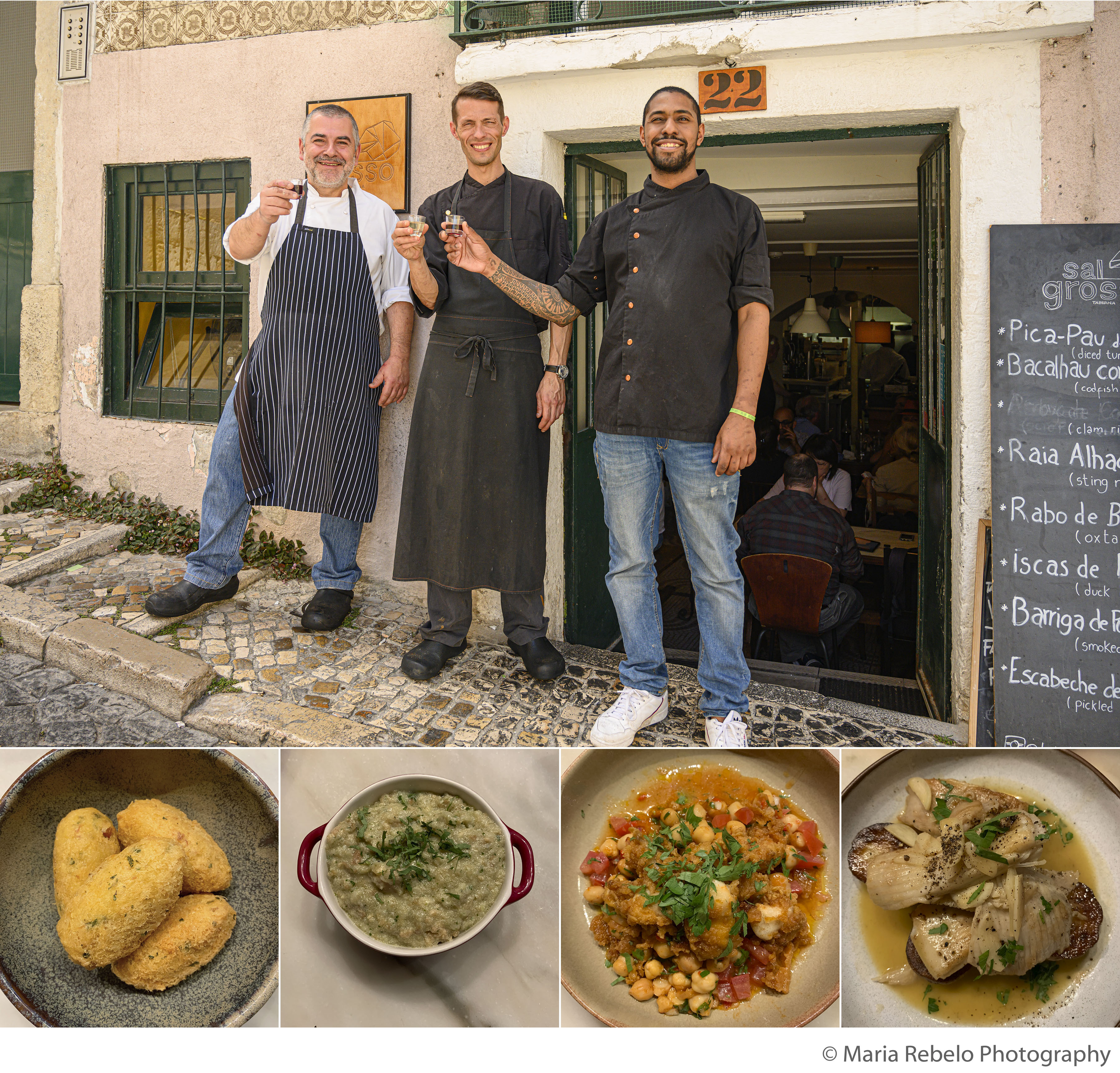
When we arrived at number 22, Calçada do Forte in Lisbon’s old Alfama neighborhood, there was a group of people congregated around the door. They were all trying to get a table in a small restaurant called Taberna do Sal Grosso (Coarse Salt Tavern). An exasperated waiter explained that he could not bend the laws of physics to accommodate more guests. No one was happy with the news that miracles could not be made. We too walked away disappointed. But we were so intrigued by the tavern’s atmosphere that we made reservations for lunch two days later.

As soon as we sat for lunch, it became obvious why the place is so popular. It serves delicious food with a happy vibe at modest prices. This trio of qualities is rare. It is hard to keep the quality of the food consistent and feel happy about serving inexpensive meals. Joaquim Saragga, the chef and owner, manages to do it because because he views his restaurant as more than just a business.

Joaquim lost his job, so he decided to change his life. When he was a student in London,  he used to cook for his roommates. He remembered feeling happy in the kitchen, so he enrolled in culinary school and went on to complete a Masters in gastronomy.

When he opened the tavern in 2015, he shunned the tricks that most eateries use to become more profitable. There are no couvert charges. He serves only two inexpensive but very drinkable house wines and a few artisanal beers. Desserts are modestly priced.

“I’m not trying to innovate, only to serve my favorite traditional recipes prepared with local, seasonal ingredients. I cook the food I like to eat.” he told us. Everything we tried was perfect: a watercress and orange salad, codfish cakes, manta ray and garlic, oxtail with quince, codfish and chickpeas.  “I needed to create my own job,” he explained, “but I also wanted to create a place where people feel at home.”

We proposed to take a photo of the staff at the door of the restaurant but then another wave of guests came in. Joaquim asked one of the chefs and the waiters to pose for us but he stayed inside the restaurant, clearing the tables and welcoming people. It is this dedication to serving others that make Taberna do Sal Grosso such a special place.

Taberna do Sal Grosso is located at Calçada do Forte, 22. Reservations are a must. They do not accept phone reservations. Reservations can only be made by sending a message through Facebook. You need to receive a confirmation in order for the reservation to be valid.

Where great views and delicious food go together

EPUR

It is often said that restaurants with good views serve lousy food. This aphorism doesn’t apply to EPUR, chef Vincent Farges’ new restaurant in Lisbon. Its windows offer beautiful views of the Tagus river and the rooftops of downtown Lisbon. But, once the food arrives, it is hard to choose between looking out the window and admiring the elegance of the sustenance on our plate. When we taste the food, our brain’s ability to process pleasurable sensations has to stretch even further.

Served on graceful white plates, the food looks ready for a Vogue photoshoot. Its beauty is not superficial, it stems from the quality of the ingredients and the meticulous preparations.

We tried a flavorful rabbit rillette with foie gras, seasoned with pear vinegar, a delicate avocado mousse topped with crispy Galician cabbage, the type of cabbage used to make caldo verde. Our lunch ended with a sumptuous soup starring a trio of marvelous fish: manta ray, sea bass, and monkfish.

It is hard to think of a better place to meet Lisbon for a lunch date than at Vincent Farge’s EPUR.

EPUR is located at Largo da Academia Nacional de Belas Artes 14, Lisboa, tel. 21 346 0519.


The sea tavern

Taberna do Mar Composit.jpg

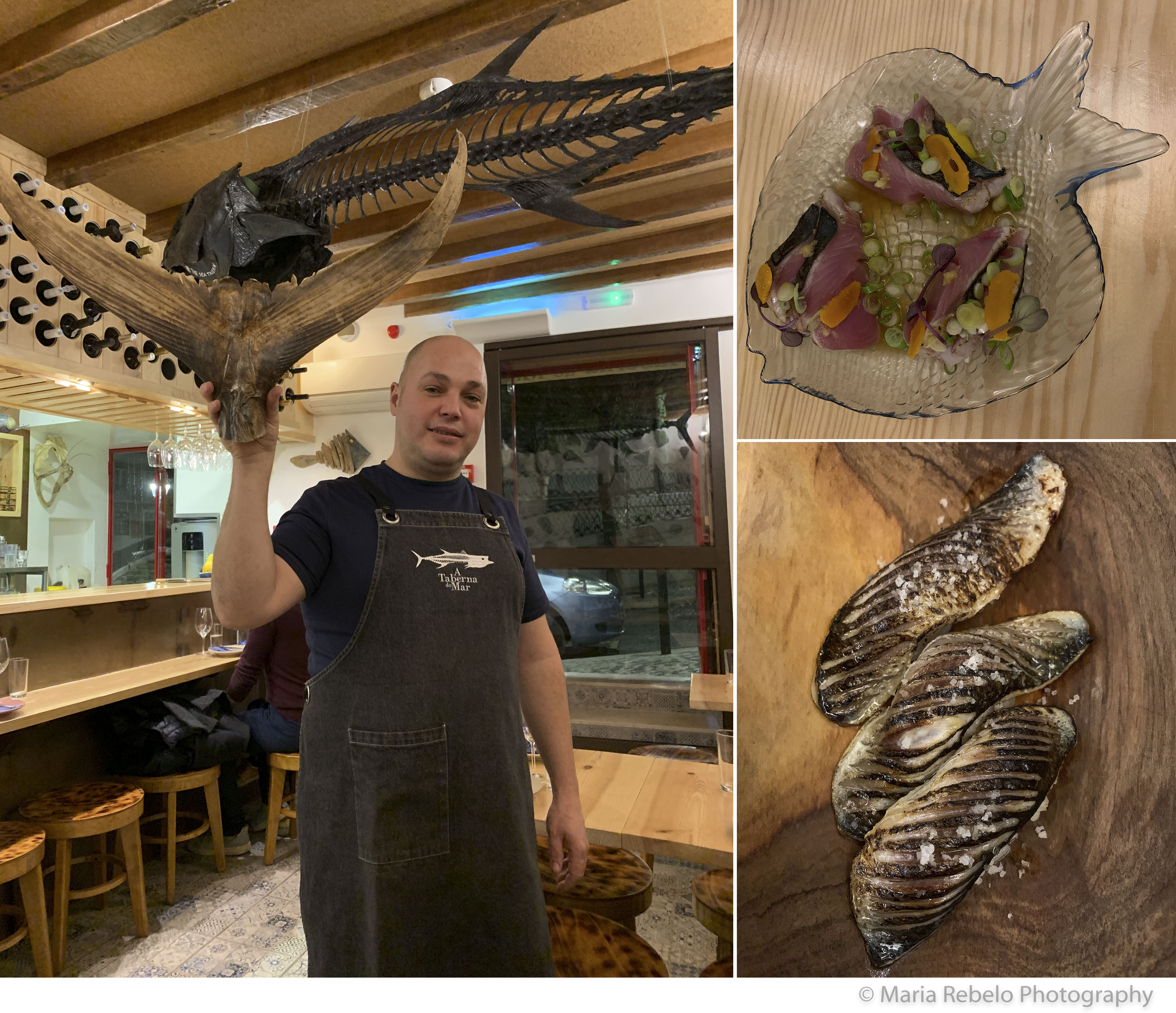
A dinner at A Taberna do Mar (the sea tavern) is a culinary plunge into the waters of Sesimbra, Trafaria and Costa da Caparica. These are the beaches near Lisbon where chef Filipe Rodrigues sources his fish.

Filipe was born in the Algarve. His grandparents were cannery workers who taught him some of the secrets of the sea. He discovered other secrets on his own, through years of hard work. After creating the menu for several popular restaurants, Filipe decided to open his own place. It is a cozy tavern with ancient stone walls and a quaint tile floor.

You can order a la carte or choose a menu prepared by the chef. Feeling adventurous, we went for the menu. The feast began with a warm tortilla decorated with cuttlefish ink topped with a cream of lupini beans, mint, and sea fennel, a plant that grows on sandy dunes. Then, we enjoyed a carob bun stuffed with dried horse mackerel accompanied by a miso mayonnaise. It came with a dumpling stuffed with tender veal tongue, seaweed and mushrooms. It was moist and delicious. We went back to the sea with a plate of sarrejão sashimi. Sarrejão is a fish from the bonito family that shines brightly when it is very fresh.

We were still savoring this delight when Filipe brought us his version of muxama. This prosciutto of the sea, made by salting and drying the best parts of the tuna, has been produced in the Algarve since Roman times. Filipe marinated the tuna in a mixture of soy and moscatel wine before he dried it. The muxama came with an exuberant combination of pumpkin pickle, sushi rice and a large shrimp from Algarve called “carabineiro.”

An appetizing bread seasoned with sardine sauce and a tasty mackerel soup came next. They were followed by xerem, an Algarve version of polenta, with berbigão and seaweed. Then the air filled with the aroma of grilled sardines that came from a tray where the sardine nigiri was being prepared. Our taste buds jumped for joy while the sardine melted in our mouth.

Filipe asked us whether we would like to repeat any of the items from the menu. We answered in unison:  yes, we would love some more sardine nigiri!

The meal ended with three desserts: a carob mousse served with tangerine sorbet, a bread pudding and a crème brulée where the milk was replaced with a berry puree.

A Taberna do Mar is a place where East meets West, where Japanese cooking techniques are used to recreate Portuguese flavors with delicious results.

Taberna do Mar is located at Calçada da Graça 20 B, in Lisbon, tel. 21 093 9360.


An unforgettable supper at Ceia

ceia composit 1

ceia composit 2

ceia composit 3

This article describes our experience in Ceia when Pedro Pena Bastos was the chef. Pedro is now at Cura. Ceio has a new star team, headed by chef Diogo Caetano.

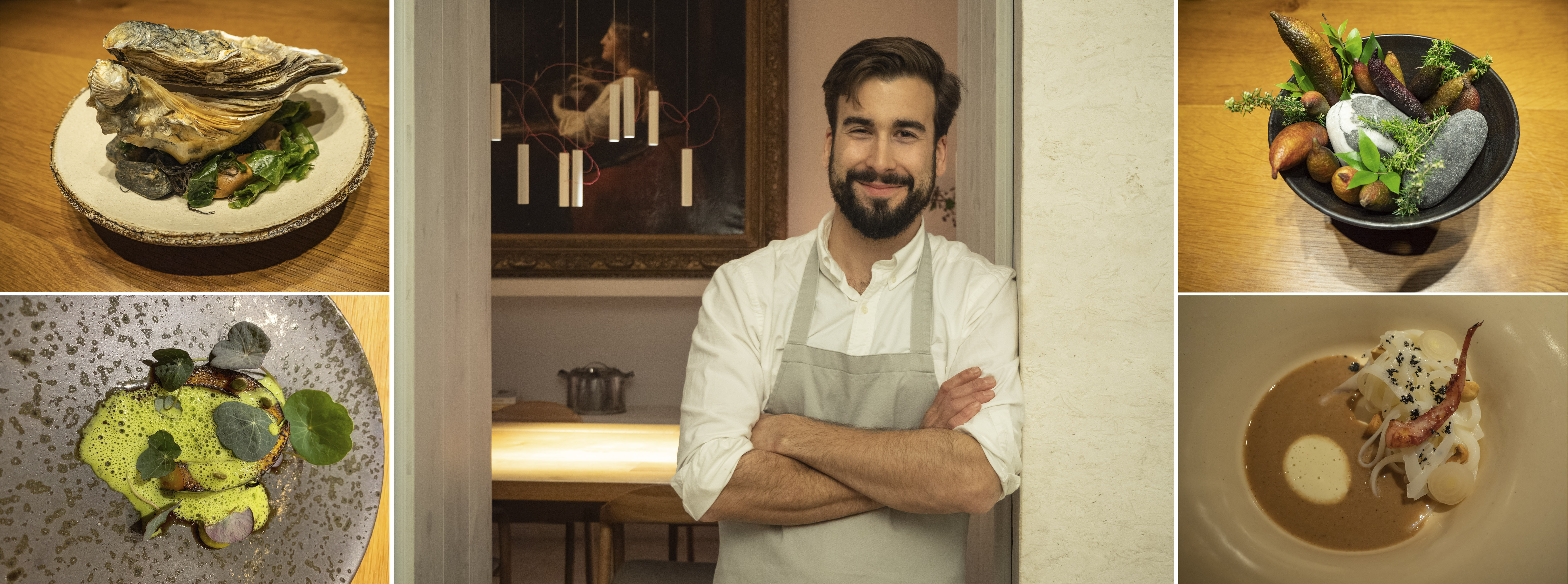
If food was just fuel for the body, how come there are meals that linger in our memory as incandescent moments? One of these moments was a lunch amid the vineyards of Herdade do Esporão prepared by a young chef called Pedro Pena Bastos. Another such moment was a recent dinner at a new Lisbon restaurant called Ceia, the Portuguese word for supper. The setting was different but the chef was the same.

We were received in the spacious courtyard outside the Ceia dining room by sommelier Mário Marques. He offered us a choice of two welcome drinks: cherry kombucha or a natural sparkling wine from Quinta da Serradinha. The drinks came with plates of beet beignets served with smoked codfish eggs. Like everything else in this enchanted evening, these choices seemed unusual until we tried them and perfect once we tried them.

Mário invited us into the serene dining room where a long wooden table awaited 14 lucky guests. Pedro welcomed us with three tantalizing bites: Jerusalem artichokes, French toast with seaweed and cockles, and venison from Alentejo served with fermented walnuts and black olives. They were followed by a precious taco made with rose prawns from Algarve, beetroot pearls and yuzu.

A Japanese-inspired tomato broth with mackerel and broccoli showcased Pedro’s ability to create unusual combinations that work perfectly. Then, a large oyster shell from Alvor was placed on the table surrounded by bowls with sweet oysters, fermented asparagus and lima caviar. We were still savoring this intense taste from the sea when flavors from the woods arrived: grilled Hokkaido pumpkin, mushrooms, and a beurre blanc made with Indian cress.

The service progressed with the pace of a sacred ritual that has been perfected throughout the ages. Alexandre Coelho, our amiable server, invited us to visit the adjacent room where chefs place final touches on their next offerings. It is fascinating to observe the choreographed precision that produces such refined food.

Each guest received a bowl of pasta, only it was not pasta—it was the freshest squid, delicately cooked, cut like tagliatelle and served with a sauce made with bergamot zest, hazelnuts and pickled onions. The flavors of the sea continued with a line-caught robalo (sea bass) dressed with chanterelle mushrooms, marjoram and fennel cooked in parsley oil.

A beautiful loaf of sourdough bread smoked with tomato and thyme created an intermission that separated the fish from the meat courses. It came with aged butter seasoned with salt from Castro Marim and a bright-green, spicy olive oil from Pedro’s family estate.

These rustic flavors prepared out palates for the next dish, a rectangular prism of slow-cooked bísaro pork jowl that melted in our mouths. The other meat course was a cylinder of beef from Simental cows, grilled on charcoal and adorned by collard greens and buckwheat.

Next, came a plate of lovage with compote, ganache and sorbet made from a huge Buddha’s hand lemon cultivated in Alentejo. The pungent citrus notes readied our palates for a trio of desserts made with enoki mushrooms, cocoa and quince.

Coffee, brewed in a double-globe glass coffee maker, was served with gum made from dehydrated beets and coriander, raspberry bonbons, and spicy cookies coated with a cream of turmeric and sweet potatoes.

Throughout the meal, Pedro Pena Bastos combines tastes, aromas, textures, and temperatures with the skill of a master orchestrator. His deep understanding of the subtle qualities of different ingredients allows him to create brilliant flavors and invent bold harmonies. The result is a culinary symphony that is unforgettable.

Ceia is located at Campo de Santa Clara, 128. Lisbon. Click here for the restaurant’s website.

A noble crab soup

IMG_1905 2

Almost three decades ago, a friend took us to a new restaurant called Nobre in the Ajuda neighborhood. The name, which means noble, came from the surname of the chef, Justa Nobre. We recall with fondness the meals we enjoyed there. After a successful run, Nobre closed so that the chef could pursue other projects,

Last week, the same friend invited us for lunch. We were delighted to discover that we were going to a new restaurant that marks Justa Nobre’s return to Ajuda. It is called “À Justa,” an expression based on the chef’s first name that means “just right.”

The menu offers a cuisine without foreign accents that has the satisfying taste of authenticity. The recipes are grounded in the cooking of Justa’s grandmothers. But they are not a copy of the past. They reflect years of refinements shaped by the personality and creativity of this self-taught chef.

The restaurant was full. The Portuguese like to flirt with contemporary food trends but they always come back to their one true love, which is the traditional cooking of Portugal.

We had a great meal that included bright green fava beans, chickpeas with codfish, codfish “pataniscas,” and fried cuttlefish. These delights were preceded by a classic of Justa Nobre’s repertoire: the spider crab soup. Its aristocratic taste makes all other seafood soups in Lisbon look common by comparison.

Many chefs keep their secrets, but Justa generously shared some of her recipes in a book titled Passion for Cooking. We translate her recipe for spider crab soup below. But you must try the original at À Justa where they make it just right.


Justa Nobre’s spider crab soup

Ingredients: 2 large spider crabs weighing about 1 kg. each, 3 liters of water, 3 tablespoons of sea salt, 150 grams of margarine, a large onion, 2 cloves of garlic, a parsley bunch, a sliced fennel head, 4 tablespoons of tomato paste, half liter of cream, 0.1 liter of dry white port, one teaspoon of powdered ginger, one teaspoon of saffron, 2 tablespoons of potato starch.

Preparation: Boil the crabs in the salted water for 8 minutes. Remove them, let then cool off and extract all the meat. Return the shells to the pan. Add some shrimp shells and let them boil for 10 minutes. In a large pot, melt the margarine and add the sliced onion, fennel and garlic. Let these ingredients cook briefly and then add the white port, the cream, the tomato paste, the spices, and two liters of the crab broth. Mix the potato starch with some cold water and add it to the soup. Check the seasoning and strain the soup. Add the crab meat and serve the soup it in the shell of the spider crab.

À Justa is located at Calçada Ajuda 107, in Lisbon. The restaurant seats only 36 people, so reservations are a must. Call 21 363 0993 or email reservas@ajusta.pt. Click here for Justa Nobre’s web site.


The luxurious Dom Feijão

Dom Feijão

There are plenty of “tascas” in Lisbon, small informal restaurants that offer seasonal menus at low prices. But when locals want to have a nice meal with friends or family, they don’t go to a tasca. They prefer to pay a little bit more and eat at a neighborhood restaurant with better ingredients and service.

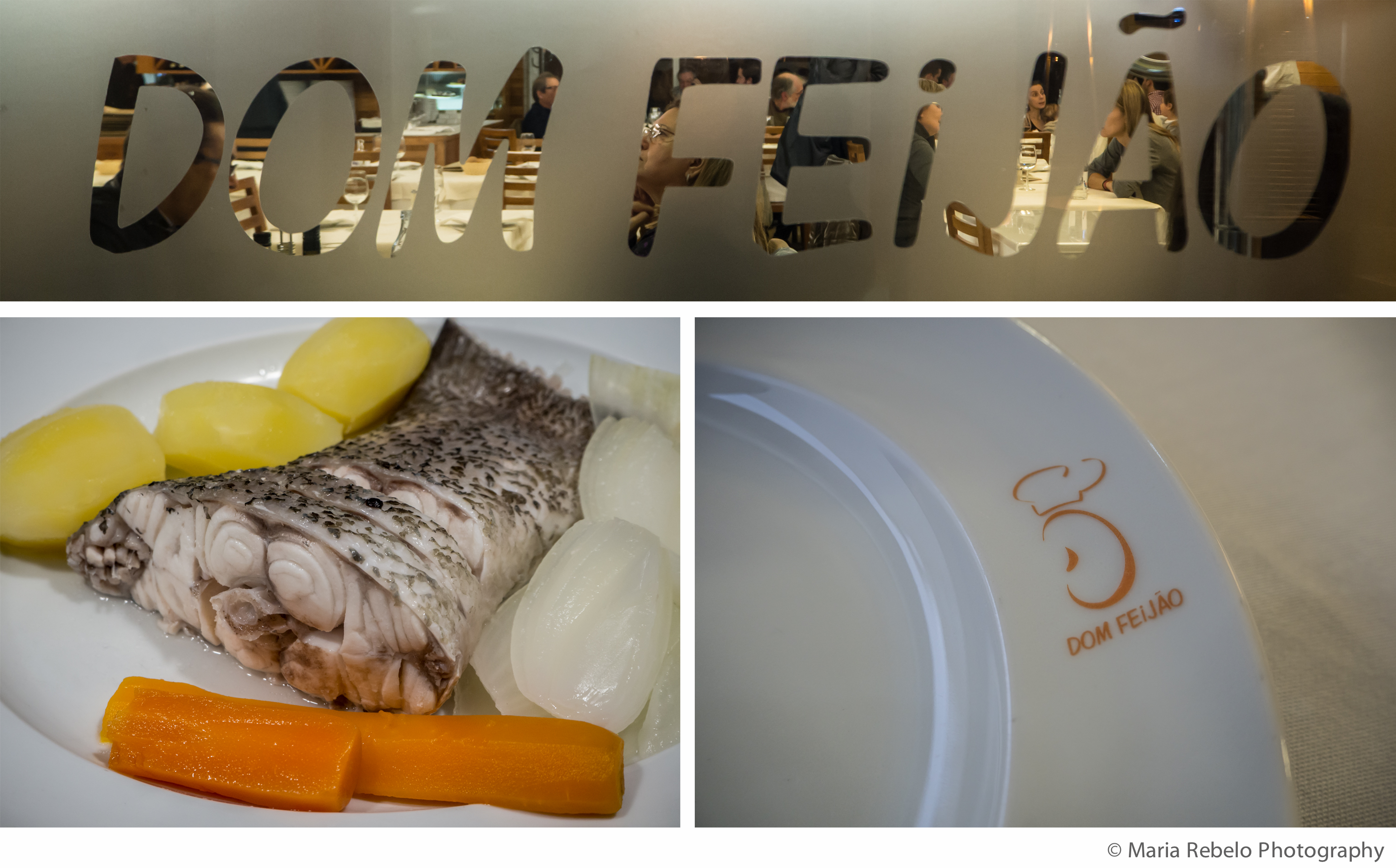
One of our favorite neighborhood restaurants in Lisbon is Dom Feijão (Sir Bean), a place with generous portions, modest prices and top-notch ingredients. What’s the catch? You have to be persistent to get a reservation or be prepared to wait for a table. The waiters don’t answer the reservations phone line when they’re very busy and they’re almost always very busy.

The restaurant is popular with families, on our last visit the place was full of grandparents, parents and children sharing the pleasures of the table.

Before we had time to open the menu, our waiter brought us some delicious fried marinated sardines and a plate of the same black-pork prosciutto they serve in heaven on special occasions.

We’d seen a large “sável,” a prized river fish, in the restaurant’s refrigerator so we asked the waiter whether we could order it. “Not today,” he replied “The sável has to be thinly sliced and marinated for a few hours. Sorry, but we cannot rush the preparation.”

We ordered instead poached cherne (sea bream). It was deliciously succulent, a reminder that when the ingredients are perfect, simple preparations are the best.

Next, we had grilled “secretos,” divine slices of fatty black pork. Two decades ago, these cuts of black pork were exported to Spain. Since then, the Portuguese have wised up and started consuming them. Exports suffered but our happiness boomed.

We ended the meal with some grilled codfish. The waiter asked what was our favorite part of the codfish so he could ask the chef to prepare it. Large tranches of codfish swimming with roasted potatoes in a sea of olive oil made our delights.

We told chef João Araújo how much we enjoyed the meal. “We’re a simple restaurant that serves traditional Portuguese food,” he said. “Our only luxury is the ingredients we use.”   This is, of course, the kind of luxury we fancy.

Dom Feijão is located near the posh Avenida de Roma at Largo Machado de Assis 7 D, tel. 21 846 4038. There’s a convenient paid garage underneath the restaurant. You can ask the waiter to validate your parking.

Belcanto

Composit Bel Canto

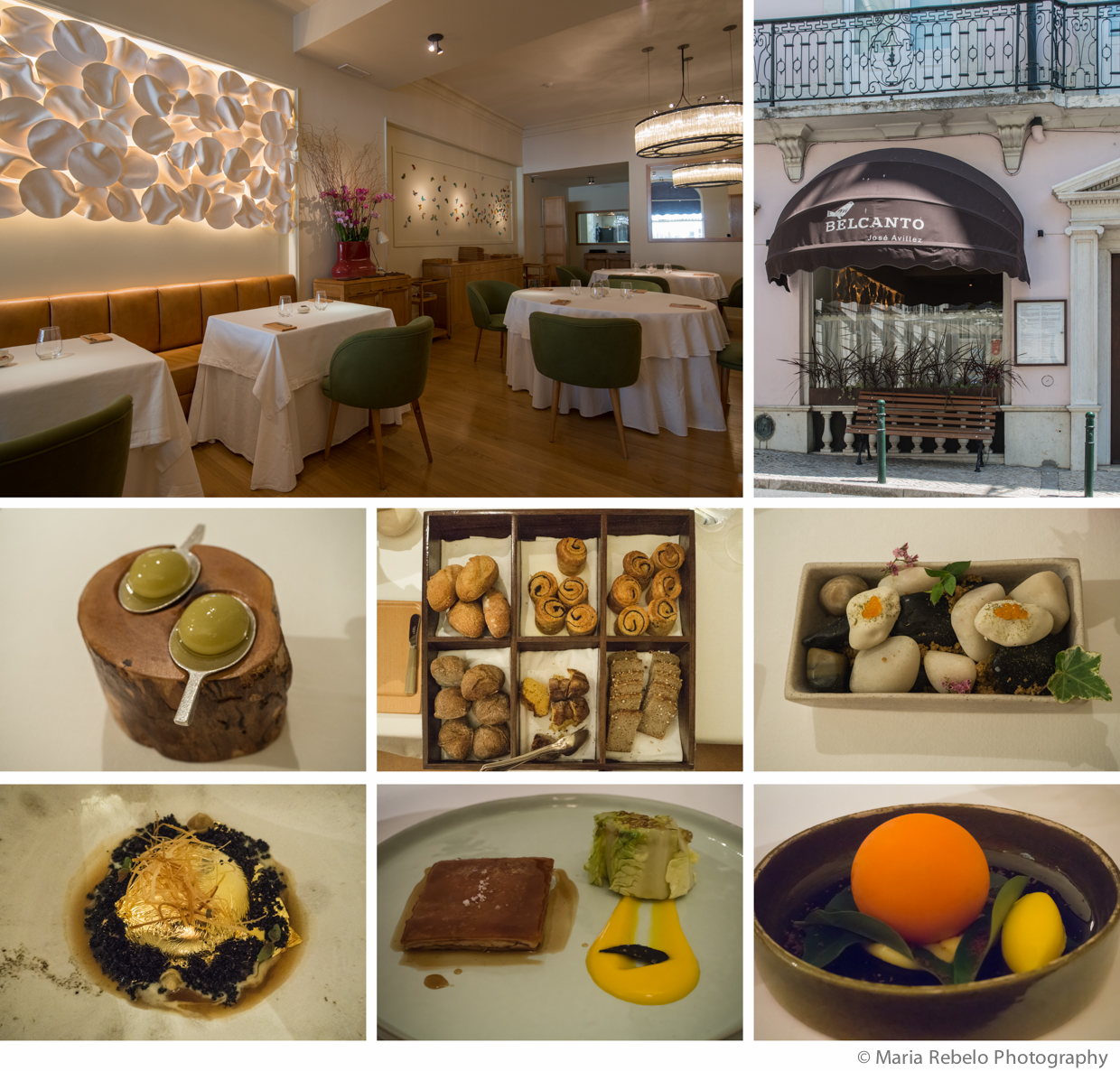
Perhaps it’s not a coincidence that Belcanto, the most celebrated restaurant in Lisbon, is close to the São Carlos opera house. Decorated with whimsical porcelain plates, the restaurant looks like a stage and its meals are as thrilling as a great opera performance.

Our lunch’s overture was composed of small bites often included in the couvert of traditional restaurants:  tremoços (lupini beans), olives, and a carrot and garlic salad. The presentation was unusual–they were served on top of Portuguese cobblestones. But the real surprise was that they all turned liquid once we bit into them, filling our mouth with explosions of flavor. This culinary prelude was accompanied by Vicentino, a wine from Zambujeira do Mar that left our paletes refreshed with hints of green pepper.

There were more surprises. First, a fake edible stone covered with salmon caviar. Then, crispy chicken skin with corn coriander and liver, a combination that tastes like roasted chicken. Next, a delicious algae cornet filled with tuna served inside a flower pot.

A genial waiter introduced a chorus of breads made from corn, buckwheat, quinoa, and puff pastry. Next came a duet for clams and “lingueirão” (razor clams) accompanied by a 1979 Porta dos Cavaleiros, a velvety red wine from the Dão region produced in the birth year of chef Avillez.

Then the arias started. The first was a Golden Egg–an egg cooked at a low temperature, covered with gold leaf and adorned with threads of fried leek. It arrived with a lively Arinto white wine made by António Maçanita in Pico, a volcanic island in the Azores archipelago.

The second aria was called Ocean Dive: a pristine sea bass (robalo) cooked in sea water with seaweed, “salicórnia” (samphire), razor clams, and mussels. We were still savoring the final chords of this crowd pleaser when a new theme was introduced: a flavorful remake of the bucolic “cozido” that the chef’s grandmother used to prepare with boiled meats and cabbage. It came with a vigorous 2012 Bruto from the Douro region.

The performance reached its climax with another traditional recipe reinvented: the roasted piglet from Bairrada. We don’t know what culinary sorcery was used to produce this perfect combination of crispy skin and juicy roasted meat. All we can tell you is that the result is magical.

A new theme was introduced by a duo of pre-desserts: a raspberry sorbet and an “abade de priscos” pudding. They were followed by a tangerine dream made from frozen juice and filed with tangerine sorbet. Vila Oeira, a rare dessert wine from Carcavelos harmonized with these sweet delights. Coffee and mignardises brought our meal to a blissful finale.

You have to be patient to dine at Belcanto. The restaurant is booked for weeks in advance. But it’s worth the wait to experience such an unforgettable culinary performance.

Belcanto is located at Largo do São Carlos in Lisbon, tel. 21-342-0607.


Magano

Composit Magano

When lunch time comes, some Lisbon residents dream about being magically transported to the plains of Alentejo. “O Magano,” a restaurant in the Campo de Ourique neighborhood, is a place where these dreams come true. Open for more than a decade, it brings to the capital untranslatable Alentejo delights such as “pézinhos de coentrada” and “carne de alguidar.”

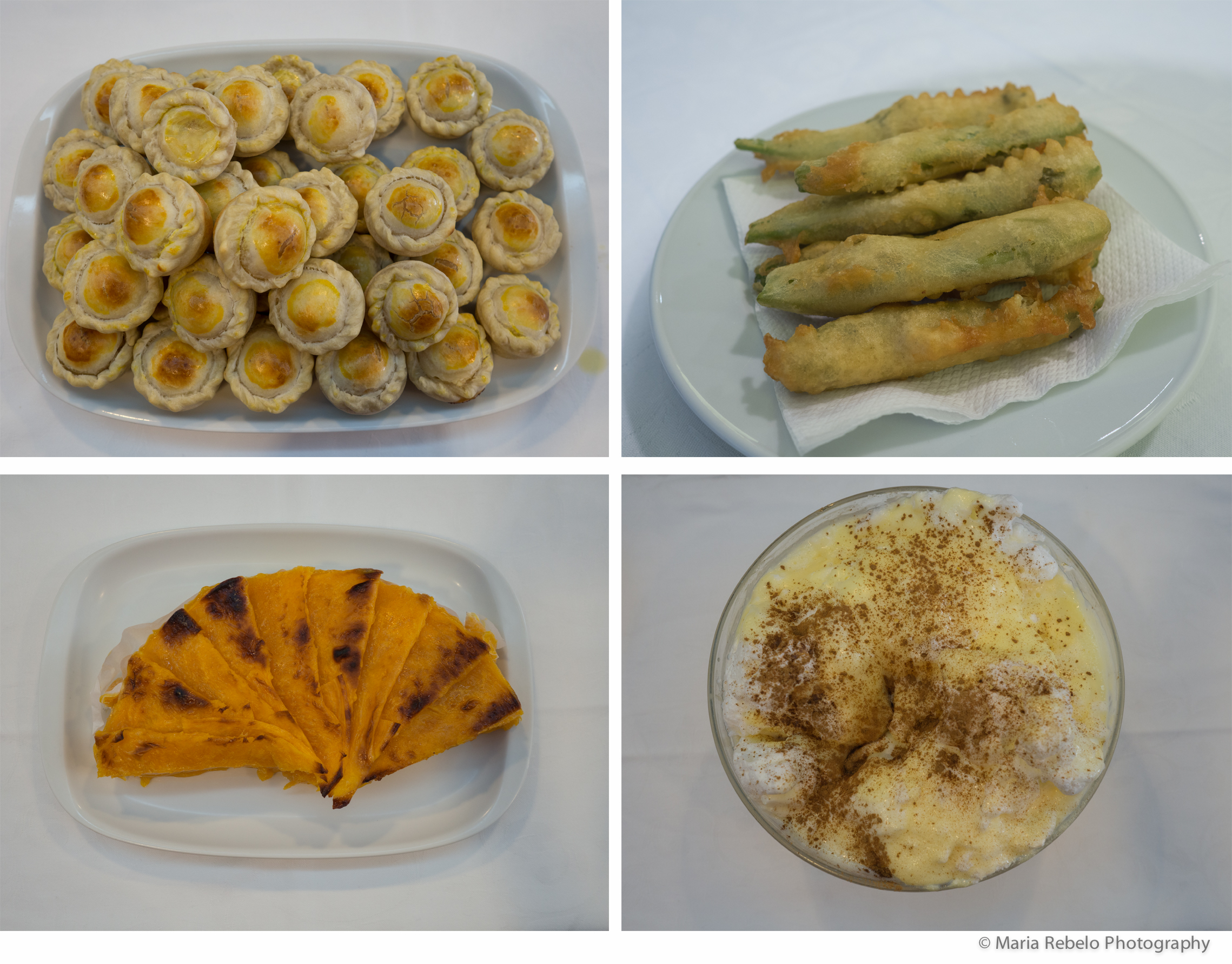
We told our waiter that we wanted to try a little of everything. “I can bring you the menu or you can leave it up to me,” he said with a twinkle in his eyes. We agreed to put him in charge and soon the table was covered with small plates of codfish with chickpeas, grilled peppers, favas with chouriço, miniature pies, green bean tempura, and marinated partridge with razor-thin fried potatoes.

“This was a wonderful lunch,” we said, complimenting our waiter on his choices “It’s not a problem if you want to skip it,” he said “but I had something else for you to try.” He went to the kitchen and brought back a steaming terrine of tomato broth. He carefully placed a piece of bread on each soup plate. Then, he poured the tomato broth and toped each piece of bread with a slice of grouper. The result was pure culinary satisfaction.

We made it clear that we didn’t have room for dessert. “I understand,” our waiter said with an enigmatic smile. He then brought us a plate with “queijadas,” “lérias,” “fidalgo,” and a Portuguese version of “îles flottantes.” “Just in case you change your mind and decide to end the meal on a sweet note,” he said. It was a pleasure to succumb to these temptations.

Magano means mischievous boy in the slang of Alentejo. Our waiter is a magano who knows that no one can resist the brilliant simplicity of the food of Alentejo.

O Magano is located at Rua Tomás Anunciacão 52 in Lisbon, tel. 21 395 4522. Reservations are a must.