Sleeping in a medieval castle by the Sado river

Composite Alcácer

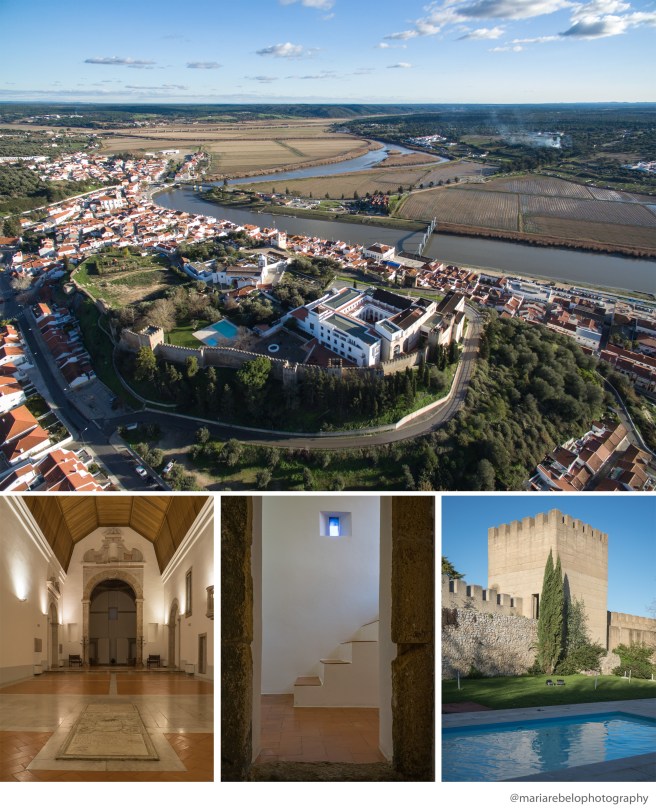
One hour away from Lisbon, you can stay in an historical hotel that occupies a medieval castle with wonderful views of the Sado river and the rice fields of Alcácer of Sal. It is a place where people have gathered since the Iron Age to worship the gods above.

For more than 2,000 years, people came to Alcácer do Sal to farm the land, tend to herds of sheep and goats and produce salt on the marshes of the Sado river. The Sado made it all possible, its waters bestowed fertility on the land and carried boats loaded with agricultural products to far away lands. Underneath the pousada there are remnants of Greek pottery and Egyptian jewelry, foreign luxuries purchased with the fruits of the Sado river.

In the 2nd century BC, Alcácer was conquered by the Romans who made it a center for the production of wool and salt. With their penchant for grandiose names, the Romans named the city Salacia Urbs Imperatoria.

In the 6th century AC, the Visigoths conquered the territory that is now Portugal. But life did not change in Alcácer until the moorish conquered the city in the middle of the 8th century AC. They built the caste and made the town an important trading outpost.

The first king of Portugal, D. Afonso Henriques, conquered Alcácer in 1160. But the moors fought back and it was only in 1217 that Alcácer became a permanent part of the Portuguese territory. The castle was then converted into a monastery occupied by the order of Saint James.

In the 17th century, the old monastery was adapted to welcome the nuns of Saint Claire of Assisi. The new building was called the Convent of Her Lady of Aracaeli.

The Pousada is a magical place. Every window frames a beautiful landscape. Every step reminds us that we are on hallowed ground. But hard decisions have to be made: should we stay by the spacious hotel pool relaxing or go see the gorgeous beaches of the coast of Alentejo?

Here’s a link to the pousadas’ website. You can find a large collection of photos of the pousadas at www.mariarebelophotography.com.

Our Portuguese music playlist

DV1xCUFX4AUEmLo.jpg-large.jpeg

What gives national music its distinct character?  The great Leonard Bernstein answered this question in one of his Young People’s Concerts:

“[…] folk songs reflect the rhythms and accents and speeds of the way a particular people talks: in other words, their language — especially the language of their poetry — sort of grows into musical sounds. And those speaking rhythms and accents finally pass from folk-music into what we call the art-music, or opera or concert-music of a particular people; and that is what makes Tchaikovsky sound Russian or what makes Verdi sound Italian, or what makes Gershwin sound American.”

Portuguese is a language with closed vowels and shh sounds that can come across as Slavic. Our theory is that these traits emerged over time as a defense strategy against Spanish invasions. When the Spaniards, used to the open vowels and crisp enunciation inherited from the Latin, came to Portugal, they couldn’t understand the local language. As a result, they went back to Spain and left us alone since 1640.

If you’re traveling in Portugal, we invite you to use our Spotify playlist of local music as your soundtrack:

https://buff.ly/2Jfwz98

It is an eclectic list that includes classic fados from the great Amália Rodrigues but also the work of a wonderful new generation of fado singers that includes Ana Moura, Carminho, and Mariza. It features folk-inspired music by Trovante and instrumental music ranging from an elegant sonata by the 18th-century composer Carlos Seixas to a joyous rendition of dance music on accordion.

We hope this music, infused with the rhythms and accents of the Portuguese language, will enrich your journey through Portugal.

Reading Anna Karenina in Sagres

Composite Restaurant Os Arcos Algarve

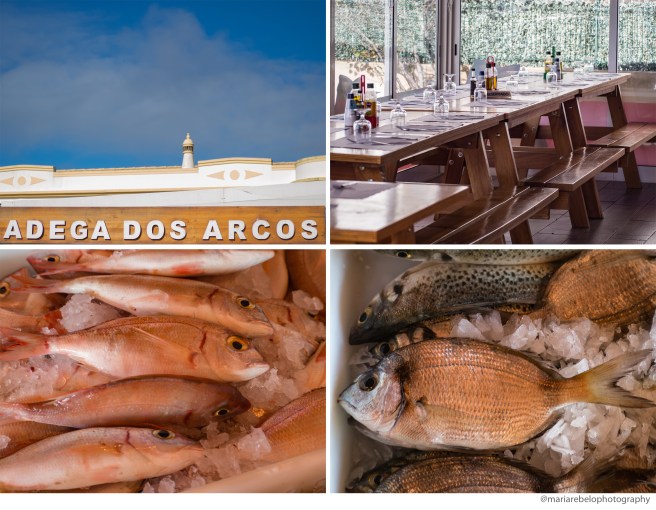
Adega dos Arcos (the cellar of the arches) is named after its many arches. It is an old “tasca,” a humble establishment that serves traditional fare. The restaurant changed owners over the years but the recipe for success has remained the same: fresh fish and grilled meats served with no frills at very modest prices.

We recommend the local fish species with names no one can translate into English. We had sargos, bicas, and liça. The sargo has a buttery taste and a wonderful consistency. Bicas have a more complex flavor reminiscent of the posh mullets. The liça has large white filets with a firm texture and delicate taste.

Everything comes with potatoes, boiled or fried and a traditional salad with lettuce, onion and tomato. The choice of wines is very limited and dominated by Caiado, a great inexpensive wine produced by Adega Mayor.

Even in the Winter, Adega dos Arcos is busy with locals and visitors. “In the Summer forget it,” says the waiter, “the lines are huge.” But the food is worth it. You can take a long Russian novel like Anna Karenina to read while you’re waiting. The novel might end badly, but we guarantee that your wait will have a happy ending.

Adega dos Arcos is located on Rua Roca da Veiga, Sagres, tel. 960 294 290.

Aladdin’s cave in Bairrada

Composite Caves S. João

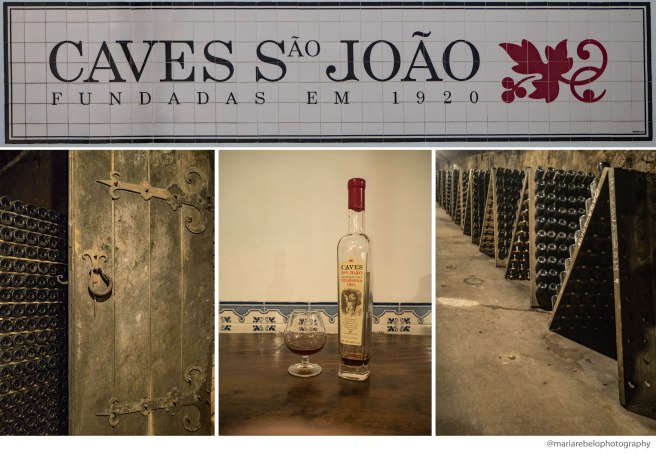
Three brothers, José, Manuel and Albano Costa, built in 1920 wine cellars called Caves São João. They used the cellars to store the wine from Bairrada that they sold to taverns throughout Portugal.

In the 1930s, the Costa brothers ventured into wine production. They dreamed about producing wines that future generations could drink with pride. With the help of French enologist Gaston Mainousson, they learned the secrets of champagne production and started making sparkling wine in Bairrada.

In the 1950s they started producing two iconic wines: Frei João in Bairrada and Porta dos Cavaleiros in the Dão region. Made with great care, these wines were stored so that time could tame their tannins and leave only the smooth taste of the fruit.

As their wines gathered fame, the three brothers increased production and expanded storage capacity. Today the cellar holds 2.5 million bottles that preserve the rhythms of the seasons and the fruits of the toil of generations of farmers. These irreplaceable time capsules are guarded by the great-great grandchildren of the original owners.

We tried two white wines produced at Quinta do Poço dos Lobos. The first, a reserve wine from 2013 had a pale, yellow color, and a smooth taste that left our palate refreshed with notes of citrus. The second was a Poço dos Lobos colheita from 1995. What a difference three decades make! The older wine had an intense yellow color. The citrus notes were now singing with a choir of harmonious flavors orchestrated by time.

We sampled two vintages of Frei João. A red from 1980 that was rich and smooth and a white from 1986 that was still full of youth and vigor.

Our tasting ended with a brandy from 1966 that was suave and sophisticated. It is a nectar that has seen it all from the breakup of the Beatles to the fall of the Berlin wall.

Caves São João look like Aladdin’s cave, full of treasures stored away from the sun and immersed in sultry air. If a genie offers you three wishes during your visit to the cellars don’t hesitate: ask for a white Poço dos Lobos, a red Frei João or Porta dos Cavaleiros, and a bottle of 1966 brandy.

Caves São João are located at São João de Azenha in Anadia, tel. 234743118, email geral@cavessaojoao.com. Click here for their web site.


The bells of Mafra

RBD_Mafra_dezembro
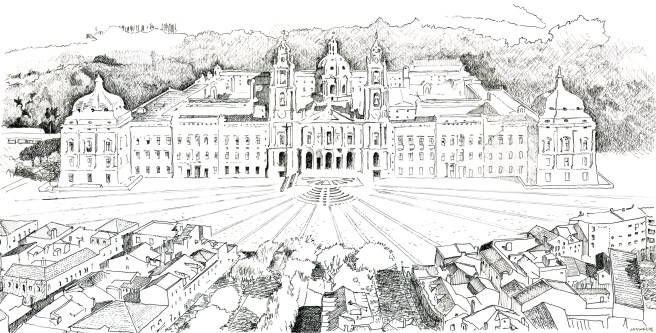
The Mafra Convent, Rui Barreiros Duarte, ink on paper, December 2016.

In 1711, king Dom João V vowed that if he was blessed with a son, he would construct a convent in Mafra. When a son was born in 1714, Dom João V spared no expense to fulfil his promise. By one count, the building has 880 rooms and 4,500 doors and windows. The convent includes a magnificent palace for the royal family and a basilica made of the purest marble, with intricate altars lavishly decorated with gold leaf.

To top it all, the king commissioned a 200-ton carillon. According to legend, when the craftsmen quoted the price of the carillon, they remarked that the cost seemed too dear for a small country like Portugal. Offended, the king replied: “I didn’t realize the bells were so cheap! I would like two sets.”   And so, two sets were made. Nicholas Levach made 57 bells for the North tower in Liége.  Willem Witlockx made 49 bells for the South tower in Antwerp.

The convent has many other bells: liturgical bells used in religious ceremonies, lecture bells that signaled the beginning and end of study periods, agony bells that rang when a monk was dying, refectory bells that reminded monks of their meal times, and the codfish bell that sounded in days when people should abstain from eating meat.

The carillon and some of the other bells were used to mark the passage of time with minuets and other compositions. In a world where musical sounds were rare, the bells of Mafra filled the village with harmony and grace.

Love and almonds

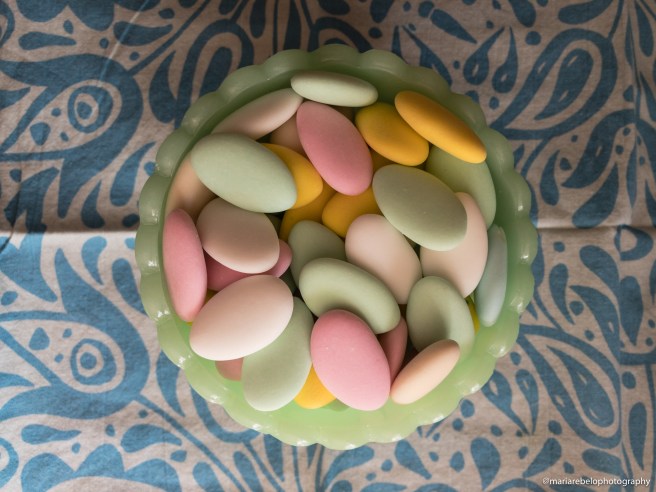
Amendoas 2018

Candied almonds, which are popular in Portugal during Easter, were used to celebrate weddings in Roman times. Perhaps this Roman custom was inspired by a Greek legend about almonds as a symbol of love. Here’s the story.

Demophon, the king of Athens, visits Thrace where he falls in love with a princess called Phyllis. Demophon sets a day for their wedding and returns to Athens. On the wedding day, Phyllis waits for Demophon at the altar but he fails to arrive. When she dies of heartbreak, the Greek gods take pity and transform her body into an almond tree.  Demophon, who had been delayed, arrives in Thrace and learns about the tragic death of his bride. He embraces the almond tree and the branches blossom with beautiful flowers.

Finding happiness in Sintra

Market products

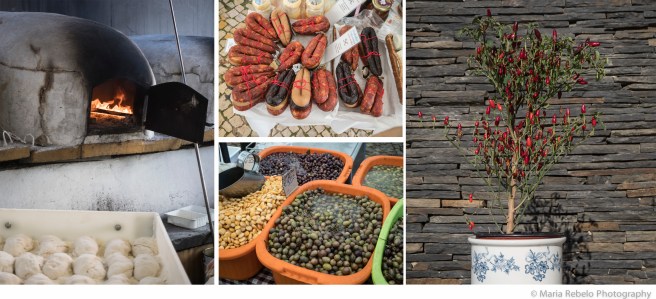
There’s a farmer’s market in São Pedro de Sintra since the 12th century. Nowadays it runs every second and fourth Sundays of each month. It is a great place to buy local fruits and vegetables, artisanal sausages, olives and cheese. Wood-fired ovens bake chouriço bread, filing the air with appetizing aromas.

We saw a farmer selling a small capsicum frutescens tree loaded with little red peppers.  Five centuries ago, Portuguese navigators brought this plant from South America to Africa, where the Bantu people called its fiery pepper “piri piri.” From Africa, the Portuguese took the plant to India where it changed the course of Indian cuisine.

How could we resist bringing home this symbol of the first age of globalization? “Trim the tree in March and you’ll have piri piri peppers between August to January,” advised the genial farmer. We got into the car feeling ecstatic at this unexpected find. Who knew that happiness is a piri piri tree?

The São Pedro market is located on Largo D. Fernando II, São Pedro de Sintra.

Sweet gratitude

Casa do Gato Preto

The recipe for Sintra’s queijadas was created in the 13th century by friar João da Anunciação at the Penha Longa convent. We know that the voluptuously thin crust is made with flour, lard, water, and salt. And that the indulgent filling has requeijão (a ricotta-style cheese), egg yolks, and two ingredients added in the 15th century: sugar and cinnamon. Each pastry store in Sintra has its own secret version of the recipe.

What are the best queijadas in Sintra? We’ve been pondering on this question for years, but the answer still eludes us. When we try the queijadas at Piriquita, we think nothing can be better. But then we taste the queijadas from Pastelaria Gregório and we fall in love with the crispness of the shell and the sweetness of the filling. Lately, we went to Casa do Preto and were astonished by the harmonious marriage of filling and shell.

One thing we know: these queijadas lift our minds above everyday concerns and fill our souls with sweet satisfaction. Thank you friar João!

Casa do Preto is located at Estr. Chão de Meninos 40, in Sintra, tel. 21 923 0436.


Quinta Dona Maria

Quinta D. Maria Winery

Estremoz is a town in Alentejo famous for its white marble. The same geological conditions that fashioned its pristine stones created limestone soils perfect for wine production. So it’s no wonder that there are so many wineries around Estremoz.

The prettiest of them all is Quinta Dona Maria. The estate, which dates back to 1718, was purchased by King João V and offered to Dona Maria, a courtesan with whom he fell in love. In the 19th century, the estate was bought by the Reynolds, a family of British merchants who came to Portugal to produce cork and wine. The current owner, Julio Bastos, inherited the estate from an aunt who married into the Reynolds family.

Bastos got his passion for wine from his father. Every year, father and son came to the harvest so that young Julio could be initiated into the mysteries of wine making. Bastos is particularly fond of Alicante Bouschet, a varietal brought to Alentejo by his family in the 19th century.

Eager to produce extraordinary wines, Bastos entered into a partnership with Lafite Rothschild. But when the Rothschild team started uprooting his old family vines to plant French varietals, Basto decided to go his own way.

He nurtured the old vines and used 17th century marble tanks to tread the grapes. The result are wines with a unique personality: rich and earthy with elegant aromas and a smooth finish.

Production volumes are low, so these wines are hard to find. If you’re traveling in Alentejo, stop by Quinta Dona Maria and take home these exquisite wines made in soils nourished by the love of the land and blessed by the richness of marble.

Click here for the website of Quinta Dona Maria.

Imagining new worlds at the Sagres pousada

Pousada de Sagres

Every Portuguese kid learns that Sagres is the place “where land ends and the sea begins.” It was here that Henry the Navigator launched the voyages that led to the discovery of new worlds.

The Sagres pousada has a spectacular location on a cliff that overlooks the fort built by Henry the Navigator in the 15th century. In 1587, the fort was captured by the British pirate Francis Drake who used it as a base of operation for two turbulent months. Rebuilt after the 1755 earthquake, the fort stands as a tribute to the golden age of discovery.

There’s a lot to do and see near the pousada: alluring beaches, small fish restaurants, quaint villages, and expansive seascapes. But it is also great to relax in the veranda of our room and contemplate the sea that enticed the Portuguese to leave the safety of their homeland to venture into the unknown.

Here’s a link to the pousadas’ website. You can find a large collection of photos of the pousadas at www.mariarebelophotography.com.