In vino veritas

OLYMPUS DIGITAL CAMERA

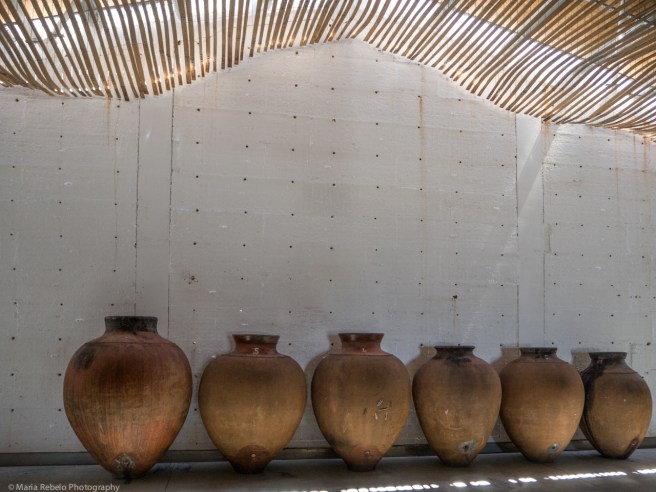
In Roman times, wine making was a simple affair. The grapes were crushed and stored in large clay amphoras where the fermentation occurred naturally. The skins, seeds, and stems were stirred. Then, the pomace fell to the bottom of the amphora, acting as a filter so that the wine, extracted through a spigot, ran clear.

Wine makers in Alentejo are using old amphoras, too large to be made in modern ovens, to revive these ancient ways of making wine.

We’ve been looking forward to trying these wines. After our recent visit to Esporão, we finally got our chance—we brought home a bottle of their amphora-made Moreto wine.

Drinking it was a grand occasion. After all, this was the kind of wine with which Caesar celebrated the conquest of Gaul, the wines with which Mark Anthony wooed Cleopatra. We closed our eyes and sipped the precious liquid. It tasted pure and clean. Suddenly, the Romans adage ‘in vino veritas,’ in wine truth, had a new meaning.

Extraordinary food in Estremoz

Composit Gadanha Mercerearia.jpg

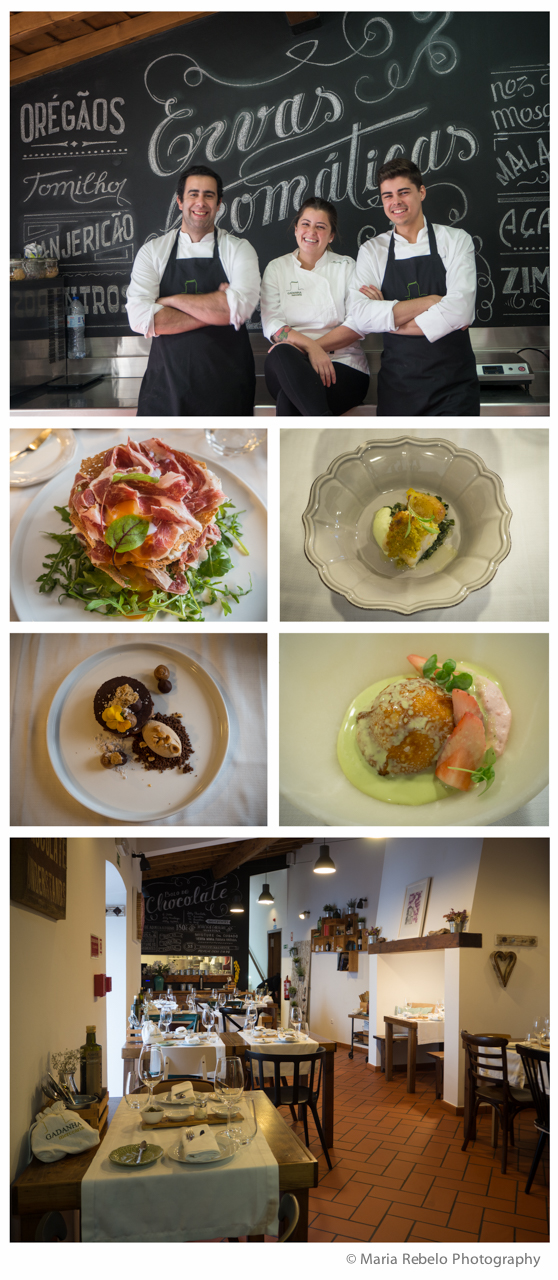
As soon as we entered, we felt that there was something special about Gadanha, a small restaurant in downtown Estremoz. The back wall is decorated with a chocolate cake recipe hand written by Michele Marques, the Brazilian chef who runs the restaurant. The dining room is furnished with old chairs and tables that give the place a cozy feeling.

We asked our waitress whether it was possible to sample a few items from the menu. Our culinary feast began with a plate of goat cheese, pears, walnuts and honey, accompanied by a thyme ice cream. This ethereal combination of flavors from Greece made us feel like gods dining on Mount Olympus.

A plate of delicious lamb croquettes paired with a roasted garlic aioli brought us back to earth. They were followed by one of the restaurant’s signature dishes: an ingenious “mille feuilles” constructed with thin slices of Alentejo bread, codfish and black pork prosciutto. The flavors of Alentejo shined on the next plate: a sausage called “farinheira” toped with fried quail eggs and accompanied by apple purée. The savory part of the meal ended with another signature dish: a delicious slow-cooked codfish topped with a crust made from cornbread, rosemary and thyme.

An extravagant combination of hazelnut and chocolate brought us to the realm of sweetness. It was followed by graceful “îles flottantes” covered with an orange crust, served with strawberries and a basil-infused crème anglaise.

We asked our waitress whether we could compliment the chef on our extraordinary meal. Michele came to our table with a radiant smile. We asked her an indiscreet question: “How does a Brazilian chef open a restaurant in the middle of Alentejo? “I fell in love with someone from Alentejo,” she told us. “That love waned but I liked Alentejo so much that I stayed.” We asked Michele where she gets her inspiration. “I did not grow up with the traditional recipes of Alentejo, I have a different culinary background.” she answered. “But I am inspired by the amazing products that the region has to offer.”

Michele introduced us to her business partner, Mário Vieira, her close collaborators, sous chef Alberto Muralha and pastry chef Gonçalo Carvalho, and all the dining room staff. “The restaurant is a team effort,” she stressed. “We’re all essential to the quality of the food and service. I have to pick the right people to make sure that everything we do, we do with love.“

It is clear that someday soon stars will shine on this restaurant in Alentejo. But we don’t need official accolades to know that Gadanha serves extraordinary food prepared with love.

Gadanha is located at Largo Dragões de Olivença, 84 A in Estremoz, tel. 268 333 262. Click here for their website.


The ducal palace of Vila Viçosa

Palácio Vila Viçosa

Portugal is a dream reborn in the prairies of Alentejo. In 1580, the king of Portugal died without an heir and the king of Spain inherited the throne of Portugal. After six decades of Spanish domination, a small group of nobles organized a coup to restore independence. They wanted to make Dom João of Braganza, a duke with royal blood who lived in Vila Viçosa, king of Portugal.

The king of Spain had arranged a marriage between Dom João and a Spanish aristocrat, Dona Luisa de Gusmão, hoping she would persuade the duke to support the Spanish rule. Instead, Dona Luisa became a passionate advocate for Portugal’s independence.

Dom João worried that the rebellion was likely to fail. He was willing to die for his country but did not like risking the fate of his wife and children. Dona Luisa convinced him to go forward with the words: “I would rather be queen for a day than duchess for life.” Portugal regained independence on December 1, 1640 and the duke became king João IV.

The ducal palace of Vila Viçosa is still owned by the House of Braganza. A visit to the palace is a rare glimpse into the domestic life of the royal family.

Dom Carlos, who ruled between 1889 and 1908, loved to vacation at Vila Viçosa. A talented painter, he covered the palace walls with his oils and watercolors. It was here that the king slept his last night before returning to Lisbon where he was assassinated.

There’s an elegant garden in the back of the palace that has no flowers. Catherine of Braganza, the Portuguese princess who married Charles II of England, banned flowers from royal gardens after learning that the king liked to pick them for his mistresses. In deference to Catherine, flowers were removed from the garden of the ducal palace.

The visit’s grand finale is the magnificent royal kitchen. It is equipped with 2.4 tons of copper pots used to prepare the elaborate banquets offered by the royal family to visiting aristocrats and foreign dignitaries.

If you’re traveling in Alentejo, don’t miss the chance to see the palace of Vila Viçosa, a retreat of kings where history was made.


A school lunch

OLYMPUS DIGITAL CAMERA

In 1940, the Portuguese government announced its “centennial plan,” a program to build a large number of primary schools. The schools in the north of the country, designed by Rogério de Azevedo, look austere with their granite and schist exteriors. The schools in the south, designed by Raul Lino, have graceful arches and whitewashed walls. Both designs used elements of the vernacular architecture and became integral parts of the Portuguese landscape.

With the number of children in decline, some of these schools have been closing. The school in the village of Cachopos near Comporta in Alentejo closed in the late 1990s but found new life as a restaurant appropriately called A Escola (the school).

The building is located in a beautiful woodland. Our arrival was greeted by the chirping of birds and perfumed by the scent of eucalyptus.

As we sat at the table remembering learning the three Rs, a plate of marinated rabbit and a carrot salad arrived. The menu has lots of great offerings, including cuttlefish rice with shrimp, fried eels, pasta with sea bass, stewed partridge, and rabbit pie with pine nut rice. The portions are generous and the food is delicious. A Escola is a great place to enjoy the simple, hearty cuisine of Alentejo.

On the school wall there’s an old map of the Portuguese empire. Those vast possessions of land and sea are long gone. But the empire of the senses–Portugal’s wonderful culinary tradition–continues to thrive.

A Escola is located at Estrada Nacional 253, Cachopos, Alcácer do Sal, tel. 265 612 816.


Perfect moments in Alentejo

Monte Barrão Composit

Many tourists drive from Lisbon to Algarve without stopping in Alentejo. If the beautiful landscapes you see from the highway tempt you to make a detour, you’ll be richly rewarded. Alentejo is a place where days are blessed by warm light and nights bejeweled by precious stars.

The best way to discover Alentejo is to stay at a local farm. Being surrounded by nature helps us put aside schedules and to-do lists to go where our senses take us: follow the scent of lavender, the sight of a stork in flight, the shade of an olive tree, or the chant of a local brook.

If you don’t have friends who own a farm in Alentejo, we can introduce you to Helena and João Borges. They receive guests in their beautiful farm near Alter do Chão through a program called Perfect Moments. You can take horseback ridding lessons, taste wines with their enologist, try the farm’s magical olive oil, eat wonderful meals cooked with local produce, and stroll through pristine fields painted with colors that no artist can rival.

Our friends Helena and João are wonderful hosts who are passionate about the land that has been in their family for centuries. If you visit them, you’ll have a great time and we bet you’ll become their friends.

Click here for the Perfect Moments web site.

The convent of the blue monks

Composit Évora

When we entered the Pousada dos Loios in Évora, we stepped on grounds that have seen war and peace, creation and destruction. The Arabs built a castle on this site that was destroyed by fire during the Portuguese war of 1383-85. In 1485, a local noble built a convent for the order of Loios on top of the castle ruins.

The villagers called the members of this order the blue monks because of the color of their robes. These religious men lived an austere life, working and praying in silence. Their serenity and wisdom led the royal family to choose them as confessors.

The convent was severely damaged by the 1755 earthquake and later rebuilt through the efforts of an enterprising priest. In 1834, Portugal abolished religious orders and the convent was closed down.

In 1963, the ancient building was converted into an historical hotel.  The cells of the monks were turned into comfortable rooms and elegant suites. The courtyard became a spacious breakfast room.

The Pousada is in the center of Évora and yet inside its thick stone walls the clatter of the city vanishes. Staying here for a few days felt like a long vacation. We were content and at ease in the convent of the blue monks.

The Pousada dos Loios in Évora is located on Largo do Conde de Vila Flor, tel. 351 266 730 070. Click here for the pousadas’ website and here for a large collection of photos of the hotel.


A tavern called Wednesday

Quarta-Feira rest composite

André Freire, the manager of the beautiful Évora pousada, urged us to try a tavern called Quarta Feira (the Portuguese word for Wednesday). “It’s a special place,” André said with a smile. “There’s no menu; you have to trust Zé Dias, the owner, and go with the flow.”

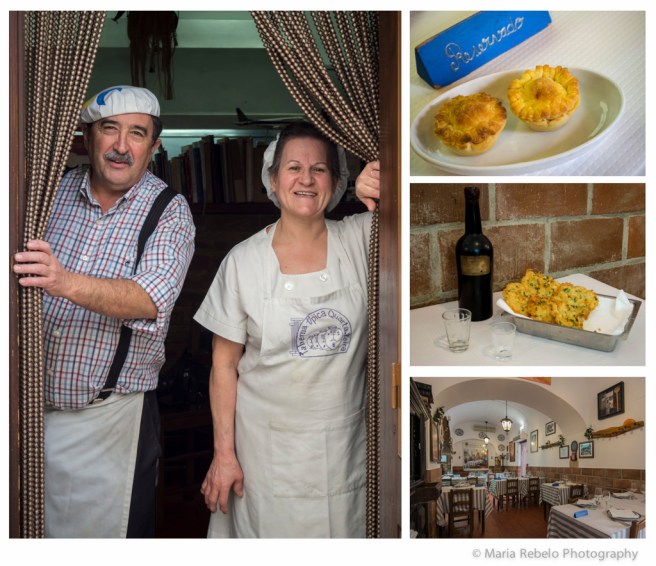
As soon as we entered the restaurant, we became friends with Zé Dias. He moved to Évora from a village in Beira Alta called Quarta Feira, the name he used for the restaurant. Dias worked as a typographer until he opened this tavern 25 years ago with Luisa Batista, a great local cook.

Dias’ enthusiasm for food, wine and life in Alentejo is infectious. Everything he serves comes from people he knows well, from the producers of cheese and sausages to the maker of the clay pots that are integral to Luisa Batista’s cooking. When we asked Dias how he managed to convince Paulo Laureano, a renowned Portuguese enologist, to make the house wine for Quarta Feira, Dias replied “Of course he said yes; we’ve been friends for a long time.”

Our dinner started with slices of local sausages and prosciutto made with black pork from Alentejo. Then a warm sheep cheese seasoned with oreganos arrived, busting with flavor. Next, we had some wonderful mushrooms cooked in mushroom water, seasoned with olive oil, garlic and coriander. “The secret is all in the timing,” Dias tells us and we believe him because at this point we believe everything he says.

The meal’s main event was the house specialty: black iberian pork shoulder marinated in wine cooked slowly in a clay pot. It was so delicious that our taste buds scintillated with delight. The dessert was composed of dried figs, walnuts, cooked quince, and samplings of two conventual desserts.

The meal ended with a glass of licoroso from Herdade do Mouchão. This sweet wine with notes of fruits and spices was a perfectly simple ending to a simply perfect meal.

Zé Dias is a philosopher king who disguises as a tavern owner so that he can share with his guests the joy of living in Alentejo.

Taberna Típica Quarta Feira is on Rua do Inverno 18, Évora, tel. 266 707 530.

Ebora cerealis

OLYMPUS DIGITAL CAMERA

If you’re traveling in Alentejo, follow the advice of ancient travelers and spend some time in Évora. The city is included in the Antonine itinerary and is mentioned in Pliny the Elder’s Natural History as Ebora Cerealis in reference to the surrounding fields of cereals.

Évora was occupied by Celts, Gauls, Phoenicians, and Persians. But it was Quintus Sertorius, the general who conquered the city in 80 B.C., that gave Évora its architectural jewel: a Roman temple with elegant corinthian columns. Known as the temple of Diana, it is more likely to have been dedicated to Jupiter.

There’s much to see in Evora: a beautiful basilica, elegant university buildings, and peaceful convents. And the food and wine are great everywhere.  You can choose a restaurant blindfolded and have a wonderful meal. If Pliny was writing today, he might call the city Ebora Delicia.

Adventures on the peach tree island

Composit do Pessegueiro-3One of the most captivating beaches in Portugal is the Pessegueiro (peach tree) beach near Porto Covo in Alentejo. It is wonderful to seat on the sand feeling the sea breeze and enjoying the view of the Pessegueiro island. The island looks so mysterious that it is impossible to resist the temptation to plunge in the emerald waters and swim a shore. It is great fun to explore the 15th century fort and the ruins that date from Roman times.

In the afternoon, it is fantastic to go horseback ridding along the coast. Claudia Castanheira and Paulo Rosa of Herdade do Pessegueiro provide all you need: well-trained, intelligent horses, horse-riding instruction, and a picnic. Riding a horse through trails and sand dunes, feeling one with nature is an unforgettable adventure.

Click here for the Herdade do Pessegueiro web site.

The sweet alchemy of Tecolameco

Tecolomeco

At the end of a wonderful meal at Flor de Rosa, a great historical hotel in Crato, Alentejo, the maître d’ brought us two slices of a dessert called Tecolameco. In our quest to eat fewer sweets, we decided to have only a small bite to be polite. But once we tasted this marvelous dessert, our will power vanished.

Tecolameco is made of sugar, eggs, almond, pork lard, butter, and cinnamon. There are many other Portuguese desserts made with these ingredients, but none tastes like Tecolameco.

It is said that an old chef found in the Crato castle an ancient book that revealed the meaning of life. All the pages were blank, except for the one with the recipe for Tecolameco.

Click here for the Pousadas’ website and here for more photos of Flor da Rosa.