A school lunch

OLYMPUS DIGITAL CAMERA

In 1940, the Portuguese government announced its “centennial plan,” a program to build a large number of primary schools. The schools in the north of the country, designed by Rogério de Azevedo, look austere with their granite and schist exteriors. The schools in the south, designed by Raul Lino, have graceful arches and whitewashed walls. Both designs used elements of the vernacular architecture and became integral parts of the Portuguese landscape.

With the number of children in decline, some of these schools have been closing. The school in the village of Cachopos near Comporta in Alentejo closed in the late 1990s but found new life as a restaurant appropriately called A Escola (the school).

The building is located in a beautiful woodland. Our arrival was greeted by the chirping of birds and perfumed by the scent of eucalyptus.

As we sat at the table remembering learning the three Rs, a plate of marinated rabbit and a carrot salad arrived. The menu has lots of great offerings, including cuttlefish rice with shrimp, fried eels, pasta with sea bass, stewed partridge, and rabbit pie with pine nut rice. The portions are generous and the food is delicious. A Escola is a great place to enjoy the simple, hearty cuisine of Alentejo.

On the school wall there’s an old map of the Portuguese empire. Those vast possessions of land and sea are long gone. But the empire of the senses–Portugal’s wonderful culinary tradition–continues to thrive.

A Escola is located at Estrada Nacional 253, Cachopos, Alcácer do Sal, tel. 265 612 816.


The convent of the blue monks

Composit Évora

When we entered the Pousada dos Loios in Évora, we stepped on grounds that have seen war and peace, creation and destruction. The Arabs built a castle on this site that was destroyed by fire during the Portuguese war of 1383-85. In 1485, a local noble built a convent for the order of Loios on top of the castle ruins.

The villagers called the members of this order the blue monks because of the color of their robes. These religious men lived an austere life, working and praying in silence. Their serenity and wisdom led the royal family to choose them as confessors.

The convent was severely damaged by the 1755 earthquake and later rebuilt through the efforts of an enterprising priest. In 1834, Portugal abolished religious orders and the convent was closed down.

In 1963, the ancient building was converted into an historical hotel.  The cells of the monks were turned into comfortable rooms and elegant suites. The courtyard became a spacious breakfast room.

The Pousada is in the center of Évora and yet inside its thick stone walls the clatter of the city vanishes. Staying here for a few days felt like a long vacation. We were content and at ease in the convent of the blue monks.

The Pousada dos Loios in Évora is located on Largo do Conde de Vila Flor, tel. 351 266 730 070. Click here for the pousadas’ website and here for a large collection of photos of the hotel.


Lisbon treasures

Composit Viuva Lamego

We’re often asked whether you can see Lisbon in a day or two. Sure, you can drink an espresso at Brasileira, take a brisk walk through Rossio and Terreiro do Paço, climb to Alfama to tour the castle, and rush right back down to go to Belém. Once there, you can try the famous Pasteis de Belém and go for a quick visit of the Jerónimos monastery and the Belém tower.

You’ll have seen a lot, but you will not know Lisbon. The city doesn’t reveal itself on a one night stand. To understand Lisbon, you must take the time to walk around and discover its many hidden gems.

One of these gems is Viúva Lamego, a store that has sold handmade tiles and ceramics since 1849. The blue-tiled back of the building faces the bustling Avenida Almirante Reis. If you walk around in search of the main entrance, you’ll be rewarded with the sight of one of the most exuberant facades in Lisbon.

There are many other jewels to discover in Lisbon: beautiful gardens, graceful architecture, quaint shops, enticing vistas, and wonderful neighborhood restaurants.

Those who discover some of these treasures get hooked and as soon as they depart, they start planning to come back.

The Viúva Lamego building is located on Largo do Intendente Pina Manique, 25.

Beauty in the details

Desenhos de Janelas
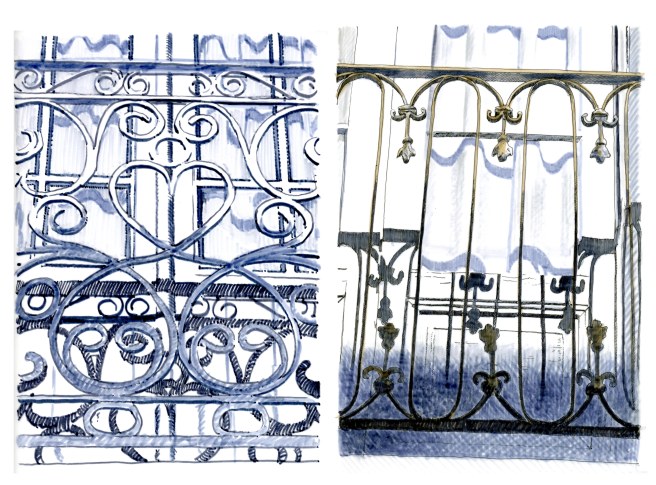
Varandas, Rui Barreiros Duarte, ink on paper, 2016.

When you visit Portugal you need to sleep well to rest your eyes, because as soon as you wake up there’s so much to see!

A walk in an old neighborhood is a visual feast of architectural details. Doors, windows, roofs, and balconies tell us about the craftsmanship of their builders and the dreams of their owners. Each is a distinctive brush stroke on the beautiful canvas that is Portugal.

The Estrela Basilica

OLYMPUS DIGITAL CAMERA

One of the buildings often found next to a Roman forum is the basilica. It served as a place where people could meet. Basilicas had no statues of Roman gods and had beautiful light that came in through windows near the roof, so they were a favorite gathering place for early Christians.

The plan of the basilica was later adopted for the construction of important churches. Lisbon has an elegant basilica at Estrela, built in 1790 by Queen  Maria I.

Few people seem to know that one can climb the stairs to the roof of the Estrela basilica and enjoy in peaceful silence breathtaking views of the city. It is a perfect place to meet Lisbon.

The rebirth of Lisbon

DCIM103GOPRO

One of the most beautiful monuments in Lisbon is a ruin. The Carmo convent, founded in 1389, was destroyed by the earthquake that stroke Lisbon on November 1, 1755. The convent’s gothic arches were left reaching towards the sky, asking questions for which we have no answers.

Today, Carmo is a place of peace and tranquility. For we know that from the ashes of the old city, a new Lisbon was reborn.

The Carmo convent is located in the homonymous Largo do Carmo in Lisbon.

The Alcobaça game

Alcobaça Composite

It can be hard to visit monuments with little kids, so it is always a good idea to engage them in a game. If you visit Alcobaça, a beautiful abbey in the middle of Portugal, you can ask your kids to go on a treasure hunt. They can look for stones with carved initials and photograph them. This game can turn an otherwise boring visit into a memorable one.

Masons often carved their personal marks on stones placed in the parts of the cathedral where they worked. They did it to show pride in their work but also to claim the work as theirs so they could get paid.

Centuries later, these signatures remind us of the humble people whose hard work created a legacy of enduring beauty.

A pink palace in the Algarve

358 - Pousada de Estói - @mariarebelophotography.comFIt takes a long time to build a beautiful palace. An Algarve aristocrat started in 1840 to build the Estoi palace in an estate near Faro. When he died, his son took over. But by 1893, the building was still unfinished and seemed destined to become a decorative ruin. It was then that a wealthy landowner bought the palace and spent a fortune on its completion. The sumptuous inauguration took place in May 1909. Decades later, the palace was abandoned.

In 2009, a century after its inauguration, Estoi opened once again, this time as a luxury historical hotel. It is a place out of a fairytale, its opulent salons and elegant gardens restored to their original glory.

Our stay at Estoi was an extraordinary experience. Some days, we relaxed by the pool and spent time admiring the statues, fountains and myriad of architectural details. Other days, we went to the beach and enjoyed the pleasures of the sea even more than usual. For we knew that when the day was done, we would have our pink palace to return to.

The Estoi palace is part of a network of historical hotels called Pousadas. Click here for the Pousadas’ website and here to see a large collection of photos of the palace.

The coolest bar in Lisbon

OLYMPUS DIGITAL CAMERA

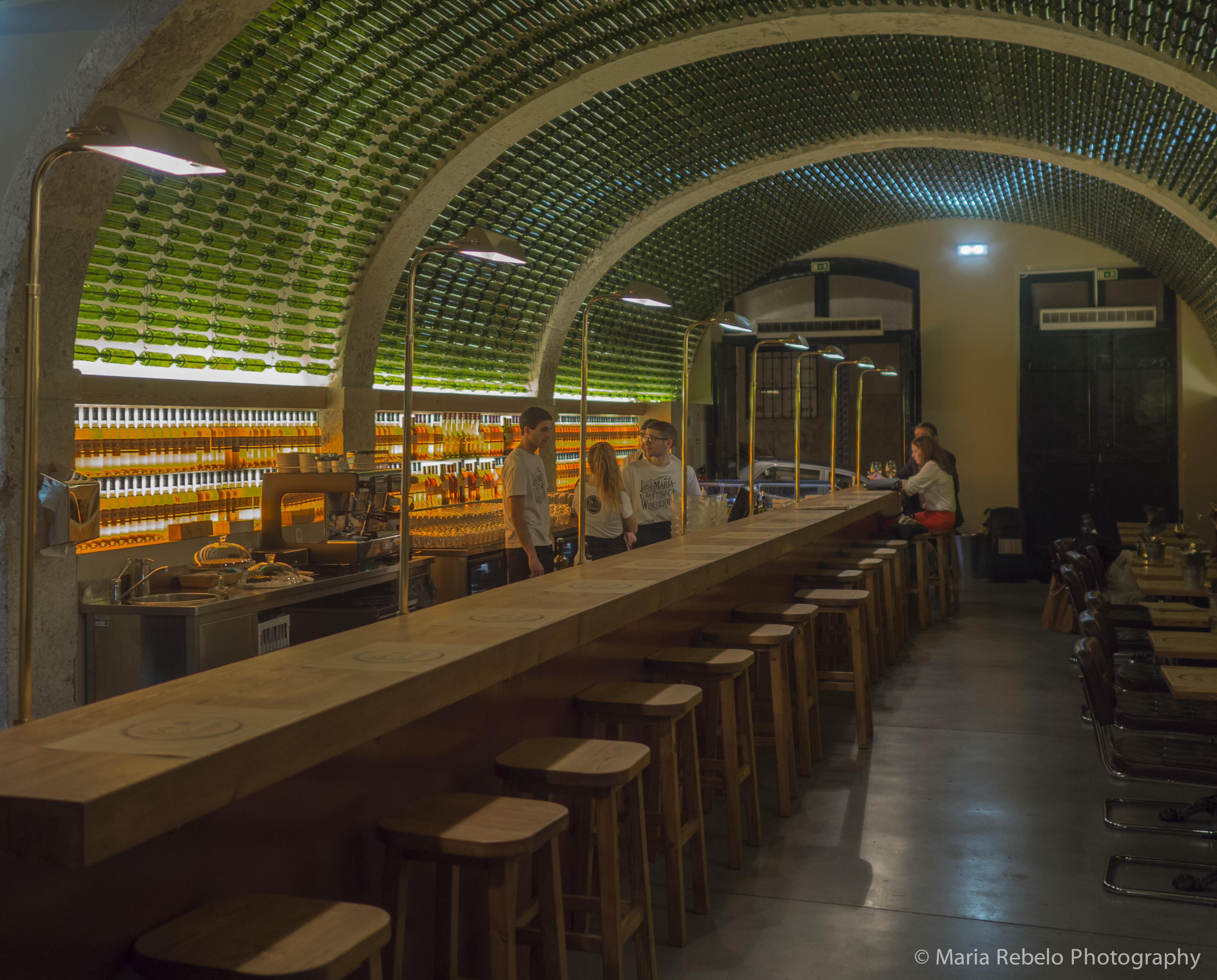
“By the wine,” the coolest bar in Lisbon, has a ceiling decorated with 3267 bottles of Periquita, one of the oldest table wines in Portugal. The bar belongs to Periquita’s producer, José Maria da Fonseca. This company has produced wine since 1834, including the famous Setúbal Moscatel.

“By the wine,” is the perfect place to have a few bites: slices of memorable sausages and prosciutto, cheese, and seafood.

José Maria da Fonseca stocks the bar with a great selection of wines, including some that are hard to find because they are produced in small quantities. It is a delight to try these unique wines surrounded by the beautiful people that give this bar a wonderful vibe!

By the Wine is on Rua das Flores, 41/43, near Chiado, tel. 213420319. 

Monserrate: a must-see palace in Sintra

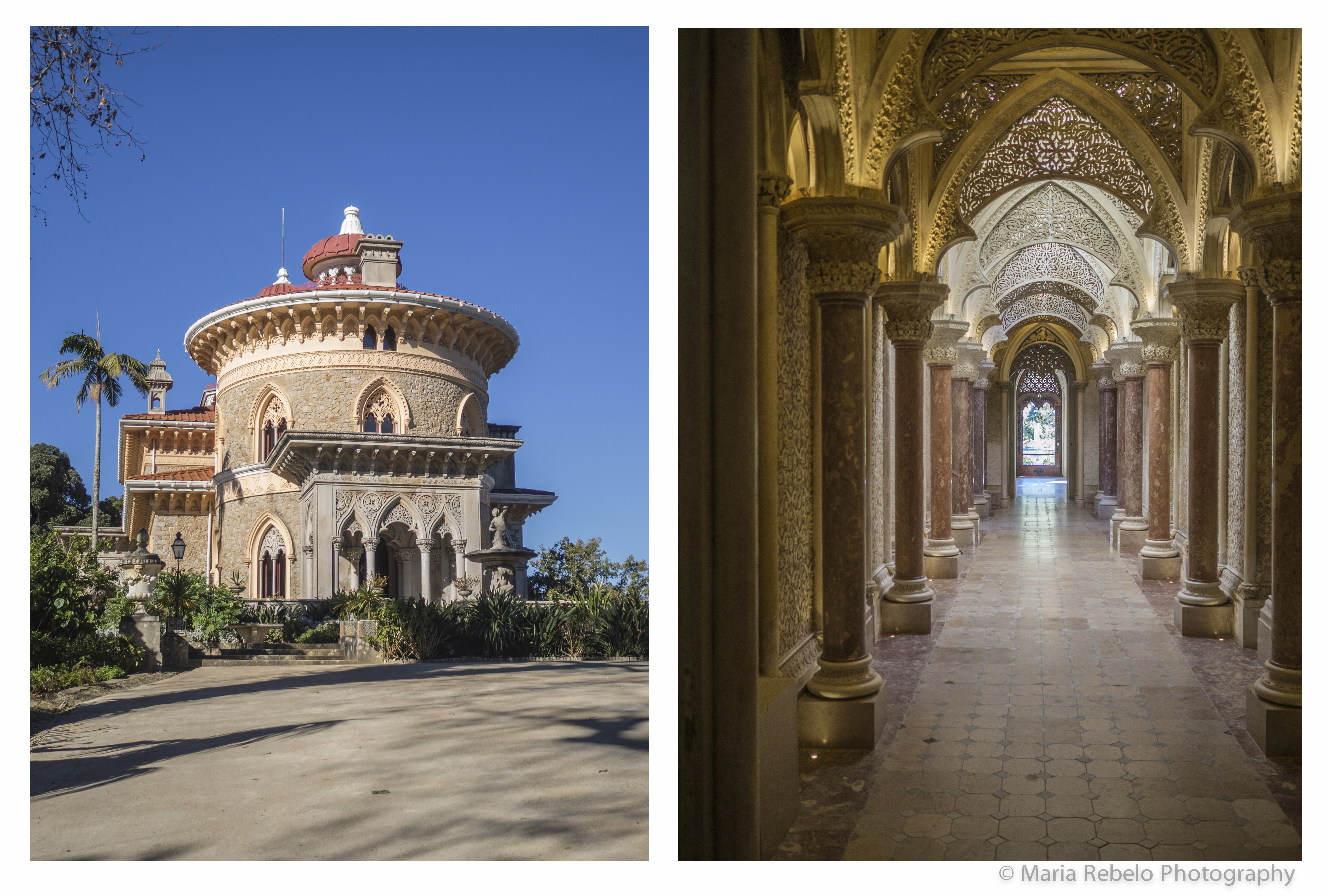
Monserrate - ©mariarebelophotography.comSintra has many romantic palaces but each has something unique to offer. One of our favorites is Monserrate, a palace surrounded by luscious gardens built in 1856 by Francis Cook, a famous British art collector.

When the Portuguese government bought the estate in 1949, the palace was in disrepair. The costly restoration work started in 1999 and only finished recently. It was worth the wait. We now have the privilege of seeing how the palace looked when the Danish writer Hans Christian Andersen visited it in 1866. Here’s what he wrote:

“Large white bell-flowers hang from one tree; pearl-shaped, rose-colored berries from another, juicy fruits and sun-filled colored flowers grew here. Down over the smooth velvet lawn rippled the clear spring water. Above this fresh green, the castle rose in Moorish style, a fit subject for the Arabian Nights or a romantic fairy picture. The sun sank into the sea, which became rose-colored; the brightness of the sea and sky was reflected magically upon the marble white walls and decorations, filling with light the large mirror-clear window panes. The air was so warm, so still, so penetrated with the perfume of flowers, that one felt carried away from reality.”