
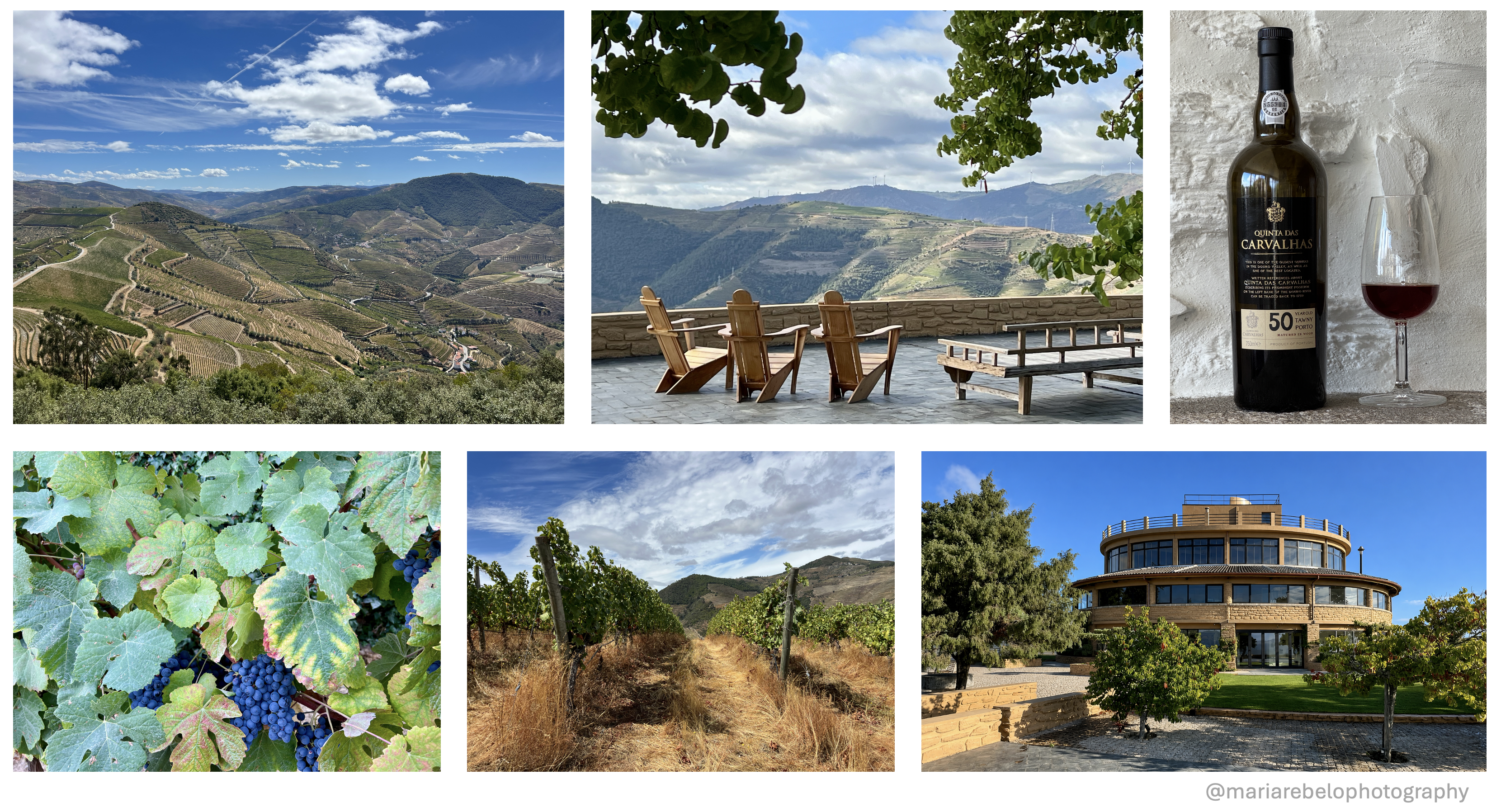
As you approach Pinhão, just before crossing the elegant iron bridge that spans the Douro river, a tall green gate quietly comes into view. It marks the entrance to Quinta das Carvalhas, one of the Douro Valley’s most remarkable estates.
Carvalhas belongs to Real Companhia Velha, founded in 1756 by the Marquis of Pombal, the powerful prime minister of King José I, to regulate the Port wine trade. In 1852, the government brought the company’s regulatory mandate to an end. Since 1960, Real Companhia Velha has been under the stewardship of the Silva Reis family. Today, Pedro Silva Reis leads the company alongside his sons, Tiago, who oversees its commercial activities, and Pedro Jr., an enologist.
The estate rises from the riverbank to an altitude of almost 500 meters. This variation in elevation allows both red and white grapes to thrive on the same property, something unusual in the Douro. Old vines cling to slopes facing every direction and at every altitude, creating a remarkable mosaic that offers the winemakers an exceptionally rich palette with which to work.
As we follow the winding road towards the summit, we find ourselves surrounded by an extraordinary abundance of life. The vines grow alongside olive trees, orange groves and wild vegetation. Carvalhas is far from a vineyard monoculture: biodiversity is deliberately nurtured and protected.
At the summit stands a round house. From there, the valley unfolds in a 360-degree panorama, offering the kind of view one imagines might be reserved for angels.
The estate’s resident viticulturist, Álvaro Martinho, takes us on a tour. He explains that temperatures can soar to 42°C in summer and fall to –3°C in winter. The soil contains little organic matter, yet life flourishes everywhere. The secret lies in the schist: fractured, porous and permeable, it allows water and oxygen to travel deep beneath the surface, sustaining microorganisms and encouraging the vines to send their roots several meters into the earth in search of nourishment.
These vines do not live amid abundance, but they find enough to flourish. Their yields are modest, yet their grapes possess remarkable intensity. This frugal existence also contributes to their longevity: some of the vines at Carvalhas are more than a century old.
In 2007, the estate stopped using insecticides and synthetic fungicides, replacing them with organic alternatives. The transformation was remarkable: leaves that had once appeared greyish green took on a vibrant hue.
Carvalhas is dotted with viewpoints from which visitors can pause and contemplate the magnificent landscape. But as the sun began to set, we gathered inside the round house for dinner.
Pedro Silva Reis invited two distinguished enologists to join us: Carlos Agrellos of Quinta do Noval and Jorge Moreira, head enologist at Carvalhas. Jorge spent the first seven years of his career at Carvalhas before leaving to focus on Poeira, his acclaimed family project. Seven years later, Pedro Silva Reis persuaded him to return to Carvalhas, where he now works while continuing to produce Poeira.
The delicious dinner, prepared with local produce, was accompanied by wines from Quinta das Carvalhas, alongside celebrated bottles from France and Italy. All were exceptional, but the Carvalhas wines linger in the memory like poems we long to know by heart.
The 2016 Reserva is a seductive wine of structure, depth and complexity. It blends grapes from vineyards with different sun exposures, including a very old north-facing parcel.
The Vinhas Velhas 2011 is elegant and slender, almost Burgundian in its restraint. When Jorge returned to Carvalhas, he recognized the potential of three north-facing parcels planted with vines nearly a century old. From them, he created this singular wine, foot-treading the grapes in granite lagares. It is intense yet astonishingly fresh, reflecting the vineyards’ cool northern exposure.
Then came Íncola, a wine born from a dream of Pedro Silva Reis Jr. Its name derives from the Latin word for “local inhabitant.” With haunting aromas, extraordinary tension and remarkable complexity, it comes from very old, south-facing vines and includes rare grape varieties such as Tinta Bastardinha and Rufete.
The meal concluded with a final revelation: the Quinta das Carvalhas 50-Year-Old Tawny. Layered, unctuous, and almost meditative, it is the perfect combination of age and youth. The blend, which includes wines from 1927, 1967, and 1978, can never be replicated; it is a once-in-a-lifetime composition.
We remained at the table, talking about wine and life until the candles burned low. The following morning, we awoke to find the valley dressed in soft light, with mist rising gently from the river. Still half-dreaming, we looked through the window and asked the only reasonable question: are we in heaven?


We went on a weeks river cruise up the Douro a few years ago but we would like to return by car. Which towns do you recommend and do you have any hotel recommendations
Here are our recommendations, have a great trip!