
Arinto is one of Portugal’s great historic white grapes. Its name appears in fourteenth- and fifteenth-century documents drawing on now-lost medieval records from the Monastery of Alcobaça and the variety is later mentioned by Vicêncio Alarte in his 1712 treatise, Agricultura das Vinhas.
Although now grown throughout Portugal, Arinto is most closely associated with Bucelas, a small region north of Lisbon—hence its traditional name, Arinto de Bucelas. Its naturally firm acidity produces fresh, precise white wines with remarkable aging potential.
Bucelas enjoyed an extraordinary reputation in nineteenth-century Britain, where its wines were known as “Portuguese Hock,” a reference to the white wines of Germany’s Rhine region. During the Peninsular War, the Duke of Wellington commanded the Anglo-Portuguese forces fighting Napoleon’s invading armies. In 1810, the French advance toward Lisbon was halted at the Lines of Torres Vedras, a vast system of fortifications extending through the countryside around Bucelas. Legend has it that Wellington developed a taste for the local wine during the campaign and later introduced it to British society.
But the English connection may be much older. In Shakespeare’s Henry VI, written at the end of the sixteenth century, a character offers “a cup of charneco,” a wine thought to have been produced in Charneca, a village near Bucelas.
Three expressions of Arinto
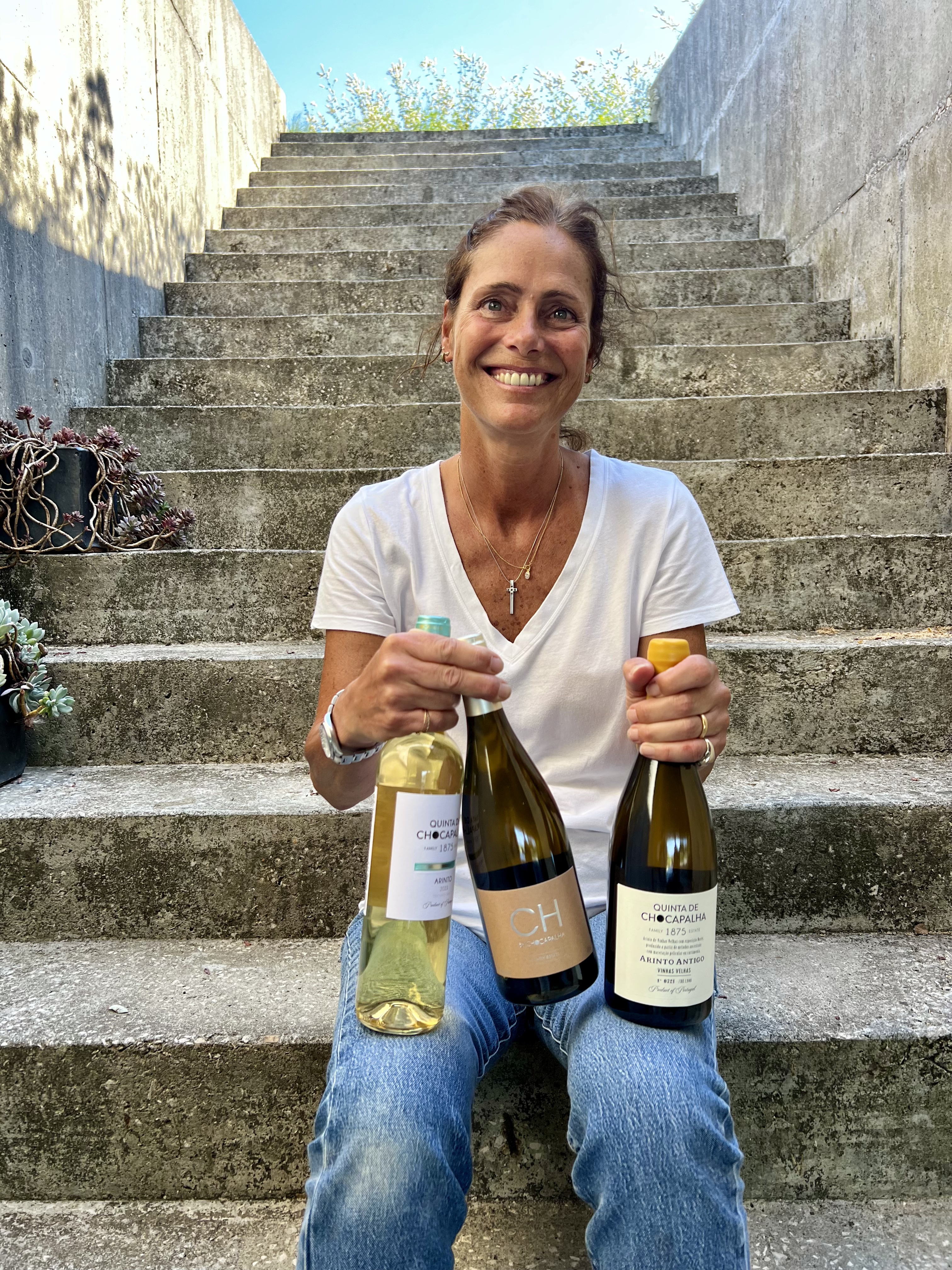
One of the best places to understand Arinto’s versatility and potential is Quinta de Chocapalha, an estate close to Bucelas that belongs to the Tavares da Silva family. Enologist Sandra Tavares da Silva makes the wines, and her sister Andrea (pictured in the photo) leads the project.
We visited Chocapalha on the first day of harvest. Andrea marked the occasion by photographing the talented group of young winemakers who had come from around the world to work at the estate, drawn by its distinctive terroir and by Andrea and Sandra’s uncompromising commitment to making great wine.
The team was finishing the day’s work, cleaning the equipment and scrubbing the floors until the winery was as pristine as a laboratory. A small speaker perched on a stainless-steel tank pumped out energetic music, helping everyone keep their spirits up at the end of a long day.
The sun was still shining generously when Andrea led us through the rolling hills covered in vineyards, speaking passionately about Arinto. Back at the winery, she showed us how three wines reveal different dimensions of the same grape.
The Quinta de Chocapalha Arinto shows the grape in its most direct and transparent expression. There is little between the grape and the glass. Fermented in stainless steel and aged for several months on its fine lees, it is pure and precise, with citrus and saline notes and a lovely sense of tension.
The CH Branco has a Burgundian character: elegant and structured, yet still unmistakably Arinto. Fermented in French oak and aged for nine months with bâtonnage, it retains the grape’s citrus freshness and firm acidity while gaining richness, texture, and volume on the palate.
Arinto Antigo explores an ancestral approach in which white grapes are vinified much like reds, with skin contact. The skins give the wine tannins, but they are remarkably fine. Produced from old, north-facing vines, it is aged for two years in neutral barriques. The result is greater salinity, tension, structure, and depth. This wine is both powerful and restrained. It is textured without heaviness, structured without losing freshness. It is the most complex of the three and perhaps the most striking demonstration of all that Arinto can be.
Few grapes can take on such different expressions while preserving such a clear identity. And few wineries can express those qualities with such grace.
Chocapalha is located at Aldeia Galega da Merceana, 50 km from Lisbon. You can schedule a wine tasting by emailing visitas@chocapalha.com. Click here for their website.

