
What if you could travel back in time to taste Port from the seventeenth and eighteenth centuries? In this installment of his masterclass on the Douro Valley, viticulturist António Magalhães takes us on that journey, tracing how tastes swung between dry and sweet wines.
His account unfolds through five milestones, one per century: 1678, 1756, 1820, 1932, and 2001. Along the way, three white Ports help us imagine how Douro Valley wines tasted in earlier times.
1678: The English Taste for Sweetness
Testifying before a committee of the British House of Commons in 1852, Joseph James Forrester presented export records that began with “the first pipe of port-wine shipped in the year 1678.” John Croft’s account is consistent with this chronology: in A Treatise on the Wines of Portugal, published in 1788, he wrote that English merchants had settled in Porto more than a century earlier.
These early wines catered to the English taste for sweetness. Francisco Rebelo da Fonseca, writing in 1782, recalled that by 1681 this preference had prompted growers to plant vineyards on the sunniest slopes along the rivers. British tastes were already shaping the Douro’s hillsides.
By 1754, however, this taste for sweetness had become contentious. In a bitter exchange of letters, Douro wine brokers accused British merchants of demanding wines that exceeded nature’s limits: they should burn like gunpowder, have the color of writing ink, and contain “a Brazil in sweetness.”
Adding brandy to interrupt fermentation offered a way to preserve that sweetness. In his Memoir, written in the late eighteenth century, Rebelo da Fonseca described the method: “after the must has been put into casks, brandy is added to it […] Brandy added to the fermenting must slows its fermentation; and if added in large quantities, it can stop it altogether.”
1756: The Rise of Dry Port
Founded in 1756, the Companhia Geral da Agricultura das Vinhas do Alto Douro, often called the Royal Company, imposed strict rules on Port production. Brandy could be added only after fermentation was complete, so drier wines became predominant.
Afonso Pereira Cabral, a Douro winegrower, described how these wines were made: “[…] fermentation was complete, and all the sugar had been converted into alcohol. In this state, the wine was put into casks without the addition of brandy and left to rest until the month of December. At this point, with any secondary fermentation completely finished, the wine was racked, and only then did it receive a small addition of brandy.”
The Royal Company was granted a monopoly over brandy production and wholesale trade within its territory. Winegrowers were allowed a narrow exception: they could use their own stills to distill spoiled wines and lees (the sediment left at the bottom of wine casks) from their production. Using foreign brandy was forbidden.
John Croft believed the ban deprived Port of better brandy. In his 1788 Treatise, he wrote: “If Port wines could be enriched and blended with the livelier spirit and more delicate aroma of French brandy, this would greatly help to temper their heavy nature, making them both healthier and more pleasant to drink.” The spirit used instead, he complained, was “strong and coarse.”
Winemakers needed to judge the strength of the spirit. In a paper presented to the Royal Academy of Sciences in 1790, Rebelo da Fonseca described the “ladder test.” A drop of pure olive oil was placed against the inside rim of a cylindrical glass filled with brandy. If it sank quickly to the bottom and stayed against the glass instead of drifting toward the center, the brandy passed the test.
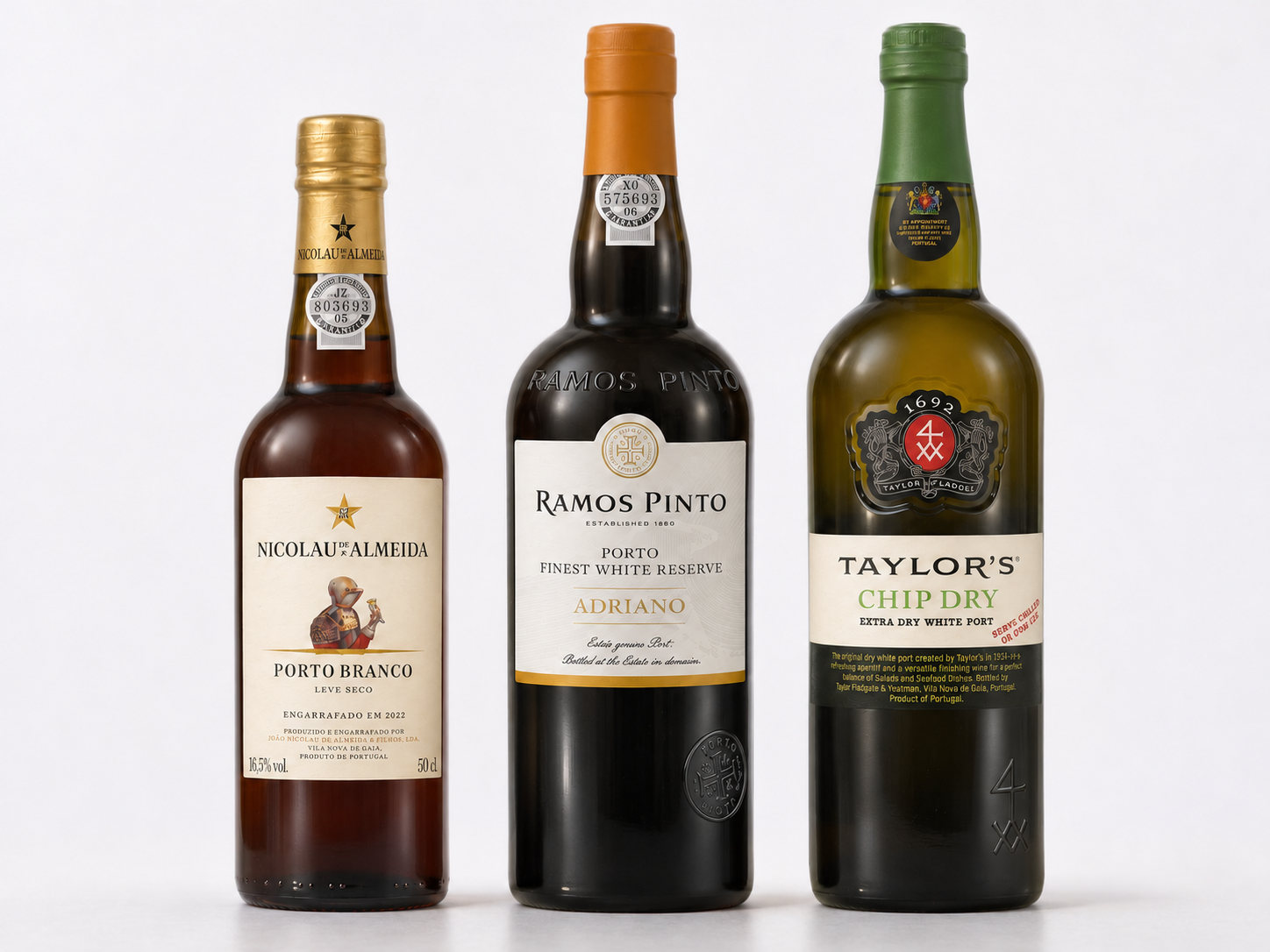
Pour a glass of Nicolau de Almeida’s Porto Branco Leve Seco, chilled to 6–10 °C (43–50 °F). With 16.5 percent alcohol and only 24 grams of residual sugar per liter, it suggests the drier, less heavily fortified style favored after 1756.
1820: The Return to Sweetness
In 1820, exceptionally ripe grapes produced juice unusually rich in sugar. Fermentation stalled before all the sugar was converted to alcohol, resulting in sweet, full, and soft wines. They were a sensation in England. Even Forrester, despite his later opposition to sweeter Port, acknowledged the vintage’s excellence. His quarrel was with what followed.
Merchants wanted to reproduce the 1820 style every year, demanding a consistency the vineyards could not deliver. Forrester believed wines should reflect their vineyard sites, their grape varieties, and the year’s growing conditions. The pressure to make them ever darker, stronger, and sweeter threatened to erase those differences.
Now taste Adriano Finest White Port, with 19 percent alcohol and 124 grams of sugar per liter, served at the same temperature as the previous Port. Its pronounced sweetness suggests the appeal of the richer wines that captivated English drinkers after 1820.
On October 8, 1844, Forrester invited vineyard owners and public officials to dinner at his quinta in Peso da Régua. Earlier that day, he had opened his cellars to guests and explained how he made his wines. At the table, he served only wines made according to what he called the “ancient system.”
When Forrester rose to speak, he attacked the demand for wines that were “black, strong, and sweet” and the practices used to satisfy it. Elderberries supplied color; other additions provided sweetness. The wine grading system encouraged these subterfuges: first-class wines had to have enough richness for themselves and some to spare for blending. A sound wine could be rejected simply because its color did not resemble ink.
Forrester blamed wine adulteration for the unsold stocks, falling prices, and damage to the Douro’s reputation. His solution was to “follow the ancient system” established under the Royal Company: let the wine ferment fully and add brandy sparingly. “Forty or fifty years ago, four gallons and half of brandy (20.5 liters) per pipe (534 liters) were reckoned, on an average, so that of course some wines had even less this quantity,” he recalled.
The French winemaking tradition likely contributed to Forrester’s unease about fortification, as if adding brandy was an enological sin.
Throughout the nineteenth century, dry wines (prova seca) and sweet wines (prova doce) coexisted alongside a moderately sweet style called prova adamada.
The timing of fortification and the amount of the brandy added determined the wine’s style. Added after fermentation, brandy preserved a dry wine. Added sooner, in sufficient quantity, it stopped fermentation, preserving some of the grapes’ natural sweetness. Sweeter Port could thus be made without the adulterations Forrester condemned.
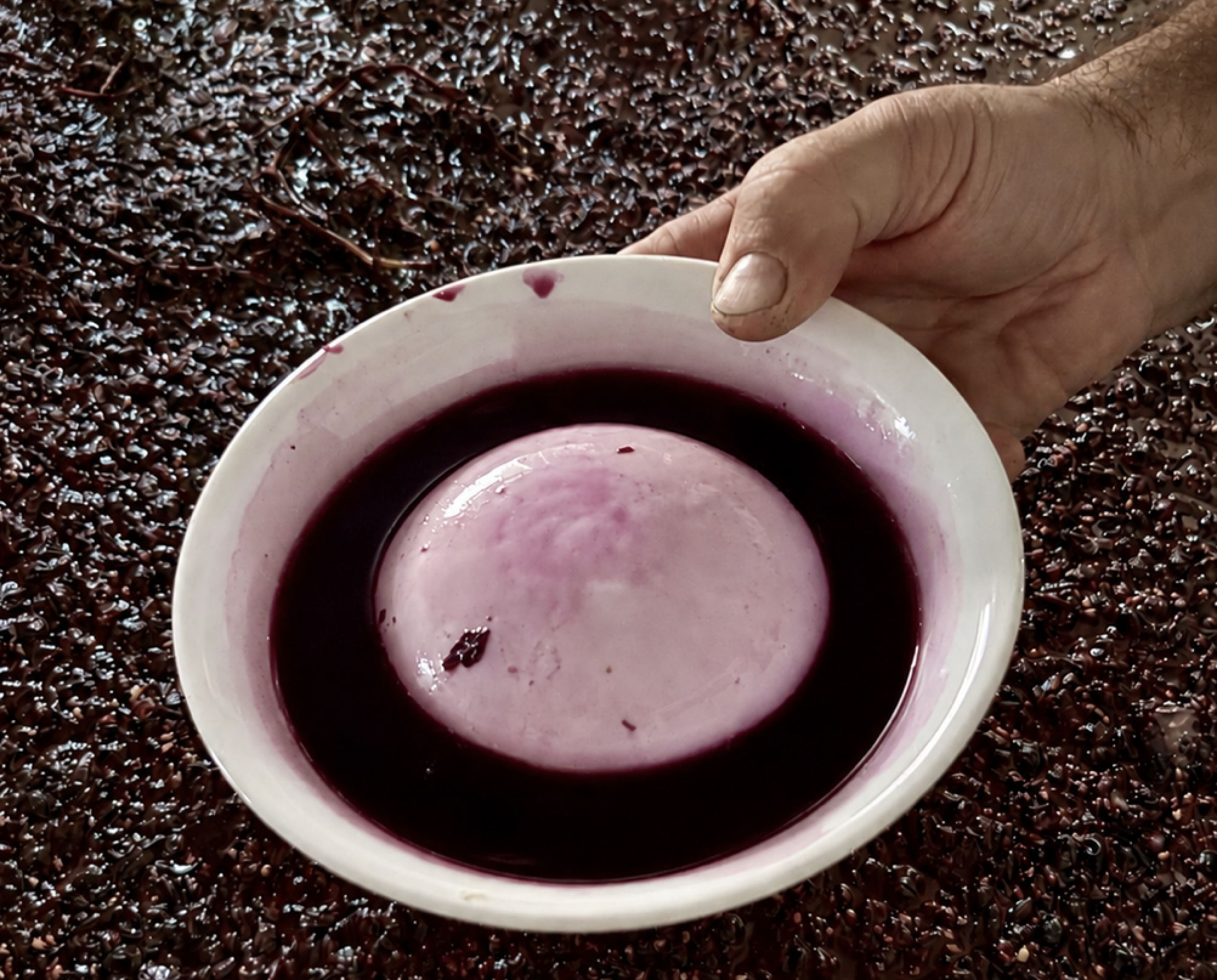
Wine and spirit flow slowly into the mixing vessel in carefully chosen proportions, forming what António calls “a marriage for life.” Under the older dry method, the winemaker could wait until fermentation was complete before adding the spirit; with sweeter Port, the winemaker had to act while the wine was still evolving.
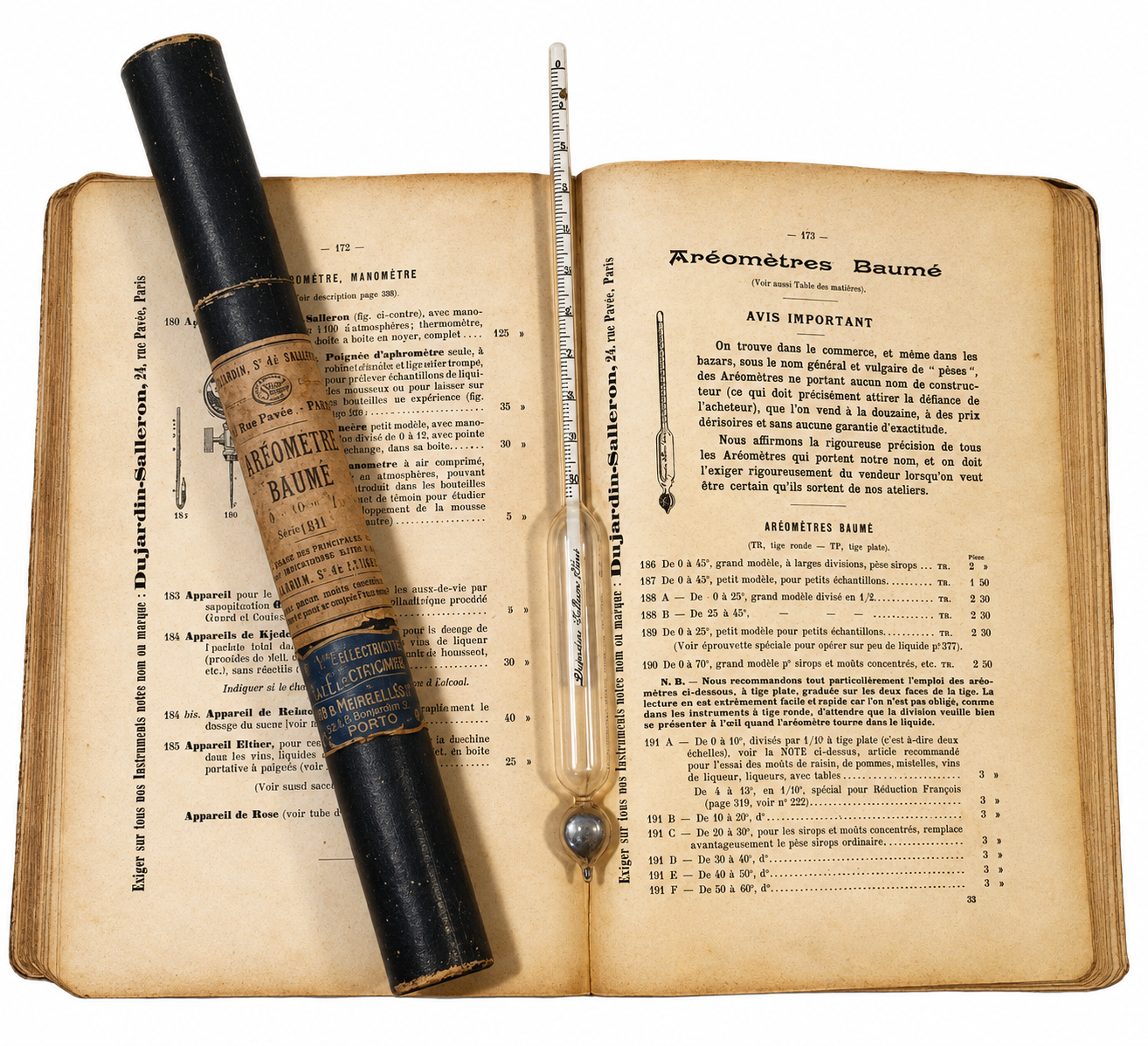
To decide when to fortify, winemakers relied on smell, taste, and the way the wine flowed across a shallow ceramic tasting vessel called tambuladeira. Measuring instruments gradually supplemented these methods. Baumé’s hydrometer, introduced in 1768, allowed winemakers to estimate the sugar content of grape juice by measuring its density. Dr. Guyot’s glucometer followed around 1860, with scales for density, sugar, and potential alcohol. Yet, experience remained essential for deciding when to fortify.
During this period, the dry style still had its champions, including John Alexander Fladgate, who directed Taylor, Fladgate & Yeatman and owned Quinta da Roeda. In 1869, the Viscount of Vila Maior described changes Fladgate had begun two years earlier. Fermentation continued until the wine was dry, and brandy was added only afterward. Some wine was kept unfortified until May, then shipped to Porto and onward to England.
Fladgate was also exacting about the spirit’s purity. Such care mattered especially for sweeter Ports, where spirit could account for roughly a fifth of the finished wine. A flaw in the spirit would taint the whole blend. António sees the same care in Fladgate’s descendant, David Guimaraens, Taylor, Fladgate & Yeatman’s chief winemaker.
1932: Defining Modern Port
In the twentieth century, clearer rules and increasingly precise measurements helped define the range of Port styles we recognize today. Casa do Douro was established in 1932 to represent growers. The exporters’ guild and the Port Wine Institute followed in 1933. Together, these institutions regulated production and trade and protected the wine’s quality and origin.
Our third white Port, Taylor’s Chip Dry, was first produced in 1934. With 20 percent alcohol and 34.6 grams of sugar per liter, it combines the strength of modern Port with restrained sweetness. Winemakers add the brandy later in fermentation, after much of the sugar has been converted to alcohol.
2001: Dry Douro Wines
António’s final milestone is 2001, when a new statute was approved for the Douro denomination of origin. Dry, unfortified wines were already part of the region’s tradition; the statute set out the rules for the DOC Douro designation.
Today, the Douro offers both dry, unfortified wines and Ports ranging from extra-dry to very sweet. And the old demand for “a Brazil in sweetness” can be satisfied without resorting to adulteration.
At his 1844 dinner, Forrester raised a toast to the prosperity of the Douro Valley and the restoration of its wines’ reputation. Nearly two centuries later, he would have reason to celebrate both.

