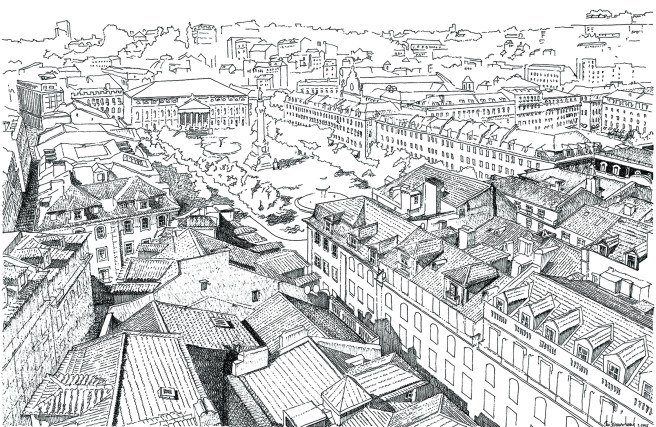
Rossio, Rui Barreiros Duarte, ink on paper, December 2016.
We envy the early risers. They see Lisbon wake up, dress in pale blue light, put on a cinnamon fragrance and get ready to enchant its visitors.
We’re often asked about the drawings used on our blog. They’re the work of architect Rui Barreiros Duarte. For the first time, he’s selling a few original drawings like the one on this post. The sizes are around 60 cm x 40 cm and the prices around 200 euros. If you’re interested, email apprbd@gmail.com .
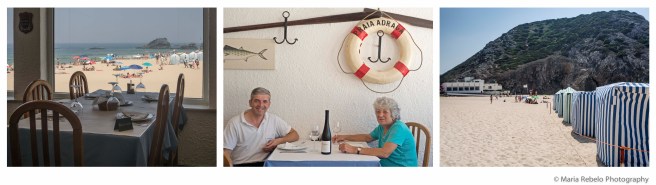
When we were very young, our parents used to take us to an idyllic beach with crystal blue waters and natural rock archways sculpted by the sea. In the end of the afternoon, we often had dinner in a small restaurant right on the beach. It was simple fare: “percebes” (gooseneck barnacles), grilled fish, and salad. But the flavor and aromas were amazing and so was the spectacle of the sun setting on the ocean. We forgot the name of the beach and that is just as well, for places change and fail to live up to our memories of them.
During a visit to Sintra this summer, we decided to have lunch in the nearby Adraga beach. As soon as we arrived, we realized that this was the beach from our childhood! There were little kids playing in the same rock archways we once loved and bathing in the same blue waters we so much enjoyed.
We sat at the beachside restaurant and ordered “percebes,” grilled fish, and salad. We kept our expectations low. Surely, the food has changed. Then the seafood and fish arrived, fresh, full of flavor, meticulously prepared. It was as if we were going back in time, to a simplicity and authenticity that are so rare today.
We complimented Jorge Pimenta and his mother Suzette, the restaurant owners, on the quality of their food. They responded with modesty: “Everything we do is simple but we try to do it well. The percebes were caught this morning right on the beach. The fish is very fresh. All we do is respect the ingredients that the sea brings to us.”
The reasonably-priced wine list has many great choices. But in a restaurant where everything is local, it makes sense to drink the magical wine produced nearby in Casal de Santa Maria by a Russian Baron who is 103 years old.
The same family has owned the Restaurante da Adraga for four generations. In the beginning of the 20th century, queen Dona Amélia used to come here to eat fish while the king hunted in the Sintra mountain. One century later, the Adraga restaurant continues to delight anyone who loves great food, whether or not they have royal blood.
Restaurante da Adraga is located at Praia da Adraga, 143, Sintra, tel. 219280028. Reservations are a must. Ask for a table near the windows facing the beach for a spectacular view.
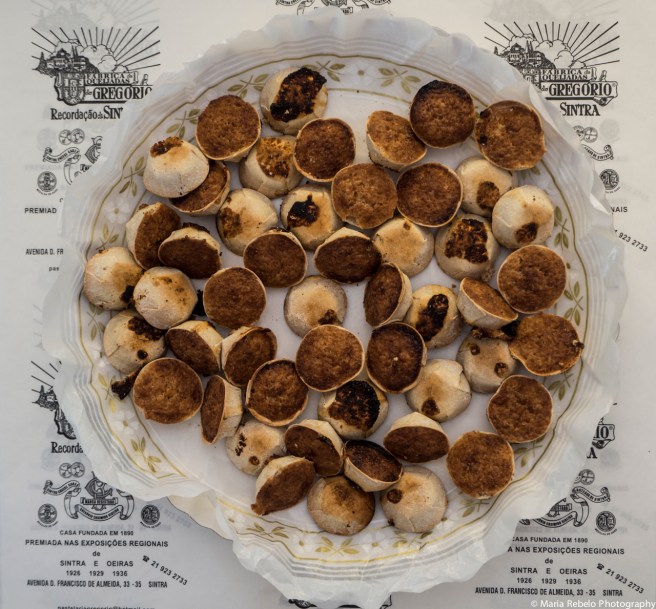
The road to Sintra is paved with sweet temptations. We stopped for a coffee at Pastelaria Gregório and couldn’t resist eating one of their travesseiros (pillows). They were still warm, the layers of dough fusing with the rich almond cream. Our palates were so delighted that we asked for a queijada, another classic Sintra pastry. A plate with several miniature queijadas arrived and, although we tried, it was impossible to eat only one.
Gregório Ribeiro started producing and selling these wonderful queijadas in 1890. The business continues to be in the family. Gregório’s great-grandchildren work at the pastry store, making sure that the quality is exceptional, baking the pastries in small batches so that everything is fresh out of the oven.
There was a constant flow of regular customers who came in for their favorite sweet treats: almond tarts, bolos de amor (love cakes), broas de mel (honey cakes), and much more. We asked Teresa Matos, the owner of Pastelaria Gregório, whether they’re always this busy.
“Christmas is our toughest season,” she answered. “Customers love our traditional Bolo Rei (king’s cake) so there’s always a long line outside the store. We know it’s frustrating to wait for so long to buy our cake. But we don’t want to bake the cakes in advance because they lose their freshness.”
“Is the cake really worth the wait?” we asked. “You need to decide for yourself,” said Teresa with a mischievous smile. In December we’ll be waiting in line to find out.
Pastelaria Gregório is located at Av. D. Francisco de Almeida 33/35 in Sintra, tel. 219-232-733.
We love showing Lisbon to our friends. It is a joy to stroll through streets where so much history was written, admiring the old architecture, visiting interesting shops, stopping by beautiful cafés for coffee and pastries. So, when VoiceMap invited us to record a voice-guided walking tour of Lisbon, we didn’t hesitate.
VoiceMap is a new company that produces GPS-based walking tours. To go on a tour, all you need is a smart phone. You can download the tour in advance and use the maps offline.
Their app shows you a map with your current location and where you should go next. The audio is synchronized with the map, so you can walk at your own pace while your guide tells you about what you’re seeing. It is a great way to immerse yourself in the place you are visiting.
Our tour is about the relationship of Lisbon with the Tagus river. We start at Chiado, by the iconic Brasileira coffee shop, and stroll down to Baixa, the area of downtown Lisbon that was rebuilt after the 1755 earthquake. On the way, we tell you about everything from myths and legends to royal gossip. We show you the architecture and the views of the Tagus river that inspired so many poets. And we end the tour with a celebratory drink in the most beautiful esplanade in Lisbon. Come join us!
Click here to download our VoiceMap tour of Lisbon.
When we were young, every September our family ate fried eels that came from Murtosa, a small town in the estuary of the Vouga river. The eels were marinated in “escabeche,” a sauce made with olive oil, white wine, onions, paprika, laurel, and vinegar. These ingredients were combined according to ancient rules of alchemy so that when the eels, the sauce and boiled potatoes were placed on the plate, they transformed into culinary gold.
Eels are mysterious creatures. They spend their early years in fresh river waters. After reaching maturity, they swim to the middle of the Atlantic ocean to lay their eggs in the Sargasso Sea. The baby eels swim back in search of fresh river water and the cycle of life restarts.
How do the infant eels know where to go? And why do the best tasting eels end up in Murtosa? These are inscrutable mysteries.
Before refrigeration was available, the Murtosa eels were a local delicacy. The fisherman ate them fried or in a “caldeirada” that combines the fish with potatoes, tomato, onion, garlic, olive oil, lard, herbs, and spices.
In the first half of the 20th century, some local cooks started marinating fried eels in escabeche sauce. First they packed them in wooden barrels and later in tin cans. These marinated eels gained great fame and popularity in the center of Portugal.
Over time, eels became scarce, the number of fisherman declined, canning factories closed, and it became hard to find marinated eels. So imagine our surprise when, strolling in downtown Lisbon, we found a store called 1942 that specializes in marinated eels from Murtosa! The cans come from a factory that has been processing eels since 1942.
We took this precious find home and opened the can slowly, preparing to be disappointed. But, when we placed the eels, the sauce and boiled potatoes on a plate, the old magic flavors came to life and we felt young again.
The 1942 store is located on the corner of Rua da Conceição and Rua da Prata in Lisbon (tel. 21-599-9890).
If you arrive in Lisbon by ship, you might understand how Portuguese navigators felt as they entered the tranquil waters of the Tagus river to glide into the city’s warm embrace.
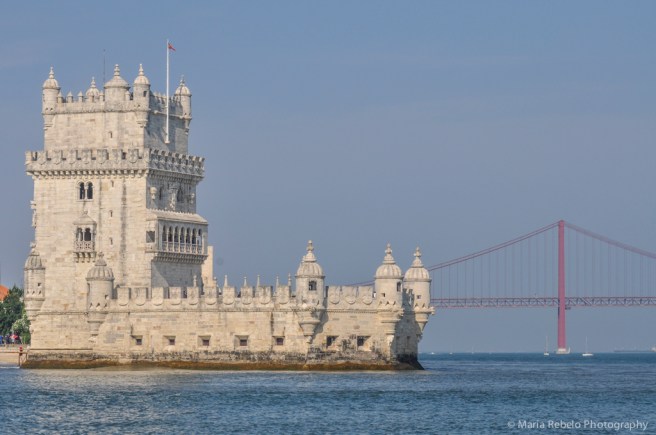
The Belém tower
Every week, a Royal Caribbean cruise ship treads the same waters where Vasco da Gama once sailed to bring its passengers to Lisbon. The cruise operator asked us: what is the best way for our passengers to spend 10 hours in Lisbon? This post is about our suggestions.
The most convenient way to travel in Lisbon is to take taxis. Their fares are relatively inexpensive and the drivers are experts at navigating the narrow streets of the old neighborhoods. Traffic can at times be heavy, so it is a good idea to plan on taking about 30 minutes to travel between the three locations we describe below (Belém, St. George’s castle, and Chiado).
Morning
We recommend for your first stop the Antiga Confeitaria de Belém (Belém’s Old Pastry Store, Rua de Belém, 84-92).
Belém
When the religious orders were abolished in 1834, the monks of the Jerónimos monastery started selling custard tarts to earn some income. These tarts, which became known as “pasteis de Belém,” gained great popularity.
Pasteis de Belém
The convent’s pastry chef sold the recipe to an entrepreneur who opened the Confeitaria in 1937. Today, this pastry store continues to thrive as one of Lisbon’s most popular destinations.
Unlike the “pasteis de nata” you find elsewhere in the city, these custards are best enjoyed while they’re still warm. The Confeitaria is always full and there’s often a long line of people waiting to order. We suggest that you bypass the line and go to the large room in the back where you can sit down and enjoy these pastries without waiting.
The Jeronimos Monastery
Next, we recommend a visit to the Jerónimos monastery. Financed with a tax on the gold, silver and spices brought from Africa and the Far East, its construction began in 1501 and finished only one century later. It is a masterpiece of the Manueline, a Portuguese gothic style that uses nautical motifs, such as sirens, nets, ropes, corals, and seaweed. See if you can spot these motifs during your visit.
Inside Jerónimos, you’ll find monuments to two Portuguese heroes. The first is Luis Vaz de Camões, the author of a famous epic poem about the exploits of Portuguese navigators in “seas that had never been sailed, facing perils and wars with force that is rare in humans.” The second is Vasco da Gama, the navigator who discovered how to sail from Portugal to India. This discovery allowed Portugal to bring rare spices from the Orient, such as pepper, clover and cinnamon, and sell them for extravagant prices in Europe.
After visiting Jerónimos, walk towards the Tagus river to the monument to the discoveries. In the 15th century, the river came close to the monastery, so you are walking on land claimed from the Tagus.
The monument to the discoveries was first built in 1940 with plaster and then rebuilt in 1960 with cement and stone. It features the statues of navigators, and other important protagonists of the age of discovery.
Monument to the discoveries
Henry the Navigator, the prince who sponsored Portugal’s first naval explorations, has pride of place in front of the monument. Some say his stern demeanor comes from contemplating the perils that Portuguese explorers had to face. Others, think that he is afraid of being pushed into the river (despite his nautical fame, prince Henry did not know how to swim).
There are a few additional activities available in Belém. You can take the elevator to the top of the monument to the discoveries for a breathtaking view of the river and the city. You can also walk to the beautiful Tower of Belém, a defensive structure built in the 16th century to guard the city from pirates and other foes. If you’re traveling with kids, you might want to visit the nearby Coach Museum (Avenida da Índia, 136). It has a beautiful collection of ancient coaches.
Lunch
We have three lunch suggestions. Wherever you choose to go, if you find clams Bulhão Pato on the menu, order them. They are culinary poetry.
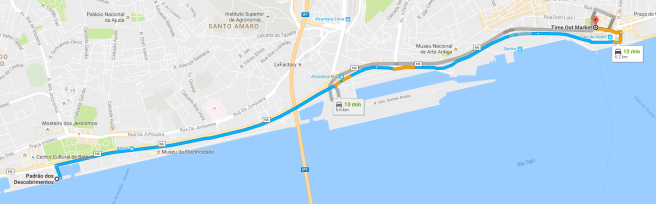
For a quick lunch, visit Mercado da Ribeira (Avenida 24 de Julho, 49).
From Belém to Mercado da Ribeira
You can tour the beautiful food market to admire the freshness of the fish and produce. Then, walk over to a large food court set up by Time Out magazine where many of the top chefs in Lisbon have stalls.
Time Out food court at Mercado da Ribeira
It is always crowded, but it offers a wide selection so you can sample well-prepared versions of many popular Portuguese dishes. Seafood rice, codfish cakes, and roasted piglet (leitão assado) are obvious choices. Paired with a glass of Portuguese wine, they make a great meal.
Afternoon
If you have lots of energy left, we suggest you take a taxi or a tuk tuk to St. Jorge’s castle.
Otherwise, take a taxi to Chiado.
St. George’s castle was occupied by the Romans, the Visigoths and the Moors. Dom Afonso Henriques, the first king of Portugal, conquered the castle in 1147 and built there the first royal palace. The castle has beautiful views of the city. It is great fun to wander around in Alfama, the neighborhood between the castle and the Tagus river.
Mercado da Ribeira to St. Jorge’s castleLisbon’s tuk tuks.
It is Lisbon’s oldest neighborhood, the only one to survive the devastating 1755 earthquake.
Next, we recommend you go to Chiado. One fun way to get there is to board the famous tram 28 (but please watch out for pick pockets on the tram). Alternatively, you can take a taxi.
St. Jorge castle to Chiado
Once you reach Chiado, you can participate in an important debate. On the corner of the Camões plaza you’ll find Manteigaria (Rua do Loreto, 2), a new “pastel de nata” store. Try their custard tarts and compare them to the ones you tried in Belém. Which ones do you like the best? We eagerly await your views in the comments to this post!
You can now walk towards Lisbon’s most famous café, A Brasileira (Rua Garrett, 120).
A Brasileira
Inaugurated in 1905 to sell coffee from Brazil, it quickly became a popular meeting point for painters and writers. Go in to see the interior. In the esplanade, you’ll find the bronze statue of Fernando Pessoa, a great Portuguese poet who often came to A Brasileira to write.
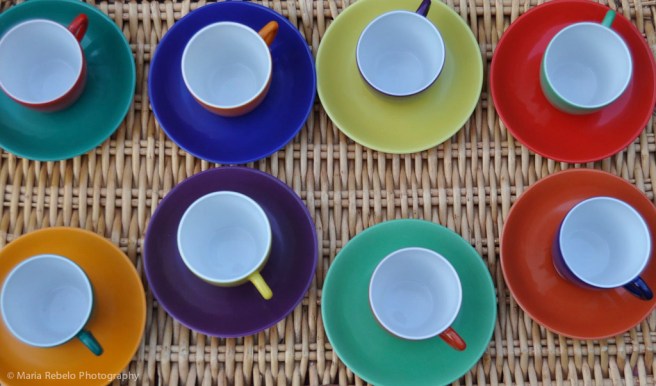
If you’d like to buy a gift for a friend, check out the Vista Alegre porcelain store (Largo do Chiado 20-23). They have beautiful plates and the world’s most perfect tea and espresso cups.
Espresso cups from Vista Alegre
Now you have two options. The first is to take a walking tour (all downhill) with us as your guide. Click here to log on to VoiceMap to download the audio tour and we will guide you through the streets of Lisbon.
Chiado to Ribeira das Naus
The second option is to take a self-guided walking tour.
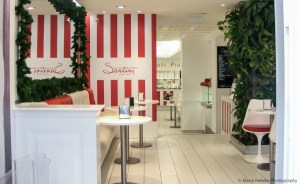
Santini ice cream store
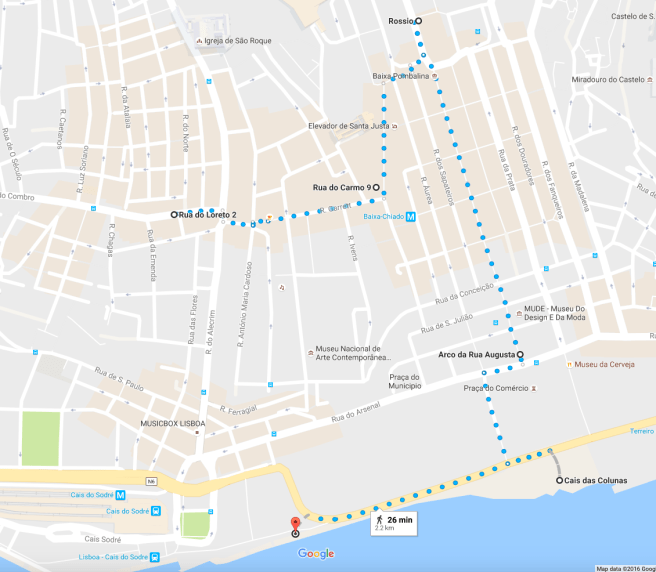
We recommend that you go down on Rua Garrett and turn left on Rua do Carmo. You can stop at Santini (Rua do Carmo, 9) to try one of their famous ice creams. Continue on Rua do Carmo until you reach Rossio, one of Lisbon’s main plazas.
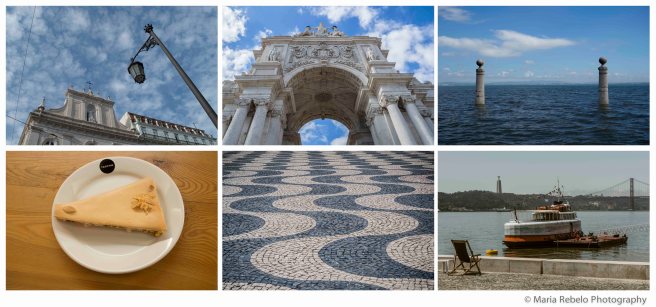
Cross the plaza and find Rua Augusta. Keep walking towards the river until you reach the Rua Augusta arch. On your left, you can buy tickets to take an elevator to the top of the arch which offers spectacular views of downtown Lisbon.
View from the top of the Rua Augusta arch
Once you cross the arch, you are in Terreiro do Paço, also called Praça do Comércio (commerce plaza). This is the place where the second royal palace was located before it was destroyed by the 1755 earthquake. It was here that king Dom Carlos and his son were assassinated in 1908 by revolutionaries. Two years later, in 1910, Portugal became a republic.
We recommend that you walk past the statue of king Dom José towards the two columns on the river. This is the “cais das colunas” (the pier of the columns).
Cais das colunas
In the days when most visitors arrived in Lisbon by sea, this pier was the port of entry for VIPs. Now walk towards Ribeira das Naus, the place where the caravels used to be built and repaired.
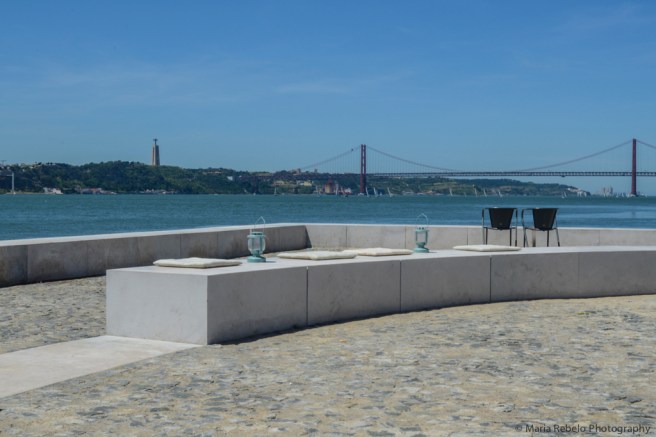
There you’ll find the most beautiful esplanade in Lisbon. We recommend that you order an aperitif from the kiosk. Our favorite is Favaios, made in the Douro from moscatel grapes. Sit on a chair and enjoy the magnificent view.
Ribeira das Naus esplanade.
We hope you have enjoyed your 10 hours in Lisbon. You have seen a lot, but Lisbon does not reveal all its charms on a first date. We look forward to seeing you back; our blog will be here to guide you.
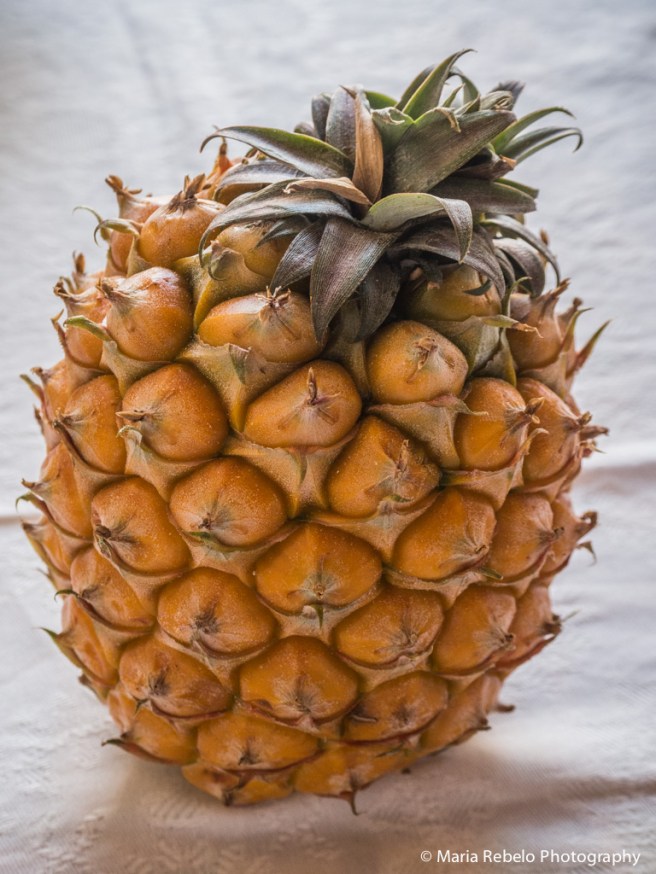
The ancient gods of Greece and Rome satiated their hunger with ambrosia, a food with exuberant colors, an elegant aroma and a taste that has the perfect combination of sweetness and acidity.
No one knows what this divine food looks like except the people from the island of São Miguel in Azores. It is an open secret that ambrosia grows in the island in the form of a small pineapple.
While other places produce ordinary pineapples meant for human consumption, São Miguel produces extraordinary pineapples meant for the gods.
If you visit the island, don’t miss the chance to try this transcendent food. Just make sure the gods are not looking.
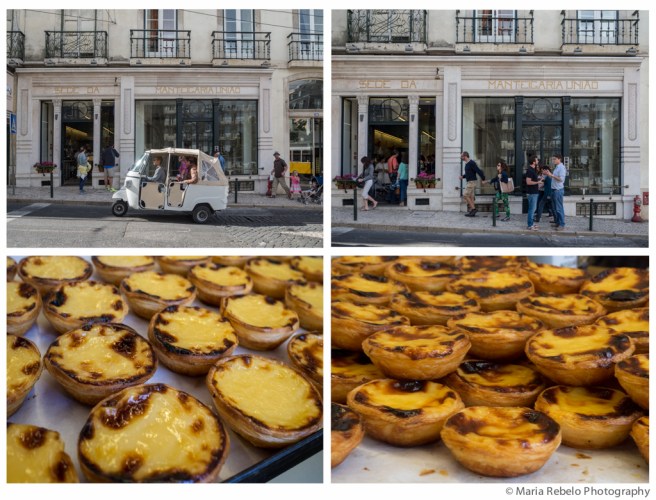
What is the best pastel de nata in Lisbon? The answer depends on our mood. Some days, we like them perfumed with lemon. Other days, we prefer them scented with vanilla.
Our current favorites are the lemony kind. They are made by Manteigaria in Praça Camões near Chiado at a location that was once occupied by a butter shop (manteiga is the Portuguese word for butter). Perhaps as an homage to the past, Manteigaria’s pasteis have a buttery taste. The crispy crust and the rich filling are so satisfying that they make us feel, for a moment, that we discovered the meaning of life.
Whenever a new batch of pasteis comes hot out of the oven, Mantegaria’s cashier rings a bell. You’ll see people dropping what they’re doing and rushing to Manteigaria in search of a moment of sweetness.
Manteigaria is located on Rua do Loreto, 2 near Chiado in Lisbon, tel. 21-347-1492.
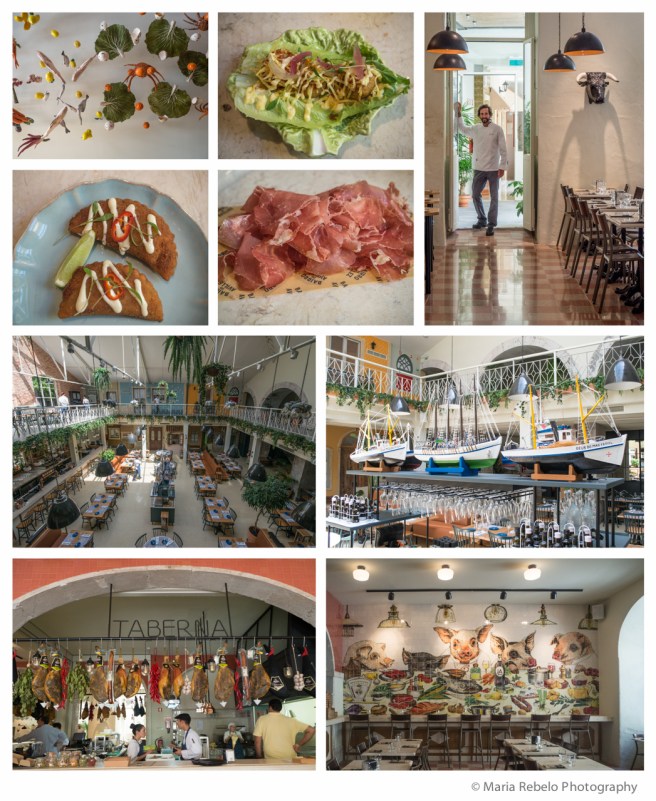
It is common for writers to imagine new worlds and share them with us. But it is uncommon for chefs to pursue this creative strategy. José Avillez, the Michelin-starred chef of Belcanto, dreamed of an old Lisbon neighborhood where friends gathered to share great food. He imagined timeworn buildings guarded by carved wooden doors with windows adorned by crocheted curtains.
When the space once occupied by the 13th-century Convent of Trindade became available, Avillez seized the opportunity to make his dreams come true. He invited architect Joana Astolfi to design an installation inspired by old building facades, artist Cátia Pessoa to create ceramic sculptures representing fish and vegetables, and painter Henriette Arcelin to produce a large tile panel at the famous Viúva Lamego factory.
The result is a fun atmosphere perfect to enjoy the classics of Portuguese cuisine, refined and, in some cases, reinvented. Bairro do Avillez (Avillez’s neighborhood) has a grocery store (Mercearia) with some of the chef’s favorite products, a tapas bar (Taberna), and a restaurant (Páteo).
In the Taberna, you can eat a wide variety of “petiscos” (the Portuguese word for tapas), from Portuguese prosciutto and sausages, to codfish with cornbread, and roasted piglet.
The Páteo offers pristine fish from the Portuguese coast, grilled, cooked with rice, or combined with bread, olive oil and garlic in a fragrant “açorda.” The menu also includes great seafood (lobster, shrimp, clams, crab, and razor clams), delicious steaks, and grilled black pork from Alentejo.
There’s a wonderful house wine made in collaboration with Quinta do Monte d’Oiro. And there is also a great new line of artisanal beers called Selection 1927.
We told José Avillez that we were impressed to see him take time to welcome the people who walked in to see the new space. He told us that these gestures are important to him: “What makes Portugal unique is the combination of great ingredients and a rich culinary tradition with our warm hospitality.”
Chef José Avillez is a dreamer who makes Lisbon more fun with his gracious demeanor and delicious food. It is a privilege to be in his neighborhood.
Bairro do Avillez is located at Rua Nova da Trindade, 18, Lisbon, tel. 215 830 290.
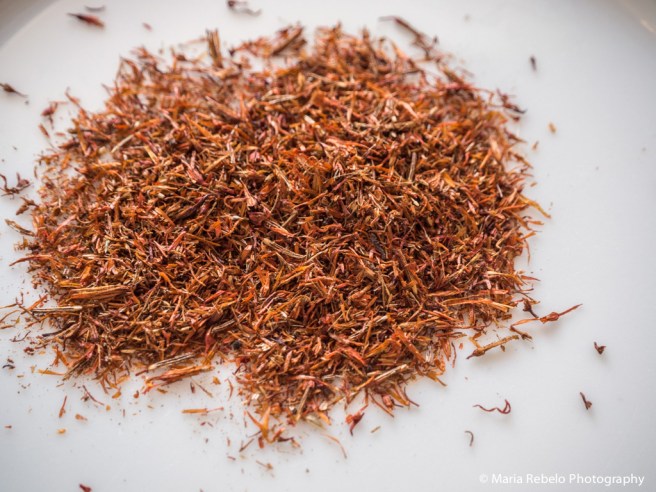
“There’s something special about this seafood rice.” We’ve been hearing similar comments all Summer long; about soups, stews, and other preparations. It’s all because we’ve been cooking with açaflor. It is a saffron-like spice produced in the Azores islands. The flowers of the Carthamus tinctorius are dried and crushed to produce beautiful yellow and red strands that add a delicate flavor to everything they touch.
If you’re looking for an original gift for a friend who likes to cook, get a bag of açaflor. In a world where almost everything is known, açaflor is a wonderful new spice waiting to be discovered.
You can find açaflor in stores that sell products from the Azores. Our favorite one is Merçearia dos Açores on Rua da Madalena, 115 Lisbon, tel. 218-880-070. Their email is loja@merceariadosacores.pt. Click here for their website.