Taberna Albricoque

Taberna Albricoque

Albricoque, a quaint word for apricot used in the Algarve, is a great name for a Lisbon restaurant that blends the old with the new. The space is old; it opened in 1905 as a tavern for travelers from the nearby Santa Apolónia train station. The food is rooted in the traditional culinary vocabulary of the Algarve, the birth place of Albricoque’s chef, Bertílio Gomes. But the approach to food and service is new. Every recipe has been refined to make it more appealing. The character of the restaurant, imparted by features such as the original floor paved with hydraulic tiles, was preserved. But modern amenities, unthinkable in 1905, have been added.

Everything on the menu is delicious. Our meal began with a plate of olives that tasted like sausage because of the way in which they were fermented. There was also a salad made with the purple carrots that were common in the Algarve in old times. Then, the feast continued: savory muxama (cured tuna), plump oysters from Ria Formosa, crispy rissois de berbigão (cockle turnovers), silky alhada de raia (manta ray with garlic), extraordinary marinated carapau (horse mackerel) combined with figs and toasted almonds and served on shinzo leafs.

Chef Bertílio likes to explore the methods for preserving food used in the Algarve before refrigerators became common. He salts a fish called abrótea then hangs it in the cold for a couple of days to drain its liquid. The result is an intense, satisfying taste reminiscent of that of salted codfish.

We didn’t order the fried moreia (moray), because it is usually greasy and chewy, but the chef brought a plate to the table for us to try. It was very thinly sliced and perfectly fried, a revelation of flavor, texture and aroma. The meal ended on a sweet note with almere, a dessert made with the liquid that is left from the making of requeijão, flavored with thyme and pine nuts.

If you’re near Santa Apolónia, stop by Taberna Albricoque to try its delicacies. If you’re far, come to Santa Apolónia for the privilege of dining at Taberna de Albricoque.

Taberna Albricoque is located at Rua Caminhos de Ferro nº98, Lisboa, tel. 21 886 1182, email reservas@albricoque.pt.

The shark’s beach

IMG_2617

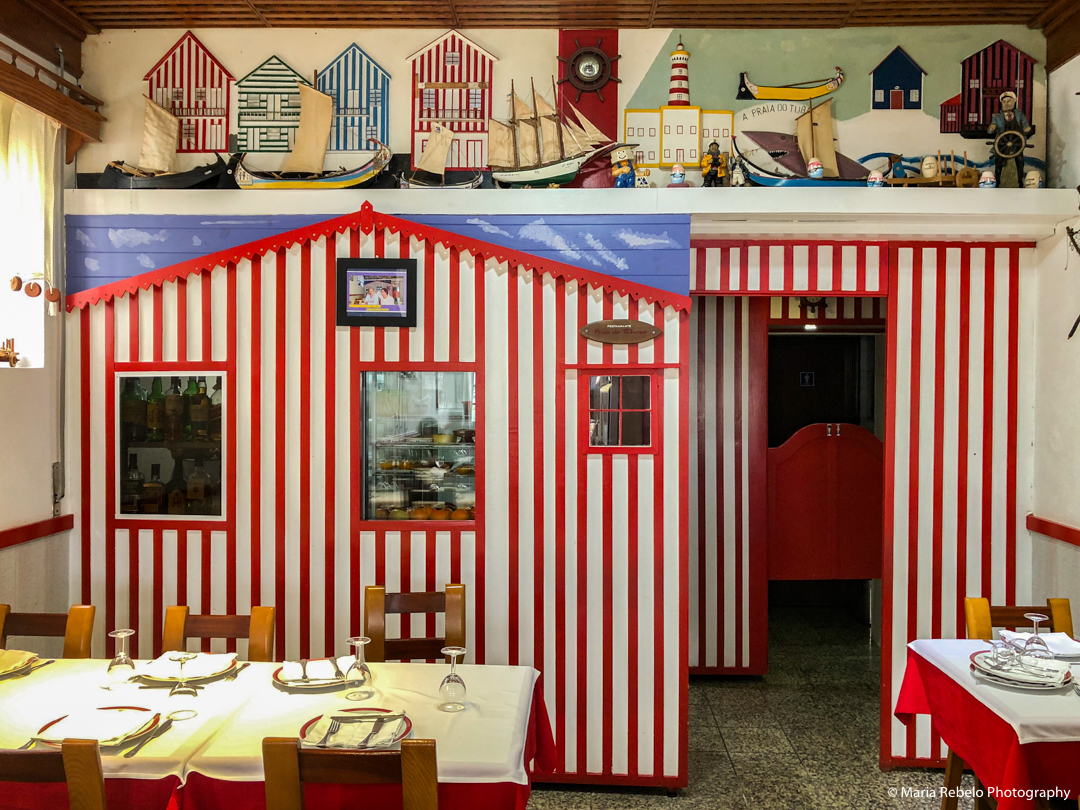
Roger Sobreiro, an American wine merchant of Portuguese descent, recommended a small restaurant called A Praia do Tubarão (the shark’s beach) that is his safe harbor when he visits Portugal. We drove to the picturesque town of Costa Nova to try it out.

The restaurant’s facade is painted with the traditional red and white stripes used to decorate fishermen houses. The same red and white palette dominates the cosy interior where Adriano Ferreira, the owner, was waiting for us. He has worked in Costa Nova for 50 years, first as a waiter and then, in the last three decades, together with his wife at A Praia do Tubarão.

“I hunt and fish and all hunters and fishermen are liars,” he said as a way of introduction. Despite this forewarning, we asked Adriano to choose our lunch menu.  “Most of our food is served in the pots where it is cooked: caldeiradas (boulliabaisses) , “ensopados,” and seafood rices. We follow two simple rules: everything is fresh and everything is cooked to order,” he explained.

Adriano went into the kitchen and returned with a plate of petinga (small sardines) and tiny fried balls of berbigão rice. Then, he poured two generous glasses of the wonderful Duas Quintas white from Ramos Pinto. The petinga was crisp, hot, luxuriously fresh and perfectly fried. The rice balls were flavorful and deeply satisfying.

We ate an “ensopado,” a plate made with fish, potatoes, onions, garlic, and olive oil. It is seasoned with “sal d’unto,” a salt and lard combination. It comes with a sauce called “alhada,” made from garlic, lemon and piri piri. The flavors blend to create a unique taste and aroma. The quality of the ingredients and the cooking is superb.

Dessert was a small bowl of the traditional “ovos moles,” a convent sweet made with egg yolks and sugar. The meal ended with a vibrant espresso made with Delta’s famous diamond blend.

We said goodbye to Adriano and promised to be back soon to this welcoming place that serves delicious traditional food.

A Praia do Tubarão is located at Rua José Estevão, 136, Costa Nova Prado, Ilhavo, tel. 234 369 602.

Culinary bliss at Essencial

Restaurant Essencial_

If the cobblestones of Bairro Alto were not so slippery, we would tell you to run to Essencial, a new restaurant in Bairro Alto. Walk instead as fast as you can because this dinning room that seats only 25 guest will soon be impossible to get into.

The restaurant is headed by André Cordeiro, a chef with impeccable knowledge of French technique. He studied for five years with Alain Ducasse in Paris and then worked with three chefs who earned the coveted title of Meilleurs Ouvriers de France (best craftsmen in France). André came back to Lisbon to combine fine-dining ingredients such as truffles and foie gras with the amazing fresh produce available in Portugal. The results are stunning–elegant food that is a joyful symphony of tastes, textures and aromas.

While we were chatting with chef André, a plate of bread arrived. It came with a blend of butter from Pico in Azores, lard and rosemary. It was the one of several unexpected  combinations that delighted our palates throughout the meal.

The first appetizer was a crowd pleaser: delicate slices of marinated salmon with radishes, crème fraiche and tarragon oil, served with the luscious crêpes vonnassiennes made famous by chef George Blanc. The second appetizer was a sea urchin shell filled with beef tartare, sea urchin and nori seaweed. These dissonant ingredients created a pleasing harmony that made our taste buds sing.

It is customary to serve the fish entrée before the meat but here the latter came first. It was a paté en croute made with duck, pork and foie gras served with smoked carrot purée and beets. How could the fish compete with these gratifying earthy flavors? The answer came in the form of a plate of sole. The freshness of the fish was a canvas that made the truffle stuffing and the Champagne sauce stand out.

The last entrée was a lush journey to the flavors of the woods: hare with foie gras, trumpet mushrooms and Jerusalem artichokes in a reduction of red wine, port wine and chocolate.

A vanilla mille feuilles with salted caramel produced a happy ending to a blissful meal. But our culinary experience was not over. There were still fireworks provided by a buttery French toast with vanilla mouse and a rich choux with praline.

Essencial’s minimalist space, impeccable service and interesting French and Portuguese boutique wines perfectly complement the food. We do not need the Michelin guide to tell us that the culinary stars shine brightly on Essencial’s dinner table.

Essencial is located at Rua da Rosa, 176, tel. 211573713, email info@essencialrestaurant.pt. Click here for the restaurants website. 

Pristine fish at Taberna do Valentim

OLYMPUS DIGITAL CAMERA

We met Valentim, the chef and owner of Taberna Valentim in Viana do Castelo, as soon as we entered the restaurant. He was working hard at the grill but took time to show us the superb mullets that had just been delivered. “The seas are often rough during Winter so at times we have to close the restaurant because we can’t find fresh fish of the quality we seek. These mullets came from Póvoa do Varzim. The sea was rough yet the fishermen still went out. Their fish is gorgeous but the they take too much risk to catch it.”

Taberna do Valentim has offered the same small menu for 40 years: pristine seasonal fish perfectly grilled, fish rice, “ensopado de peixe,” a fish stew prepared with white pepper and served on bread toasts, and caldeirada (bouillabaisse). The quality is high and prices are modest so the place is always packed.

After a very satisfying lunch, we resumed our conversation with Valentim.  “I started working when I was 8, serving glasses of wine and codfish cakes in my mother’s tavern,” he told us. “Then, I began to cook, so I’ve been cooking for a long time. But time is not what’s important. Passion is. Unless you have passion for what you do you’ll never be great at it.” This passion is evident in everything that comes to the table at Taberna Valentim.

Taberna Valentim is located at Avenida Campo do Castelo nº45 in Viana do Castelo, tel. 258-827-505.

Prado: the prairie in Lisbon

Prado Composit

Never underestimate the power of the light of Lisbon. Chef António Galapito was happily working at Nuno Mendes’ Taberna do Mercado in London when he was offered the opportunity to open a restaurant in Lisbon. Galapito said he was not interested. But he agreed to see the space.

It is a place full of memories, from Roman ruins to old fish-canning equipment from a factory that once operated there. The ceilings are high, making room for generous windows that invite the light in. It was impossible for Galapito to say no. He called the restaurant Prado, the Portuguese word for prairie, to signal his intention of bringing the best products from the fields of Portugal to his table.

The light became the inspiration for the menu. The food is simple, fresh, organic and seasonal. The wines are natural and biodynamic. The vibe is relaxed and the decoration minimalist.

We sat at a beautiful common table made from old pine wood. Our dinner started with a refreshing strawberry kombucha. Then, a plate of bread and goat cheese arrived at the table. The bread, fermented for 28 hours at Gleba, fused with the flavorful goat cheese and melted in our mouth.

The menu has many small plates that are perfect for sharing. We sampled several of these delights:  mussels, leeks, parsley and fried bread, cabbage cooked with sour milk and sunflower seeds, pleurotus mushrooms, with pimentão (a traditional pepper-based paste) and crunchy sarraceno wheat, green asparagus, requeijão and azedas, mackerel, mizuna, lettuce and tangerine, and finally, squid from Azores cooked in a pork broth.

Dinning at Prado is a wonderful opportunity to taste pristine produce harmoniously combined to create satisfaction and joy.

Prado is located at Travessa das Pedras Negras, 2, tel. 210 534 649, email info@pradorestaurante.com. Click here for the restaurant’s website. 

The donkey’s shelter

Cozido no Pão

When we visited Moínho de Avis at Serra de Montejunto, Miguel Nobre showed us his new venture–a small restaurant sheltered from the wind with sprawling mountain views. It is called Curral do Burro (the donkey’s shelter) because it occupies the place where the donkey used to lodge. “Donkeys were a miller’s prized possession because they carted the bags of grain and flour back and forth, so they had to be well fed and protected from the elements,” Miguel explained.

Miguel used his skills as a carpenter to build the restaurant’s furniture. The menu offers simple, delicious food: mussels, clams, cockles, eggs with farinheira (a type of sausage), and grilled black pork.

The specialty is “cozido no pão” a combination of meats, sausages, potatoes, cabbage and carrots cooked in the oven inside bread. The vegetables have a glorious taste imparted by the sausages and the meat. It is a privilege to enjoy these deeply satisfying flavors on a mountain top, sheltered from the wind, away from it all.

Eating at Curral do Burro requires making reservations in advance by sending a Facebook message to Moínho de Avis, click here for the link.


Dining with the minister at Campo Maior

Taberna O Ministro

We strolled around in Campo Maior, a small town in Alentejo close to the border with Spain, looking for a place for lunch. We noticed a tavern called O Ministro (the minister) which was full of locals. There was a bottle of Caiado–the wonderful entry wine from Adega Mayor—on every table. Encouraged by these favorable omens, we decided to enter.

Traditional music played in the background, mostly fado tunes about the travails of love and the fickleness of life. Every now and then, a folk song from Alentejo came on and the locals raised their voices to sing along.

A plate with codfish cakes, slices of sausage, and green olives arrived at the table. We ordered “migas” made with bread and turnips and fried cação, a small shark that somehow manages to swim from the coast to the menus of Alentejo. We also ordered “carne do alguidar,” marinated pork loin. We were astonished by the quality of everything that came to the table. It was delicious and deeply satisfying food, with a perfect sense of time and place.

João Paulo Borrega, the chef and owner of this magical restaurant came out of the kitchen, and stoped by each table to ask whether people liked his food. “The food is fantastic,” we told him. “Can we make reservations for dinner and arrive a little early to talk to you?” Sure, he said with a bemused smile.

Late in the afternoon, he sat down to talk with us. Like most Alentejo cooks, he learned cooking from his mother and grandmother. His restaurant opened in 1989 and has changed location over the years. It is named after João Paulo’s father, a man whose role in the revolutionary days after April 1974 earned him the nickname “the minister.”

João Paulo tells us that the current restaurant location is ideal. “I want to cook by myself, and this space has the maximum number of tables I can comfortably handle.” He talks enthusiastically about his favorite recipes: fried rabbit, toasted chicken, chickpea soup, and ensopado de borrego (lamb stew).

“Why does your food taste so good?,” we asked. “I am going to show you my secret,” he said, inviting us into the small kitchen. He pointed to an old, tiny refrigerator. “Everything I use I buy fresh every day. That is why I have no freezer, just this small refrigerator. At the end of the day I give away any leftovers to my friends. The next day I start everything from scratch. Meats, fish, vegetables, herbs, sauces, everything has to be fresh.”

All his products are local and seasonal, produced by people he knows. He rattled off the names of the friends who supply him: the olive-oil maker, the farmer who plants the potatoes and onions, the person who chooses ripe melons for his table; the list goes on. The quality of his sourcing would make many three-star chefs envious.

João Paulo talks with great knowledge about the details of the different recipes and the properties of various herbs and spices. “People often use too much laurel. That is a mistake,” he says. “Laurel is very powerful and can overwhelm other ingredients.” “The cuisine of Alentejo does not require much fussing around,” he explains. “But the ingredients need to be first rate and the last flourishes before the dish is brought to the table have to be perfect. Some dishes are finished with white wine, others with vinegar, herbs play a key role.”

We sat down for a wonderful dinner. It started with toasted chicken perfumed with vinegar and prepared with olive oil, garlic and parsley. Then came a steaming chickpea soup with Alentejo sausages, Savoy cabbage, carrots, and mint. Next, we tried the fried rabbit. The meat had been  marinated with rosemary, thyme, pepper, white and red wine. Then it was stewed to perfection in a large iron-cast pan with olive oil, garlic, and some more wine. Delicious slices of ripe melon brought this memorable meal to a sweet finale.

No matter how much you travel, it is hard to find food that is as simply satisfying as the one served in this little tavern in Alentejo. If you have a chance, come to Campo Maior to dine with the minister.

Taberna O Ministro is located at Travessa dos Combatentes da Grande Guerra
Campo Maior, Portalegre, tel. 351-965-421-326.

A dinner in grape country

País das Uvas

Paulo Laureano recommended that we try O País das Uvas for dinner. “Sopa de Cardo (thistle soup) is one of their specialties,” he said.

The name of the restaurant, which means The Grape Country, is a literary reference. It is the title of a book by Fialho de Almeida, a writer born in 1857 in Vila De Frades, the Vidigueira village where the restaurant is located.

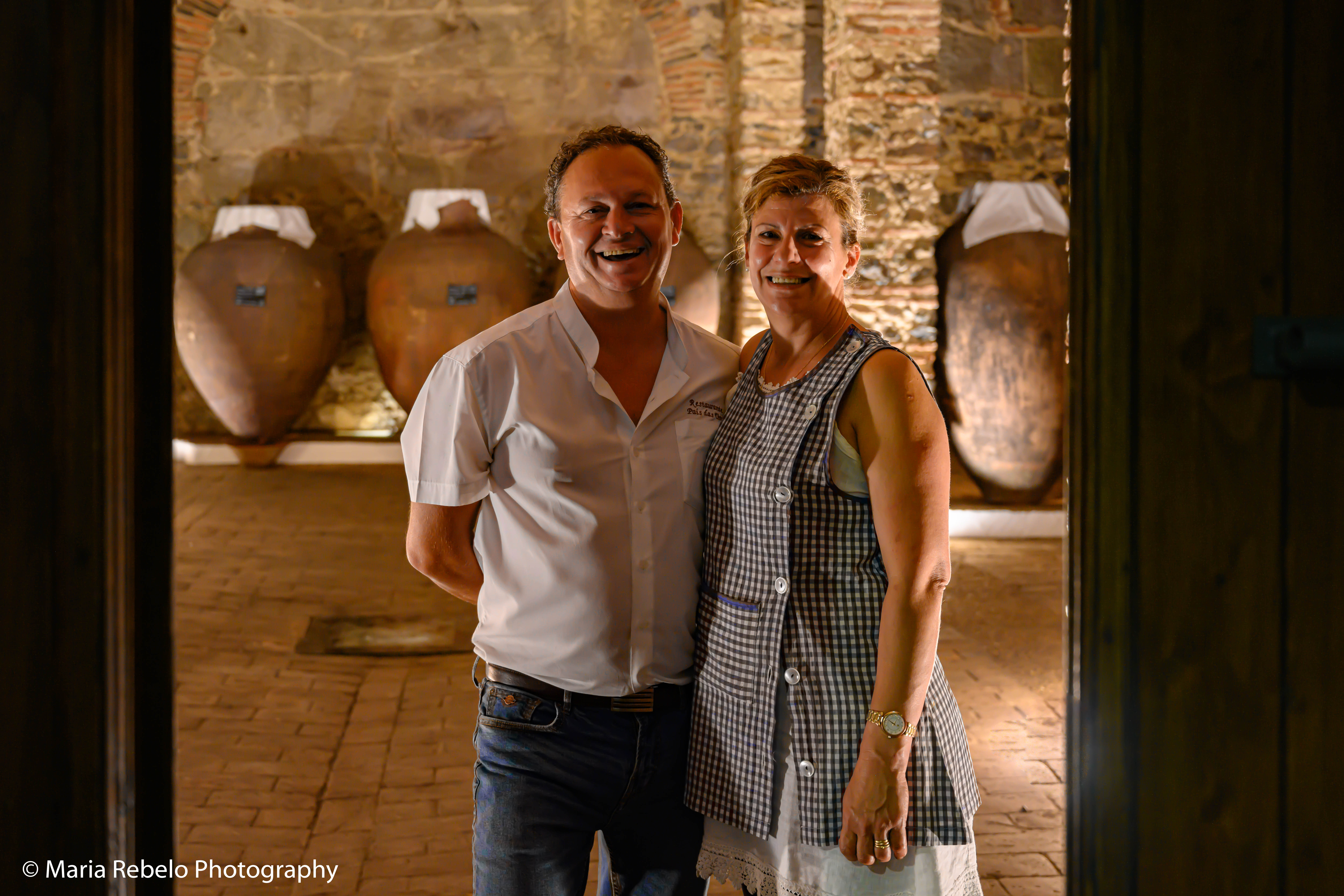
The restaurant is full of ancient amphoras inscribed with messages left by patrons praising the food and the hospitality. António Honrado told us that this place has been a tavern for more than a century. He bought it 17 years ago with his wife Jacinta to turn it into a restaurant.

In the early days, Jacinta’s mother was in charge of the cooking. But she was advanced in age and the work was hard. One day, Jacinta told her mother that they had hired a new cook who had come during the night to prepare the most popular dishes on the menu. Jacinta’s mother worried that hiring a new chef would worsen the quality of the food. But upon trying the different dishes she exclaimed: “They taste exactly like my cooking! Who prepared them?” “I did,” confessed Jacinta. Since that day, Jacinta has been the chef at O País das Uvas.

We ordered the famous Thistle Soup and Cozido de Grão, a traditional chickpea stew made with cabbage, carrots, potatoes, meats, and sausages. Both dishes have bold, satisfying flavors that made our taste buds fall in love with the simple ways of Alentejo.

After dinner, António and Jacinta invited us to see their discovery. When they did some construction on the restaurant, they uncovered a cellar that is many centuries old. It has a well-preserved clay-tile floor, graceful arches and a water well. They restored the cellar and devoted it to producing amphorae wine with the help of Paulo Laureano.

We bid farewell to António and Jacinta, promising to return. Then we went out into the warm Summer night, enchanted by the honesty of the food and the warmth of the people of Alentejo.

O País das Uvas is located at Rua General Humberto Delgado, nº19, Vila De Frades, Alentejo, tel. 284 441 023.

Ancient wheat, dancing in the wind

Adolfo Henriques

Another wondrous lunch with Adolfo Henriques at Maçussa. A taste of another recipe that almost got lost: “manja,” a combination of bread, potatoes, garlic and olive oil that goes great with grilled sardines.

The meal started with Adolfo’s legendary goat cheeses served with bread made from barbela wheat and a baked mixture of cornbread and olive oil called gaspiada. “I call this one cabrabert,” says Afonso, pointing to a round cheese, proud of his play on the Portuguese word for goat (cabra) and the word camembert. The cheese was followed by a variety of wonderful sausages, codfish liver, gravlax, and figs.

After lunch, Adolfo took us to a field planted with barbela wheat. Barbela is an ancient Egyptian variety abandoned after World War I in favor of wheats that offer larger yields in exchange for less taste and nutrition. “People often choose quantity over quality,” laments Adolfo.  It took him several years to harvest enough wheat to make bread. He grinds his crop in windmills that only process traditional grains, like Valentim da Silva’s Moinho do Boneco at Moita dos Ferreiros and Miguel Nobre’s Moinho de Avis in the Montejunto mountain. The result is the type of flour used a century ago. It that makes a rustic, delicious, nutritious bread.

Adolfo does not use fertilizers or pesticides. After each crop, he lets the field rest for a year so that the soil can recover. Standing in the middle of a field planted with his prized crop, Adolfo smiles and says: “Look at how the wheat dances in the wind.”

Adolfo Henriques’ company, Granja dos Moinhos, is located on Rua do Moinhos 3, Maçussa, Azambuja, tel 919 474 476, email granjadosmoinhos@sapo.pt. 


Taberna Sal Grosso

Taberna Sal Grosso

When we arrived at number 22, Calçada do Forte in Lisbon’s old Alfama neighborhood, there was a group of people congregated around the door. They were all trying to get a table in a small restaurant called Taberna do Sal Grosso (Coarse Salt Tavern). An exasperated waiter explained that he could not bend the laws of physics to accommodate more guests. No one was happy with the news that miracles could not be made. We too walked away disappointed. But we were so intrigued by the tavern’s atmosphere that we made reservations for lunch two days later.

As soon as we sat for lunch, it became obvious why the place is so popular. It serves delicious food with a happy vibe at modest prices. This trio of qualities is rare. It is hard to keep the quality of the food consistent and feel happy about serving inexpensive meals. Joaquim Saragga, the chef and owner, manages to do it because because he views his restaurant as more than just a business.

Joaquim lost his job, so he decided to change his life. When he was a student in London,  he used to cook for his roommates. He remembered feeling happy in the kitchen, so he enrolled in culinary school and went on to complete a Masters in gastronomy.

When he opened the tavern in 2015, he shunned the tricks that most eateries use to become more profitable. There are no couvert charges. He serves only two inexpensive but very drinkable house wines and a few artisanal beers. Desserts are modestly priced.

“I’m not trying to innovate, only to serve my favorite traditional recipes prepared with local, seasonal ingredients. I cook the food I like to eat.” he told us. Everything we tried was perfect: a watercress and orange salad, codfish cakes, manta ray and garlic, oxtail with quince, codfish and chickpeas.  “I needed to create my own job,” he explained, “but I also wanted to create a place where people feel at home.”

We proposed to take a photo of the staff at the door of the restaurant but then another wave of guests came in. Joaquim asked one of the chefs and the waiters to pose for us but he stayed inside the restaurant, clearing the tables and welcoming people. It is this dedication to serving others that make Taberna do Sal Grosso such a special place.

Taberna do Sal Grosso is located at Calçada do Forte, 22. Reservations are a must. They do not accept phone reservations. Reservations can only be made by sending a message through Facebook. You need to receive a confirmation in order for the reservation to be valid.